Animal NDC 46066-313-19 Activated Charcoal Gel
Activated Charcoal
Animal Product Information
| Field Name | Field Value |
|---|---|
| Animal NDC Code | 46066-313-19 |
| Proprietary Name | Activated Charcoal Gel What is the Proprietary Name? The proprietary name also known as the trade name is the name of the product chosen by the medication labeler for marketing purposes. |
| Non-Proprietary Name | Activated Charcoal What is the Non-Proprietary Name? The non-proprietary name is sometimes called the generic name. The generic name usually includes the active ingredient(s) of the product. |
| Labeler Name | Aspen Veterinary Resources, Ltd. |
| Product Type | Otc Animal Drug |
| Usage Information |
|
| Active Ingredient(s) |
|
| Inactive Ingredient(s) |
|
| Marketing Category | UNAPPROVED DRUG OTHER What is the Marketing Category? Product types are broken down into several potential Marketing Categories, such as NDA/ANDA/BLA, OTC Monograph, or Unapproved Drug. One and only one Marketing Category may be chosen for a product, not all marketing categories are available to all product types. Currently, only final marketed product categories are included. The complete list of codes and translations can be found at www.fda.gov/edrls under Structured Product Labeling Resources. |
Activated Charcoal Gel Images
Activated Charcoal Gel Animal Product Labeling Information
The product labeling information includes all published material associated to a drug. Product labeling documents include information like generic names, active ingredients, ingredient strength dosage, routes of administration, appearance, usage, warnings, inactive ingredients, etc.
Table of Contents
Veterinary Indications
INDICATION:
Activated Charcoal Gel is a veterinary aid designed to assist in the absorption of toxins. This gel formulation is used in emergency situations involving suspected toxicosis in animals such as cattle, horses, goats, dogs, and cats.
In all cases of suspected poisonings, consult your veterinarian for complete diagnosis and specific treatment.
Dosage & Administration
DOSAGE AND ADMINISTRATION:
Administer orally on the back of the tongue.
Cats, Dogs, Goats, Sheep, Calves and Foals: 0.5-1.5 mL/lb body weight.
Adult Horses and Cattle: It is recommended to give up to 300 mL.
Repeat every 4-8 hours or as directed by your veterinarian. If toxin ingestion is suspected, consult with your veterinarian immediately. Shake well before administration.
Precautions
PRECAUTIONS
Activated charcoal gel may not be effective against poisoning by mercury, other heavy metals, or inorganic arsenic.
Storage And Handling
STORAGE AND HANDLING
Store in a cool, dry location out of direct sunlight.
Do not freeze.
Replace cap tightly after opening.
Not for human consumption.
Keep out of reach of children.
How Supplied
Activated Charcoal Gel is available in 300cc and 60cc multi-dose syringes for flexible and precise dosing.
Aspen Veterinary Resources, Ltd.
Liberty, MO 64068, USA
Rev. 06/25
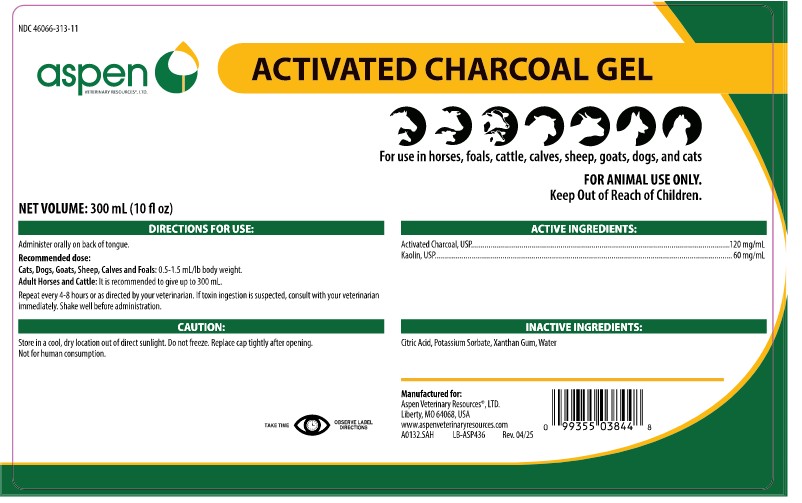
Principal Display Panel - 300 Ml Syringe Label
NDC 46066-313-11
Aspen Veterinary Resources Ltd.
Activated Charcoal Gel
INDICATION:
For oral administration as an aid in treating poisoning by most organic chemicals in large and small animals.
Net Volume: 300 mL (10 fl oz)
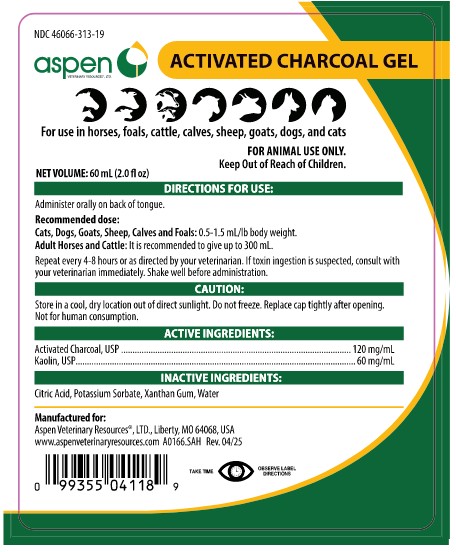
Principal Display Panel - 60 Ml Syringe Label
NDC 46066-313-19
Aspen Veterinary Resources Ltd.
Activated Charcoal Gel
INDICATION:
For oral administration as an aid in treating poisoning by most organic chemicals in large and small animals.
Net Volume: 60 mL (2 fl oz)
* The information on this page is for an ANIMAL PRODUCT, please review the complete disclaimer below.
