Animal NDC 54771-7441-1 Quest
Moxidectin
Animal Product Information
| Field Name | Field Value |
|---|---|
| Animal NDC Code | 54771-7441-1 |
| Proprietary Name | Quest What is the Proprietary Name? The proprietary name also known as the trade name is the name of the product chosen by the medication labeler for marketing purposes. |
| Non-Proprietary Name | Moxidectin What is the Non-Proprietary Name? The non-proprietary name is sometimes called the generic name. The generic name usually includes the active ingredient(s) of the product. |
| Labeler Name | Zoetis Inc. |
| Product Type | Otc Animal Drug |
| Usage Information |
|
| Active Ingredient(s) |
|
| Marketing Category | NADA - NEW ANIMAL DRUG APPLICATION What is the Marketing Category? Product types are broken down into several potential Marketing Categories, such as NDA/ANDA/BLA, OTC Monograph, or Unapproved Drug. One and only one Marketing Category may be chosen for a product, not all marketing categories are available to all product types. Currently, only final marketed product categories are included. The complete list of codes and translations can be found at www.fda.gov/edrls under Structured Product Labeling Resources. |
| FDA Application Number | NADA141087 What is the FDA Application Number? This corresponds to the NDA, ANDA, or BLA number reported by the labeler for products which have the corresponding Marketing Category designated. If the designated Marketing Category is OTC Monograph Final or OTC Monograph Not Final, then the Application number will be the CFR citation corresponding to the appropriate Monograph (e.g. “part 341”). For unapproved drugs, this field will be null. |
Quest Images
Quest Animal Product Labeling Information
The product labeling information includes all published material associated to a drug. Product labeling documents include information like generic names, active ingredients, ingredient strength dosage, routes of administration, appearance, usage, warnings, inactive ingredients, etc.
Table of Contents
- Indications
- Strategic Protection Programs
- Mode Of Action
- Administration And Dosage
- How To Set The Dose
- How To Give Quest Gel To A Horse Or Pony
- Treating A Second Horse Or Pony With The Same Syringe
- Animal Safety
- Environmental Safety
- Precautions
- Warnings
- Human Warnings
- How Supplied
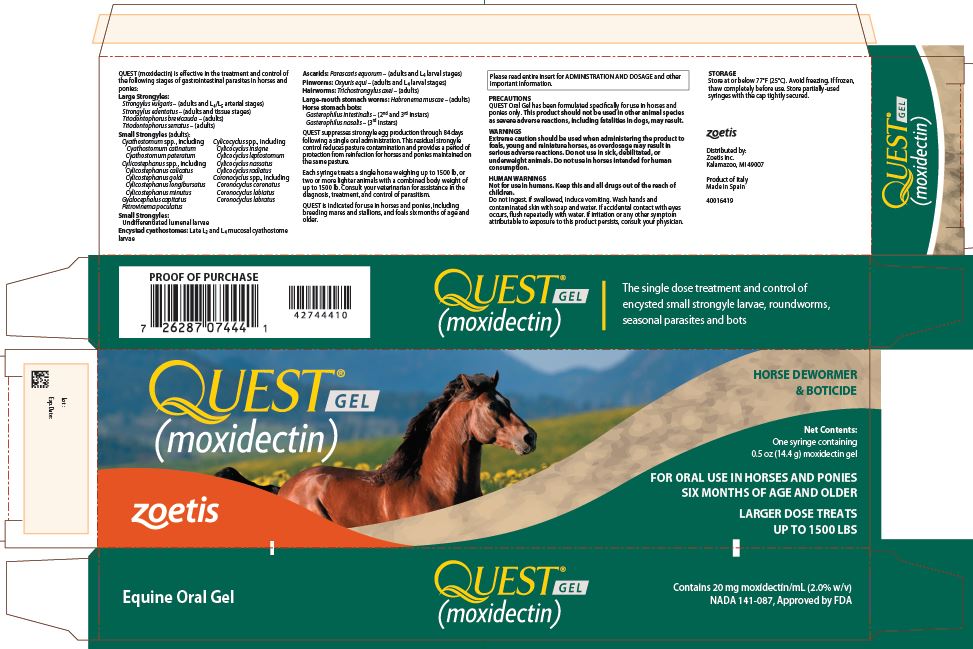
- Principal Display Panel - 11.3 G Syringe Carton
Indications
QUEST (moxidectin) 2% Equine Oral Gel when administered at the recommended dose level of 0.4 mg moxidectin/kg (2.2 lb) body weight is effective in the treatment and control of the following stages of gastrointestinal parasites in horses and ponies:
Large Strongyles:
- Strongylus vulgaris – (adults and L4/L5 arterial stages)
- Strongylus edentatus – (adults and tissue stages)
- Triodontophorus brevicauda – (adults)
- Triodontophorus serratus – (adults)
- Cyathostomum spp., including
- Cyathostomum catinatum
- Cyathostomum pateratum
- Cylicostephanus spp., including
- Cylicostephanus calicatus
- Cylicostephanus goldi
- Cylicostephanus longibursatus
- Cylicostephanus minutus
- Cylicocyclus spp., including
- Cylicocyclus insigne
- Cylicocyclus leptostomum
- Cylicocyclus nassatus
- Cylicocyclus radiatus
- Coronocyclus spp., including
- Coronocyclus coronatus
- Coronocyclus labiatus
- Coronocyclus labratus
- Gyalocephalus capitatus
- Petrovinema poculatus
Small Strongyles (adults):
Small Strongyles:
Undifferentiated lumenal larvae
Encysted cyathostomes
Late L3 and L4 mucosal cyathostome larvae
Ascarids
Parascaris equorum – (adults and L4 larval stages)
Pinworms
Oxyuris equi – (adults and L4 larval stages)
Hairworms
Trichostrongylus axei – (adults)
Large-mouth stomach worms
Habronema muscae – (adults)
Horse stomach bots
Gasterophilus intestinalis – (2nd and 3rd instars)
Gasterophilus nasalis – (3rd instars)
One administration of the recommended dose rate of QUEST (moxidectin) 2% Equine Oral Gel also suppresses strongyle egg production through 84 days. QUEST is indicated for use in horses and ponies, including breeding mares and stallions, and foals six months of age and older.
Strategic Protection Programs
Consult your veterinarian for assistance in the diagnosis, treatment, and control of parasitism. For best control of parasites, all horses and ponies should be included in a strategic treatment program, with particular attention given to high performance animals, brood mares, stallions and foals. In foals, initial treatment is recommended at 6 months of age, after which they should be included in a recurrent treatment program. Because QUEST provides effective control of the mucosal stages of small strongyles (encysted cyathostomes), it is useful in reducing the frequency of treatment required for successful strategic equine parasite control. A veterinarian can assist in preparing the best program for your needs.
QUEST 2% Equine Oral Gel when used at the recommended dose rate suppresses strongyle egg production through 84 days following a single oral administration. This residual strongyle control reduces pasture contamination and provides a period of protection from reinfection for horses and ponies maintained on the same pasture.
Mode Of Action
QUEST 2% Equine Oral Gel acts by interfering with chloride channel-mediated neurotransmission in the parasite. This results in paralysis and elimination of the parasite. Moxidectin is safe for use in horses and ponies because it does not have the same injurious effect on the mammalian nervous system.
Administration And Dosage
QUEST (moxidectin) 2% Equine Oral Gel is specially formulated as a palatable gel which is easily
administered to horses and ponies. QUEST Gel is packaged in ready-to-use SURE-DIAL® syringes. The
syringe is calibrated in 50-pound increments, up to 1500 pounds. This enables the administration of
the recommended dose level of 0.4 mg moxidectin/kg body weight by choosing a setting consistent
with the animal’s weight.
How To Set The Dose
Since the dose is based on the weight of the animal, you need to use a scale or weight tape to fi nd
each animal’s weight before treating with QUEST Gel. Once the weight is known, set the dose for
each horse or pony as follows.
1. Hold the syringe with the capped end pointing to the left and so that you can see the weight
measurements and tick marks (small black lines). Each tick mark relates to 50 lb of body weight.
2. Turn the white dial ring until the left side of the ring lines up with the weight of the animal
How To Give Quest Gel To A Horse Or Pony
1. Make sure there is no feed in the animal’s mouth.
2. Remove the cap from the end of the syringe. Save the cap for reuse.
3. Place the tip of the syringe inside the animal’s mouth at the space between the teeth.
4. Gently push the plunger until it stops, depositing the gel on the back of the tongue.
5. Remove the syringe from the animal’s mouth and raise the animal’s head slightly to make sure it
swallows the gel.
6. Replace the syringe cap.
Treating A Second Horse Or Pony With The Same Syringe
If the first animal you treat weighs less than 1500 lb, there will be gel left in the syringe. You can use
this gel to treat other horses or ponies. To set the next dose, add the weight of the animal you want
to treat to the dose setting already on the syringe. For example, if the syringe was first used to treat a
250 lb animal, the white dial ring is set on 250 lb. To treat a 500 lb animal next, move the white dial ring
to the 750 lb marking (250+500=750). You need more than one syringe to treat horses weighing more
than 1500 lb.
Animal Safety
QUEST (moxidectin) 2% Equine Oral Gel can be safely administered at the recommended dose of 0.4 mg
moxidectin/kg body weight to horses and ponies of all breeds at least 6 months of age or older. Transient
depression, ataxia and recumbency may be seen when very young or debilitated animals are treated.
In these instances, supportive care may be advisable.
Reproductive safety studies demonstrate a wide margin of safety when the product is used in the
treatment of estrual and pregnant mares and breeding stallions.
To report adverse drug reactions or to obtain a copy of the Safety Data Sheet (SDS) call 1-888-963-8471.
Environmental Safety
Care should be taken to avoid the release of significant volumes of moxidectin into either ground or free-running water since moxidectin may be injurious to aquatic life. SURE-DIAL® syringes and their contents should be disposed of in an approved landfill or by incineration.
Precautions
QUEST 2% Equine Oral Gel has been formulated specifically for use in horses and ponies only. This product should not be used in other animal species as severe adverse reactions, including fatalities in dogs, may result.
Warnings
Extreme caution should be used when administering the product to foals, young and miniature horses, as overdosage may result in serious adverse reactions. Do not use in sick, debilitated, or underweight animals. Do not use in horses intended for human consumption.
Human Warnings
Not for use in humans. Keep this and all drugs out of the reach of children. Do not ingest. If swallowed, induce vomiting. Wash hands and contaminated skin with soap and water. If accidental contact with eyes occurs, flush repeatedly with water. If irritation or any other symptom attributable to exposure to this product persists, consult your physician.
How Supplied
QUEST 2% Equine Oral Gel is available in one syringe applicator size.
Each SURE-DIAL® syringe contains 0.5 oz (14.4 g) of QUEST 2% Equine Oral Gel which is suffi cient to
treat a single horse weighing up to 1500 lb, or two or more lighter animals with a combined body
weight of up to 1500 lb.
0.5 oz (14.4 g) syringe - 20 mg moxidectin per mL
Store at or below 77°F (25°C). Avoid freezing. If frozen, thaw completely before use.
Store partially-used syringes with the cap tightly secured.
Principal Display Panel - 11.3 G Syringe Carton
Net Contents: One syringe
containing 0.4 oz (11.3 g)
moxidectin gel
QUEST® GEL
(moxidectin)
FOR ORAL USE IN HORSES AND PONIES
SIX MONTHS OF AGE AND OLDER
LARGER DOSE TREATS
UP TO 1500 LBS
HORSE DEWORMER
& BOTICIDE
zoetis
* The information on this page is for an ANIMAL PRODUCT, please review the complete disclaimer below.
