Animal NDC 61133-4005-4 Eprimectin
Eprinomectin
Animal Product Information
| Field Name | Field Value |
|---|---|
| Animal NDC Code | 61133-4005-4 |
| Proprietary Name | Eprimectin What is the Proprietary Name? The proprietary name also known as the trade name is the name of the product chosen by the medication labeler for marketing purposes. |
| Non-Proprietary Name | Eprinomectin What is the Non-Proprietary Name? The non-proprietary name is sometimes called the generic name. The generic name usually includes the active ingredient(s) of the product. |
| Labeler Name | Bimeda, Inc. |
| Product Type | Otc Animal Drug |
| Usage Information |
|
| Active Ingredient(s) |
|
| Marketing Category | ANADA - ABBREVIATED NEW ANIMAL DRUG APPLICATION What is the Marketing Category? Product types are broken down into several potential Marketing Categories, such as NDA/ANDA/BLA, OTC Monograph, or Unapproved Drug. One and only one Marketing Category may be chosen for a product, not all marketing categories are available to all product types. Currently, only final marketed product categories are included. The complete list of codes and translations can be found at www.fda.gov/edrls under Structured Product Labeling Resources. |
| FDA Application Number | ANADA200626 What is the FDA Application Number? This corresponds to the NDA, ANDA, or BLA number reported by the labeler for products which have the corresponding Marketing Category designated. If the designated Marketing Category is OTC Monograph Final or OTC Monograph Not Final, then the Application number will be the CFR citation corresponding to the appropriate Monograph (e.g. “part 341”). For unapproved drugs, this field will be null. |
Eprimectin Images
Eprimectin Animal Product Labeling Information
The product labeling information includes all published material associated to a drug. Product labeling documents include information like generic names, active ingredients, ingredient strength dosage, routes of administration, appearance, usage, warnings, inactive ingredients, etc.
Table of Contents
Description
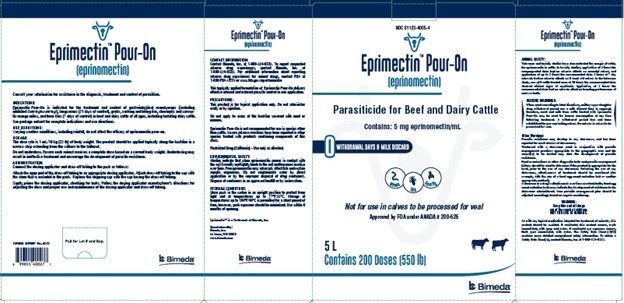
EprimectinTM Pour-On
(eprinomectin)
Parasiticide for Beef and Dairy Cattle
Contains: 5 mg eprinomectin/mL
Not for use in calves to be processed for veal.
INTRODUCTIONEprimectin Pour-On delivers effective internal and external parasite control in one application. Eprimectin Pour-On contains eprinomectin, a unique avermectin. Its broad-spectrum efficacy in a weatherproof formulation, margin of safety, zero slaughter withdrawal and zero milk discard, make it a convenient product for parasite control in beef and dairy cattle, including lactating dairy cattle.
Mechanism Of Action
MODE OF ACTION
Eprinomectin is a member of the macrocyclic lactone class of endectocides which have a unique mode of action. Compounds of the class bind selectively and with high affinity to glutamate-gated chloride ion channels which occur in invertebrate nerve and muscle cells.
This leads to an increase in the permeability of the cell membrane to chloride ions with hyperpolarization of the nerve or muscle cell, resulting in paralysis and death of the parasite. Compounds of this class may also interact with other ligand-gated chloride channels, such as those gated by the neurotransmitter gamma-aminobutyric acid (GABA).
The margin of safety for compounds of this class is attributable to the fact that mammals do not have glutamate-gated chloride channels, the macrocyclic lactones have a low affinity for other mammalian ligand-gated chloride channels and they do not readily cross the blood-brain barrier.
Indications & Usage
INDICATIONS
Eprimectin Pour-On (eprinomectin) is indicated for the treatment and control of gastrointestinal roundworms (including inhibited Ostertagia ostertagi), lungworms, grubs, sucking and biting lice, chorioptic and sarcoptic mange mites, and horn flies in beef and dairy cattle of all ages, including lactating dairy cattle.
Applied at the recommended dose volume of 1 mL/10 kg (22 lb) body weight, to achieve a dose level of 500 mcg eprinomectin/kg body weight, Eprimectin Pour-On is indicated for the effective treatment and control of the following parasites:
Gastrointestinal Roundworms
Haemonchus placei (adults and L4)
Ostertagia ostertagi (adults and L4)
(including inhibited L4)
Trichostrongylus axei (adults and L4)
Trichostrongylus colubriformis (adults and L4)
Trichostrongylus longispicularis (adults only)
Cooperia oncophora (adults and L4)
Cooperia punctata (adults and L4)
Cooperia surnabada (adults and L4)
Nematodirus helvetianus (adults and L4)
Oesophagostomum radiatum (adults and L4)
Bunostomum phlebotomum (adults and L4)
Strongyloides papillosus (adults only)
Trichuris spp. (adults only)
Lungworms
Dictyocaulus viviparus (adults and L4)
Cattle Grubs (all parasitic stages)
Hypoderma lineatum
Hypoderma bovis
Lice
Damalinia bovis
Linognathus vituli
Haematopinus eurysternus
Solenopotes capillatus
Mange Mites
Chorioptes bovis
Sarcoptes scabiei
Horn Flies
Haematobia irritans
Persistent Activity
Eprinomectin pour-on for beef and dairy cattle has been proved to effectively control infections and to protect cattle from re-infection with Dictyocaulus viviparus for 21 days after treatment and Haematobia irritans for 7 days after treatment.
Use Conditions
Varying weather conditions, including rainfall, do not affect the efficacy of Eprinomectin pour-on.
Management Considerations for Treatment of External Parasites
For best results Eprimectin Pour-On should be applied to all cattle in the herd. Cattle introduced to the herd later should be treated prior to introduction. Consult your veterinarian or an entomologist for the most effective timing of applications for the control of external parasites.
Chorioptic Mange: In clinical studies evaluating the efficacy of eprinomectin pour-on against chorioptic mange mites, mites were not recovered from skin scrapings taken 8 weeks after treatment; however, chronic skin lesions were still present on some animals.
Horn flies: For optimal control of horn flies, as Eprimectin Pour-On provides 7 days of persistent activity against horn flies, the product should be used as part of an integrated control program utilizing other control methods to provide extended control.
Dosage & Administration
DOSAGE
The product is formulated only for external application to beef and dairy cattle. The dose rate is 1 mL/10 kg (22 lb) of body weight. The product should be applied topically along the backline in a narrow strip extending from the withers to the tailhead.
Do not underdose. Ensure each animal receives a complete dose based on a current body weight. Underdosing may result in ineffective treatment, and encourage the development of parasite resistance.
ADMINISTRATION
Backpack (2.5 L and 5 L Packs); 10 L Container
Connect the dosing applicator and draw-off tubing to the pack as follows:
Attach the open end of the draw-off tubing to an appropriate dosing applicator. Attach draw-off tubing to the cap with the stem that is included in the pack. Replace the shipping cap with the cap having the draw-off tubing.
Gently prime the dosing applicator, checking for leaks. Follow the dosing applicator manufacturer's directions for adjusting the dose and proper use and maintenance of the dosing applicator and draw-off tubing.
Animal Safety
Tolerance and toxicity studies have demonstrated the margin of safety for eprinomectin in cattle. In toxicity studies, application of 3 times the recommended dose had no adverse effects on neonatal calves, and application of up to 5 times the recommended dose 3 times at 7 day intervals had no adverse effects on 8 week old calves. In the tolerance study, one of 6 cattle treated once at 10 times the recommended dose showed clinical signs of mydriasis. Application of 3 times the recommended dose had no adverse effect on breeding performance of cows or bulls.
Residue Warning
RESIDUE WARNINGS:
When used according to label directions, neither a pre-slaughter drug withdrawal period nor a milk discard time is required, therefore, meat and milk from cattle treated with Eprimectin Pour-On (eprinomectin) may be used for human consumption at any time following treatment. A withdrawal period has not been established for pre-ruminating calves. Do not use in calves to be processed for veal.
Warnings
WARNING:
Keep this and all drugs out of the reach of children.
NOT FOR USE IN HUMANS.
As with any topical medication intended for treatment of animals, skin contact should be avoided. If accidental skin contact occurs, wash immediately with soap and water. If accidental eye exposure occurs, flush eyes immediately with water. The Safety Data Sheet (SDS) contains more detailed occupational safety information. To obtain a Safety Data Sheet(s), contact Bimeda, Inc. at 1-888-524-6332.
CONTACT INFORMATION
Contact Bimeda, Inc. at 1-888-524-6332. To report suspected adverse drug experiences, contact Bimeda, Inc. at 1-888-524-6332. For additional information about reporting adverse drug experiences for animal drugs, contact FDA at 1-888-FDA-VETS, or www.fda.gov/reportanimalae
Precautions
PRECAUTIONS
This product is for topical application only. Do not administer orally or by injection.
Do not apply to areas of the backline covered with mud or manure.
Eprimectin Pour-On is not recommended for use in species other than cattle. Severe adverse reactions have been reported in other species treated with products containing compounds of this class.
Restricted Drug (California) - Use only as directed.
When To Treat Cattle With Grubs
Eprimectin Pour-On is effective against all stages of cattle grubs. However, proper timing of treatment is important. For the most effective results, cattle should be treated as soon as possible after the end of the heel fly (warble fly) season. While this is not peculiar to eprinomectin, destruction of Hypoderma larvae (cattle grubs) at the period when these grubs are in vital areas may cause undesirable host-parasite reactions. Killing Hypoderma lineatum when it is in the esophageal tissues may cause bloat; killing H. bovis when it is in the vertebral canal may cause staggering or paralysis. Cattle should be treated either before or after these stages of grub development.
Cattle treated with Eprimectin Pour-On at the end of the fly season may be re-treated with Eprimectin Pour-On during the winter without danger of grub-related reactions. For further information and advice on a planned parasite control program, consult your veterinarian.
Environmental Safety
Studies indicate that when eprinomectin comes in contact with soil, it readily and tightly binds to the soil and becomes inactive over time. Free eprinomectin may adversely affect fish and certain aquatic organisms. Do not permit cattle to enter lakes, streams or ponds for at least 6 hours after treatment. Do not contaminate water by direct application or by the improper disposal of drug containers. Dispose of containers in an approved landfill or by incineration.
As with other avermectins, eprinomectin is excreted in the dung of treated animals and can inhibit the reproduction and growth of pest and beneficial insects that use dung as a source of food and for reproduction. The magnitude and duration of such effects are species and life-cycle specific. When used according to label directions, the product is not expected to have an adverse impact on populations of dung-dependent insects.
Other Warnings
Parasite resistance may develop to any dewormer, and has been reported for most classes of dewormers.
Treatment with a dewormer used in conjunction with parasite management practices appropriate to the geographic area and the animal(s) to be treated may slow the development of parasite resistance.
Fecal examinations or other diagnostic tests and parasite management history should be used to determine if the product is appropriate for the herd prior to the use of any dewormer. Following the use of any dewormer, effectiveness of treatment should be monitored (for example, with the use of a fecal egg count reduction test or another appropriate method).
A decrease in a drug’s effectiveness over time as calculated by fecal egg count reduction tests may indicate the development of resistance to the dewormer administered. Your parasite management plan should be adjusted accordingly based on regular monitoring.
Adverse Reactions
ADVERSE REACTIONS
No adverse reactions were observed during clinical trials.
Storage And Handling
STORAGE CONDITIONS
Store pack/container in the carton in an upright position to protect from light and at temperatures up to 77°F/25°C. Storage at temperatures up to 104°F/40°C is permitted for a short period of time, however, such exposure should be minimized. Use within 6 months of opening.
How Supplied
HOW SUPPLIED
Eprimectin Pour-On (eprinomectin) for Beef and Dairy Cattle is available in a 2.5 L or 5 L backpack, or 10 L container intended for use with appropriate automatic dosing equipment.
Approved by FDA under ANADA # 200-626
Other
Manufactured by:
Bimeda, Inc.
Le Sueur, MN 56058
www.bimeda.com
Rev 03/25
* The information on this page is for an ANIMAL PRODUCT, please review the complete disclaimer below.
