Animal NDC 66104-6409-1 Bmd 10%
Bacitracin Methylene Disalicylate
Animal Product Information
| Field Name | Field Value |
|---|---|
| Animal NDC Code | 66104-6409-1 |
| Proprietary Name | Bmd 10% What is the Proprietary Name? The proprietary name also known as the trade name is the name of the product chosen by the medication labeler for marketing purposes. |
| Non-Proprietary Name | Bacitracin Methylene Disalicylate What is the Non-Proprietary Name? The non-proprietary name is sometimes called the generic name. The generic name usually includes the active ingredient(s) of the product. |
| Labeler Name | Phibro Animal Health |
| Product Type | Otc Animal Drug |
| Usage Information |
|
| Active Ingredient(s) |
|
| Marketing Category | EXPORT ONLY What is the Marketing Category? Product types are broken down into several potential Marketing Categories, such as NDA/ANDA/BLA, OTC Monograph, or Unapproved Drug. One and only one Marketing Category may be chosen for a product, not all marketing categories are available to all product types. Currently, only final marketed product categories are included. The complete list of codes and translations can be found at www.fda.gov/edrls under Structured Product Labeling Resources. |
Bmd 10% Images
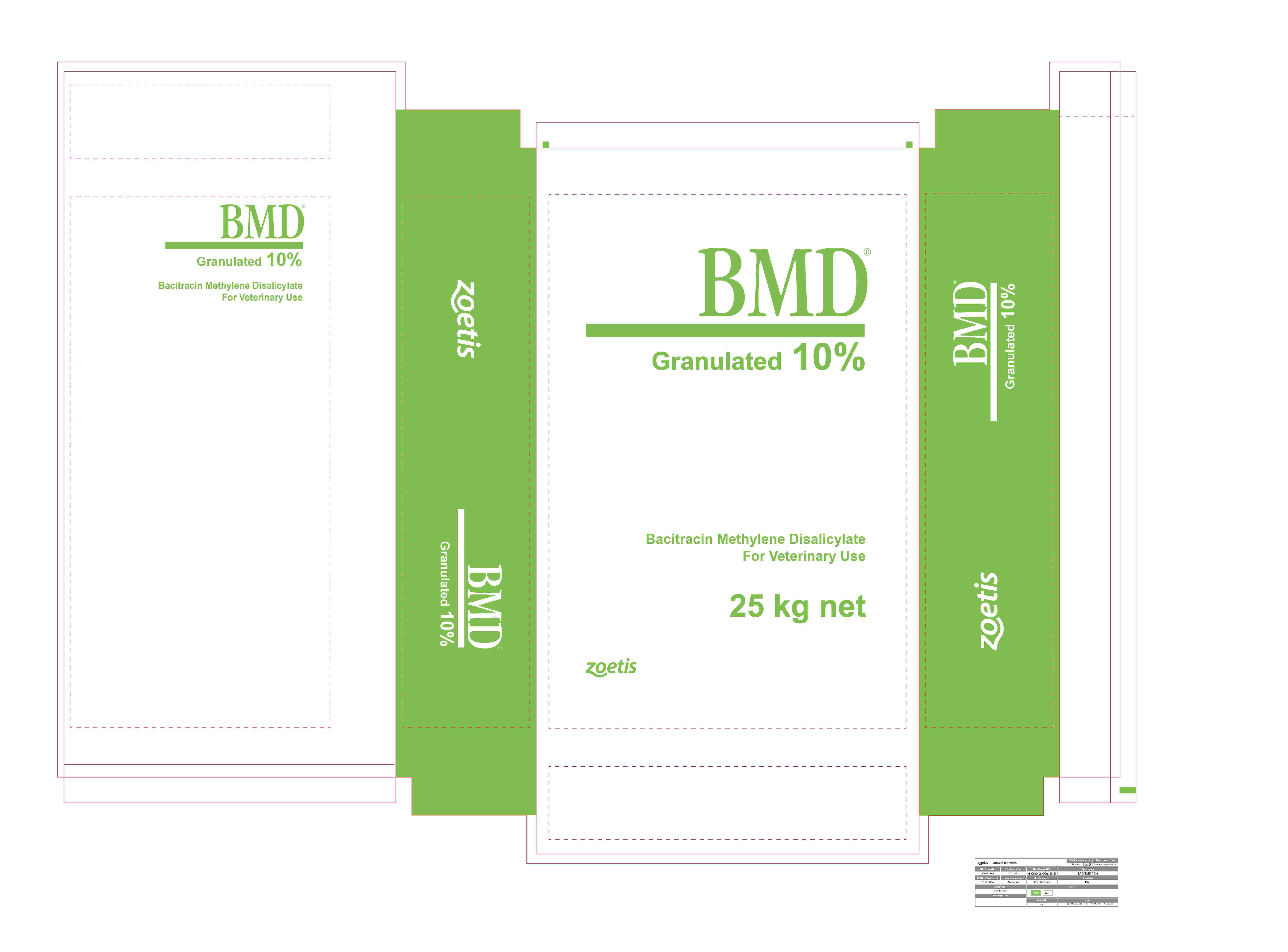
Bmd 10% Animal Product Labeling Information
The product labeling information includes all published material associated to a drug. Product labeling documents include information like generic names, active ingredients, ingredient strength dosage, routes of administration, appearance, usage, warnings, inactive ingredients, etc.
Table of Contents
Description
BMD 10%
Indications & Usage
Species Dose Indications for Use
Broiler and replacement chickens: 4 - 50 For increased rate of weight gain and improved feed efficiency.
50 As an aid in prevention of necrotic enteritis caused or complicated
by Clostridium spp. or other organisms susceptible to bacitracin methylene disalicylate.
100-200 As an aid in control of necrotic enteritis caused or complicated by
Clostridium spp. or other organisms susceptible to bacitracin
methylene disalicylate.
CAUTION: To control a necrotic enteritis outbreak, start medication
at the first clinical signs of disease. The dosage range permitted
provides for different levels based on severity of the infection.
Consult a poultry diagnostic laboratory or pathologist to determine
the diagnosis and advice regarding the optimal level of drug.
Administer continuously for 5 - 7 days or as long as clinical signs
persist, and then reduce medication to prevention level (50 g/ton).
Laying Hens: 10 - 25 For increased egg production and improved feed efficiency during
the first seven months of production
Growing turkeys: 4 - 50 For increased rate of weight gain and improved feed efficiency.
200 As an aid in control of transmissible enteritis in growing turkeys
complicated by organisms susceptible to bacitracin methylene
disalicylate.
Pheasants: 4 - 50 For increased rate of weight gain and improved feed efficiency.
Quail: 5 - 20 For increased rate of weight gain and improved feed efficiency in
quail not over 5 weeks of age.
200 For prevention of ulcerative enteritis in growing quail due to
Clostridium colinum susceptible to bacitracin methylene disalicylate.
Feed continuously as the sole ration.
Growing/Finishing Swine: 10 - 30 For increased rate of weight gain and improved feed efficiency.
250 For control of swine dysentery (bloody scours) associated with
Brachyspira hyodysenteriae in pigs up to 250 lbs body weight. Feed
250 grams per ton of complete feed on premises with a history of
swine dysentery, but where signs of the disease have not yet
occurred or following an approved treatment of the disease
condition.
The 250 g/ton level will provide 5 to 7 mg/lb in swine weighing 40 to
250 lbs.
CAUTION: Diagnosis should be confirmed by a veterinarian when
results are not satisfactory. Feed containing an approved level of
bacitracin methylene disalicylate should be the sole ration.
Pregnant Sows: 250 For control of clostridial enteritis caused by C. perfringens in
suckling piglets when fed to sows from 14 days before through 21
days after farrowing on premises with a history of clostridial scours.
mg/head/day CAUTION: Diagnosis should be confirmed by a veterinarian when
results are not satisfactory. Feed containing an approved level of
bacitracin methylene disalicylate should be the sole ration.
Feedlot beef cattle: 70 For reduction in the number of liver condemnations due to
(continuously) abscesses in feedlot beef cattle.
250 For reduction in the number of liver condemnations due to
(continuously) abscesses in feedlot beef cattle.
Note: Where minimum levels are shown, increase the antibiotic concentration within approved range when
necessary to fit the feeding program, and to insure adequate levels of antibiotic in the complete ration.
Package Label.Principal Display Panel
BMD 10 Label
* The information on this page is for an ANIMAL PRODUCT, please review the complete disclaimer below.
