Animal NDC 66104-8101-1 Paqflor
Florfenicol
Animal Product Information
| Field Name | Field Value |
|---|---|
| Animal NDC Code | 66104-8101-1 |
| Proprietary Name | Paqflor What is the Proprietary Name? The proprietary name also known as the trade name is the name of the product chosen by the medication labeler for marketing purposes. |
| Non-Proprietary Name | Florfenicol What is the Non-Proprietary Name? The non-proprietary name is sometimes called the generic name. The generic name usually includes the active ingredient(s) of the product. |
| Labeler Name | Phibro Animal Health |
| Product Type | Vfd Type A Medicated Article Animal Drug |
| Usage Information |
|
| Active Ingredient(s) |
|
| Marketing Category | ANADA - ABBREVIATED NEW ANIMAL DRUG APPLICATION What is the Marketing Category? Product types are broken down into several potential Marketing Categories, such as NDA/ANDA/BLA, OTC Monograph, or Unapproved Drug. One and only one Marketing Category may be chosen for a product, not all marketing categories are available to all product types. Currently, only final marketed product categories are included. The complete list of codes and translations can be found at www.fda.gov/edrls under Structured Product Labeling Resources. |
| FDA Application Number | ANADA200803 What is the FDA Application Number? This corresponds to the NDA, ANDA, or BLA number reported by the labeler for products which have the corresponding Marketing Category designated. If the designated Marketing Category is OTC Monograph Final or OTC Monograph Not Final, then the Application number will be the CFR citation corresponding to the appropriate Monograph (e.g. “part 341”). For unapproved drugs, this field will be null. |
Paqflor Images
Paqflor Animal Product Labeling Information
The product labeling information includes all published material associated to a drug. Product labeling documents include information like generic names, active ingredients, ingredient strength dosage, routes of administration, appearance, usage, warnings, inactive ingredients, etc.
Table of Contents
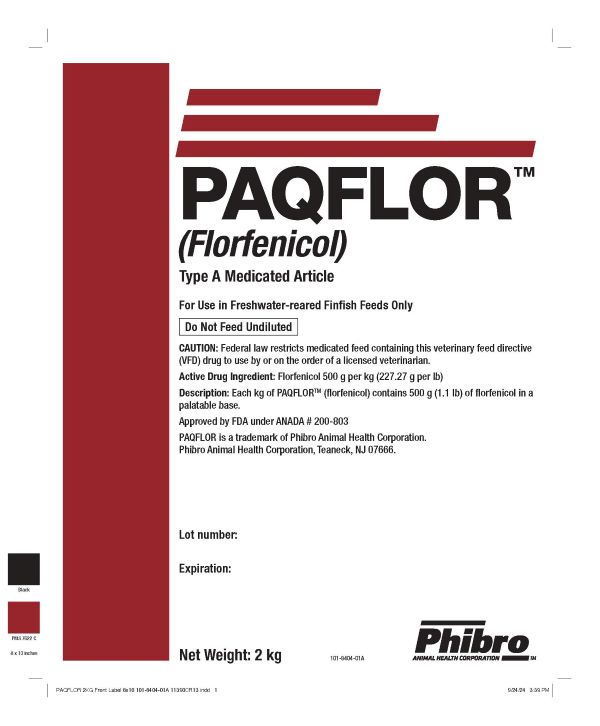
- Paqflortm(Florfenicol)Type A Medicated Article
- For Use In Freshwater-Reared Finfish Feeds Onlydo Not Feed Undiluted
- For Use In Freshwater-Reared Finfish Feeds Onlyactive Drug Ingredient: Florfenicol 500 G Per Kg (227.27 G Per Lb)Inert Ingredients: Lactose And Povidone.Description: Each Kg Of Paqflortm (Florfenicol) Contains 500 G (1.1 Lb) Of Florfenicolin A Palatable Base.
- Label
Paqflortm(Florfenicol)Type A Medicated Article
Active Drug Ingredient:Florfenicol 500 g per kg (227.27 g per lb)
Description: Each kg of PAQFLORTM (florfenicol) contains 500 g (1.1 lb) of florfenicol in a
palatable base.
Approved by FDA under ANADA # 200-803
PAQFLOR is a trademark of Phibro Animal Health Corporation.
Phibro Animal Health Corporation, Teaneck, NJ 07666.
Lot number:
Expiration:
Net Weight: 2 kg
101-8404-01A
For Use In Freshwater-Reared Finfish Feeds Onlydo Not Feed Undiluted
CAUTION: Federal law restricts medicated feed containing this veterinary feed directive
(VFD) drug to use by or on the order of a licensed veterinarian.
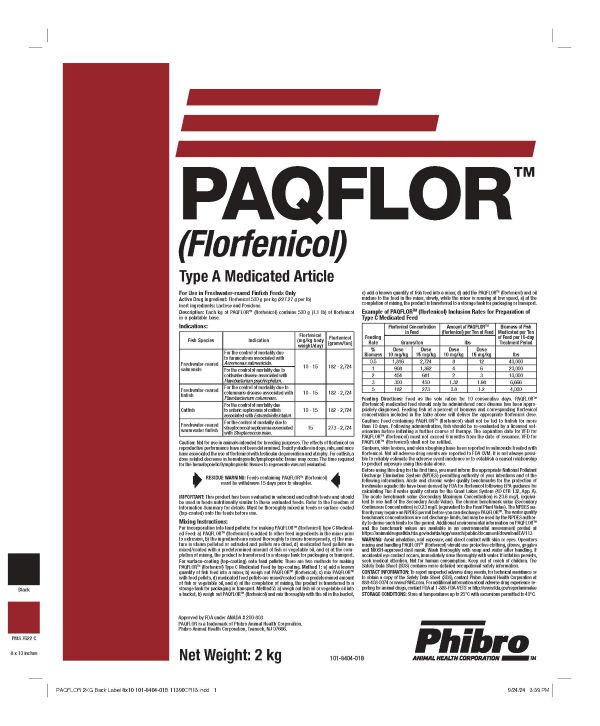
For Use In Freshwater-Reared Finfish Feeds Onlyactive Drug Ingredient: Florfenicol 500 G Per Kg (227.27 G Per Lb)Inert Ingredients: Lactose And Povidone.Description: Each Kg Of Paqflortm (Florfenicol) Contains 500 G (1.1 Lb) Of Florfenicolin A Palatable Base.
Indications:
| Fish Species | Indication | Florefenicol (mg/kg body weight/day) | Florefenicol (grams/ton) |
| Freshwater-reared salmonids | For the control of mortality due to furunculosis associated with Aeromonas salmonicida. | 10-15 | 182-2,724 |
| For the control of mortality due to coldwater disease associated with Flavobacterium psychrophilum. | |||
| Freshwater-reared finfish | For the control of mortality due to columnaris disease associated with Flavobacterium columnare. | 10-15 | 182-2,724 |
| Catfish | For the control of mortality due to enteric septicemia of catfish associated with Edwardsiella ictaluri. | 10-15 | 182-2,724 |
| Freshwater-reared warmwater finfish | For the control of mortality due to streptococcal septicemia associated with Streptococcus iniae. | 15 | 273-2,724 |
Caution: Not for use in animals intended for breeding purposes. The effects of florfenicol on
reproductive performance have not been determined. Toxicity studies in dogs, rats, and mice
have associated the use of florfenicol with testicular degeneration and atrophy. For catfish, a
dose related decrease in hematopoietic/lymphopoietic tissue may occur. The time required
for the hematopoietic/lymphopoietic tissues to regenerate was not evaluated.
RESIDUE WARNING: Feeds containing PAQFLORTM (florfenicol) must be withdrawn 15 days prior to slaughter.
IMPORTANT: This product has been evaluated in salmonid and catfish feeds and should
be used in feeds nutritionally similar to these evaluated feeds. Refer to the Freedom of
Information Summary for details. Must be thoroughly mixed in feeds or surface-coated
(top-coated) onto the feeds before use.
Mixing Instructions:For incorporation into feed pellets: For making PAQFLORTM (florfenicol) Type C Medicated
Feed: a) PAQFLORTM (florfenicol) is added to other feed ingredients in the mixer prior
to extrusion, b) the ingredients are mixed thoroughly to insure homogeneity, c) the mixture
is steam pelleted or extruded and pellets are dried, d) medicated feed pellets are
mixed/coated with a predetermined amount of fish or vegetable oil, and e) at the completion
of mixing, the product is transferred to a storage tank for packaging or transport.
For surface-coating (top-coating) onto feed pellets: There are two methods for making
PAQFLORTM (florfenicol) Type C Medicated Feed by top-coating. Method 1:a) add a known
quantity of fish feed into a mixer, b) weigh out PAQFLORTM (florfenicol), c) mix PAQFLORTM
with feed pellets, d) medicated feed pellets are mixed/coated with a predetermined amount
of fish or vegetable oil, and e) at the completion of mixing, the product is transferred to a
storage tank for packaging or transport. Method 2: a) weigh out fish oil or vegetable oil into
a bucket, b) weigh out PAQFLORTM (florfenicol) and mix thoroughly with the oil in the bucket,
c) add a known quantity of fish feed into a mixer, d) add the PAQFLORTM (florfenicol) and oil
mixture to the feed in the mixer, slowly, while the mixer is running at low speed, e) at the
completion of mixing, the product is transferred to a storage tank for packaging or transport.
Example of PAQFLORTM (florfenicol) Inclusion Rates for Preparation of Type C Medicated Feed
Feeding Rate | Florfenicol Concentration in Feed | Amount of PAQFLORTM (florfenicol per Ton of Feed) | Biomass of Fish of Feed per 10-day Treatment Period | ||
| Grams/ton | lbs | ||||
% Biomass | Dose 10 mg/kg | Dose 15 mg/kg | Dose 10 mg/kg | Dose 15 mg/kg | lbs |
| 0.5 | 1,816 | 2,724 | 8 | 12 | 40,000 |
| 1 | 908 | 1,362 | 4 | 6 | 20,000 |
| 2 | 454 | 681 | 2 | 3 | 10,000 |
| 3 | 300 | 450 | 1.32 | 1.98 | 6,666 |
| 5 | 182 | 273 | 0.8 | 1.2 | 4,000 |
Feeding Directions: Feed as the sole ration for 10 consecutive days. PAQFLORTM
(florfenicol) medicated feed should only be administered once disease has been appropriately
diagnosed. Feeding fish at a percent of biomass and corresponding florfenicol
concentration included in the table above will deliver the appropriate florfenicol dose.
Label
PAQFLOR Front and Back Label
* The information on this page is for an ANIMAL PRODUCT, please review the complete disclaimer below.
