Animal NDC 69043-047-05 Enropro 22.7
Enrofloxacin
Animal Product Information
Enropro 22.7 Images
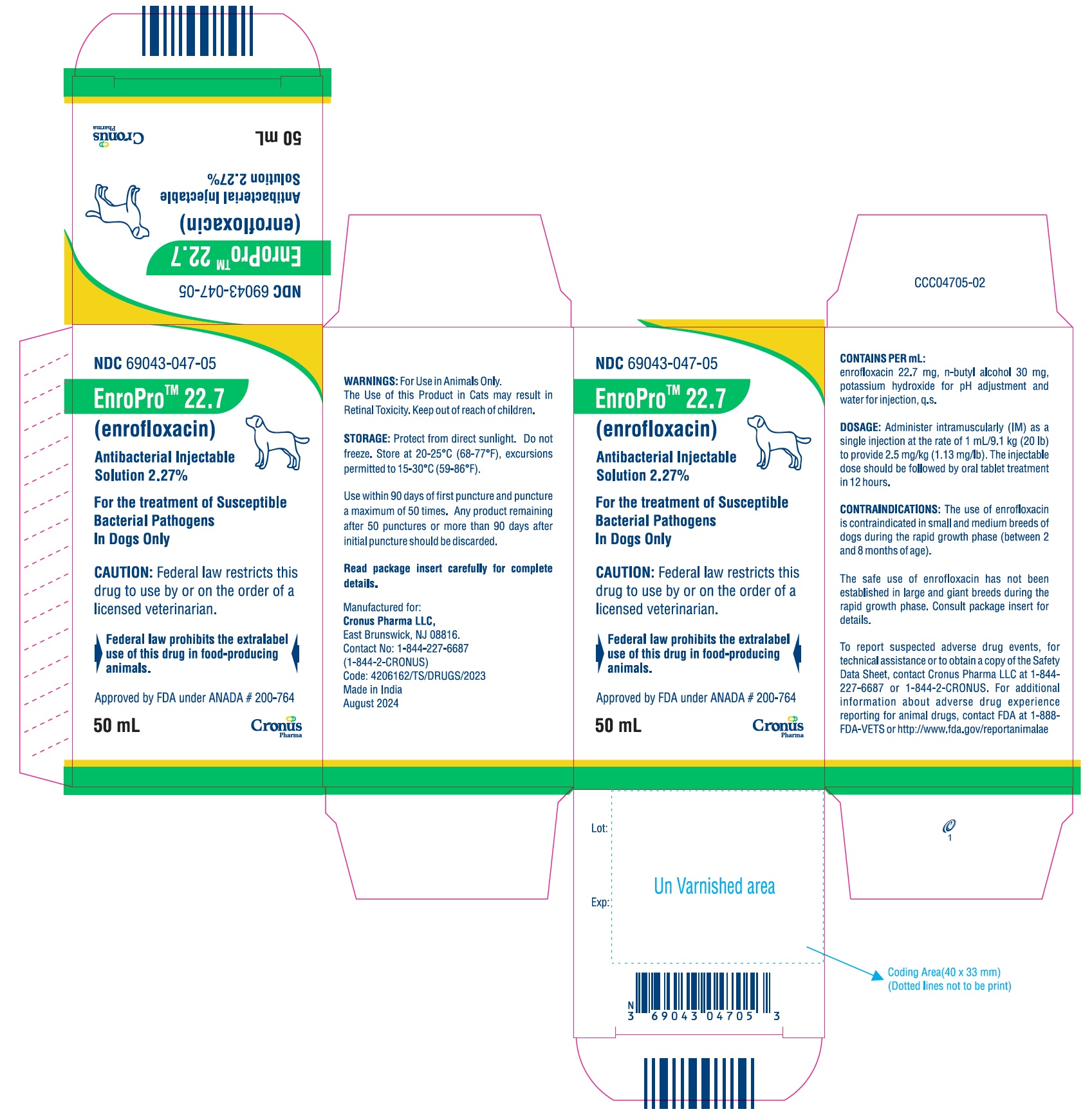
Enropro 22.7 Animal Product Labeling Information
The product labeling information includes all published material associated to a drug. Product labeling documents include information like generic names, active ingredients, ingredient strength dosage, routes of administration, appearance, usage, warnings, inactive ingredients, etc.
Table of Contents
- Other
- Description:
- Chemical Nomenclature And Structural Formula:
- Actions:
- Indications:
- Efficacy Confirmation:
- Contraindications:
- Adverse Reactions:
- Contact Information
- Animal Safety Summary:
- Drug Interactions:
- Warnings:
- Precaution:
- Dosage And Administration:
- Storage:
- How Supplied:
- References:
- Principal Display Panel:
Other
CAUTION:
Federal law restricts this drug to use by or on the order of a licensed veterinarian.
►Federal law prohibits the extralabel use of this drug in food-producing animals.◄
Description:
Enrofloxacin is a synthetic chemotherapeutic agent from the class of the quinolone carboxylic acid derivatives. It has antibacterial activity against a broad spectrum of Gram negative and Gram positive bacteria (See Tables I and II). Each mL of injectable solution contains: enrofloxacin 22.7 mg, n-butyl alcohol 30 mg, potassium hydroxide for pH adjustment and water for injection, q.s.
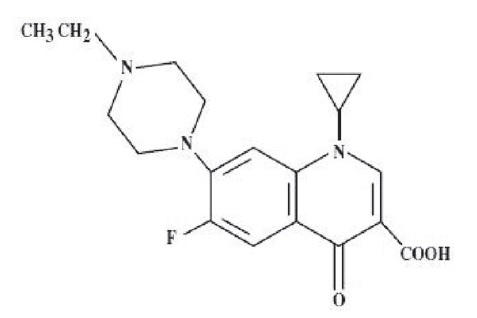
Chemical Nomenclature And Structural Formula:
1-cyclopropyl-7-(4-ethyl-1-piperazinyl)-6-fluoro-1,4-dihydro-4-oxo-3-quinolinecarboxylic acid.
Actions:
Microbiology: Quinolone carboxylic acid derivatives are classified as DNA gyrase inhibitors. The mechanism of action of these compounds is very complex and not yet fully understood. The site of action is bacterial gyrase, a synthesis promoting enzyme. The effect on Escherichia coli is the inhibition of DNA synthesis through prevention of DNA supercoiling. Among other things, such compounds lead to the cessation of cell respiration and division. They may also interrupt bacterial membrane integrity.1
Enrofloxacin is bactericidal, with activity against both Gram negative and Gram positive bacteria. The minimum inhibitory concentrations (MICs) were determined for a series of 37 isolates representing 9 genera of bacteria from natural infections in dogs, selected principally because of resistance to one or more of the following antibiotics: ampicillin, cephalothin, colistin, chloramphenicol, erythromycin, gentamicin, kanamycin, penicillin, streptomycin, tetracycline, triple sulfa and sulfa/trimethoprim. The MIC values for enrofloxacin against these isolates are presented in Table I. Most strains of these organisms were found to be susceptible to enrofloxacin in vitro but the clinical significance has not been determined for some of the isolates.
The susceptibility of organisms to enrofloxacin should be determined using enrofloxacin 5 mcg disks. Specimens for susceptibility testing should be collected prior to the initiation of enrofloxacin therapy.
| Organisms | Isolates | MIC Range (mcg/mL) |
| Bacteroides spp | 2 | 2 |
| Bordetella bronchiseptica | 3 | 0.125-0.5 |
| Brucella canis | 2 | 0.125-0.25 |
| Clostridium perfringens | 1 | 0.5 |
| Escherichhia coli | 4 | ≤0.016-0.031 |
| Klebsiella spp. | 10 | 0.031-0.5 |
| Proteus mirabilis | 6 | 0.062-0.125 |
| Pseudomonas aeruginosa | 4 | 0.5-8 |
| Staphylococcus spp. | 5 | 0.125 |
The inhibitory activity on 120 isolates of seven canine urinary pathogens was also investigated and is listed in Table II.
| Organisms | Isolates | MIC Range (mcg/mL) |
| E.coli | 30 | 0.06-2.0 |
| P.mirabilis | 20 | 0.125-2.0 |
| K.pneumoniae | 20 | 0.06-0.5 |
| P.aeruginosa | 10 | 1.0-8.0 |
| Enterobacter spp | 10 | 0.06-1.0 |
| Staph. (coag. +) | 20 | 0.125-0.5 |
| Strep. (alpha hemol.) | 10 | 0.5-8.0 |
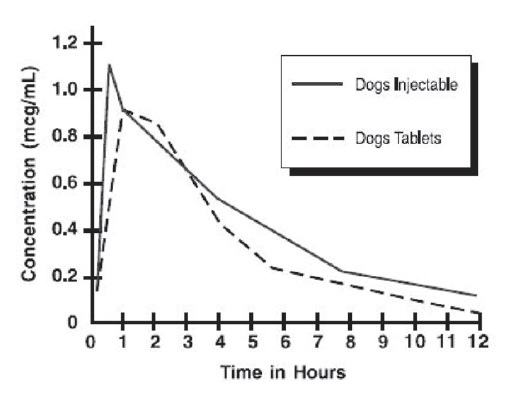
Distribution in the Body: Enrofloxacin penetrates into all canine tissues and body fluids. Concentrations of drug equal to or greater than the MIC for many pathogens (See Tables I, II and III) are reached in most tissues by two hours after dosing at 2.5 mg/kg and are maintained for 8-12 hours after dosing. Particularly high levels of enrofloxacin are found in urine. A summary of the body fluid/tissue drug levels at 2 to 12 hours after dosing at 2.5 mg/kg is given in Table III.
| Post-treatment Enrofloxacin Levels Canine (n=2) | ||
| Body Fluids (mcg/mL) | 2 Hr. | 8 Hr. |
| Urine | 43.05 | 55.35 |
| Eye Fluids | 0.53 | 0.66 |
| Whole Blood | 1.01 | 0.36 |
| Plasma | 0.67 | 0.33 |
| Tissues (mcg/g) Hematopoietic System | ||
| Liver | 3.02 | 1.36 |
| Spleen | 1.45 | 0.85 |
| Bone Marrow | 2.10 | 1.22 |
| Lymph Node | 1.32 | 0.91 |
| Urogenital System | ||
| Kidney | 1.87 | 0.99 |
| Bladder Wall | 1.36 | 0.98 |
| Testes | 1.36 | 1.10 |
| Prostate | 1.36 | 2.20 |
| Uterine Wall | 1.59 | 0.29 |
| Gastrointestinal and Cardiopulmonary Systems | ||
| Lung | 1.34 | 0.82 |
| Heart | 1.88 | 0.78 |
| Stomach | 3.24 | 2.16 |
| Small Intestine | 2.10 | 1.11 |
| Other | ||
| Fat | 0.52 | 0.40 |
| Skin | 0.66 | 0.48 |
| Muscle | 1.62 | 0.77 |
| Brain | 0.25 | 0.24 |
| Mammary Gland | 0.45 | 0.21 |
| Feces | 1.65 | 9.97 |
Indications:
EnroProTM 22.7 Injectable Solution is indicated for the management of diseases in dogs associated with bacteria susceptible to enrofloxacin.
Efficacy Confirmation:
Clinical efficacy was established in dermal infections (wounds and abscesses) associated with susceptible strains of Escherichia coli, Klebsiella pneumoniae, Proteus mirabilis, and Staphylococcus intermedius; respiratory infections (pneumonia, tonsillitis, rhinitis) associated with susceptible strains of Escherichia coli and Staphylococcus aureus; and urinary cystitis associated with susceptible strains of Escherichia coli, Proteus mirabilis, and Staphylococcus aureus.
Contraindications:
Enrofloxacin is contraindicated in dogs known to be hypersensitive to quinolones.
Based on the studies discussed under the section on Animal Safety Summary, the use of enrofloxacin is contraindicated in small and medium breeds of dogs during the rapid growth phase (between 2 and 8 months of age). The safe use of enrofloxacin has not been established in large and giant breeds during the rapid growth phase. Large breeds may be in this phase for up to one year of age and the giant breeds for up to 18 months. In clinical field trials utilizing a daily oral dose of 5.0 mg/kg, there were no reports of lameness or joint problems in any breed. However, controlled studies with histological examination of the articular cartilage have not been conducted in the large or giant breeds.
Adverse Reactions:
No drug-related side effects were reported in 122 clinical cases treated with enrofloxacin injectable solution followed by enrofloxacin tablets at 5.0 mg/kg per day.
Contact Information
To report suspected adverse drug events, for technical assistance or to obtain a copy of the Safety Data Sheet, contact Cronus Pharma LLC at 1-844-227-6687 or 1-844-2-CRONUS. For additional information about adverse drug experience reporting for animal drugs, contact FDA at 1-888-FDA-VETS or http://www.fda.gov/reportanimalae
Animal Safety Summary:
Adult dogs receiving enrofloxacin orally at a daily dosage rate 52 mg/kg for 13 weeks had only isolated incidences of vomition and inappetence. Adult dogs receiving the tablet formulation for 30 consecutive days at a daily treatment of 25 mg/kg did not exhibit significant clinical signs nor were there effects upon the clinical chemistry, hematological or histological parameters. Daily doses of 125 mg/kg for up to 11 days induced vomition, inappetence, depression, difficult locomotion and death while adult dogs receiving 50 mg/kg/day for 14 days had clinical signs of vomition and inappetence.
Adult dogs dosed intramuscularly for three treatments at 12.5 mg/kg followed by 57 oral treatments at 12.5 mg/kg, all at 12 hour intervals, did not exhibit either significant clinical signs or effects upon the clinical chemistry, hematological or histological parameters.
Oral treatment of 15 to 28 week old growing puppies with daily dosage rates of 25 mg/kg has induced abnormal carriage of the carpal joint and weakness in the hindquarters. Significant improvement of clinical signs is observed following drug withdrawal. Microscopic studies have identified lesions of the articular cartilage following 30 day treatments at either 5, 15 or 25 mg/kg in this age group. Clinical signs of difficult ambulation or associated cartilage lesions have not been observed in 29 to 34 week old puppies following daily treatments of 25 mg/kg for 30 consecutive days nor in 2 week old puppies with the same treatment schedule.
Tests indicated no effect on circulating microfilariae or adult heart-worms (Dirofilaria immitis) when dogs were treated at a daily dosage rate of 15 mg/kg for 30 days. No effect on cholinesterase values was observed.
No adverse effects were observed on reproductive parameters when male dogs received 10 consecutive daily treatments of 15 mg/kg/day at 3 intervals (90, 45 and 14 days) prior to breeding or when female dogs received 10 consecutive daily treatments of 15 mg/kg/day at 4 intervals; between 30 and 0 days prior to breeding, early pregnancy (between 10th & 30th days), late pregnancy (between 40th & 60th days), and during lactation (the first 28 days).
Drug Interactions:
Concomitant therapy with other drugs that are metabolized in the liver may reduce the clearance rates of the quinolone and the other drug.
Enrofloxacin has been administered to dogs at a daily dosage rate of 10 mg/kg concurrently with a wide variety of other health products including anthelmintics (praziquantel, febantel), insecticides (pyrethrins), heartworm preventatives (diethylcarbamazine) and other antibiotics (ampicillin, gentamicin sulfate, penicillin). No incompatibilities with other drugs are known at this time.
Warnings:
For use in animals only. The use of this product in cats may result in Retinal Toxicity. Keep out of reach of children.
Avoid contact with eyes. In case of contact, immediately flush eyes with copious amounts of water for 15 minutes. In case of dermal contact, wash skin with soap and water. Consult a physician if irritation persists following ocular or dermal exposure. Individuals with a history of hypersensitivity to quinolones should avoid this product. In humans, there is a risk of user photosensitization within a few hours after excessive exposure to quinolones. If excessive accidental exposure occurs, avoid direct sunlight.
Precaution:
Quinolone-class drugs should be used with caution in animals with known or suspected Central Nervous System (CNS) disorders. In such animals, quinolones have, in rare instances, been associated with CNS stimulation which may lead to convulsive seizures.
Quinolone-class drugs have been associated with cartilage erosions in weight-bearing joints and other forms of arthropathy in immature animals of various species.
The use of fluoroquinolones in cats has been reported to adversely affect the retina. Such products should be used with caution in cats.
Dosage And Administration:
EnroProTM 22.7 Injectable Solution may be used as the initial dose at 2.5 mg/kg. It should be administered intramuscularly (IM) as a single dose, followed by initiation of enrofloxacin tablet therapy.
EnroProTM 22.7 Injectable Solution may be administered as follows:
| Weight of Animal | EnroProTM 22.7 Injectable Solution* 2.5 mg/kg |
| 9.1 kg (20 lb) | 1.00 mL |
| 27.2 kg (60 lb) | 3.00 mL |
*The initial EnroProTM 22.7 Injectable administration should be followed 12 hours later by initiation of enrofloxacin tablet therapy.
The lower limit of the dose range was based on efficacy studies in dogs where enrofloxacin was administered at 2.5 mg/kg twice daily. Target animal safety and toxicology studies were used to establish the upper limit of the dose range and treatment duration.
Storage:
Protect from direct sunlight. Do not freeze. Store at 20-25°C (68-77°F), excursions permitted to 15-30°C (59-86°F).
Use within 90 days of first puncture and puncture a maximum of 20 times for 20 mL fill and 50 times for 50 mL fill. Any product remaining after specified punctures or more than 90 days after initial puncture should be discarded.
How Supplied:
| Code Number | EnroProTM 22.7 Injectable Solution 22.7 mg/mL Vial Size |
| NDC 69043-047-02 | 20 mL |
| NDC 69043-047-05 | 50 mL |
EnroProTM is the registered trademarks of Cronus Pharma LLC
References:
1. Dougherty, T.J. and Saukkonen, J.J. Membrane Permeability Changes Associated with DNA Gyrase Inhibitors in Escherichia coli. Antimicrob.Agents and Chemoth., V. 28, Aug. 1985: 200-206.
2. Walker, R.D., et al. Pharmacokinetic Evaluation of Enrofloxacin Administered Orally to Healthy Dogs. Am.J. Res., V. 53, No. 12, Dec. 1992: 2315-2319.
Approved by FDA under ANADA # 200-764
Manufactured for:
Cronus Pharma LLC,
East Brunswick, NJ 08816.
Contact No: 1-844-227-6687
(1-844-2-CRONUS)
Made in India
August 2024
Principal Display Panel:
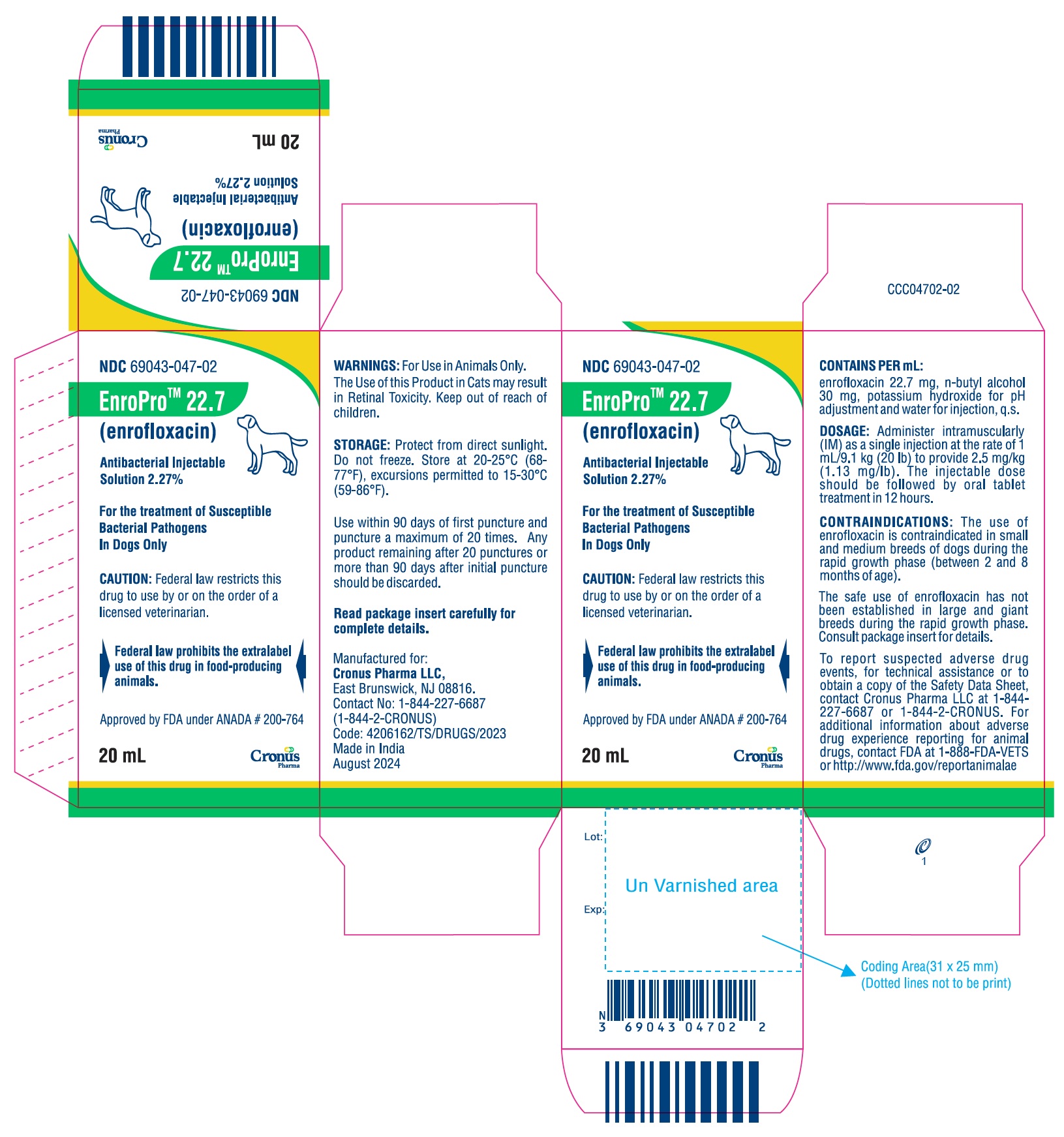
NDC 69043-047-02
EnroProTM 22.7
(enrofloxacin)
Antibacterial Injectable Solution 2.27%
For the treatment of Susceptible Bacterial Pathogens In Dogs Only
CAUTION: Federal law restricts this drug to use by or on the order of a licensed veterinarian.
Federal law prohibits the extra label use of this drug in food-producing animals.
Approved by FDA under ANADA #200-764
20 mL
C 69043-047-05
EnroProTM 22.7
(enrofloxacin)
Antibacterial Injectable Solution 2.27%
For the treatment of Susceptible Bacterial Pathogens In Dogs Only
CAUTION: Federal law restricts this drug to use by or on the order of a licensed veterinarian.
Federal law prohibits the extra label use of this drug in food-producing animals.
Approved by FDA under ANADA #200-764
50 mL
* The information on this page is for an ANIMAL PRODUCT, please review the complete disclaimer below.
