Animal NDC 83155-200-50 Veterinary 0.9% Sodium Chloride
Sodium Chloride
Animal Product Information
Veterinary 0.9% Sodium Chloride Images
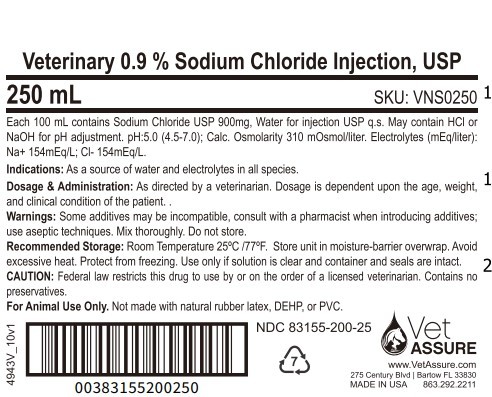
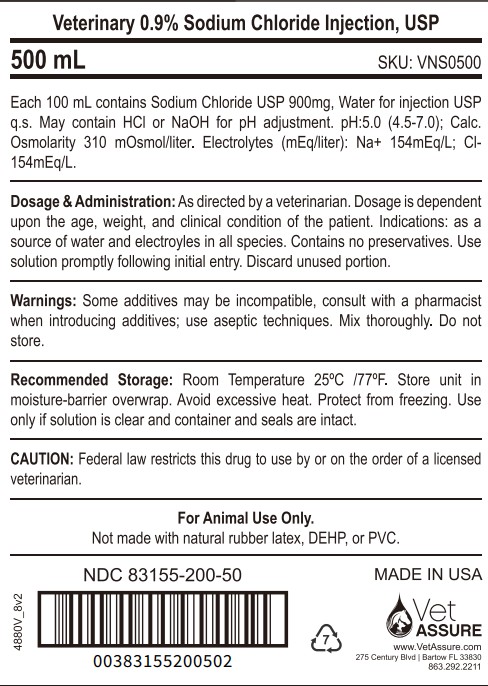
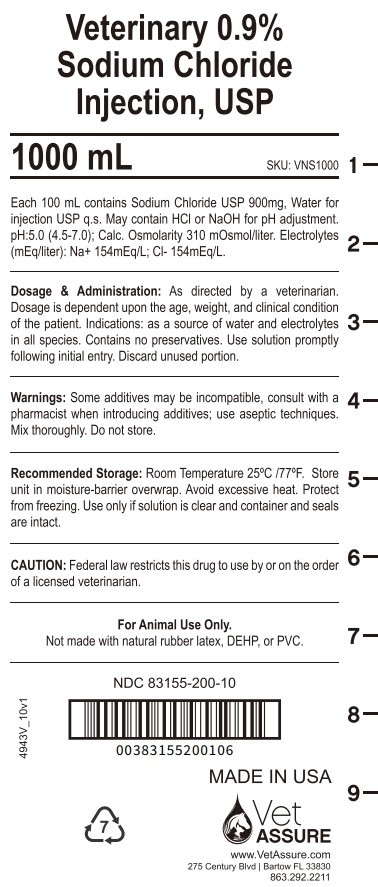
Veterinary 0.9% Sodium Chloride Animal Product Labeling Information
The product labeling information includes all published material associated to a drug. Product labeling documents include information like generic names, active ingredients, ingredient strength dosage, routes of administration, appearance, usage, warnings, inactive ingredients, etc.
Table of Contents
Description
Description:
Veterinary 0.9% Sodium Chloride Injection, USP is a sterile, nonpyrogenic solution for fluid and electrolyte replenishment in single dose containers for parenteral administration. It contains no antimicrobial agents. Discard unused portion.
Clinical Pharmacology
Veterinary 0.9% Sodium Chloride Injection, USP has value as a source of water and electrolytes. It is capable of inducing diuresis depending on the clinical condition
of the patient.
Indications And Usage
Veterinary 0.9% Sodium Chloride Injection, USP is indicated as a source of water and electrolytes.
Contraindications
None known.
Warnings
Sodium Chloride Injection, USP should be used with great care, if at all, in patients with congestive heart failure, severe renal insufficiency, and in clinical states in which there exists edema with sodium retention.
The intravenous administration of Sodium Chloride Injection, USP can cause fluid and/or solute overloading resulting in dilution of serum electrolyte concentrations, overhydration, congested states, or pulmonary edema. The risk of dilutive states is inversely proportional to the electrolyte concentration of the injections. The risk of solute overload causing congested states with peripheral and pulmonary edema is directly proportional to the electrolyte concentrations of the injections.
In patients with diminished renal function, administration of Sodium Chloride Injection, USP may result in sodium retention.
Adverse Reactions
Reactions which may occur because of the solution or the technique of administration include febrile response, infection at the site of injection, venous thrombosis or phlebitis extending from the site of injection, extravasation, and hypervolemia. If an adverse reaction does occur, discontinue the infusion, evaluate the patient, institute appropriate therapeutic countermeasures, and save the remainder of the fluid for examination if deemed necessary.
Precautions
Clinical evaluation and periodic laboratory determinations are necessary to monitor changes in fluid balance, electrolyte concentrations, and acid base balance during prolonged parenteral therapy or whenever the condition of the patient warrants such evaluation.
Caution must be exercised in the administration of Veterinary 0.9% Sodium Chloride Injection, USP to patients receiving corticosteroids or corticotropin. Do not administer unless solution is clear and seal is intact.
Dosage And Administration
As directed by a veterinarian. Dosage is dependent upon the age, weight and clinical condition of the patient, as well as laboratory determinations.
Parenteral drug products should be inspected visually for particulate matter and discoloration prior to administration whenever solution and container permit.
All solutions for injection contained in plastic containers are intended for administration using sterile equipment and aseptic technique. Additives may be incompatible. Complete information is not available. Those additives known to be incompatible should not be used. Consult with pharmacist, if available. If, in the informed judgment of the veterinarian, it is deemed advisable to introduce additives, use aseptic technique. Mix thoroughly when additives have been introduced.
Do not store solutions containing additives. Discard unused portion.
Over Dosage
In an event of overhydration or solute overload, re-evaluate the patient and institute appropriate corrective measures.
See Warnings, Adverse Reactions and Precautions.
How Supplied
Veterinary 0.9% Sodium Chloride Injection, USP is supplied in plastic bags as follows:
The plastic container is fabricated from a multi-layer, Polyolefin/Styrene-block copolymer film. The amount of water that can permeate from inside the container into the overwrap is insufficient to affect the solution significantly.
Storage:
Exposure of pharmaceutical products to heat should be minimized. Avoid excessive heat. It is recommended the product be stored in the moisture overwrap at room temperature (25°C/77°F); brief exposure up to (40°C/104°F) does not adversely affect the product.
Directions For Use Of Plastic Container
To Open
Tear overwrap down side at slit and remove solution bag. Some opacity of the plastic due to moisture absorption during the sterilization process may be observed.
This is normal and does not affect the solution quality or safety.The opacity will diminish gradually. Check for minute leaks by squeezing inner bag firmly. If leaks
are found, discard solution as sterility may be impaired. If supplemental medication is desired, follow directions below.
Preparation for Administration
1. Suspend container from eyelet support.
2. Remove protector from outlet port at bottom of container.
3. Attach administration set. Refer to complete directions accompanying set.
To Add Medication
WARNING: Additives may be incompatible.
To add medication before solution administration
1. Prepare medication site.
2. Using syringe with 19 to 22 gauge needle, puncture resealable medication port and inject.
3. Mix solution and medication thoroughly. For high density medication such as potassium chloride, turn bag so ports are upright, and no liquid remains in
ports and mix thoroughly.
To add medication during solution administration
1. Close clamp on the administration set to stop the flow to the patient.
2. Prepare medication port.
3. Using syringe with 19 to 22 gauge needle, puncture resealable medication port and inject.
4. Remove container from IV pole and/or turn to an upright position.
5. Evacuate both ports while container is in the upright position.
6. Mix solution and medication thoroughly.
7. Return container to in-use position and continue administration.
* The information on this page is for an ANIMAL PRODUCT, please review the complete disclaimer below.
