- Mean LDL cholesterol increased by 8 mg/dL in patients treated with OLUMIANT 2 mg and by 14 mg/dL in patients treated with baricitinib 4 mg.
- Mean HDL cholesterol increased by 7 mg/dL in patients treated with OLUMIANT 2 mg and by 9 mg/dL in patients treated with baricitinib 4 mg.
- The mean LDL/HDL ratio remained stable.
- Mean triglycerides increased by 7 mg/dL in patients treated with OLUMIANT 2 mg and by 15 mg/dL in patients treated with baricitinib 4 mg.
[See Warnings and Precautions (5.5)].
Creatine Phosphokinase (CPK) – OLUMIANT treatment was associated with increases in CPK within one week of starting OLUMIANT and plateauing after 8 to 12 weeks. At 16 weeks, the mean change in CPK for OLUMIANT 2 mg and baricitinib 4 mg was 37 IU/L and 52 IU/L, respectively.
Creatinine – In controlled clinical trials, dose-related increases in serum creatinine were observed with OLUMIANT treatment. At 52 weeks, the mean increase in serum creatinine was less than 0.1 mg/dL with baricitinib 4 mg. The clinical significance of the observed serum creatinine increases is unknown.
Other Adverse Reactions
Other adverse reactions are summarized in Table 4.
Table 4: Adverse Reactions occurring in greater than or equal to 1% of OLUMIANT 2 mg and Baricitinib 4 mg Treated Patients in Placebo-Controlled Trials
|
|
| Events | Weeks 0-16 |
| Placebo | OLUMIANT
2 mg | Baricitinib
4 mg |
n=1070
(%) | n=479
(%) | n=997
(%) |
| Upper respiratory tract infectionsa | 11.7
| 16.3
| 14.7
|
| Nausea
| 1.6
| 2.7
| 2.8
|
| Herpes simplexb | 0.7
| 0.8
| 1.8
|
| Herpes zoster
| 0.4
| 1.0
| 1.4
|
Additional adverse drug reactions occurring in fewer than 1% of patients: acne.
Risk Summary
The limited human data on use of OLUMIANT in pregnant women are not sufficient to inform a drug-associated risk for major birth defects or miscarriage. In animal embryo-fetal development studies, oral baricitinib administration to pregnant rats and rabbits at exposures equal to and greater than approximately 20 and 84 times the maximum recommended human dose (MRHD), respectively, resulted in reduced fetal body weights, increased embryolethality (rabbits only), and dose-related increases in skeletal malformations. No developmental toxicity was observed in pregnant rats and rabbits treated with oral baricitinib during organogenesis at approximately 5 and 13 times the exposure at the MRHD, respectively. In a pre- and post-natal development study in pregnant female rats, oral baricitinib administration at exposures approximately 43 times the MRHD resulted in reduction in pup viability (increased incidence of stillborn pups and early neonatal deaths), decreased fetal birth weight, reduced fetal body weight gain, decreased cytotoxic T cells on post-natal day (PND) 35 with evidence of recovery by PND 65, and developmental delays that might be attributable to decreased body weight gain. No developmental toxicity was observed at an exposure approximately 9 times the exposure at the MRHD [see Animal Data].
The estimated background risk of major birth defects and miscarriage for the indicated population(s) are unknown. All pregnancies have a background risk of birth defect, loss, or other adverse outcomes. In the U.S. general population, the estimated background risk of major birth defects and miscarriage in clinically recognized pregnancies is 2-4% and 15-20%, respectively.
Data
Animal Data
In an embryofetal development study in pregnant rats, dosed orally during the period of organogenesis from gestation days 6 to 17, baricitinib was teratogenic (skeletal malformations that consisted of bent limb bones and rib anomalies) at exposures equal to or greater than approximately 20 times the MRHD (on an AUC basis at maternal oral doses of 10 mg/kg/day and higher). No developmental toxicity was observed in rats at an exposure approximately 5 times the MRHD (on an AUC basis at a maternal oral dose of 2 mg/kg/day).
In an embryofetal development study in pregnant rabbits, dosed orally during the period of organogenesis from gestation days 7 to 20, embryolethality, decreased fetal body weights, and skeletal malformations (rib anomalies) were observed in the presence of maternal toxicity at an exposure approximately 84 times the MRHD (on an AUC basis at a maternal oral dose of 30 mg/kg/day). Embryolethality consisted of increased post-implantation loss that was due to elevated incidences of both early and late resorptions. No developmental toxicity was observed in rabbits at an exposure approximately 12 times the MRHD (on an AUC basis at a maternal oral dose of 10 mg/kg/day).
In a pre- and post-natal development study in pregnant female rats dosed orally from gestation day 6 through lactation day 20, adverse findings observed in pups included decreased survival from birth to post-natal day 4 (due to increased stillbirths and early neonatal deaths), decreased birth weight, decreased body weight gain during the pre-weaning phase, increased incidence of malrotated forelimbs during the pre-weaning phase, and decreased cytotoxic T cells on PND 35 with recovery by PND 65 at exposures approximately 43 times the MRHD (on an AUC basis at a maternal oral dose of 25 mg/kg/day). Developmental delays (that may be secondary to decreased body weight gain) were observed in males and females at exposures approximately 43 times the MRHD (on an AUC basis at a maternal oral dose of 25 mg/kg/day). These findings included decreased forelimb and hindlimb grip strengths, and delayed mean age of sexual maturity. No developmental toxicity was observed in rats at an exposure approximately 9 times the MRHD (on an AUC basis at a maternal oral dose of 5 mg/kg/day).
Risk Summary
No information is available on the presence of OLUMIANT in human milk, the effects of the drug on the breastfed infant, or the effects of the drug on milk production. Baricitinib is present in the milk of lactating rats. Due to species-specific differences in lactation physiology, the clinical relevance of these data are not clear. Because of the potential for serious adverse reactions in nursing infants, advise an OLUMIANT-treated woman not to breastfeed.
Data
A single oral dose of 25 mg/kg radiolabeled baricitinib was administered to lactating female Sprague-Dawley rats on post-partum day 13. Drug exposure was approximately 45-fold greater in milk than in plasma based on AUC0-t values.
Baricitinib inhibition of IL-6 induced STAT3 phosphorylation – Baricitinib administration resulted in a dose dependent inhibition of IL-6 induced STAT3 phosphorylation in whole blood from healthy subjects with maximal inhibition observed approximately 1 hour after dosing, which returned to near baseline by 24 hours. Similar levels of inhibition were observed using either IL-6 or TPO as the stimulus.
Immunoglobulins – Mean serum IgG, IgM, and IgA values decreased by 12 weeks after starting treatment with OLUMIANT, and remained stable through at least 52 weeks. For most patients, changes in immunoglobulins occurred within the normal reference range.
C-reactive protein – In patients with rheumatoid arthritis, decreases in serum C-reactive protein (CRP) were observed as early as one week after starting treatment with OLUMIANT and were maintained throughout dosing.
Cardiac Electrophysiology – At a dose 10 times the maximum recommended dose, baricitinib does not prolong the QT interval to any clinically relevant extent.
Absorption – The absolute bioavailability of baricitinib is approximately 80%. An assessment of food effects in healthy subjects showed that a high-fat meal decreased the mean AUC and Cmax of baricitinib by approximately 11% and 18%, respectively, and delayed the tmax by 0.5 hours. Administration with meals is not associated with a clinically relevant effect on exposure. In clinical studies, OLUMIANT was administered without regard to meals.
Distribution – After intravenous administration, the volume of distribution is 76 L, indicating distribution of baricitinib into tissues. Baricitinib is approximately 50% bound to plasma proteins and 45% bound to serum proteins. Baricitinib is a substrate of the Pgp, BCRP, OAT3 and MATE2-K transporters, which play roles in drug distribution.
Elimination – The total body clearance of baricitinib is 8.9 L/h in patients with RA. Elimination half-life in patients with rheumatoid arthritis is approximately 12 hours.
Metabolism – Approximately 6% of the orally administered baricitinib dose is identified as metabolites (three from urine and one from feces), with CYP3A4 identified as the main metabolizing enzyme. No metabolites of baricitinib were quantifiable in plasma.
Excretion – Renal elimination is the principal clearance mechanism for baricitinib through filtration and active secretion as baricitinib is identified as a substrate of OAT3, Pgp, BCRP and MATE2-K from in vitro studies. In a clinical pharmacology study, approximately 75% of the administered dose was eliminated in the urine, while about 20% of the dose was eliminated in the feces. Baricitinib was excreted predominately as unchanged drug in urine (69%) and feces (15%).
Specific Populations
Effects of Body Weight, Gender, Race, and Age
Body weight, gender, race, ethnicity, and age did not have a clinically relevant effect on the PK (AUC and Cmax) of baricitinib (Figure 1). The mean effects of intrinsic factors on PK parameters (AUC and Cmax) were generally within the inter-subject PK variability of baricitinib. The inter-subject variabilities (% coefficients of variation) in AUC and Cmax of baricitinib are approximately 41% and 22%, respectively. [See Use in Specific Populations (8.5)].
Renal Impairment
Baricitinib systemic exposure in AUC was increased by 1.41-, 2.22-, 4.05- and 2.41-fold for mild, moderate, severe, and ESRD (with hemodialysis) renal impairment sub-groups, respectively, compared to subjects with normal renal function. The corresponding values for increase in Cmax were 1.16-, 1.46-, 1.40- and 0.88-fold, respectively (Figure 1) [see Use in Specific Populations (8.7)].
Hepatic Impairment
Baricitinib systemic exposure and Cmax increased by 1.19- and 1.08-fold for the moderate hepatic impairment group, respectively, compared to subjects with normal hepatic function (Figure 1) [see Use in Specific Populations (8.6)].
Figure 1: Impact of Intrinsic Factors on Baricitinib Pharmacokineticsa,b
a Reference values for weight, age, gender, and race comparisons are 70 kg, 54 years, male, and white, respectively; reference groups for renal and hepatic impairment are subjects with normal renal and hepatic function, respectively.
b Effects of renal and hepatic impairment on baricitinib exposure were summarized from dedicated renal and hepatic impairment studies, respectively. Effects of other intrinsic factors on baricitinib exposure were summarized from population PK analysis.
Drug Interactions
Potential for Baricitinib to Influence the PK of Other Drugs
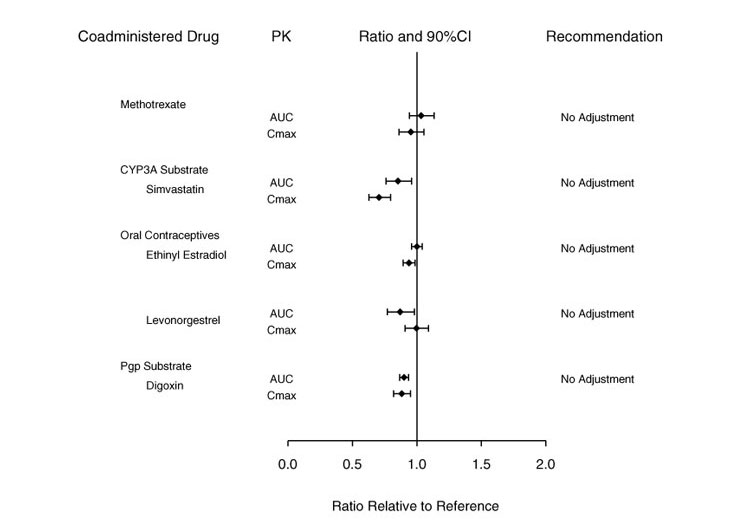
In vitro, baricitinib did not significantly inhibit or induce the activity of cytochrome P450 enzymes (CYPs 3A, 1A2, 2B6, 2C8, 2C9, 2C19, and 2D6). In clinical pharmacology studies, there were no clinically meaningful changes in the pharmacokinetics (PK) of simvastatin, ethinyl estradiol, or levonorgestrel (CYP3A substrates) when co-administered with baricitinib.
In vitro studies suggest that baricitinib is not an inhibitor of the transporters, P-glycoprotein (Pgp) or Organic Anion Transporting Polypeptide (OATP) 1B1. In vitro data indicate baricitinib does inhibit organic anionic transporter (OAT) 1, OAT2, OAT3, organic cationic transporter (OCT) 1, OCT2, OATP1B3, Breast Cancer Resistance Protein (BCRP) and Multidrug and Toxic Extrusion Protein (MATE) 1 and MATE2-K, but clinically meaningful changes in the pharmacokinetics of drugs that are substrates for these transporters are unlikely. In clinical pharmacology studies there were no clinically meaningful effects on the PK of digoxin (Pgp substrate) or methotrexate (substrate of several transporters) when co-administered with baricitinib.
Exposure changes of drugs following co-administration with baricitinib are shown in Figure 2.
Figure 2: Impact of Baricitinib on the Pharmacokinetics of Other Drugsa

Figure 2 (Olumiant Uspi F2 V1)
a Reference group is administration of concomitant drug alone.
Potential for Other Drugs to Influence the PK of Baricitinib
In vitro studies suggest that baricitinib is a CYP3A4 substrate. In clinical pharmacology studies there was no effect on the PK of baricitinib when co-administered with ketoconazole (CYP3A inhibitor). There were no clinically meaningful changes in the PK of baricitinib when co-administered with fluconazole (CYP3A/CYP2C19/CYP2C9 inhibitor) or rifampicin (CYP3A inducer).
In vitro studies suggest that baricitinib is a substrate for OAT3, Pgp, BCRP and MATE2-K. In a clinical study, probenecid administration (strong OAT3 inhibitor) resulted in an approximately 2-fold increase in baricitinib AUC0-∞ with no effect on Cmax and tmax
[see Dosage and Administration (2.5) and Drug Interactions (7.1)]. However, simulations with diclofenac and ibuprofen (OAT3 inhibitors with less inhibition potential) predicted minimal effect on the PK of baricitinib. In clinical pharmacology studies there was no clinically meaningful effect on the PK of baricitinib when co-administered with cyclosporine (Pgp and BCRP inhibitor). Co-administration with methotrexate (substrate of several transporters) did not have a clinically meaningful effect on the PK of baricitinib.
Exposure changes of baricitinib following co-administration with CYP inhibitors or inducers, transporter inhibitors, as well as methotrexate and the proton pump inhibitor, omeprazole, are shown in Figure 3.
Figure 3: Impact of Other Drugs on the Pharmacokinetics of Baricitinibb
a Values are based on simulated studies.
b Reference group is administration of baricitinib alone.
Dose-Ranging Studies
The dose-ranging studies I (NCT01185353) and II (NCT01469013) included a 12-week randomized comparison of baricitinib 1, 2, 4, and 8 mg versus placebo in 301 and 145 patients, respectively.
The results from the dose-ranging studies are shown in Table 5. In dose-ranging Study I, the observed ACR response was similar for baricitinib 1 and 2 mg daily and for baricitinib 4 and 8 mg daily, with the highest response for baricitinib 8 mg daily. In dose-ranging Study II, there was not a clear trend of dose response, with similar response rates for 1 mg and 4 mg and 2 mg and 8 mg.
Table 5: Proportion of Patients with ACR20 Response at Week 12 in Dose-Ranging Studies
| % ACR20 Responders |
| Dose-Ranging Study | Placebo | Baricitinib
1 mg daily | Baricitinib
2 mg daily | Baricitinib
4 mg daily | Baricitinib
8 mg daily |
| I (N=301)
| 41
| 57
| 54
| 75
| 78
|
| II (N=145)
| 31
| 67
| 83
| 67
| 88
|
Confirmatory Studies
The efficacy and safety of OLUMIANT 2 mg once daily was assessed in two confirmatory phase 3 trials. These trials were randomized, double-blind, multicenter studies in patients with active rheumatoid arthritis diagnosed according to American College of Rheumatology (ACR)/European League Against Rheumatism 2010 criteria. Patients over 18 years of age were eligible if at least 6 tender and 6 swollen joints were present at baseline. The two studies (Studies III and IV) evaluated OLUMIANT 2 mg and baricitinib 4 mg.
Study III (NCT01721057) was a 24-week trial in 684 patients with moderately to severely active rheumatoid arthritis who had an inadequate response or intolerance to conventional DMARDs (cDMARDs). Patients received OLUMIANT 2 mg or 4 mg once daily or placebo added to existing background cDMARD treatment. From Week 16, non-responding patients could be rescued to receive baricitinib 4 mg once daily. The primary endpoint was the proportion of patients who achieved an ACR20 response at Week 12.
Study IV (NCT01721044) was a 24-week trial in 527 patients with moderately to severely active rheumatoid arthritis who had an inadequate response or intolerance to 1 or more TNF inhibitor therapies with or without other biologic DMARDs (TNFi-IR). Patients received OLUMIANT 2 mg or baricitinib 4 mg once daily or placebo added to background cDMARD treatment. From Week 16, non-responding patients could be rescued to receive baricitinib 4 mg once daily. The primary endpoint was the proportion of patients who achieved an ACR20 response at Week 12.
Clinical Response
The percentages of OLUMIANT-treated patients achieving ACR20, ACR50, and ACR70 responses, and Disease Activity Score (DAS28-CRP) <2.6 in Studies III and IV are shown in Table 6.
Patients treated with OLUMIANT had higher rates of ACR response and DAS28-CRP <2.6 versus placebo-treated patients at Week 12 (Studies III and IV) (Table 6).
In Study IV, higher ACR20 response rates (Figure 4) were observed as early as 1 week with OLUMIANT 2 mg versus placebo.
In Study IV, the proportions of patients achieving DAS28-CRP <2.6 who had at least 3 active joints at the end of Week 24 were 18.2% and 10.5%, in the placebo and OLUMIANT 2 mg arms, respectively.
Table 6: Clinical Responsea |
|
| Percent of Patients |
| cDMARD-IR | TNFi-IR |
| Study III | Study IV |
Placebo + cDMARDs
| OLUMIANT
2 mg/day + cDMARDs
∆ (95% CI)b | Placebo + cDMARDs
| OLUMIANT
2 mg/day + cDMARDs
∆ (95% CI)b |
| N | 228 | 229 | 176 | 174 |
| ACR 20 |
Week 12
%
| 39
| 66
27 (18, 35)
| 27
| 49
22 (12, 32)
|
Week 24
%
| 42
| 61
19 (10, 28)
| 27
| 45
18 (8, 27)
|
| ACR 50 |
Week 12
%
| 13
| 34
21 (13, 28)
| 8
| 20
12 (5, 19)
|
Week 24
%
| 21
| 41
20 (12, 28)
| 13
| 23
10 (2, 18)
|
| ACR 70 |
Week 12
%
| 3
| 18
15 (9, 20)
| 2
| 13
11 (5, 16)
|
Week 24
%
| 8
| 25
17 (11, 24)
| 3
| 13
10 (4, 16)
|
| DAS28-CRP<2.6 |
Week 12
%
| 9
| 26
(10, 24)
| 4
| 11
(2, 12)
|
Week 24
%
| 11
| 31
(13, 27)
| 6
| 11
(-1, 11)
|
The effects of OLUMIANT treatment on the components of the ACR response criteria for Studies III and IV are shown in Table 7.
Table 7: Components of ACR Response at Week 12 in Studies III and IVa |
|
|
| cDMARD-IR | TNFi-IR |
| Study III | Study IV |
Placebo
+ cDMARDs | OLUMIANT
2 mg/day
+ cDMARDs | Placebo
+ cDMARDs | OLUMIANT
2 mg/day
+ cDMARDs |
| N | 228 | 229 | 176 | 174 |
| Number of Tender Joints (0-68) |
| Baseline
| 24 (15)
| 24 (14)
| 28 (16)
| 31 (16)
|
| Week 12
| 15 (14)
| 11 (13)
| 20 (16)
| 19 (18)
|
| Number of Swollen Joints (0-66) |
| Baseline
| 13 (7)
| 14 (9)
| 17 (11)
| 19 (12)
|
| Week 12
| 8 (8)
| 5 (6)
| 12 (10)
| 10 (12)
|
| Painb |
| Baseline
| 57 (23)
| 60 (21)
| 65 (19)
| 62 (22)
|
| Week 12
| 43 (24)
| 34 (25)
| 55 (25)
| 46 (28)
|
| Patient Global Assessmentb |
| Baseline
| 60 (21)
| 62 (20)
| 66 (19)
| 67 (19)
|
| Week 12
| 44 (23)
| 36 (25)
| 56 (25)
| 46 (26)
|
| Physician Global Assessmentb |
| Baseline
| 62 (17)
| 64 (17)
| 67 (19)
| 67 (17)
|
| Week 12
| 41 (24)
| 33 (22)
| 50 (26)
| 36 (24)
|
| Disability Index (HAQ-DI)c |
| Baseline
| 1.50 (0.60)
| 1.51 (0.62)
| 1.78 (0.57)
| 1.71 (0.55)
|
| Week 12
| 1.17 (0.62)
| 0.96 (0.69)
| 1.59 (0.68)
| 1.31 (0.72)
|
| hsCRP (mg/L) |
| Baseline
| 17.7 (20.4)
| 18.2 (21.5)
| 20.6 (25.3)
| 19.9 (22.5)
|
| Week 12
| 17.2 (19.3)
| 8.6 (14.6)
| 19.9 (23.0)
| 13.5 (20.1)
|
Figure 4: Percent of Patients Achieving ACR20
Physical Function Response
Improvement in physical function was measured by the Health Assessment Questionnaire-Disability Index (HAQ-DI). Patients receiving OLUMIANT 2 mg demonstrated greater improvement from baseline in physical functioning compared to placebo at Week 24. The mean difference (95% CI) from placebo in HAQ-DI change from baseline at Week 24 was -0.24 (-0.35, -0.14) in Study III and -0.23 (-0.35, -0.12) in Study IV.
Other Health Related Outcomes
General health status was assessed by the Short Form health survey (SF-36). In Studies III and IV, compared to placebo, patients treated with OLUMIANT 2 mg demonstrated greater improvement from baseline in the physical component summary (PCS) score and the physical function, role physical, bodily pain, vitality, and general health domains at Week 12, with no consistent improvements in the mental component summary (MCS) scores or the role emotional, mental health, and social functioning domains.
Patient Counseling
Advise patients of the potential benefits and risks of OLUMIANT.
Infections
Inform patients that they may be more likely to develop infections when taking OLUMIANT. Instruct patients to tell their healthcare provider if they develop any signs or symptoms of an infection [see Warnings and Precautions (5.1)].
Advise patients that the risk of herpes zoster is increased in patients treated with OLUMIANT and some cases can be serious [see Warnings and Precautions (5.1)].
Malignancies and Lymphoproliferative Disorders
Inform patients that OLUMIANT may increase their risk of developing lymphomas and other malignancies, including of the skin. Instruct patients to inform their healthcare provider if they have ever had any type of cancer [see Warnings and Precautions (5.2)].
Thrombosis
Advise patients that events of DVT and PE have been reported in clinical studies with OLUMIANT. Instruct patients to tell their healthcare provider if they develop any signs or symptoms of a DVT or PE [see Warnings and Precautions (5.3)].
Laboratory Abnormalities
Inform patients that OLUMIANT may affect certain lab tests, and that blood tests are required before and during OLUMIANT treatment [see Warnings and Precautions (5.5)].
Lactation
Advise a woman not to breastfeed during treatment with OLUMIANT [see Use in Specific Populations (8.2)].
Literature revised: 07/2020
Marketed by: Lilly USA, LLC, Indianapolis, IN 46285, USA
www.olumiant.com
Copyright © 2018, 2020, Eli Lilly and Company. All rights reserved.
OLM-0004-USPI-20200708
FACT SHEET FOR HEALTHCARE PROVIDERS
EMERGENCY USE AUTHORIZATION (EUA) OF BARICITINIB
The U.S. Food and Drug Administration (FDA) has issued an Emergency Use Authorization (EUA) to permit the emergency use of baricitinib, in combination with remdesivir, for treatment of suspected or laboratory confirmed coronavirus disease 2019 (COVID-19) in hospitalized adults and pediatric patients 2 years of age or older requiring supplemental oxygen, invasive mechanical ventilation, or extracorporeal membrane oxygenation (ECMO).
Baricitinib has been authorized by FDA for the emergency uses described above. Baricitinib is not FDA-approved for these uses.
Baricitinib is authorized only for the duration of the declaration that circumstances exist justifying the authorization of the emergency use of baricitinib under section 564(b)(1) of the Act, 21 U.S.C. § 360bbb-3(b)(1), unless the authorization is terminated or revoked sooner.
This EUA is for the unapproved use of baricitinib, in combination with remdesivir, to treat COVID-19 in hospitalized adults and pediatric patients 2 years of age or older requiring supplemental oxygen, invasive mechanical ventilation, or ECMO.
Baricitinib is administered orally.
To request baricitinib under Emergency Use Authorization (EUA): In-patient pharmacies may order directly from an Authorized Distributor of Record. A current list of Lilly's Authorized Distributors of Record is available at www.lillytrade.com or visit www.baricitinibemergencyuse.com for additional access information.
Healthcare providers must submit a report on all medication errors and ALL SERIOUS ADVERSE EVENTS potentially related to baricitinib.
See specific reporting instructions below.
The recommended dosage of baricitinib under the EUA is:
- Adults and pediatric patients 9 years of age and older: 4 mg once daily
- Pediatric patients 2 years to less than 9 years of age: 2 mg once daily
Dosage adjustments are recommended for laboratory abnormalities, including renal impairment (see Table 1).
The optimal duration of treatment is unknown.
The recommended total treatment duration of baricitinib is 14 days or until hospital discharge, whichever comes first.
For information on clinical trials that are testing the use of baricitinib in COVID-19, please see www.clinicaltrials.gov.
This Fact Sheet may be updated as new data become available. The most recent version of this Fact Sheet is available at www.baricitinibemergencyuse.com for download.
INSTRUCTIONS FOR ADMINISTRATION
This section provides essential information on the unapproved use of baricitinib, in combination with remdesivir, to treat suspected or laboratory confirmed COVID-19 in hospitalized adults and pediatric patients 2 years of age or older requiring supplemental oxygen, invasive mechanical ventilation, or ECMO under this EUA.
For more information, including pharmacokinetics and safety information of baricitinib, tradename Olumiant®, see the FDA-approved package insert at http://pi.lilly.com/us/olumiant-uspi.pdf.
Contraindications
There are no known contraindications for baricitinib.
Dosing
Patient Selection