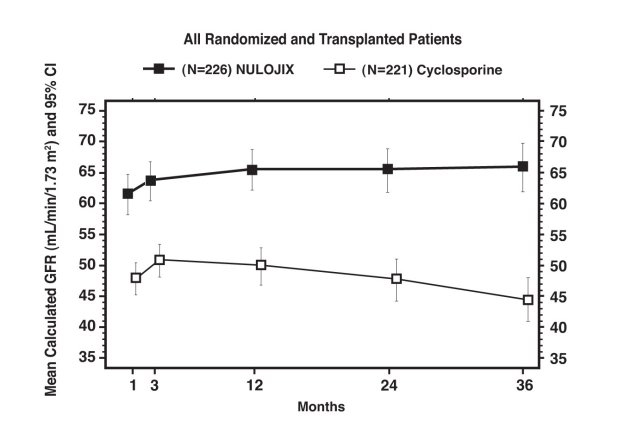
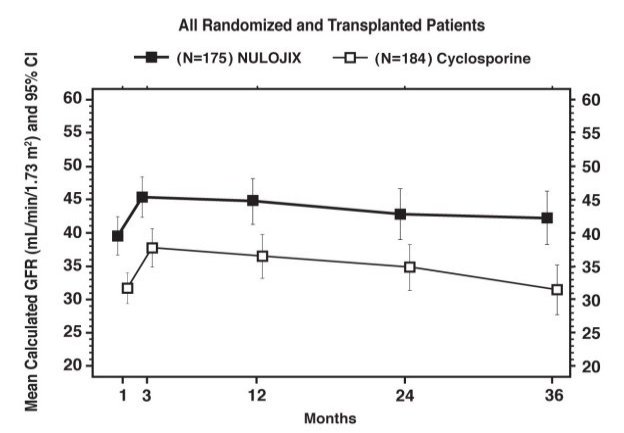
Table 7 summarizes the results of Study 1 following one and three years of treatment with the NULOJIX recommended dosage regimen and the cyclosporine control regimen. Efficacy failure at one year was defined as the occurrence of biopsy proven acute rejection (BPAR), graft loss, death, or lost to follow-up. BPAR was defined as histologically confirmed acute rejection by a central pathologist on a biopsy done for any reason, whether or not accompanied by clinical signs of rejection. Patient and graft survival was also assessed separately.
Table 7: Efficacy Outcomes by Years 1 and 3 for Study 1: Recipients of Living and Standard Criteria Deceased Donor Kidneys| Parameter | NULOJIX
Recommended Regimen
N=226
n (%) | Cyclosporine
(CSA)
N=221
n (%) | NULOJIX-CSA
(97.3% CI) |
|---|
a Patients may have experienced more than one event.
b Patients known to be alive with a functioning graft. |
Efficacy Failure by Year 1 | 49 (21.7) | 37 (16.7) | 4.9 (−3.3, 13.2) |
Components of Efficacy Failurea | | | |
Biopsy Proven Acute Rejection | 45 (19.9) | 23 (10.4) | |
Graft Loss | 5 (2.2) | 8 (3.6) | |
Death | 4 (1.8) | 7 (3.2) | |
Lost to follow-up | 0 | 1 (0.5) | |
Efficacy Failure by Year 3 | 58 (25.7) | 57 (25.8) | −0.1 (−9.3, 9) |
Components of Efficacy Failurea | | | |
Biopsy Proven Acute Rejection | 50 (22.1) | 31 (14) | |
Graft Loss | 9 (4) | 10 (4.5) | |
Death | 10 (4.4) | 15 (6.8) | |
Lost to follow-up | 2 (0.9) | 5 (2.3) | |
Patient and graft survivalb | | | |
Year 1 | 218 (96.5) | 206 (93.2) | 3.2 (−1.5, 8.4) |
Year 3 | 206 (91.2) | 192 (86.9) | 4.3 (−2.2, 10.8) |
In Study 1, the rate of BPAR at one year and three years was higher in patients treated with the NULOJIX recommended regimen than the cyclosporine regimen. Of the patients who experienced BPAR with NULOJIX, 70% experienced BPAR by Month 3, and 84% experienced BPAR by Month 6. By three years, recurrent BPAR occurred with similar frequency across treatment groups (<3%). The component of BPAR determined by biopsy only (subclinical protocol-defined acute rejection) was 5% in both treatment groups.
Patients treated with the NULOJIX recommended regimen experienced episodes of BPAR classified as Banff grade IIb or higher (6% [14/226] at one year and 7% [15/226] at three years) more frequently compared to patients treated with the cyclosporine regimen (2% [4/221] at one year and 2% [5/221] at three years). Also, T cell-depleting therapy was used more frequently to treat episodes of BPAR in NULOJIX-treated patients (10%; 23/226) compared to cyclosporine-treated patients (2%; 5/221). At Month 12, the difference in mean calculated glomerular filtration rate (GFR) between patients with and without history of BPAR was 19 mL/min/1.73 m2 among NULOJIX-treated patients compared to 7 mL/min/1.73 m2 among cyclosporine-treated patients. By three years, 22% (11/50) of NULOJIX-treated patients with a history of BPAR experienced graft loss and/or death compared to 10% (3/31) of cyclosporine-treated patients with a history of BPAR; at that time point, 10% (5/50) of NULOJIX-treated patients experienced graft loss and 12% (6/50) of NULOJIX-treated patients had died following an episode of BPAR, whereas 7% (2/31) of cyclosporine-treated patients experienced graft loss and 7% (2/31) of cyclosporine-treated patients had died following an episode of BPAR. The overall prevalence of donor-specific antibodies was 5% and 11% for the NULOJIX recommended regimen and cyclosporine, respectively, up to 36 months post-transplant.
While the difference in GFR in patients with BPAR versus those without BPAR was greater in patients treated with NULOJIX than cyclosporine, the mean GFR following BPAR was similar in NULOJIX (49 mL/min/1.73 m2) and cyclosporine treated patients (43 mL/min/1.73 m2) at one year. The relationship between BPAR, GFR, and patient and graft survival is unclear due to the limited number of patients who experienced BPAR, differences in renal hemodynamics (and, consequently, GFR) across maintenance immunosuppression regimens, and the high rate of switching treatment regimens after BPAR.
Table 9 summarizes the results of Study 2 following one and three years of treatment with the NULOJIX recommended dosage regimen and the cyclosporine control regimen. Efficacy failure at one year was defined as the occurrence of biopsy proven acute rejection (BPAR), graft loss, death, or lost to follow-up. BPAR was defined as histologically confirmed acute rejection by a central pathologist on a biopsy done for any reason, whether or not accompanied by clinical signs of rejection. Patient and graft survival was also assessed.
Table 9: Efficacy Outcomes by Years 1 and 3 for Study 2: Recipients of Extended Criteria Donor Kidneys| Parameter | NULOJIX
Recommended Regimen
N=175
n (%) | Cyclosporine
(CSA)
N=184
n (%) | NULOJIX-CSA
(97.3% CI) |
|---|
a Patients may have experienced more than one event.
b Patients known to be alive with a functioning graft. |
Efficacy Failure by Year 1 | 51 (29.1) | 52 (28.3) | 0.9 (−9.7, 11.5) |
Components of Efficacy Failurea | | | |
Biopsy Proven Acute Rejection | 37 (21.1) | 34 (18.5) | |
Graft Loss | 16 (9.1) | 20 (10.9) | |
Death | 5 (2.9) | 8 (4.3) | |
Lost to follow-up | 0 | 2 (1.1) | |
Efficacy Failure by Year 3 | 63 (36) | 68 (37) | −1.0 (−12.1, 10.3) |
Components of Efficacy Failurea | | | |
Biopsy Proven Acute Rejection | 42 (24) | 42 (22.8) | |
Graft Loss | 21 (12) | 23 (12.5) | |
Death | 15 (8.6) | 17 (9.2) | |
Lost to follow-up | 1 (0.6) | 5 (2.7) | |
Patient and graft survivalb | | | |
Year 1 | 155 (88.6) | 157 (85.3) | 3.2 (−4.8, 11.3) |
Year 3 | 143 (81.7) | 143 (77.7) | 4.0 (−5.4, 13.4) |
In Study 2, the rate of BPAR at one year and three years was similar in patients treated with NULOJIX and cyclosporine. Of the patients who experienced BPAR with NULOJIX, 62% experienced BPAR by Month 3, and 76% experienced BPAR by Month 6. By three years, recurrent BPAR occurred with similar frequency across treatment groups (<3%). The component of BPAR determined by biopsy only (subclinical protocol-defined acute rejection) was 5% in both treatment groups.
A similar proportion of patients in the NULOJIX recommended regimen group experienced BPAR classified as Banff grade IIb or higher (5% [9/175] at one year and 6% [10/175] at three years) compared to patients treated with the cyclosporine regimen (4% [7/184] at one year and 5% [9/184] at three years). Also, T cell-depleting therapy was used with similar frequency to treat any episode of BPAR in NULOJIX-treated patients (5% or 9/175) compared to cyclosporine-treated patients (4% or 7/184). At Month 12, the difference in mean calculated GFR between patients with and without a history of BPAR was 10 mL/min/1.73 m2 among NULOJIX-treated patients compared to 14 mL/min/1.73 m2 among cyclosporine-treated patients. By three years, 24% (10/42) of NULOJIX-treated patients with a history of BPAR experienced graft loss and/or death compared to 31% (13/42) of cyclosporine-treated patients with a history of BPAR; at that time point, 17% (7/42) of NULOJIX-treated patients experienced graft loss and 14% (6/42) of NULOJIX-treated patients had died following an episode of BPAR, whereas 19% (8/42) of cyclosporine-treated patients experienced graft loss and 19% (8/42) of cyclosporine-treated patients had died following an episode of BPAR. The overall prevalence of donor-specific antibodies was 6% and 15% for the NULOJIX recommended regimen and cyclosporine, respectively, up to 36 months post-transplant.
The mean GFR following BPAR was 36 mL/min/1.73 m2 in NULOJIX patients and 24 mL/min/1.73 m2 in cyclosporine-treated patients at one year. The relationship between BPAR, GFR, and patient and graft survival is unclear due to the limited number of patients who experienced BPAR, differences in renal hemodynamics (and, consequently, GFR) across maintenance immunosuppression regimens, and the high rate of switching treatment regimens after BPAR.