The efficacy and safety of SOTYKTU were assessed in two multicenter randomized, double-blind, placebo-controlled trials (Trial PsA-1, [NCT04908202] and Trial PsA-2, [NCT04908189]) in subjects 18 years and older with active psoriatic arthritis (PsA) (≥3 swollen joints, ≥3 tender joints, a C-reactive protein (CRP) level of ≥3 mg/L) and with active or a history of plaque psoriasis. Subjects in both trials at baseline had a diagnosis of psoriatic arthritis for at least 3 months and met the Classification criteria for Psoriatic Arthritis (CASPAR) at screening. In Trial PsA-1, subjects also had presence of at least one bone erosion on X-ray of hands and/or feet. Trial PsA-2 included an active safety reference treatment arm (apremilast).
The efficacy of SOTYKTU was assessed in 1,294 subjects up to Week 16. Trial PsA-1 evaluated 670 subjects who were randomized to placebo or SOTYKTU 6 mg once daily. Trial PsA-2 evaluated 624 subjects who were randomized to placebo or SOTYKTU 6 mg once daily. In addition, 105 subjects were randomized to apremilast 30 mg twice daily in Trial PsA-2. In both trials, subjects randomized to placebo were switched to SOTYKTU at Week 16.
Baseline Characteristics
Across the two trials, the mean age was 51 years, the mean weight was 84 kg, 49% of subjects were male, 23% were Hispanic or Latino, 78% were White, and 0.4% were Black and 11% were Asian. In the two trials, subjects had a median duration of disease of 4.0 years and the majority of subjects had polyarthritis (76%) followed by oligoarthritis (14%). 8% of subjects had predominant distal interphalangeal joint involvement, while 16% had peripheral plus psoriatic spondylarthritis. Dactylitis and enthesitis were present in 31% and 49% of subjects respectively. 49% had psoriasis skin involvement that was ≥3% body surface area (BSA) and a Static Physician’s Global Assessment (sPGA) of at least 2.
In the two trials, the majority of subjects were naïve to biologic treatment and had experienced an inadequate response, intolerance or loss of response to nonsteroidal anti-inflammatory drugs (NSAIDs), conventional synthetic DMARDs (csDMARDs), or apremilast. In addition, Trial PsA-2 included anti-TNF alpha-experienced subjects. In the two trials, 56% of subjects were taking concomitant methotrexate (MTX). 10% were taking other concomitant csDMARDs, and 34% were not taking csDMARDs.
Endpoints and Results
The primary endpoint in both trials were the percentage of subjects who achieved an American College of Rheumatology (ACR) 20 response at Week 16.
ACR Response
In both trials, treatment with SOTYKTU resulted in statistically significant improvement in disease activity, as measured by ACR 20, compared to placebo at Week 16 (see Table 4). Improvement in disease activity was also demonstrated as measured by ACR 50/70 compared with placebo at Week 16. In both trials, ACR20 responses at Week 16 were consistent regardless of concomitant DMARD use, age, gender, race, or baseline disease characteristics in patients receiving SOTYKTU. In Trial PsA-2, similar ACR response rates were seen regardless of prior anti-TNF alpha therapy.
Table 4: Efficacy Results in Adults with Active Psoriatic Arthritis (NRIa) | Trial PsA-1 | Trial PsA-2 |
Endpoint | SOTYKTU (N = 336) | Placebo (N = 334) | Difference from Placebo (95% CI) | SOTYKTU (N = 312) | Placebo (N = 312) | Difference from Placebo (95% CI) |
ACR20 Response |
Week 16 (%) | 54b | 34 | 20 (13, 27) | 54 b | 39 | 15 (7, 23) |
ACR50 Response |
Week 16 (%) | 25 | 14 | 11(5, 17) | 29 | 16 | 13 (6, 19) |
ACR70 Response |
Week 16 (%) | 12 | 5 | 6 (2, 10) | 11 | 5 | 5 (1, 9) |
ACR 20 [or 50 or 70]: American College of Rheumatology ≥20% (or ≥50% or ≥70%) improvement N is number of randomized subjects a NRI = Non-Responder Imputation b Multiplicity-controlled p≤0.0002, SOTYKTU vs. placebo comparison |
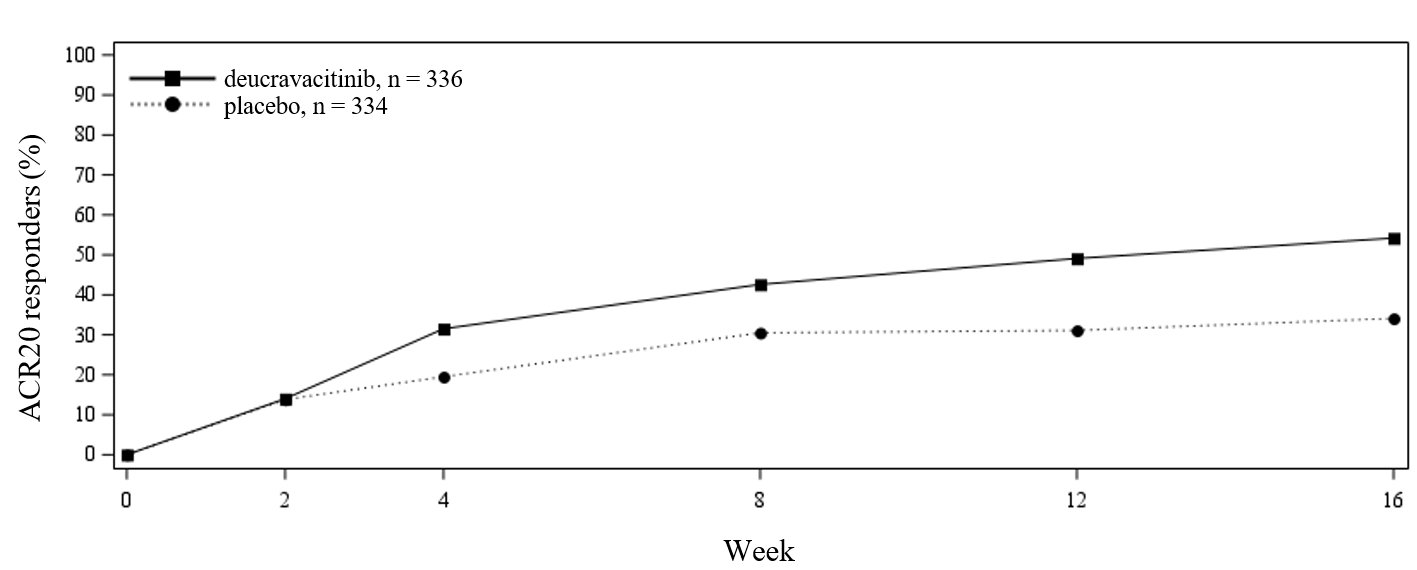
Improvements in ACR 20 and individual ACR components from baseline were observed in subjects treated with SOTYKTU at Week 16. The percentage of subjects achieving ACR20 responses in Trial PsA-1 by visit through Week 16 is shown in Figure 1. Similar responses were seen in Trial PsA-2 up to Week 16. Results of the components of the ACR response criteria for both trials are shown in Table 5.
Figure 1: Percent of Subjects Achieving ACR20 Responses in Trial PsA-1 through Week 16
Figure 1 Percent Of Subjects Achieving Acr20 Responses In Trial Psa-1 Through Week 16 (Image 01)
Table 5: Mean Change from Baseline in ACR Component Scores in Adults with Active Psoriatic Arthritis at Week 16 in Trials PsA-1 and PsA-2 | Trial PsA–1 | Trial PsA–2 |
Placebo (N = 334) | SOTYKTU (N = 336) | Placebo (N = 312) | SOTYKTU (N = 312) |
Number of Swollen Joints (0-66) |
Baseline | 10.3 | 10.7 | 9.6 | 9.2 |
Mean change at Week 16 | -3.9 | -6.4 | -4 | -5.3 |
Number of Tender Joints (0-68) |
Baseline | 19 | 19 | 16.6 | 15.2 |
Mean change at Week 16 | -6.5 | -9.2 | -5.8 | -8.1 |
Patient’s Assessment of Pain a (Pain VAS) |
Baseline | 62.6 | 64.5 | 60.2 | 58.9 |
Mean change at Week 16 | -12.6 | -23.5 | -13.8 | -20.5 |
Physician’s Global Assessment (PGA) |
Baseline | 62.5 | 62.3 | 60.1 | 59.7 |
Mean change at Week 16 | -18 | -30.4 | -21.5 | -29.8 |
Patient’s Global Assessment (PtGA) |
Baseline | 63.4 | 63.6 | 61.2 | 58.7 |
Mean change at Week 16 | -13.4 | -22.1 | -13.5 | -20 |
Health Assessment Questionnaire – Disability index (HAQ-DI) b |
Baseline | 1.3 | 1.4 | 1.2 | 1.1 |
Mean change at Week 16 | -0.2 | -0.4 | -0.2 | -0.3 |
High sensitivity C-Reactive Protein (hsCRP) (mg/L) |
Baseline | 14.2 | 12.9 | 12.2 | 11.7 |
Mean change at Week 16 | -1.9 | -2.7 | -0.6 | -3.3 |
N is number of randomized subjects a Visual analog scale; 0=best, 100=worst (PGA/PtGA/pain) b Disability Index of the Health Assessment Questionnaire; 0 = no difficulty to 3 = inability to perform, measures the patient’s ability to perform the following: dressing, arising, eating, walking, hygiene, reaching, gripping, and activities of daily living. |
In subjects with coexistent plaque psoriasis receiving SOTYKTU, statistically significant improvement was observed, relative to placebo, as measured by the Psoriasis Area Severity Index (PASI 75) at Week 16.
Physical Function Response
In both trials, subjects treated with SOTYKTU showed a statistically significant improvement from baseline in physical function as measured by the Health Assessment Questionnaire Disability Index (HAQ-DI) compared with placebo. The adjusted mean difference (95% CI) from placebo in HAQ-DI change from baseline at Week 16 was -0.17 (-0.24, -0.09) in Trial PsA-1 and -0.11 (-0.18, -0.04) in Trial PsA-2. The proportion of HAQ-DI responders (≥ 0.35 improvement from baseline) at Week 16 in Trial PsA-1 was 51% in the SOTYKTU group and 39% in the placebo group and in Trial PsA-2 was 49% in the SOTYKTU group and 43% in the placebo group.
Other Health-Related Outcomes
Health-related quality of life was assessed by the SF-36. Subjects treated with SOTYKTU showed improvements in SF-36 Physical Component Summary (PCS) score at Week 16 compared to placebo. There were also improvements in all four SF-36 (PCS) domain scale scores: physical functioning, role-physical, bodily-pain, and general health.