The percent of ORENCIA-treated patients achieving ACR 20, 50, and 70 responses and major clinical response in Studies I, III, IV, and VI are shown in Table 6. ORENCIA-treated patients had higher ACR 20, 50, and 70 response rates at 6 months compared to placebo-treated patients. Month 6 ACR response rates in Study II for the 10 mg/kg group were similar to the ORENCIA group in Study III.
In Studies III and IV, improvement in the ACR 20 response rate versus placebo was observed within 15 days in some patients and within 29 days versus methotrexate in Study VI. In Studies II, III, and VI, ACR response rates were maintained to 12 months in ORENCIA-treated patients. ACR responses were maintained up to three years in the open-label extension of Study II. In Study III, ORENCIA-treated patients experienced greater improvement than placebo-treated patients in morning stiffness.
In Study VI, a greater proportion of patients treated with ORENCIA plus methotrexate achieved a low level of disease activity as measured by a DAS28-CRP less than 2.6 at 12 months compared to those treated with methotrexate plus placebo (Table 6). Of patients treated with ORENCIA plus methotrexate who achieved DAS28-CRP less than 2.6, 54% had no active joints, 17% had one active joint, 7% had two active joints, and 22% had three or more active joints, where an active joint was a joint that was rated as tender or swollen or both.
In Study SC-1, the main outcome measure was ACR 20 at 6 months. The pre-specified non-inferiority margin was a treatment difference of −7.5%. As shown in Table 6, the study demonstrated non-inferiority of ORENCIA administered subcutaneously to intravenous infusions of ORENCIA with respect to ACR 20 responses up to 6 months of treatment. ACR 50 and 70 responses are also shown in Table 6. No major differences in ACR responses were observed between intravenous and subcutaneous treatment groups in subgroups based on weight categories (less than 60 kg, 60 to 100 kg, and more than 100 kg; data not shown).
Table 6: Clinical Responses in Controlled Trials | Percent of Patients |
|---|
| Intravenous Administration | Subcutaneous Administration |
|---|
| | Inadequate Response to
DMARDs | Inadequate
Response to
Methotrexate
(MTX) | Inadequate Response to
TNF Blocking Agent | MTX-Naive | Inadequate
Response to MTX |
|---|
| | Study I | Study III | Study IV | Study VI | Study SC-1 |
|---|
* p<0.05, ORENCIA (ORN) vs placebo (PBO) or MTX.
† p<0.01, ORENCIA vs placebo or MTX.
‡ p<0.001, ORENCIA vs placebo or MTX.
§ 95% CI: −4.2, 4.8 (based on prespecified margin for non-inferiority of −7.5%).
a 10 mg/kg.
b Dosing based on weight range [see Dosage and Administration (2.1)].
c Major clinical response is defined as achieving an ACR 70 response for a continuous 6-month period.
d Refer to text for additional description of remaining joint activity.
e Per protocol data is presented in table. For ITT; n=736, 721 for SC and IV ORENCIA, respectively. |
Response Rate | ORNa
n=32 | PBO
n=32 | ORNb
+MTX
n=424 | PBO
+MTX
n=214 | ORNb +
DMARDs
n=256 | PBO +
DMARDs
n=133 | ORNb
+MTX
n=256 | PBO
+MTX
n=253 | ORNe
SC
+MTX
n=693 | ORNe
IV
+MTX
n=678 |
ACR 20 | | | | | |
Month 3 | 53% | 31% | 62%‡ | 37% | 46%‡ | 18% | 64%* | 53% | 68% | 69% |
Month 6 | NA | NA | 68%‡ | 40% | 50%‡ | 20% | 75%† | 62% | 76%§ | 76% |
Month 12 | NA | NA | 73%‡ | 40% | NA | NA | 76%‡ | 62% | NA | NA |
ACR 50 | | | | | |
Month 3 | 16% | 6% | 32%‡ | 8% | 18%† | 6% | 40%‡ | 23% | 33% | 39% |
Month 6 | NA | NA | 40%‡ | 17% | 20%‡ | 4% | 53%‡ | 38% | 52% | 50% |
Month 12 | NA | NA | 48%‡ | 18% | NA | NA | 57%‡ | 42% | NA | NA |
ACR 70 | | | | | |
Month 3 | 6% | 0 | 13%‡ | 3% | 6%* | 1% | 19%† | 10% | 13% | 16% |
Month 6 | NA | NA | 20%‡ | 7% | 10%† | 2% | 32%† | 20% | 26% | 25% |
Month 12 | NA | NA | 29%‡ | 6% | NA | NA | 43%‡ | 27% | NA | NA |
Major
Clinical
Responsec | NA | NA | 14%‡ | 2% | NA | NA | 27%‡ | 12% | NA | NA |
DAS28-CRP
<2.6d | | | | | |
Month 12 | NA | NA | NA | NA | NA | NA | 41%‡ | 23% | NA | NA |
The results of the components of the ACR response criteria for Studies III, IV, and SC-1 are shown in Table 7 (results at Baseline [BL] and 6 months [6 M]). In ORENCIA-treated patients, greater improvement was seen in all ACR response criteria components through 6 and 12 months than in placebo-treated patients.
Table 7: Components of ACR Responses at 6 Months| | Intravenous Administration | Subcutaneous Administration |
|---|
| | Inadequate Response to
Methotrexate (MTX) | Inadequate Response to
TNF Blocking Agent | Inadequate Response to
MTX |
|---|
| Study III | Study IV | Study SC-1c |
|---|
† p<0.01, ORENCIA (ORN) vs placebo (PBO), based on mean percent change from baseline.
‡ p<0.001, ORENCIA vs placebo, based on mean percent change from baseline.
a Visual analog scale: 0 = best, 100 = worst.
b Health Assessment Questionnaire: 0 = best, 3 = worst; 20 questions; 8 categories: dressing and grooming, arising, eating,
walking, hygiene, reach, grip, and activities.
c SC-1 is a non-inferiority study. Per protocol data is presented in table. |
| ORN
+MTX
n=424 | PBO
+MTX
n=214 | ORN
+DMARDs
n=256 | PBO
+DMARDs
n=133 | ORN SC
+MTX
n=693 | ORN IV
+MTX
n=678 |
Component
(median) | BL | 6 M | BL | 6 M | BL | 6 M | BL | 6 M | BL | 6 M | BL | 6 M |
Number of
tender joints
(0-68) | 28 | 7‡ | 31 | 14 | 30 | 13‡ | 31 | 24 | 27 | 5 | 27 | 6 |
Number of
swollen joints
(0-66) | 19 | 5‡ | 20 | 11 | 21 | 10‡ | 20 | 14 | 18 | 4 | 18 | 3 |
Paina | 67 | 27‡ | 70 | 50 | 73 | 43† | 74 | 64 | 71 | 25 | 70 | 28 |
Patient global
assessmenta | 66 | 29‡ | 64 | 48 | 71 | 44‡ | 73 | 63 | 70 | 26 | 68 | 27 |
Disability
indexb | 1.75 | 1.13‡ | 1.75 | 1.38 | 1.88 | 1.38‡ | 2.00 | 1.75 | 1.88 | 1.00 | 1.75 | 1.00 |
Physician
global assessmenta | 69 | 21‡ | 68 | 40 | 71 | 32‡ | 69 | 54 | 65 | 16 | 65 | 15 |
CRP (mg/dL) | 2.2 | 0.9‡ | 2.1 | 1.8 | 3.4 | 1.3‡ | 2.8 | 2.3 | 1.6 | 0.7 | 1.8 | 0.7 |
The percent of patients achieving the ACR 50 response for Study III by visit is shown in Figure 1. The time course for the ORENCIA group in Study VI was similar to that in Study III.
Figure 1: Percent of Patients Achieving ACR 50 Response by Visit* (Study III)
*The same patients may not have responded at each time point.
The percent of patients achieving the ACR 50 response for Study SC-1 in the ORENCIA subcutaneous (SC) and intravenous (IV) treatment arms at each treatment visit was as follows: Day 15—SC 3%, IV 5%; Day 29—SC 11%, IV 14%; Day 57—SC 24%, IV 30%; Day 85—SC 33%, IV 38%; Day 113—SC 39%, IV 41%; Day 141—SC 46%, IV 47%; Day 169—SC 51%, IV 50%.
A higher proportion of patients achieved an ACR20 response after treatment with ORENCIA 10 mg/kg IV (weight range-based dosing as described above) or 125 mg SC compared to placebo at Week 24. Responses were seen regardless of prior TNFi treatment and regardless of concomitant non-biologic DMARD treatment. The percent of patients achieving ACR 20, 50, or 70 responses in Studies PsA-I and PsA-II are presented in Table 10 below.
Table 10: Proportion of Patients With ACR Responses at Week 24 in Studies PsA-I and PsA-IIa| | PsA-I | PsA-II |
|---|
* p<0.05 versus placebo
a Patients who had less than 20% improvement in tender or swollen joint counts at Week 16 met escape criteria and were considered non-responders.
b Weight range-based dosing (as described above). |
| ORENCIA
10mg/kg IVb
N=40 |
Placebo
N=42
| ORENCIA 125 mg
SC
N=213 |
Placebo
N=211
|
ACR 20 | 47.5%* | 19.0% | 39.4%* | 22.3% |
ACR 50 | 25.0% | 2.4% | 19.2% | 12.3% |
ACR 70 | 12.5% | 0% | 10.3% | 6.6% |
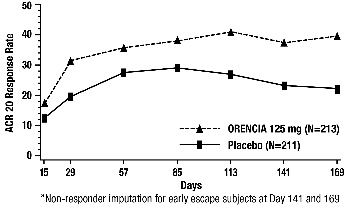
The percentage of patients in PsA-II achieving ACR20 response through Week 24 is shown below in Figure 2.
Figure 2: Percent of Patients Achieving ACR20 Responsea in PsA-II Study Through Week 24 (Day 169)

Orencia Figure 2 % Of Patients Achieving Acr20 (Orencia Fig2)
Results were generally consistent across the ACR components in Study PsA-I and PsA-II.
Improvements in enthesitis and dactylitis were seen with ORENCIA treatment at Week 24 in both PsA-I and PsA-II.