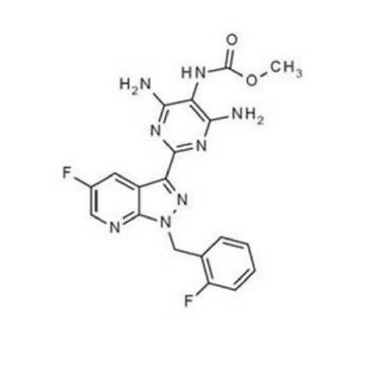
Vericiguat steady-state mean (coefficient of variation %) Cmax is 350 mcg/L (29%) and AUC is 6,680 mcg•h/L (33.9%) following administration of VERQUVO 10 mg in patients with heart failure. Vericiguat pharmacokinetics increases in a slightly less than dose-proportional manner. Vericiguat accumulates in plasma up to 155-171% and reaches steady-state after approximately 6 days.
Absorption
The absolute bioavailability of vericiguat is 93% when taken with food. Results were comparable when VERQUVO was administered orally as a whole tablet or as a crushed tablet in water.
Effect of Food
Administration of VERQUVO 10 mg with a high-fat, high-calorie meal increases Tmax from about 1 hour (fasted) to about 4 hours (fed), reduces PK variability, and increases vericiguat AUC by 44% and Cmax by 41% compared with administration in the fasted state. Similar results were obtained when VERQUVO was administered with a low-fat, low-calorie meal when compared to administration with a high-fat, high-calorie meal.
Distribution
The mean steady-state volume of distribution of vericiguat is approximately 44 L in healthy subjects. Protein binding (primarily to serum albumin) of vericiguat is about 98%.
Elimination
The half-life of vericiguat is 30 hours in patients with heart failure. Clearance in healthy subjects is 1.6 L/h.
Metabolism
Vericiguat primarily undergoes glucuronidation by UGT1A9 and to a lesser extent, by UGT1A1 to form an inactive N-glucuronide metabolite. CYP-mediated metabolism is a minor clearance pathway (<5%).
Excretion
Following oral administration of radiolabeled vericiguat to healthy subjects, approximately 53% of the dose was excreted in urine (primarily as inactive metabolite) and 45% in feces (primarily as unchanged drug).
Specific Populations
Renal Impairment
In patients with heart failure with mild, moderate, and severe renal impairment not requiring dialysis, the mean exposure (AUC) of vericiguat was increased by 5%, 13%, and 20% respectively, compared to patients with normal renal function. These differences in exposure are not considered clinically relevant. The pharmacokinetics of vericiguat have not been studied in patients with eGFR <15 mL/min/1.73m2 at treatment initiation or on dialysis [see Use in Specific Populations (8.6)].
In a dedicated clinical pharmacology study, otherwise healthy participants with mild, moderate, and severe renal impairment, had 8%, 73%, and 143% respectively, higher mean vericiguat exposure (unbound AUC normalized for body weight) after a single dose compared to healthy controls.
The apparent discrepancy of the effect of renal impairment on vericiguat exposure between the dedicated clinical pharmacology study and the analysis in patients with heart failure may be attributed to differences in study design and size.
Hepatic Impairment
No clinically relevant increases in exposure (unbound AUC normalized for body weight) were observed for individuals with mild and moderate hepatic impairment (Child Pugh A-B). Mean vericiguat exposures were 21% and 47% higher, respectively, compared to individuals with normal hepatic function. The pharmacokinetics of vericiguat have not been studied in patients with severe hepatic impairment (e.g., Child-Pugh C) [see Use in Specific Populations (8.7)].
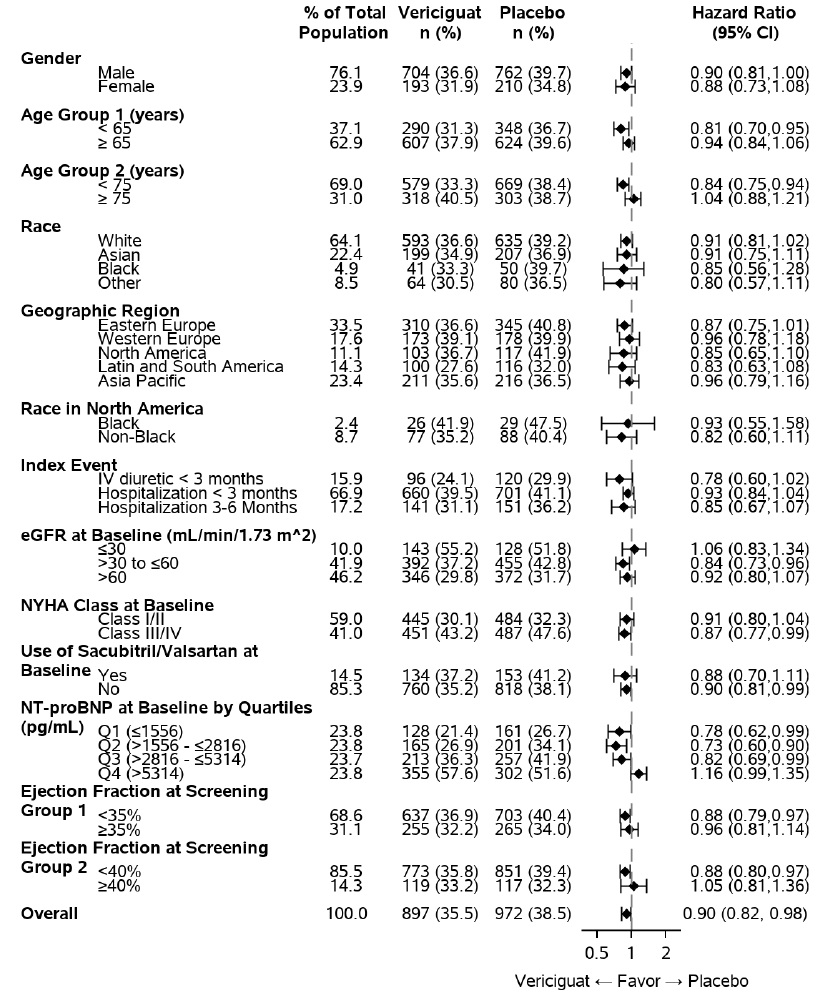
No clinically significant differences in the pharmacokinetics of vericiguat were observed based on age, sex, race/ethnicity (Black, White, Asian, Hispanic, Latino), body weight, or baseline NT-proBNP. Effects of specific populations on the pharmacokinetics of vericiguat are shown in Figure 1.
| Figure 1: Pharmacokinetics of Vericiguat in Specific Populations |
|
Drug Interaction Studies
Clinical Studies
Effects of Other Drugs on the Pharmacokinetics of Vericiguat
Vericiguat is less soluble at neutral than at acidic pH. Pre- and co-treatment with drugs that increase gastric pH, such as proton pump inhibitors or antacids, decrease vericiguat exposure (AUC) by about 30% following fasted administration. However, co-treatment with drugs that increase gastric pH did not affect vericiguat exposure in patients with heart failure when vericiguat was taken as directed with food.
No clinically significant differences on vericiguat pharmacokinetics were observed with co-administration of mefenamic acid (UGT1A9 inhibitor), ketoconazole (multi-pathway CYP and transporter inhibitor), rifampin (inducer), digoxin (P-gp substrate), warfarin, aspirin, sildenafil, or the combination of sacubitril/valsartan in healthy subjects. No clinically significant differences on vericiguat pharmacokinetics were predicted with co-administration of atazanavir (UGT1A1 inhibitor).
Effects of Vericiguat on the Pharmacokinetics of Other Drugs
No clinically significant differences on the pharmacokinetics of midazolam (CYP3A substrate), digoxin (P-gp substrate), warfarin, sildenafil, or the combination of sacubitril (including metabolite LBQ657)/valsartan were observed when coadministered with VERQUVO in healthy subjects.
In Vitro Studies
Cytochrome P450 (CYP) enzymes: vericiguat is not an inhibitor of CYP1A2, 2B6, 2C8, 2C9, 2C19, or 2D6, 3A4 and is not an inducer of CYP1A2, 2B6, or 3A4.
Uridine diphosphate (UDP)-glucuronosyl transferase (UGT) enzymes: vericiguat is not an inhibitor of UGT1A1, 1A4, 1A6, 1A9, 2B4, or 2B7.
Transporter systems: vericiguat is a substrate of P-glycoprotein (P-gp) and breast cancer resistance protein (BCRP) but is not a substrate of organic cation transporter (OCT1) or organic anion transporting polypeptides (OATP1B1 and OATP1B3). Vericiguat is not an inhibitor of P-gp, BCRP, BSEP, OATP1B1/1B3, OAT1, OAT3, OCT1, OCT2, MATE1, or MATE2K.