Mechanism of Action
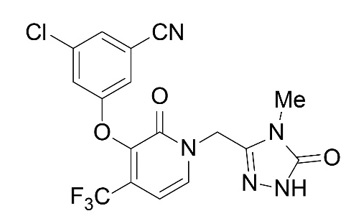
Doravirine
Doravirine is a pyridinone non-nucleoside reverse transcriptase inhibitor of HIV-1 and inhibits HIV-1 replication by non-competitive inhibition of HIV-1 reverse transcriptase (RT). The inhibitory concentration at 50% (IC50) of doravirine for RNA-dependent DNA polymerization of recombinant wild-type HIV-1 RT in a biochemical assay was 12.2±2.0 nM (n=3). Doravirine does not inhibit the human cellular DNA polymerases α, β, and mitochondrial DNA polymerase γ.
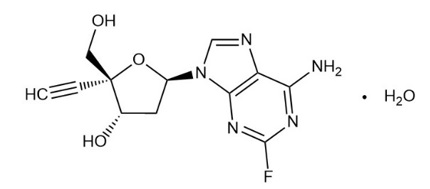
Islatravir
Islatravir is a deoxyadenosine nucleoside analog reverse transcriptase inhibitor. Islatravir is phosphorylated by cellular kinases to form the pharmacologically active islatravir-triphosphate. Islatravir-triphosphate inhibits reverse transcriptase (RT) following incorporation into the nascent viral DNA by blocking translocation (immediate chain termination) and by inducing structural changes in viral DNA that prevent further nucleotide incorporation (delayed chain termination). Islatravir-triphosphate inhibited HIV-1 RT in a biochemical assay with an IC50 value of 346 ± 59 nM (n=17). Islatravir-triphosphate does not inhibit human cellular DNA polymerase β and mitochondrial DNA polymerase γ. Islatravir-triphosphate shows weak inhibition of human DNA polymerase α in a biochemical assay (IC50 value = 29.6 µM).
Antiviral Activity in Cell Culture
The combination of doravirine and islatravir was not antagonistic with respect to antiviral activity in cell culture.
Doravirine
Doravirine exhibited an EC50 value of 12.0±4.4 nM against wild-type laboratory strains of HIV-1 when tested in the presence of 100% normal human serum using MT4-GFP reporter cells and a median EC50 value for HIV-1 subtype B primary isolates (n=118) of 4.1 nM (range: 1.0 nM-16.0 nM). Doravirine demonstrated antiviral activity against a broad panel of primary HIV-1 isolates (subtypes A, A1, AE, AG, B, BF, C, D, G, H) with EC50 values ranging from 1.2 nM to 10.0 nM.
Islatravir
Islatravir exhibited EC50 values <1 nM against wild-type laboratory strains of HIV-1 in MT-4 cells, PBMCs and monocyte-derived macrophages. Islatravir demonstrated antiviral activity against a panel of 50 primary HIV-1 isolates (subtypes A, A1, AE, AG, B, BF, C, D, F1, G, H) with EC50 values ranging from 2.4 nM to 6.9 nM. The median EC50 value against the subtype B isolates was 4.3 nM (range 3.0 nM-5.3 nM) (n=6).
Resistance
In Cell Culture
Doravirine
Doravirine-resistant strains were selected in cell culture starting from wild-type HIV-1 of different origins and subtypes, as well as NNRTI-resistant HIV-1. Observed emergent amino acid substitutions in RT included: V106A, V106I, V106M, V108I, H221Y, F227C, F227I, F227L, F227V, M230I, L234I, P236L, and Y318F. The V106A, V106M, V108I, H221Y, F227C, M230I, P236L, and Y318F substitutions conferred 3.4-fold to 70-fold reductions in susceptibility to doravirine. Y318F in combination with V106A, V106M, V108I, or F227C conferred greater decreases in susceptibility to doravirine than Y318F alone, which conferred a 10-fold reduction in susceptibility to doravirine.
Islatravir
In cell culture, M184I and M184V were the main amino acid substitutions selected in RT with islatravir in wild-type HIV-1 of different origins and subtypes. The M184I substitution conferred a reduction in islatravir susceptibility of 3- to 7-fold and the M184V substitution conferred a reduction in islatravir susceptibility of 4- to 10-fold. The following substitutions were also observed in islatravir selection experiments: M41L, L74I, V90I, A114S, I142V, A158T, C162Y, T165A or R, H221Y, and A400T. Although the A114S substitution alone conferred 2-fold decreased susceptibility to islatravir, when A114S was in combination with M184V and other substitutions (e.g., A114S/M184V, M41L/A114S/M184V, and M41L/A114S/M184V/A400T), islatravir had 38- to 65-fold decreased susceptibility. The other substitutions conferred a ≤2-fold decreased susceptibility to islatravir.
In Clinical Trials
In the IDVYNSO arm of Trial 051 (n=366), 5 participants had HIV-1 RNA ≥50 copies/mL at Week 48. Two participants had virologic failure with HIV-1 RNA >20,000 copies/mL at Week 4 and were ineligible for enrollment due to a prior history of virologic failure and/or doravirine resistance-associated substitutions. Both had NNRTI resistance-associated substitutions (A98A/G, K101A, K103K/N, V106V/I or M, Y188Y/L or L/W, F227L, and/or L228L/R), thymidine analog substitutions (many as mixtures with wild-type), and substitutions M184M/I/V or T at baseline. By Week 4, the baseline NNRTI resistance-associated substitutions and thymidine analog resistance substitutions had developed to full substitutions without mixtures with wild-type and were present with M184V or I/T. Phenotypic analysis showed resistance to doravirine with >74- to >93-fold reduced susceptibility and 8- to 25-fold reduced susceptibility to islatravir. Two other participants had no evidence of genotypic or phenotypic resistance emergence and one participant had all samples fail resistance testing.
There were no participants in the baseline ART group with HIV-1 RNA ≥50 copies/mL at Week 48 who had samples submitted for post-baseline resistance analysis.
In the IDVYNSO arm of Trial 052 (n=342), 5 participants had HIV-1 RNA ≥50 copies/mL at Week 48. One participant had resistance-associated substitutions T69T/S, K70K/R, K101K/E, K103K/N, and M184M/V at baseline and K103N, M184V, H221Y, M230L and L234I at Week 24. Phenotypic analysis at Week 24 showed resistance to doravirine with >104-fold reduced susceptibility and 7-fold reduced susceptibility to islatravir. Another participant, who had resistance-associated substitutions M41L, V106V/I, Y181Y/C, M184M/V, and T215E at baseline, had HIV-1 RNA <50 copies/mL at Week 60 and had no post-baseline resistance testing conducted. For the other 3 participants, there was no evidence of resistance post-baseline (one had no evidence of genotypic or phenotypic resistance, one had viral load below the assay cutoff for resistance testing, and one had failed resistance testing).
There were no participants in the BIC/FTC/TAF group with HIV-1 RNA ≥50 copies/mL at Week 48 who had samples submitted for post-baseline resistance analysis.
Baseline NNRTI and NRTI resistance-associated substitutions from virologic failure on previous ART regimens likely contributed to the treatment outcome (HIV-1 RNA ≥50 copies/mL) at Week 48 in 4 participants receiving IDVYNSO in Trial 051 and Trial 052, emphasizing the importance of having no prior virologic treatment failure before initiating IDVYNSO.
Presence of NNRTI Resistance-associated Substitutions and/or M184I, V, or T at Baseline
Of the 598 virologically-suppressed participants receiving IDVYNSO in Trial 051 and Trial 052 with resistance data at baseline and virologic data at Week 48, 152 (25%) had NNRTI resistance-associated substitutions and 41 (7%) had M184I, V or T at baseline. In the IDVYNSO groups, 4 participants who had NNRTI resistance-associated substitutions and M184I, V or T at baseline and 1 participant who had NNRTI resistance-associated substitutions only at baseline had HIV-1 RNA ≥50 copies/mL at Week 48. In the comparator groups in Trial 051 and Trial 052, none of the participants who had NNRTI resistance-associated substitutions and M184I, V or T at baseline and 2 participants who had NNRTI resistance-associated substitutions only at baseline had HIV-1 RNA ≥50 copies/mL at Week 48.
Cross-Resistance
Doravirine
Cross-resistance has been observed among NNRTIs. Treatment-emergent doravirine resistance-associated substitutions can confer cross resistance to efavirenz, etravirine, nevirapine, and rilpivirine. The treatment-emergent doravirine resistance-associated substitution Y318F alone did not confer reduced susceptibility to efavirenz, etravirine, or rilpivirine.
A panel of 96 diverse clinical isolates containing NNRTI resistance-associated substitutions was evaluated for susceptibility to doravirine. Clinical isolates containing the Y188L substitution alone or in combination with K103N or V106I, V106A in combination with G190A and F227L, or E138K in combination with Y181C and M230L showed greater than 100-fold reduced susceptibility to doravirine.
Doravirine maintained antiviral activity against variants containing NRTI resistance-associated substitutions M184I and M184V.
Islatravir
Islatravir was evaluated in cell culture against a panel of 94 diverse clinical isolates containing substitutions in HIV-1 RT for antiviral activity. The M184I and M184V substitutions conferred a 5-fold reduction in susceptibility to islatravir. Thymidine analog substitutions conferred 3- to 4-fold reductions in susceptibility to islatravir; variants with insertions at RT position 69 (69 Ins) conferred a 10-fold reduction in susceptibility to islatravir. The addition of M184I or V substitutions in variants containing thymidine analog substitutions or 69 ins reduced islatravir susceptibility by 11- to 18-fold and 21-fold, respectively.
Islatravir maintained antiviral activity against variants containing NNRTI resistance-associated substitutions.