1 Indications And Usage
North American Coral Snake Antivenin (Equine) is indicated only for the treatment of envenomation caused by bites of North American coral snakes - Micrurus (including the eastern and Texas varieties).
The following Structured Product Label (SPL) was submitted to the FDA by Wyeth Pharmaceuticals Llc, A Subsidiary Of Pfizer Inc. for the product North American Coral Snake Antivenin (equine) (NDC 0008-0423). This document serves as the official prescribing information, containing essential scientific data and clinical materials required for healthcare providers and patients.
This specific version of the label includes detailed information regarding 1 indications and usage, 2 dosage and administration, 2.1 dose, other, 3 dosage forms and strengths, 4 contraindications, 5.1 hypersensitivity reactions, 6 adverse reactions, and other regulatory disclosures. Use the navigation below to review specific sections of the FDA submission.
North American Coral Snake Antivenin (Equine) is indicated only for the treatment of envenomation caused by bites of North American coral snakes - Micrurus (including the eastern and Texas varieties).
For intravenous use only.
Preparation
Administration
Risk Summary
There are no available human data that establish developmental toxicity related to the use of North American Coral Snake Antivenin (Equine). There are no available animal data informing the North American Coral Snake Antivenin (Equine)-associated risk. North American Coral Snake Antivenin (Equine) should be given to a pregnant woman only if clearly required. In the US general population, the background risk of major birth defects is 2–4% and of miscarriage is 15–20% in clinically recognized pregnancies.
Risk Summary
Lactation studies have not been conducted with North American Coral Snake Antivenin (Equine). It is not known whether North American Coral Snake Antivenin (Equine) is excreted in human milk. North American Coral Snake Antivenin (Equine) should be administered to lactating women only if clearly indicated. The developmental and health benefits of breastfeeding should be considered along with the mother's clinical need for North American Coral Snake Antivenin (Equine) and any potential adverse effects on the breastfed child from North American Coral Snake Antivenin (Equine) or from the underlying maternal condition.
U.S. Govt. License No. 3

Logo (Antivenin 01)
LAB-0726-6.0
Each package contains one single use vial with lyophilized North American Coral Snake Antivenin (Equine) for dilution with 10 mL of diluent (Sterile Water for Injection, USP). Contents of each reconstituted vial can neutralize approximately 250 mouse (Lethal Dose) LD50 or approximately 2 mg of M. f. fulvius venom.
Patients sensitive to North American Coral Snake Antivenin (Equine) or horse serum may develop anaphylaxis. Prior to intravenous North American Coral Snake Antivenin (Equine) administration, consider performing a proper skin test and modify therapy if indicated.
Consider the following precautions to manage hypersensitivity reactions:
Patients who receive a course of treatment with a foreign protein such as North American Coral Snake Antivenin (Equine) may become sensitized to it. Therefore, use caution when administering a repeat course of treatment with North American Coral Snake Antivenin (Equine) for a subsequent envenomation episode.
The most common adverse reactions observed after treatment with North American Coral Snake Antivenin (Equine) were anaphylaxis and serum sickness, vomiting, and abdominal pain. Because these reactions were reported voluntarily from a population of uncertain size, it is not always possible to estimate their frequency reliably or to establish a causal relationship to drug exposure.
Controlled clinical studies of safety and effectiveness in pediatric patients have not been conducted.
Potential cases of Coral Snake envenomation and subsequent treatment with North American Coral Snake Antivenin (Equine) have been reported in pediatric patients;2 adverse reactions included anaphylaxis (wheezing) requiring treatment with epinephrine, vomiting, and abdominal pain.
Specific studies in elderly patients have not been conducted.
North American Coral Snake Antivenin (Equine) is a sterile lyophilized powder for solution for injection containing serum globulins obtained by fractionating blood from healthy horses that have been immunized with eastern coral snake (Micrurus fulvius fulvius) venom. Prior to lyophilization, the product contains 0.25% phenol.
North American Coral Snake Antivenin (Equine) specifically binds to and neutralizes coral snake venom.
North American Coral Snake Antivenin (Equine) is standardized for potency in mice in terms of its LD50 neutralizing capacity per milliliter as determined by intravenous injection of a graded series of mixtures of North American Coral Snake Antivenin (Equine) with M. f. fulvius venom. Based on this assay system, the reconstituted contents of each vial (10 mL) will neutralize approximately 250 mouse LD50 or approximately 2 mg of M.f. fulvius venom.
The results of cross-neutralization tests indicate that North American Coral Snake Antivenin (Equine) will neutralize the venom of M. fulvius tenere (Texas coral snake) but will not neutralize the venom of Micruroides euryxanthus (Arizona or Sonoran coral snake).
There have been no well-controlled clinical studies of the use of North American Coral Snake Antivenin (Equine) in patients experiencing envenomation by the Eastern Coral Snake, however a retrospective analysis3 has been published of 387 coral snake exposures treated in a healthcare facility in Florida between 1998 and 2010, including 252 patients who were treated with North American Coral Snake Antivenin (Equine). Patients were managed according to different treatment strategies: (a) asymptomatic at ED arrival and treated empirically (n=134); (b) asymptomatic at ED arrival, but treatment withheld until symptoms appeared (n=106; 6 of the 106 received North American Coral Snake Antivenin (Equine) at some point; the remainder were never treated); (c) symptomatic at ED arrival and treated with North American Coral Snake Antivenin (Equine) (n=112); and (d) symptomatic at ED arrival but not treated with North American Coral Snake Antivenin (Equine) (n=35). The average number of vials administered to treated patients was 3.75 (range 1 – 20 vials); the 17 patients who received repeat treatment were administered 8.3 vials, on average. There was no reported usage of foreign antivenom or acetylcholinesterase inhibitors in this case series. The 387 patients were assessed for clinical outcomes, as shown in Table 1. Outcomes codes range from full recovery with no residual effects ("No Effect") to less than full recovery with significant residual effects ("Major"). Empiric treatment of asymptomatic patients resulted in more 'moderate' and 'major' outcomes compared to withholding treatment until symptoms appeared (p<.001), however, the patients were not randomized and selection biases could have affected this result.
| Treatment Strategy | Empiric (N = 134) | Withhold (N = 106) | Symptomatic with AV (N = 112) | Symptomatic without AV (N = 35) |
|---|---|---|---|---|
| ADR, adverse drug reaction; AV, antivenom; Avg, average; LOS, length of stay; ICU, intensive care unit. | ||||
| Primary outcome | ||||
| Endotracheal intubation (%) | 3 (2.2) | 1 (0.94) | 7 (6.25) | 0 (0) |
| Secondary outcomes | ||||
| Days intubated Avg. (SD) | 5.67 (2.89) | 24 (N/A) | 8 (6.22) | 0 (0) |
| ICU admission (%) p < 0.01 between empiric and withhold strategies. | 97 (72.39) | 49 (46.23) | 90 (80.36) | 9 (25.71) |
| ICU LOS Avg.(SD) | 1.5 (1.18) | 1.73 (3.28) | 2.25 (3.35) | 1.3 (0.5) |
| Total LOS Avg.(SD) | 1.58 (1.56) | 1.17 (2.94) | 2.47 (3.68) | 0.94 (0.85) |
| Antivenom ADR (%) | 26 (19.4) | 0 (0) | 20 (17.86) | 0 (0) |
| Outcome code % | ||||
| No Effect | 4.76 | 29.29 | 0 | 0 |
| Minor | 71.43 | 56.57 | 34.23 | 63.64 |
| Moderate | 20.63 | 13.13 | 54.05 | 36.36 |
| Major | 3.17 | 1.01 | 11.71 | 0 |
Adverse reactions associated with North American Coral Snake Antivenin (Equine) administration were documented in 46 (18.25%) cases. The most common adverse reactions were hives, rash and/or welts (12%); itching (9%); shortness of breath (8%); hypotension (2%) and angioedema (1%). Antihistamines were administered to 46 patients, corticosteroids to 40, and epinephrine to 10 cases to treat these adverse reactions.
North American Coral Snake Antivenin (Equine) is supplied as a sterile lyophilized powder in single use vial (NDC 0008-0423-01) in a carton (NDC 0008-0423-03).
Store vials between 2 and 8°C (36 and 46° F). Do not freeze.
Use the reconstituted and diluted product within 4 hours.
Advise patients to contact the physician or emergency department immediately if they experience any signs and symptoms of delayed allergic reactions or serum sickness up to 14 days following hospital discharge. Symptoms include rash, pruritus, joint pain, arthralgia, fever, lymphadenopathy, and malaise.
NDC 0008-0423-01
Antivenin
Micrurus fulvius
equine origin
North American
Coral Snake
Antivenin
10 mL
Rx only

Principal Display Panel (10 mL Vial Label)
NDC 0008-0423-03
Contains 1 of NDC 0008-0423-01
Antivenin
Micrurus fulvius
equine origin
North American
Coral Snake
Antivenin
10 mL
This package contains one vial of
lyophilized Antivenin (Micrurus fulvius)
with 0.25% phenol as a preservative
(before lyophilization).
Sealed under partial vacuum.
Pfizer Injectables
Rx only
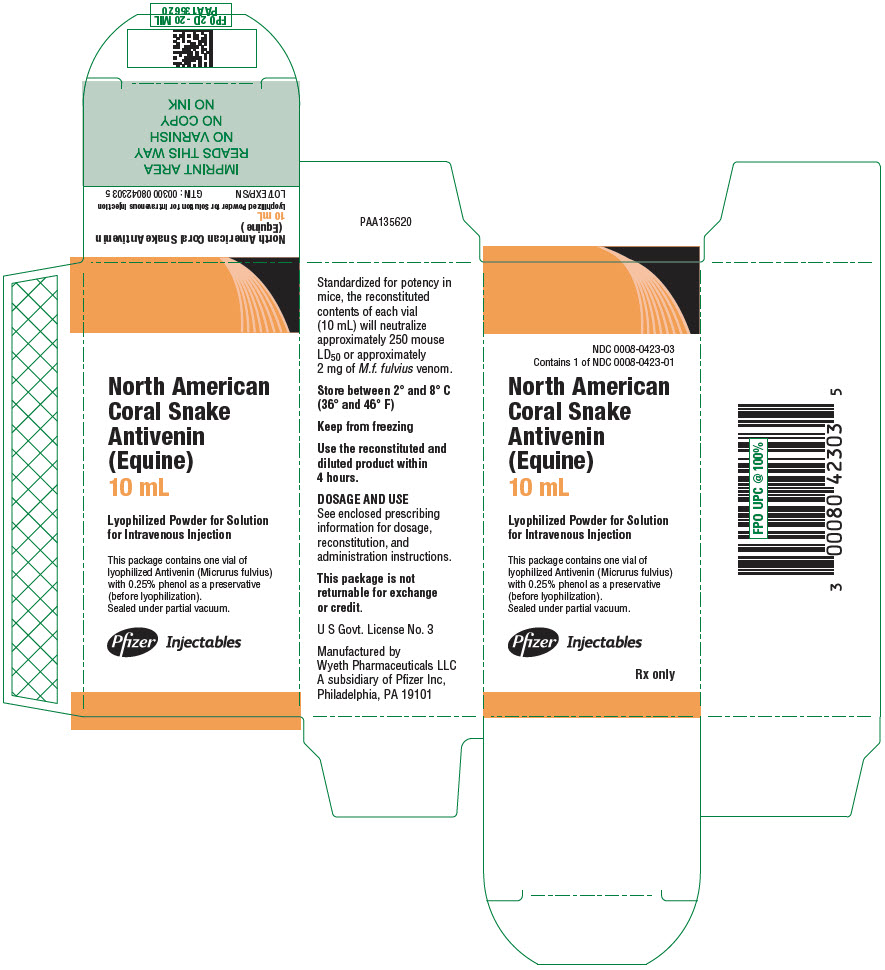
Principal Display Panel (10 mL Vial Carton)
* Please review the disclaimer below.
