Limitations of Use:
The use of depo-subQ provera 104 is not recommended as a long-term (i.e., longer than 2 years) birth control method or medical therapy for endometriosis-associated pain unless other options are considered inadequate [see Dosage and Administration (2.1) and Warnings and Precautions (5.1)].
Breast Cancer
The use of hormonal contraceptives, including depo sub-Q provera 104, is contraindicated in women who have or have had breast cancer because breast cancer may be sensitive to hormones [see Contraindications (4)]. Women who have a family history of breast cancer or a significant risk of breast cancer should be monitored.
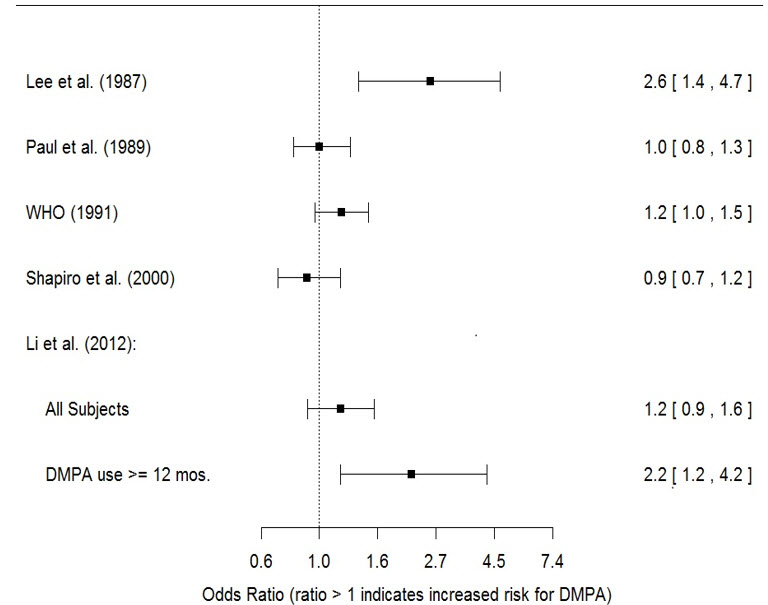
The results of five large case-control studies assessing the association between DMPA-IM use and the risk of breast cancer are summarized in Figure M. Three of the studies suggest a slightly increased risk of breast cancer in the overall population of users; these increased risks were statistically significant in one study. One US study1 evaluated the timing and duration of use and found a statistically significant increased risk of breast cancer in recent DMPA-IM users (defined as last use within the past five years) who used DMPA-IM for 12 months or longer; this is consistent with results of a previous study2.
| Figure M. Risk Estimates of Breast Cancer in DMPA-IM Users |
|---|
Odds ratio estimates were adjusted for the following covariates:
Lee et al. (1987): age, parity, and socioeconomic status.
Paul et al. (1989): age, parity, ethnic group, and year of interview.
WHO (1991): age, center, and age at first live birth.
Shapiro et al. (2000): age, ethnic group, socioeconomic status, and any combined estrogen/progestogen oral contraceptive use.
Li et al. (2012): age, year, BMI, duration of OC use, number of full-term pregnancies, family history of breast cancer, and history of
screening mammography. |
| Odds Ratio [95% confidence interval (CI)] displayed on logarithmic scale |
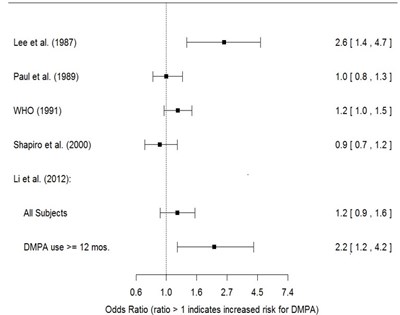 Figure M (Depo Subq Provera 13) |
Based on the published SEER-18 2015 incidence rate (age-adjusted to the 2000 US Standard Population) of breast cancer for US women, all races, age 20 to 49 years, a doubling of risk would increase the incidence of breast cancer in women who use DMPA-IM from about 73 to about 146 cases per 100,000 women.
Other Cancers
The relative rate of invasive squamous-cell cervical cancer in women who ever used DMPA-IM was estimated to be 1.11 (95% CI: 0.96 to 1.29). No trends in risk with duration of use or times since initial or most recent exposure were observed.
Long-term, case-controlled surveillance of users of DMPA-IM found no overall increased risk of ovarian or liver cancer.
Adverse Reactions in the Contraception Adult Studies
Table 1 presents frequently reported adverse reactions (>1%) in the contraception pooled studies. In these studies, the most frequently reported adverse reactions (>5%) were dysfunctional uterine bleeding (e.g., irregular, increased, decreased, or spotting), headache, increased weight, amenorrhea, and injection site reactions (e.g., pain/tenderness, nodule/lump, persistent atrophy/indentation/dimpling or lipodystrophy).
The frequency reported is based on the all-causality incidence in the pooled results of the three contraception studies. Closely related "Adverse Reaction" terms were grouped but individual patients reporting two or more grouped events were only counted once.
Table 1. Frequently Reported Adverse Reactions in the Contraception Studies (>1%)| Adverse Reaction | Frequency |
|---|
| Dysfunctional uterine bleeding (irregular, increase, decrease, spotting) | 18% |
| Headache | 9% |
| Increased weight (see below) | 7% |
| Amenorrhea | 6% |
| Injection site reactions (such as pain/tenderness, nodule/lump, persistent atrophy/indentation/dimpling, lipodystrophy) | 6% |
| Vaginitis, including candidiasis and bacterial | 5% |
| Abdominal pain | 4% |
| Urinary tract infections | 4% |
| Acne | 4% |
| Depression | 3% |
| Decreased libido | 3% |
| Nausea | 3% |
| Back pain | 3% |
| Breast pain/tenderness | 2% |
| Fatigue | 2% |
| Anxiety | 1% |
| Irritability | 1% |
| Dizziness | 1% |
Dysfunctional Uterine Bleeding
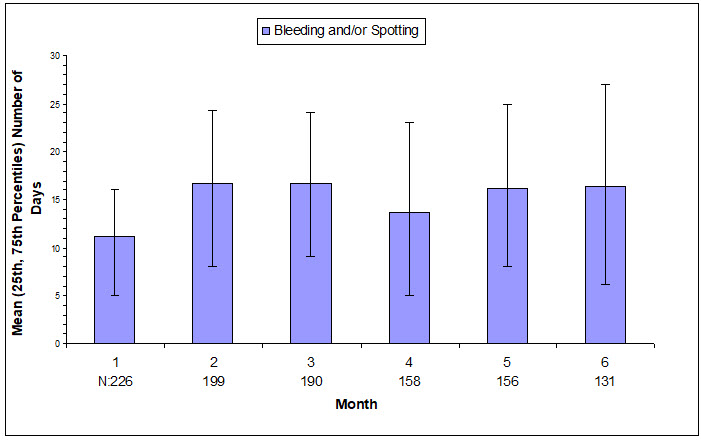
The extent of bleeding and spotting in the three contraception trials is presented in Figure N; data from the endometriosis trials are presented in Figure O [see Warnings and Precautions (5.1)].
Figure N. Mean Number of Bleeding or Spotting Days in the Subgroup of Women with Bleeding or Spotting Among Women Treated with depo-subQ provera 104 in Contraception Studies| N=Number of subjects with bleeding or spotting during indicated month. |
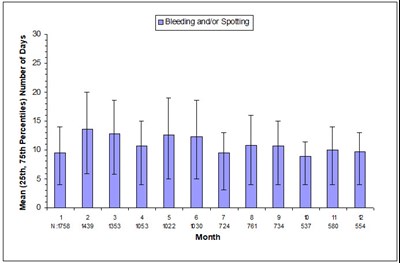 Figure N (Depo Subq Provera 14) |
Figure O. Mean Number of Bleeding or Spotting Days in the Subgroup of Women with Bleeding or Spotting Among Women Treated with depo-subQ provera 104 in Endometriosis Studies| N=Number of subjects with bleeding or spotting during indicated month. |
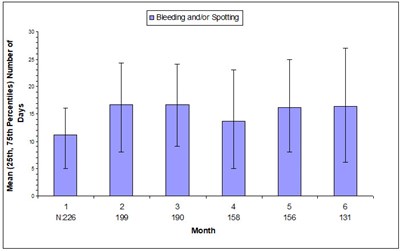 Figure O (Depo Subq Provera 15) |
Weight Gain
In three large clinical trials, the mean weight gain in depo-subQ provera 104 treated patients was 3.5 lb (1.6 kg) in the first year of use. Half (50%) of women remained within 4.9 lb (2.2 kg) of their initial body weight; 12% of women lost more than 4.9 lb (2.2 kg), and 38% of women gained more than 5.1 lb (2.3 kg). In a small, 2-year study comparing depo-subQ provera 104 to DMPA-IM, the mean weight gain observed for women using depo-subQ provera 104 [7.5 lb (3.4 kg)] was similar to the mean weight gain for women using DMPA-IM [7.7 lb (3.5 kg)].
Other Adverse Reactions Observed in Contraception Clinical Trials with depo-subQ provera 104
Other adverse reactions occurring at an incidence of <1% in women who received depo-subQ provera 104 were as follows:
- Neoplasms benign, malignant and unspecified (including cysts and polyps): breast lump
- Blood and lymphatic system disorders: anemia
- Immune system disorders: drug hypersensitivity
- Metabolism and nutrition disorders: weight decreased, fluid retention
- Nervous system disorders: facial palsy, syncope, paresthesia, somnolence
- Cardiac disorders: tachycardia
- Vascular disorders: hot flushes
- Respiratory, thoracic and mediastinal disorders: asthma, dyspnea
- Gastrointestinal disorders: diarrhea, abdominal distension
- Skin and subcutaneous tissue disorders: urticaria, pruritus, dry skin
- Reproductive system and breast disorders: dysmenorrhea, galactorrhea, dyspareunia
- General disorders and administration site conditions: chest pain
Adverse Reactions in the Endometriosis Adult Studies
The safety profile of depo-subQ provera 104 in endometriosis clinical trials was similar to the safety profile of depo-subQ provera 104 in the contraception studies with the exception of the following adverse reactions which were more frequently reported in patients with endometriosis: abdominal pain, diarrhea, nausea, and back pain.
In endometriosis studies, subjects recorded daily the occurrence and severity of hot flushes. Of the depo-subQ provera 104 users, 29% reported experiencing moderate or severe hot flushes at baseline, 36% at Month 3, and 27% at Month 6. Of the leuprolide users, 33% reported experiencing moderate or severe hot flushes at baseline, 74% at Month 3, and 69% at Month 6.
Adverse Reactions in the Adolescent Contraception Study
Depo-sub-Q provera 104 and DMPA-IM clinical trials reported similar safety profiles in adult study populations (see Table 1 above). Accordingly, a similar safety profile is expected for adolescents receiving depo-subQ provera 104 as for adolescents receiving DMPA-IM.
The safety profile of DMPA-IM for prevention of pregnancy in adolescents was observed to be generally similar to the safety profile of adult women using DMPA-IM for prevention of pregnancy, with the exception of the following adverse reactions which were reported more frequently by adolescents: abdominal pain, diarrhea, back pain, weight increased, depression, headache, and dysmenorrhea.
Moderate or Strong CYP3A Inducers
Concomitant use with moderate or strong CYP3A inducers may decrease concentrations of medroxyprogesterone acetate which may reduce depo-subQ provera 104 efficacy. This effect is based upon the primary metabolism of medroxyprogesterone acetate by CYP3A and was not confirmed by a clinical study.
Avoid coadministration of depo-subQ provera 104 with moderate or strong CYP3A inducers. Some examples of moderate CYP3A inducers are bosentan, efavirenz, etravirine, and modafinil. Some examples of strong CYP3A inducers are rifampin, carbamazepine, phenytoin, phenobarbital, mitotane, and St. John's wort (the CYP3A4 induction effect of St. John's wort varies widely and is preparation dependent). These examples are a guide and do not represent a comprehensive list of all possible drugs that may fit these categories.
The use of CYP3A inducers may require using a back-up or alternate contraceptive method.
Absorption
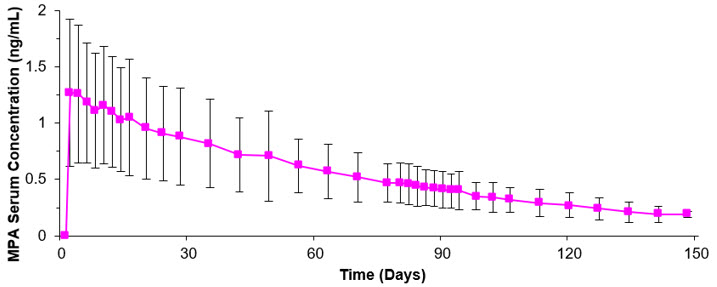
Following a single subcutaneous injection of depo-subQ provera 104 in healthy women, serum MPA concentrations reached ≥0.2 ng/mL within 24 hours. The mean Tmax was attained approximately 1 week after injection.
Figure P. Serum Concentration-Time Profile of MPA Mean (SD) after a Single Injection of depo-subQ provera 104 to Healthy Women 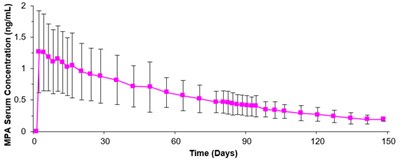 Figure P (Depo Subq Provera 17) |
In a study to assess accumulation and the achievement of steady state following multiple subcutaneous administrations, trough concentrations of MPA were determined after 6, 12, and 24 months, and in a subset of 8 subjects, bi-weekly concentrations were determined within one dosing interval in the second year of administration. The mean (SD) MPA trough concentrations were 0.67 (0.36) ng/mL (n=157), 0.79 (0.36) ng/mL (n=144), and 0.87 (0.33) ng/mL (n=106) at 6, 12, and 24 months, respectively.
Depo-subQ provera 104 was administered subcutaneously into the anterior thigh or the abdomen to evaluate effects of injection site location on the MPA concentration-time profile. MPA trough concentrations (Cmin; Day 91) were similar for the two injection site locations.
Distribution
Plasma protein binding of MPA averages 86%. MPA binding occurs primarily to serum albumin. No binding of MPA occurs with sex-hormone-binding globulin (SHBG).
Elimination
Metabolism
MPA is extensively metabolized in the liver by P450 enzymes. Its metabolism primarily involves ring A and/or side-chain reduction, loss of the acetyl group, hydroxylation in the 2-, 6-, and 21-positions or a combination of these positions, resulting in more than 10 metabolites.
Excretion
Residual MPA concentrations at the end of the first dosing interval (12 to 14 weeks) of depo-subQ provera 104 were generally below 0.5 ng/mL, consistent with its apparent terminal half-life of ~40 days after subcutaneous administration. Most MPA metabolites were excreted in the urine as glucuronide conjugates with only small amounts excreted as sulfates.
Specific Populations
Effect of Body Weight
Although total MPA exposure was lower in obese women, no dosage adjustment of depo-subQ provera 104 is necessary based on body weight. The effect of body weight on the pharmacokinetics of MPA following a single dose was assessed in a subset of women [n=42, body mass index (BMI) ranged from 18.2 to 46.7 kg/m2]. The AUC0–91 values for MPA were 71.6, 67.9, and 46.3 ng∙day/mL in women with BMI categories of ≤28 kg/m2, >28–38 kg/m2, and >38 kg/m2, respectively. The mean MPA Cmax was 1.74 ng/mL in women with BMI ≤28 kg/m2, 1.53 ng/mL in women with BMI >28–38 kg/m2, and 1.02 ng/mL in women with BMI >38 kg/m2, respectively. The MPA trough (Cmin) concentrations had a tendency to be lower in women with BMI >38 kg/m2.
BMD Recovery Post-Treatment in Women
Given the similar effects on BMD from depo-subQ provera 104 and DMPA-IM described above, BMD recovery post-treatment is also expected to be similar. In a controlled clinical study that compared changes in BMD in adult women using DMPA-IM for contraception or no hormonal contraception, the 2-year post-treatment follow-up demonstrated incomplete recovery of BMD following the last injection of DMPA-IM. Table 4 shows the change in BMD in women after 5 years of treatment with DMPA-IM and in the control group, as well as the extent of BMD recovery in the subset of women for whom 2-year post-treatment data were available.
Table 4. BMD Mean Percent Change from Baseline in Women by Skeletal Site and Cohort (5 Years of Treatment and 2 Years of Follow-Up)| Time in Study | Spine | Total Hip | Femoral Neck |
|---|
| DMPA-IM Women who received DMPA-IM for 5 years and were then followed for 2 years post-treatment (total time in study of 7 years). | Control Women who did not use hormonal contraception and were followed for 7 years. | DMPA-IM | Control | DMPA-IM | Control |
|---|
| 5 years | -5.38%
n=33 | 0.43%
n=105 | -5.16%
n=21 | 0.19%
n=65 | -6.12%
n=34 | -0.27%
n=106 |
| 7 years | -3.13%
n=12 | 0.53%
n=60 | -1.34%
n=7 | 0.94%
n=39 | -5.38%
n=13 | -0.11%
n=63 |
BMD Recovery Post-Treatment in Adolescents
Longer duration of treatment and smoking were associated with less recovery of BMD following the last injection of DMPA-IM. Table 6 shows the extent of recovery of BMD up to 60 months post-treatment for adolescents who received DMPA-IM for two years or less compared to more than two years. Post-treatment follow-up showed that, in adolescents treated for more than two years, only lumbar spine BMD recovered to baseline levels after treatment was discontinued. Adolescents treated with DMPA-IM for more than two years did not recover to their baseline BMD level at the femoral neck and total hip even up to 60 months post-treatment. Adolescents in the untreated cohort gained BMD throughout the trial period [see Warnings and Precautions (5.1)].
Table 6. BMD Recovery (Months Post-Treatment) in Adolescents by Years of DMPA-IM Use (2 Years or Less vs. More than 2 Years)Duration of Treatment
(Months) | 2 Years or Less | More than 2 Years |
|---|
| N | Mean % Change from baseline | N | Mean % Change from baseline |
|---|
| Total Hip BMD |
| End of Treatment | 49 | -1.5% | 49 | -6.2% |
| 12 M post-treatment | 33 | -1.4% | 24 | -4.6% |
| 24 M post-treatment | 18 | 0.3% | 17 | -3.6% |
| 36 M post-treatment | 12 | 2.1% | 11 | -4.6% |
| 48 M post-treatment | 10 | 1.3% | 9 | -2.5% |
| 60 M post-treatment | 3 | 0.2% | 2 | -1.0% |
| Femoral Neck BMD |
| End of Treatment | 49 | -1.6% | 49 | -5.8% |
| 12 M post-treatment | 33 | -1.4% | 24 | -4.3% |
| 24 M post-treatment | 18 | 0.5% | 17 | -3.8% |
| 36 M post-treatment | 12 | 1.2% | 11 | -3.8% |
| 48 M post-treatment | 10 | 2.0% | 9 | -1.7% |
| 60 M post-treatment | 3 | 1.0% | 2 | -1.9% |
| Lumbar Spine BMD |
| End of Treatment | 49 | -0.9% | 49 | -3.5% |
| 12 M post-treatment | 33 | 0.4% | 23 | -1.1% |
| 24 M post-treatment | 18 | 2.6% | 17 | 1.9% |
| 36 M post-treatment | 12 | 2.4% | 11 | 0.6% |
| 48 M post-treatment | 10 | 6.5% | 9 | 3.5% |
| 60 M post-treatment | 3 | 6.2% | 2 | 5.7% |
Loss of Bone Mineral Density
Advise the patient that the use of depo-subQ provera 104 decreases BMD [see Warnings and Precautions (5.1)].
Arterial and Venous Thromboembolic Disorders
Advise the patient that serious arterial and venous thrombotic events have been seen in women treated with depot medroxyprogesterone acetate (DMPA) [see Warnings and Precautions (5.2)].
Anaphylaxis
Counsel patients on the importance of seeking urgent medical attention if they experience symptoms of anaphylaxis [see Warnings and Precautions (5.5)].
Ectopic Pregnancy
Advise patients to tell their healthcare professional right away if they become pregnant or experience severe abdominal pain to exclude a diagnosis of ectopic pregnancy [see Warnings and Precautions (5.4)].
Bleeding Irregularities
Advise patients at the beginning of treatment that their menstrual cycle may be disrupted, resulting in irregular and unpredictable bleeding or spotting. Explain that bleeding and spotting irregularities usually decrease to the point of amenorrhea as treatment with depo-subQ provera 104 continues, and does not require other therapy [see Warnings and Precautions (5.11)].
Risks of Breast Cancer
Counsel patients about the possible increased risk of breast cancer in women who use depo-subQ provera 104 [see Warnings and Precautions (5.3)].
Depression
Counsel patients about the possible risk of depression and mood disorders. Advise patients with a history of depression or who are receiving treatment for depression to be alert to any mood changes or worsening of their depression. Counsel patients to follow up with their healthcare professional accordingly [see Warnings and Precautions (5.9)].
Risk of Hyperglycemia in Patients with Diabetes
Advise diabetic patients that some patients receiving progestins may exhibit a decrease in glucose tolerance and hyperglycemia [see Warnings and Precautions (5.12)].
Liver Dysfunction
Advise patients to seek medical advice if they experience symptoms of liver problems such as jaundice [see Warnings and Precautions (5.13)].
Fluid Retention
Counsel patients with conditions that may be influenced by fluid retention to inform their healthcare professional if they experience symptoms of fluid retention [see Warnings and Precautions (5.6)].
Injection Site Reactions
Counsel patients on injection site reactions. Advise patients that dimpling or scarring may occur in 1 out of 100 patients [see Warnings and Precautions (5.10)].
Sexually Transmitted Infections
Counsel patients that depo-subQ provera 104 does not protect against HIV infection (AIDS) and other sexually transmitted infections [see Warnings and Precautions (5.14)].
Drug Interactions
Counsel patients to contact their healthcare professional if they start a medication that is a CYP3A enzyme inducer [see Drug Interactions (7)]. Advise patients that taking a medication that is a CYP3A enzyme inducer may require using a back-up or alternate contraceptive method.
This product's labeling may have been updated. For the most recent prescribing information, please visit www.pfizer.com.

Logo (Depo Subq Provera 19)
LAB-0295-16.0