Registry of Patients with Acromegaly Treated with SOMAVERT
ACROSTUDY is an international observational registry that captures long term safety data in patients with acromegaly treated with SOMAVERT, as used in clinical practice. Treatment dose and schedule were at the discretion of each treating physician. Although safety monitoring as per the recommended schedule was mandatory, not all assessments were performed at all time points for every patient. Because of this, comparison of rates of adverse events to those in the original clinical trial is not appropriate. In an interim report, there were 1288 patients enrolled (mean duration of treatment 3.7 years).
At the start of SOMAVERT treatment 648 patients were on SOMAVERT monotherapy for acromegaly. Of the 454 patients who had a normal AST and ALT at baseline, 4 patients had elevated tests >3 times ULN, two of whom had elevated tests >5 times ULN.
Lipohypertrophy was reported in 6 (0.5%) patients.
MRIs were compared to any previous ones, and a change in tumor volume was reported as significant locally only if the diameter increased by more than 3 mm for microadenomas or volume increased by more than 20% for macroadenomas. All MRI changes considered significant at the local reading were reanalyzed centrally. Of the 747 patients who had a MRI reported at baseline and at least once during follow up in the study, 51 (7%) were reported to have an increase by local MRI. Of these, 16 patients (2%) had confirmation of this increase, 6 patients had a decrease, 12 had "no change"; there was 1 with insufficient data and 16 patients did not have a central MRI reading.
Absorption: Following subcutaneous administration, peak serum pegvisomant concentrations are not generally attained until 33 to 77 hours after administration. The mean extent of absorption of a 20-mg subcutaneous dose was 57%, relative to a 10-mg intravenous dose.
Distribution: The mean apparent volume of distribution of pegvisomant is 7 L (12% coefficient of variation), suggesting that pegvisomant does not distribute extensively into tissues. After a single subcutaneous administration, exposure (Cmax, AUC) to pegvisomant increases disproportionately with increasing dose. Mean ± SEM serum pegvisomant concentrations after 12 weeks of therapy with daily doses of 10, 15, and 20 mg were 6600 ± 1330; 16,000 ± 2200; and 27,000 ± 3100 ng/mL, respectively.
The relative bioavailability of 1 × 30 mg pegvisomant was compared to 2 × 15 mg pegvisomant in a single dose study. The AUCinf and Cmax of pegvisomant when administered as one injection of 30 mg strength was approximately 6% and 4% greater, respectively, as compared to when administered as two injections of 15 mg strengths.
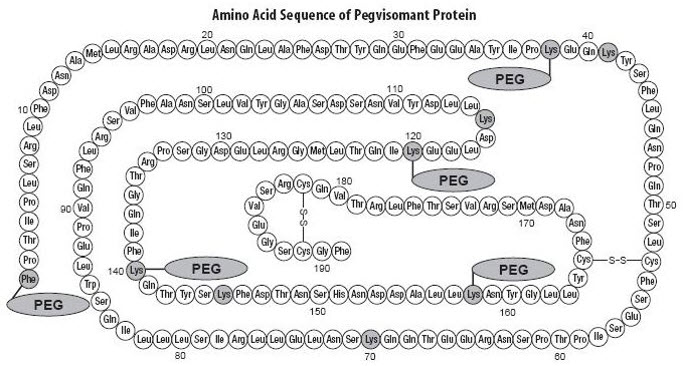
Metabolism and Elimination: The pegvisomant molecule contains covalently bound polyethylene glycol polymers in order to reduce the clearance rate. Clearance of pegvisomant following multiple doses is lower than seen following a single dose. The mean total body systemic clearance of pegvisomant following multiple doses is estimated to range between 36 to 28 mL/h for subcutaneous doses ranging from 10 to 20 mg/day, respectively. Clearance of pegvisomant was found to increase with body weight. Pegvisomant is eliminated from serum with a mean half-life estimates ranging from 60 to 138 hours following either single or multiple doses. Less than 1% of administered drug is recovered in the urine over 96 hours. The elimination route of pegvisomant has not been studied in humans.
Drug Interaction Studies
In clinical studies, patients on opioids often needed higher serum pegvisomant concentrations to achieve appropriate IGF-I suppression compared with patients not receiving opioids. The mechanism of this interaction is not known [see Drug Interactions (7.2)].
Specific Populations
No pharmacokinetic studies have been conducted in patients with renal impairment, patients with hepatic impairment, geriatric patients, or pediatric patients and the effects of race on the pharmacokinetics of pegvisomant has not been studied. No gender effect on the pharmacokinetics of pegvisomant was found in a population pharmacokinetic analysis.