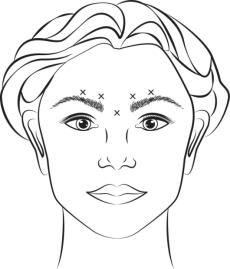
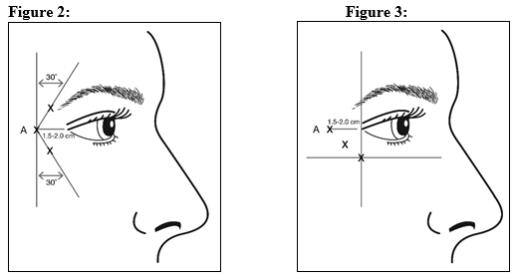
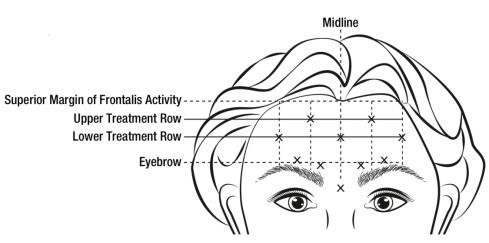
Two randomized, multi-center, double-blind, placebo-controlled studies of identical design were conducted to evaluate BOTOX Cosmetic for use in the temporary improvement of the appearance of moderate to severe glabellar facial lines. The studies enrolled healthy adults (ages 18 to 75) with glabellar lines of at least moderate severity at maximum frown. Subjects were excluded if they had ptosis, deep dermal scarring, or an inability to substantially lessen glabellar lines even by physically spreading them apart. Subjects received a single treatment with BOTOX Cosmetic (N=405, combined studies) or placebo (N=132, combined studies). Injection volume was 0.1 mL/injection site, for a dose/injection site in the active treatment groups of 4 Units. Subjects were injected intramuscularly in five sites, 1 in the procerus muscle and 2 in each corrugator supercilii muscle, for a total dose in the active treatment groups of 20 Units.
The co-primary efficacy endpoints were the investigator’s rating of glabellar line severity at maximum frown and the subject’s global assessment of change in appearance of glabellar lines, both at Day 30 post-injection. For the investigator rating, using a 4-point grading scale (0=none, 3=severe) a responder was defined as having a severity grade of 0 or 1. For the subject’s global assessment of change, the ratings were from +4 (complete improvement) to -4 (very marked worsening). A responder was defined as having a grade of at least +2 (moderate improvement). After completion of the randomized studies, subjects were offered participation in an open label, repeat treatment study to assess the safety of repeated treatment sessions.
The combined results of these two efficacy studies are presented here. The mean age was 46 years, with 32 subjects (6%) ≥65 years of age. Most of the subjects were women (82%), and White (84%). At baseline, 210 subjects (39%) had glabellar line severity scores at rest of moderate or severe.
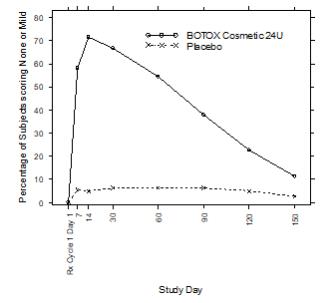
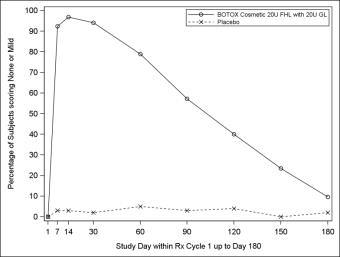
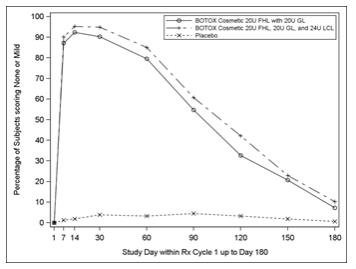
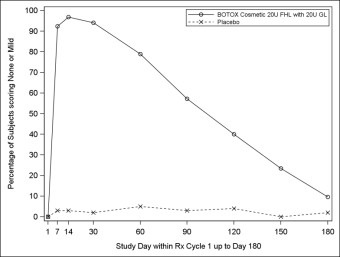
In these studies, the severity of glabellar lines was reduced for up to 120 days in the BOTOX Cosmetic group compared to the placebo group as measured both by investigator rating of glabellar line severity at maximum frown (Table 8), and by subject’s global assessment of change in appearance of glabellar lines (Table 9).
Table 8: Investigator’s Assessment of Glabellar Line Severity at Maximum Frown – Responder Rates (% and Number of Subjects with Severity of None or Mild)| Day | BOTOX
Cosmetic | Placebo | Differencea |
| 7 | 74% 299/405 | 6% 8/132 | 68% (62, 74) |
| 30b | 80% 325/405 | 3% 4/132 | 77% (72, 82) |
| 60 | 70% 283/403 | 2% 2/130 | 69% (64, 74) |
| 90 | 48% 192/403 | 2% 3/128 | 45% (40, 51) |
| 120 | 25% 102/403 | 2% 2/128 | 24% (19, 29) |
a 95% confidence intervals are shown in parenthesis
b Day 30: Co-Primary Efficacy Time point, p<0.001
Table 9: Subject’s Assessment of Change in Appearance of Glabellar Lines – Responder Rates (% and Number of Subjects with at Least Moderate Improvement)| Day | BOTOX Cosmetic | Placebo | Differencea |
| 7 | 82% 334/405 | 9% 12/132 | 73% (68, 80) |
| 30b | 89% 362/405 | 7% 9/132 | 83% (77, 88) |
| 60 | 82% 330/403 | 4% 5/130 | 78% (73, 83) |
| 90 | 63% 254/403 | 3% 4/128 | 60% (54, 66) |
| 120 | 39% 157/403 | 1% 1/128 | 38% (33, 43) |
a 95% confidence intervals are shown in parenthesis
b Day 30: Co-Primary Efficacy Time point, p<0.001
In the subset of subjects with resting severity scores of moderate or severe, the investigator assessment of a resting severity of mild or none at Day 30 was also achieved by more BOTOX Cosmetic treated subjects (74%, 119/161) than placebo treated subjects (20%, 10/49).
Analysis of the limited number of subjects 65 years or older suggested a lower treatment-associated response compared to subjects less than 65 years of age (Table 10).
Table 10: Investigator’s and Subject’s Assessment – Responder Rates for Subjects <65 and ≥65 Years of Age at Day 30| Assessment | Age Group | BOTOX Cosmetic (N=405) | Placebo (N=132) | Differencea |
| Investigators (maximal frown) | <65 | 83% 316/382 | 2% 2/123 | 81% (77, 86) |
| Subjects | <65 | 91% 346/382 | 7% 8/123 | 84% (79, 90) |
| Investigators (maximal frown) | ≥65 | 39% 9/23 | 22% 2/9 | 17% (-17, 51) |
| Subjects | ≥65 | 70% 16/23 | 11% 1/9 | 58% (31, 86) |
a 95% confidence intervals are shown in parenthesis
Exploratory analyses by gender suggested that responder rates in the BOTOX Cosmetic treated group were higher for women than for men for both the investigator assessment (Day 30; 85% of 334 women, 59% of 71 men) and the Subject Assessment (Day 30; 93% of women, 72% of men). In the limited number of subjects that identified as other races (n=64 in the BOTOX Cosmetic treated group) the responder rates were similar to those observed in White subjects.