I. Iron Deficiency Anemia: Periodic hematologic determination (hemoglobin and hematocrit) is a simple and accurate technique for monitoring hematological response, and should be used as a guide in therapy. It should be recognized that iron storage may lag behind the appearance of normal blood morphology. Serum iron, total iron binding capacity (TIBC) and percent saturation of transferrin are other important tests for detecting and monitoring the iron deficient state.
After administration of iron dextran complex, evidence of a therapeutic response can be seen in a few days as an increase in the reticulocyte count.
Although serum ferritin is usually a good guide to body iron stores, the correlation of body iron stores and serum ferritin may not be valid in patients on chronic renal dialysis who are also receiving iron dextran complex.
Although there are significant variations in body build and weight distribution among males and females, the accompanying table and formula represent a convenient means for estimating the total iron required. This total iron requirement reflects the amount of iron needed to restore hemoglobin concentration to normal or near normal levels plus an additional allowance to provide adequate replenishment of iron stores in most individuals with moderately or severely reduced levels of hemoglobin. It should be remembered that iron deficiency anemia will not appear until essentially all iron stores have been depleted. Therapy, thus, should aim at not only replenishment of hemoglobin iron but iron stores as well.
Factors contributing to the formula are shown below.
Factors Contributing To The Formula Are Shown Below. (Infed Iron Dextran Injection 01)
a…Blood volume . . . . . . . . . . . . . . . .65 mL/kg of body weight
b. Normal hemoglobin (males and females)
over 15 kg (33 lbs) . . . . . . . . . . . .14.8 g/dl
15 kg (33 lbs) or less . . . . . . . . . .12.0 g/dl
c. Iron content of hemoglobin . . . . .
0.34%
d. Hemoglobin deficit
e. Weight
Based on the above factors, individuals with normal hemoglobin levels will have approximately 33 mg of blood iron per kilogram of body weight (15 mg/lb).
Note: The table and accompanying formula are applicable for dosage determinations only in patients with iron deficiency anemia; they are not to be used for dosage determinations in patients requiring iron replacement for blood loss.
TOTAL INFeD REQUIREMENT FOR HEMOGLOBIN RESTORATION AND IRON STORES REPLACEMENT*
PATIENT
LEAN BODY WEIGHT | Milliliter Requirement of INFeD Based On Observed
Hemoglobin of |
| kg | lb | 3
(g/dl) | 4
(g/dl) | 5
(g/dl) | 6
(g/dl) | 7
(g/dl) | 8
(g/dl) | 9
(g/dl) | 10
(g/dl) |
5
10
15
20
25
30
35
40
45
50
55
60
65
70
75
80
85
90
95
100
105
110
115
120 | 11
22
33
44
55
66
77
88
99
110
121
132
143
154
165
176
187
198
209
220
231
242
253
264 | 3
7
10
16
20
23
27
31
35
39
43
47
51
55
59
63
66
70
74
78
82
86
90
94 | 3
6
9
15
18
22
26
29
33
37
41
44
48
52
55
59
63
66
70
74
77
81
85
88 | 3
6
9
14
17
21
24
28
31
35
38
42
45
49
52
55
59
62
66
69
73
76
80
83 | 3
5
8
13
16
19
23
26
29
32
36
39
42
45
49
52
55
58
62
65
68
71
75
78 | 2
5
7
12
15
18
21
24
27
30
33
36
39
42
45
48
51
54
57
60
63
67
70
73 | 2
4
7
11
14
17
20
22
25
28
31
34
36
39
42
45
48
50
53
56
59
62
64
67 | 2
4
6
10
13
15
18
21
23
26
28
31
34
36
39
41
44
46
49
52
54
57
59
62 | 2
3
5
9
12
14
17
19
21
24
26
28
31
33
35
38
40
42
45
47
50
52
54
57 |
*Table values were calculated based on a normal adult hemoglobin of 14.8 g/dl for weights greater than 15 kg (33 lbs) and a hemoglobin of 12.0 g/dl for weights less than or equal to 15 kg (33 lbs).
The total amount of INFeD in mL required to treat the anemia and replenish iron stores may be approximated as follows:
Adults and Children over 15 kg (33 lbs): See Dosage Table. Alternatively the total dose may be calculated: Dose (mL) = 0.0442 (Desired Hb - Observed Hb) x LBW + (0.26 x LBW)
Based on: Desired Hb = the target Hb in g/dl.
Observed Hb = the patient’s current hemoglobin in g/dl.
LBW = Lean body weight in kg. A patient’s lean body weight (or actual body weight if less than lean body weight) should be utilized when determining dosage.
For males: LBW = 50 kg + 2.3 kg for each inch of patient’s height over 5 feet
For females: LBW = 45.5 kg + 2.3 kg for each inch of patient’s height over 5 feet
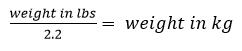
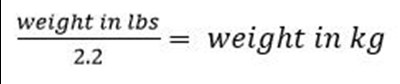
To calculate a patient's weight in kg when lbs are known:

To Calculate A Patient's Weight In Kg When Lbs Are Known: (Infed Iron Dextran Injection 02)
Children 5 - 15 kg (11 - 33 lbs): See Dosage Table.
INFeD should not normally be given in the first four months of life. (See PRECAUTIONS: Pediatric Use.)
Alternatively the total dose may be calculated:
Dose (mL) = 0.0442 (Desired Hb - Observed Hb) x W + (0.26 x W)
Based on: Desired Hb = the target Hb in g/dl. (Normal Hb for Children 15 kg or less is 12 g/dl) W = Weight in kg.
To calculate a patient's weight in kg when lbs are known:

To Calculate A Patient's Weight In Kg When Lbs Are Known: (Infed Iron Dextran Injection 03)
II. Iron Replacement for Blood Loss: Some individuals sustain blood losses on an intermittent or repetitive basis. Such blood losses may occur periodically in patients with hemorrhagic diatheses (familial telangiectasia; hemophilia; gastrointestinal bleeding) and on a repetitive basis from procedures such as renal hemodialysis.
Iron therapy in these patients should be directed toward replacement of the equivalent amount of iron represented in the blood loss. The table and formula described under I. Iron Deficiency Anemia are not applicable for simple iron replacement values.
Quantitative estimates of the individual’s periodic blood loss and hematocrit during the bleeding episode provide a convenient method for the calculation of the required iron dose.
The formula shown below is based on the approximation that 1 mL of normocytic, normochromic red cells contains 1 mg of elemental iron:
Replacement iron (in mg) = Blood loss (in mL) x hematocrit
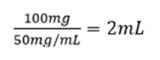
Example: Blood loss of 500 mL with 20% hematocrit Replacement Iron = 500 x 0.20 = 100 mg INFeD dose = 100 mg = 2 mL
50