Missed SARCLISA Doses
If a planned dose of SARCLISA is missed, administer the dose as soon as possible and adjust the treatment schedule accordingly, maintaining the treatment interval.
Infusion Rates
Following dilution, administer the SARCLISA infusion solution intravenously at the infusion rates presented in Table 2. Incremental escalation of the infusion rate should be considered only in the absence of infusion-related reactions [see Warnings and Precautions (5.1) and Adverse Reactions (6.1)].
Table 2: Infusion Rates of SARCLISA Administration | Dilution Volume | Initial Rate | Absence of Infusion-Related Reaction | Rate Increment | Maximum Rate |
|---|
| First infusion | 250 mL | 25 mL/hour | For 60 minutes | 25 mL/hour every 30 minutes | 150 mL/hour |
| Second infusion | 250 mL | 50 mL/hour | For 30 minutes | 50 mL/hour for 30 minutes then increase by 100 mL/hour every 30 minutes | 200 mL/hour |
| Subsequent infusions | 250 mL | 200 mL/hour | – | – | 200 mL/hour |
Interference with Serological Testing (Indirect Antiglobulin Test)
SARCLISA binds to CD38 on red blood cells (RBCs) and may result in a false positive indirect antiglobulin test (indirect Coombs test). In ICARIA-multiple myeloma (MM), the indirect antiglobulin test was positive during SARCLISA treatment in 67.7% of the tested patients. In patients with a positive indirect antiglobulin test, blood transfusions were administered without evidence of hemolysis. ABO/RhD typing was not affected by SARCLISA treatment. Before the first SARCLISA infusion, conduct blood type and screen tests on SARCLISA-treated patients. Consider phenotyping prior to starting SARCLISA treatment. If treatment with SARCLISA has already started, inform the blood bank that the patient is receiving SARCLISA and SARCLISA interference with blood compatibility testing can be resolved using dithiothreitol-treated RBCs. If an emergency transfusion is required, non–cross-matched ABO/RhD-compatible RBCs can be given as per local blood bank practices [see Drug Interactions (7.1)].
Interference with Serum Protein Electrophoresis and Immunofixation Tests
SARCLISA is an IgG kappa monoclonal antibody that can be incidentally detected on both serum protein electrophoresis and immunofixation assays used for the clinical monitoring of endogenous M-protein. This interference can impact the accuracy of the determination of complete response in some patients with IgG kappa myeloma protein [see Drug Interactions (7.1)].
Multiple Myeloma
The safety of SARCLISA was evaluated in ICARIA-MM, a randomized, open-label clinical trial in patients with previously treated multiple myeloma. Patients were eligible for inclusion if they had ECOG status of 0–2, platelets ≥75,000 cells/mm3, absolute neutrophil count ≥1 × 10⁹/L, creatinine clearance ≥30 mL/min (MDRD formula), and AST and/or ALT ≤3 × ULN. Patients received SARCLISA 10 mg/kg intravenously, weekly in the first cycle and every two weeks thereafter, in combination with pomalidomide and low dose dexamethasone (Isa-Pd) (n=152) or pomalidomide and low dose dexamethasone (Pd) (n=149) [see Clinical Studies (14)]. Among patients receiving Isa-Pd, 66% were exposed to SARCLISA for 6 months or longer and 24% were exposed for greater than 12 months or longer.
The median age of patients who received Isa-Pd was 68 years (range 36–83); 58% male, 76% white, and 14% Asian.
Serious adverse reactions occurred in 62% of patients receiving Isa-Pd. Serious adverse reactions in >5% of patients who received Isa-Pd included pneumonia (26%), upper respiratory tract infections (7%), and febrile neutropenia (7%). Fatal adverse reactions occurred in 11% of patients (those that occurred in more than 1% of patients were pneumonia and other infections [3%]).
Permanent discontinuation due to an adverse reaction (grades 1-4) occurred in 7% of patients who received Isa-Pd. The most frequent adverse reactions requiring permanent discontinuation in patients who received Isa-Pd were infections (2.6%). In addition, SARCLISA alone was discontinued in 3% of patients due to infusion-related reactions.
Dosage interruptions due to an adverse reaction occurred in 31% of patients who received SARCLISA. The most frequent adverse reaction requiring dosage interruption was infusion-related reaction (28%).
The most common adverse reactions (≥20%) were neutropenia, infusion-related reactions, pneumonia, upper respiratory tract infection, and diarrhea.
Table 3 summarizes the adverse reactions in ICARIA-MM.
Table 3: Adverse Reactions (≥10%) in Patients Receiving SARCLISA, Pomalidomide, and Dexamethasone with a Difference Between Arms of ≥5% Compared to Control Arm in ICARIA-MM Trial| Adverse Reactions | SARCLISA + Pomalidomide + Dexamethasone (Isa-Pd) | Pomalidomide + Dexamethasone (Pd) |
|---|
| (N=152) | (N=149) |
|---|
| All grades
(%) | Grade 3
(%) | Grade 4
(%) | All grades
(%) | Grade 3
(%) | Grade 4
(%) |
|---|
| CTCAE version 4.03 |
| Infusion-related reaction | 38 | 1.3 | 1.3 | 0 | 0 | 0 |
| Infections |
| Pneumonia Pneumonia includes atypical pneumonia, bronchopulmonary aspergillosis, pneumonia, pneumonia haemophilus, pneumonia influenzal, pneumonia pneumococcal, pneumonia streptococcal, pneumonia viral, candida pneumonia, pneumonia bacterial, haemophilus infection, lung infection, pneumonia fungal, and pneumocystis jirovecii pneumonia. | 31 | 22 | 3.3 | 23 | 16 | 2.7 |
| Upper respiratory tract infection Upper respiratory tract infection includes bronchiolitis, bronchitis, bronchitis viral, chronic sinusitis, fungal pharyngitis, influenza-like illness, laryngitis, nasopharyngitis, parainfluenzae virus infection, pharyngitis, respiratory tract infection, respiratory tract infection viral, rhinitis, sinusitis, tracheitis, upper respiratory tract infection, and upper respiratory tract infection bacterial. | 57 | 9 | 0 | 42 | 3.4 | 0 |
| Blood and lymphatic system disorders |
| Febrile neutropenia | 12 | 11 | 1.3 | 2 | 1.3 | 0.7 |
| Respiratory, thoracic and mediastinal disorders |
| Dyspnea Dyspnea includes dyspnea, dyspnea exertional, and dyspnea at rest. | 17 | 5.0 | 0 | 12 | 1.3 | 0 |
| Gastrointestinal disorders |
| Diarrhea | 26 | 2 | – | 19 | 0.7 | – |
| Nausea | 15 | 0 | – | 9 | 0 | – |
| Vomiting | 12 | 1.3 | – | 3.4 | 0 | – |
Table 4 summarizes the hematology laboratory abnormalities in ICARIA-MM.
Table 4: Treatment Emergent Hematology Laboratory Abnormalities in Patients Receiving Isa-Pd Treatment versus Pd Treatment – ICARIA-MM| Laboratory Parameter n (%) | SARCLISA + Pomalidomide + Dexamethasone (Isa-Pd) | Pomalidomide + Dexamethasone (Pd) |
|---|
| (N=152) | (N=149) |
|---|
| All Grades | Grade 3 | Grade 4 | All Grades | Grade 3 | Grade 4 |
|---|
| Anemia | 151 (99) | 48 (32) | 0 | 145 (97) | 41 (28) | 0 |
| Neutropenia | 146 (96) | 37 (24) | 92 (61) | 137 (92) | 57 (38) | 46 (31) |
| Lymphopenia | 140 (92) | 64 (42) | 19 (13) | 137 (92) | 52 (35) | 12 (8) |
| Thrombocytopenia | 127 (84) | 22 (14) | 25 (16) | 118 (79) | 14 (9) | 22 (15) |
Description of Selected Adverse Reactions
Infusion-related reactions
In ICARIA-MM, infusion-related reactions (defined as adverse reactions associated with the SARCLISA infusions, with an onset typically within 24 hours from the start of the infusion) were reported in 58 patients (38%) treated with SARCLISA. All patients who experienced infusion-related reactions, experienced them during the 1st infusion of SARCLISA, with 3 patients (2%) also having infusion-related reactions at their 2nd infusion, and 2 patients (1.3%) at their 4th infusion. Grade 1 infusion-related reactions were reported in 3.9%, Grade 2 in 32%, Grade 3 in 1.3%, and Grade 4 in 1.3% of the patients. Signs and symptoms of Grade 3 or higher infusion-related reactions included dyspnea, hypertension, and bronchospasm. The incidence of infusion interruptions because of infusion-related reactions was 29.6%. The median time to infusion interruption was 55 minutes.
In a separate study (TCD 14079 Part B) with SARCLISA 10 mg/kg administered from a 250 mL fixed-volume infusion in combination with Pd, infusion-related reactions (all Grade 2) were reported in 40% of patients, at the first administration, the day of the infusion. Overall, the infusion-related reactions of SARCLISA 10 mg/kg administered as a 250 mL fixed-volume infusion were similar to that of SARCLISA as administered in ICARIA-MM.
Infections
In ICARIA-MM, the incidence of Grade 3 or higher infections was 43% in Isa-Pd group. Pneumonia was the most commonly reported severe infection with Grade 3 reported in 22% of patients in Isa-Pd group compared to 16% in Pd group, and Grade 4 in 3.3% of patients in Isa-Pd group compared to 2.7% in Pd group. Discontinuations from treatment due to infection were reported in 2.6% of patients in Isa-Pd group compared to 5.4% in Pd group. Fatal infections were reported in 3.3% of patients in Isa-Pd group and in 4% in Pd group.
Interference with Serological Testing
SARCLISA, an anti-CD38 antibody, may interfere with blood bank serologic tests with false positive reactions in indirect antiglobulin tests (indirect Coombs tests), antibody detection (screening) tests, antibody identification panels, and antihuman globulin crossmatches in patients treated with SARCLISA [see Warnings and Precautions (5.4)].
Interference with Serum Protein Electrophoresis and Immunofixation Tests
SARCLISA may be incidentally detected by serum protein electrophoresis and immunofixation assays used for the monitoring of M-protein and may interfere with accurate response classification based on International Myeloma Working Group (IMWG) criteria [see Warnings and Precautions (5.4)].
Risk Summary
SARCLISA can cause fetal harm when administered to a pregnant woman. The assessment of isatuximab-irfc-associated risks is based on the mechanism of action and data from target antigen CD38 knockout animal models (see Data). There are no available data on SARCLISA use in pregnant women to evaluate for a drug-associated risk of major birth defects, miscarriage or adverse maternal or fetal outcomes. Animal reproduction toxicity studies have not been conducted with isatuximab-irfc. The estimated background risk of major birth defects and miscarriage for the indicated population is unknown. All pregnancies have a background risk of birth defect, miscarriage, or other adverse outcomes. In the U.S. general population, the estimated background risk of major birth defects and miscarriage in clinically recognized pregnancies is 2% to 4% and 15% to 20%, respectively.
The combination of SARCLISA and pomalidomide is contraindicated in pregnant women because pomalidomide may cause birth defects and death of the unborn child. Refer to the pomalidomide prescribing information on use during pregnancy. Pomalidomide is only available through a REMS program.
Clinical Considerations
Fetal/neonatal reactions
Immunoglobulin G1 monoclonal antibodies are known to cross the placenta. Based on its mechanism of action, SARCLISA may cause depletion of fetal CD38-positive immune cells and decreased bone density. Defer administration of live vaccines to neonates and infants exposed to SARCLISA in utero until a hematology evaluation is completed.
Data
Animal data
Mice that were genetically modified to eliminate all CD38 expression (CD38 knockout mice) had reduced bone density which recovered 5 months after birth. Data from studies using CD38 knockout animal models also suggest the involvement of CD38 in regulating humoral immune responses (mice), feto-maternal immune tolerance (mice), and early embryonic development (frogs).
Risk Summary
There are no available data on the presence of isatuximab-irfc in human milk, milk production, or the effects on the breastfed child. Maternal immunoglobulin G is known to be present in human milk. The effects of local gastrointestinal exposure and limited systemic exposure in the breastfed infant to SARCLISA are unknown. Because of the potential for serious adverse reactions in the breastfed child from isatuximab-irfc administered in combination with pomalidomide and dexamethasone, advise lactating women not to breastfeed during treatment with SARCLISA. Refer to pomalidomide prescribing information for additional information.
Pregnancy Testing
With the combination of SARCLISA with pomalidomide, refer to the pomalidomide labeling for pregnancy testing requirements prior to initiating treatment in females of reproductive potential.
Contraception
Females
SARCLISA can cause fetal harm when administered to a pregnant woman [see Use in Specific Populations (8.1)]. Advise female patients of reproductive potential to use effective contraception during treatment and for at least 5 months after the last dose of SARCLISA. Additionally, refer to the pomalidomide labeling for contraception requirements prior to initiating treatment in females of reproductive potential.
Males
Refer to the pomalidomide prescribing information.
Cardiac Electrophysiology
Up to 2 times the approved recommended dose, SARCLISA does not prolong the QT interval to any clinically relevant extent.
A relationship between isatuximab-irfc exposure and overall response rate and progression-free survival was observed.
No apparent relationship was observed between an increase of isatuximab-irfc exposure and adverse reactions.
Distribution
The mean (CV %) predicted total volume of distribution of isatuximab-irfc is of 8.13 L (26.2%).
Metabolism
Isatuximab-irfc is expected to be metabolized into small peptides by catabolic pathways.
Elimination
Isatuximab-irfc total clearance decreased with increasing dose and with multiple doses. At steady state, the near elimination (≥99%) of isatuximab-irfc from plasma after the last dose is predicted to occur in approximately 2 months. The elimination of isatuximab-irfc was similar when given as a single agent or as combination therapy.
Specific Populations
Isatuximab-irfc exposure (AUC) at steady state decreases with increasing body weight. The following factors have no clinically meaningful effect on the exposure of isatuximab-irfc: age (36 to 85 years, 70 patients were >75 years old), sex, race (Caucasian, Black, Asian), renal impairment (eGFR <90 mL/min/1.73 m2), and mild hepatic impairment (total bilirubin 1 to 1.5 times upper limit of normal [ULN] or aspartate amino transferase [AST] > ULN). The effect of moderate (total bilirubin >1.5 times to 3 times ULN and any AST) and severe (total bilirubin >3 times ULN and any AST) hepatic impairment on isatuximab-irfc pharmacokinetics is unknown.
No dose adjustments are recommended in these specific patient populations.
ICARIA-MM
The efficacy and safety of SARCLISA in combination with pomalidomide and low-dose dexamethasone (Isa-Pd) were evaluated in ICARIA-MM (NCT02990338), a multicenter, multinational, randomized, open-label, 2-arm, phase 3 study in patients with relapsed and refractory multiple myeloma. Patients had received at least two prior therapies including lenalidomide and a proteasome inhibitor.
A total of 307 patients were randomized in a 1:1 ratio to receive either SARCLISA in combination with pomalidomide and low-dose dexamethasone (Isa-Pd, 154 patients) or pomalidomide and low-dose dexamethasone (Pd, 153 patients). Treatment was administered in both groups in 28-day cycles until disease progression or unacceptable toxicity. SARCLISA 10 mg/kg was administered as an intravenous infusion weekly in the first cycle and every two weeks thereafter. Pomalidomide 4 mg was taken orally once daily from day 1 to day 21 of each 28-day cycle. Low-dose dexamethasone (orally or intravenously) 40 mg (20 mg for patients ≥75 years of age) was given on days 1, 8, 15, and 22 for each 28-day cycle.
Overall, demographic and disease characteristics at baseline were similar between the two treatment groups. The median patient age was 67 years (range 36–86), 20% of patients were ≥75 years; 10% of patients entered the study with a history of COPD or asthma. The proportion of patients with renal impairment (creatinine clearance <60 mL/min/1.73 m2) was 34%. The International Staging System (ISS) stage at study entry was I in 37%, II in 36% and III in 25% of patients. Overall, 20% of patients had high-risk chromosomal abnormalities at study entry; del(17p), t(4;14) and t(14;16) were present in 12%, 8% and 2% of patients, respectively.
The median number of prior lines of therapy was 3 (range 2–11). All patients received a prior proteasome inhibitor, all patients received prior lenalidomide, and 56% of patients received prior stem cell transplantation; the majority of patients (93%) were refractory to lenalidomide, 76% to a proteasome inhibitor, and 73% to both an immunomodulator and a proteasome inhibitor.
The median duration of treatment was 41 weeks for Isa-Pd group compared to 24 weeks for Pd group.
The efficacy of SARCLISA was based upon progression-free survival (PFS). PFS results were assessed by an Independent Response Committee based on central laboratory data for M-protein and central radiologic imaging review using the International Myeloma Working Group (IMWG) criteria. The improvement in PFS represented a 40% reduction in the risk of disease progression or death in patients treated with Isa-Pd.
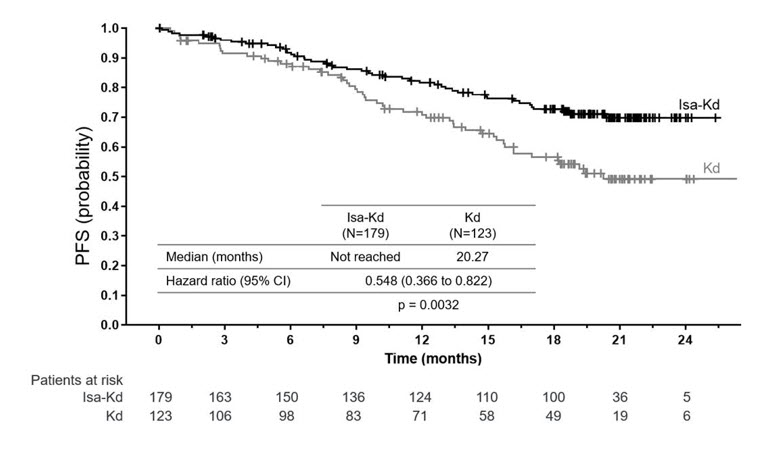
Efficacy results are presented in Table 5 and Kaplan-Meier curve for PFS is provided in Figure 1.
Table 5: Efficacy of SARCLISA in Combination with Pomalidomide and Low-Dose Dexamethasone versus Pomalidomide and Dexamethasone in the Treatment of Multiple Myeloma (ICARIA-MM)| Endpoint | SARCLISA + Pomalidomide + Dexamethasone | Pomalidomide + Dexamethasone |
|---|
| N=154 | N=153 |
|---|
| Progression-Free Survival |
| Median (months) | 11.53 | 6.47 |
| [95% CI] | [8.94–13.9] | [4.47–8.28] |
| Hazard ratio Stratified on age (<75 years versus ≥75 years) and number of previous lines of therapy (2 or 3 vs >3) according to IRT. [95% CI] | 0.596 [0.44–0.81] |
| p-value (stratified log-rank test) | 0.0010 |
| Overall Response Rate sCR, CR, VGPR and PR were evaluated by the IRC using the IMWG response criteria. |
| Responders (sCR+CR+VGPR+PR) n (%) | 93 (60.4) | 54 (35.3) |
| [95% CI] Estimated using Clopper-Pearson method. | [52.2%–68.2%] | [27.8%–43.4%] |
| p-value (stratified Cochran-Mantel-Haenszel) | <0.0001 |
| Stringent Complete Response (sCR) + Complete Response (CR) n (%) | 7 (4.5) | 3 (2) |
| Very Good Partial Response (VGPR) n (%) | 42 (27.3) | 10 (6.5) |
| Partial Response (PR) n (%) | 44 (28.6) | 41 (26.8) |
The median time to first response in responders was 35 days in Isa-Pd group versus 58 days in Pd group. The median duration of response was 13.3 months (95% CI: 10.6-NR) in the Isa-Pd group versus 11.1 months (95% CI: 8.5-NR) in the Pd group. Median overall survival was not reached for either treatment group. At a median follow-up time of 11.6 months, 43 (27.9%) patients on Isa-Pd and 56 (36.6%) patients on Pd had died. The OS results at interim analysis did not reach statistical significance.
Figure 1: Kaplan-Meier Curves of PFS – ITT Population – ICARIA-MM (assessment by the IRC)
Infusion-Related Reaction
Instruct patients to immediately report any occurrence of symptoms occurring within 24 hours of start of infusion to their healthcare provider [see Warnings and Precautions (5.1)].
Neutropenia
Inform patients about the risk of neutropenia and infection during SARCLISA treatment and the importance of reporting immediately any fever or symptoms of infection to their healthcare provider [see Warnings and Precautions (5.2) and Adverse Reactions (6.1)].
Second Primary Malignancies
Inform patients of the risk of developing second primary malignancies during treatment with SARCLISA in combination with pomalidomide and low-dose dexamethasone [see Warnings and Precautions (5.3)].
Interference with Laboratory Tests
Advise patients to inform healthcare providers and transfusion center personnel that they are treated with SARCLISA in case a red blood cell transfusion is planned [see Warnings and Precautions (5.4) and Drug Interactions (7.1)].
Embryo-Fetal Toxicity
Advise women of the potential hazard to a fetus and to avoid becoming pregnant during treatment and for at least 5 months after the last dose of SARCLISA [see Use in Specific Populations (8.1, 8.3)].
Advise patients that pomalidomide has the potential to cause fetal harm and has specific requirements regarding contraception, pregnancy testing, blood and sperm donation, and transmission in sperm. Advise patients to report suspected or known pregnancies. Pomalidomide is only available through a REMS program [see Use in Specific Populations (8.1, 8.3)].
Manufactured by:
sanofi-aventis U.S. LLC
Bridgewater, NJ 08807
A SANOFI COMPANY
U.S. License No. 1752
SARCLISA is a registered trademark of Sanofi
©2020 sanofi-aventis U.S. LLC