Cardiac: New or worsening heart failure [see Warnings and Precautions (5.4)]
Atrial flutter with 1:1 atrioventricular conduction has been reported very rarely.
Hepatic: Liver injury [see Warnings and Precautions (5.5)]
Respiratory: Interstitial lung disease including pneumonitis and pulmonary fibrosis [see Warnings and Precautions (5.6)]
Immune: Anaphylactic reactions including angioedema
Vascular: Vasculitis, including leukocytoclastic vasculitis
Drugs Prolonging the QT Interval (Inducing Torsade de Pointes)
Coadministration of drugs prolonging the QT interval (such as certain phenothiazines, tricyclic antidepressants, certain macrolide antibiotics, and Class I and III antiarrhythmics) is contraindicated because of the potential risk of torsade de pointes–type ventricular tachycardia [see Contraindications (4), Clinical Pharmacology (12.3)].
Digoxin
In the ANDROMEDA (patients with recently decompensated heart failure) and PALLAS (patients with permanent AF) trials baseline use of digoxin was associated with an increased risk of arrhythmic or sudden death in dronedarone-treated patients compared to placebo. In patients not taking digoxin, no difference in risk of sudden death was observed in the dronedarone versus placebo groups. [See Clinical Studies (14.3)].
Digoxin can potentiate the electrophysiologic effects of dronedarone (such as decreased AV-node conduction). Dronedarone increases exposure to digoxin [see Drug Interactions (7.3), Clinical Pharmacology (12.3)].
Consider discontinuing digoxin. If digoxin treatment is continued, halve the dose of digoxin, monitor serum levels closely, and observe for toxicity.
Calcium Channel Blockers
Calcium channel blockers with depressant effects on the sinus and AV nodes could potentiate dronedarone's effects on conduction.
Give a low dose of calcium channel blockers initially and increase only after ECG verification of good tolerability [see Drug Interactions (7.3), Clinical Pharmacology (12.3)].
Beta-Blockers
In clinical trials, bradycardia was more frequently observed when dronedarone was given in combination with beta-blockers.
Give a low dose of beta-blockers initially, and increase only after ECG verification of good tolerability [see Drug Interactions (7.3), Clinical Pharmacology (12.3)].
Ketoconazole and Other Potent CYP 3A Inhibitors
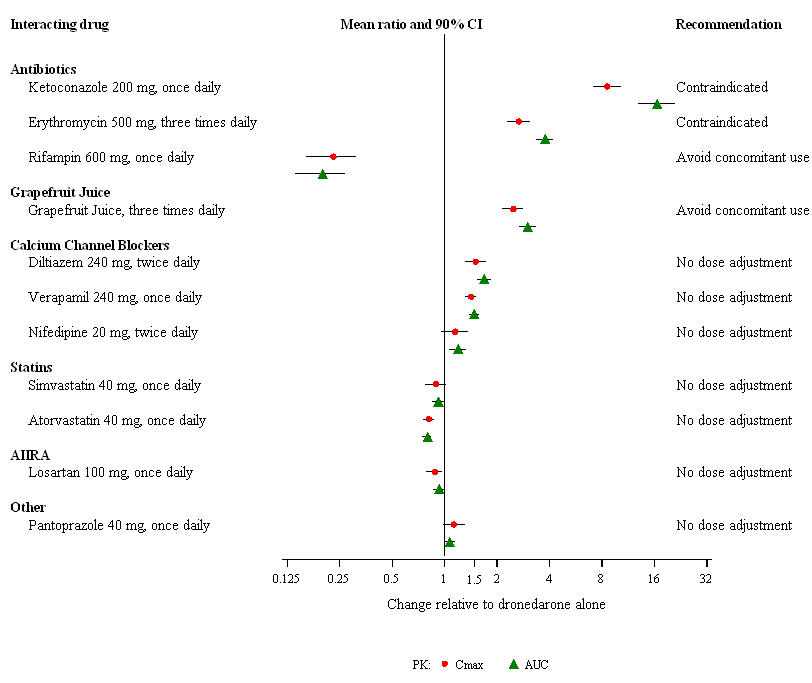
Concomitant use of ketoconazole as well as other potent CYP 3A inhibitors such as itraconazole, voriconazole, ritonavir, clarithromycin, and nefazodone is contraindicated because exposure to dronedarone is significantly increased [see Contraindications (4), Clinical Pharmacology (12.3)].
Grapefruit Juice
Patients should avoid grapefruit juice beverages while taking MULTAQ because exposure to dronedarone is significantly increased [see Clinical Pharmacology (12.3)].
Rifampin and Other CYP 3A Inducers
Avoid rifampin or other CYP 3A inducers such as phenobarbital, carbamazepine, phenytoin, and St. John's wort because they decrease exposure to dronedarone significantly [see Clinical Pharmacology (12.3)].
Calcium Channel Blockers
Verapamil and diltiazem are moderate CYP 3A inhibitors and increase dronedarone exposure. Give a low dose of calcium channel blockers initially and increase only after ECG verification of good tolerability [see Drug Interactions (7.3), Clinical Pharmacology (12.3)].
Simvastatin
Dronedarone increased simvastatin/simvastatin acid exposure. Avoid doses greater than 10 mg once daily of simvastatin [see Clinical Pharmacology (12.3)].
Other Statins
Because of multiple mechanisms of interaction with statins (CYPs and transporters), follow statin label recommendations for use with CYP 3A and P-gp inhibitors such as dronedarone.
Calcium Channel Blockers
Dronedarone increased the exposure of calcium channel blockers (verapamil, diltiazem or nifedipine). Give a low dose of calcium channel blockers initially and increase only after ECG verification of good tolerability [see Drug Interactions (7.1), Clinical Pharmacology (12.3)].
Sirolimus, Tacrolimus, and Other CYP3A Substrates with Narrow Therapeutic Range
Dronedarone can increase plasma concentrations of tacrolimus, sirolimus, and other CYP 3A substrates with a narrow therapeutic range when given orally. Monitor plasma concentrations and adjust dosage appropriately.
Beta-Blockers and Other CYP2D6 Substrates
Dronedarone increased the exposure of propranolol and metoprolol. Give low doses of beta-blockers initially, and increase only after ECG verification of good tolerability. Other CYP2D6 substrates, including other beta-blockers, tricyclic antidepressants, and selective serotonin reuptake inhibitors (SSRIs) may have increased exposure upon coadministration with dronedarone [see Drug Interactions (7.1), Clinical Pharmacology (12.3)].
P-glycoprotein Substrates
Dabigatran
Exposure to dabigatran is higher when it is administered with dronedarone than when it is administered alone.
Other P-gp substrates are expected to have increased exposure when coadministered with dronedarone.
Warfarin
When coadministered with dronedarone exposure to S-warfarin was slightly higher than when warfarin was administered alone. There were no clinically significant increases in INR [see Clinical Pharmacology (12.3)].
More patients experienced clinically significant INR elevations (≥ 5) usually within 1 week after starting dronedarone versus placebo in patients taking oral anticoagulants in ATHENA. However, no excess risk of bleeding was observed in the dronedarone group.
Postmarketing cases of increased INR with or without bleeding events have been reported in warfarin-treated patients initiated on dronedarone. Monitor INR after initiating dronedarone in patients taking warfarin.
Electrophysiological Effects
Dronedarone exhibits properties of all four Vaughn-Williams antiarrhythmic classes, although it is unclear which of these are important in producing dronedarone's clinical effects. The effect of dronedarone on 12-lead ECG parameters (heart rate, PR, and QTc) was investigated in healthy subjects following repeated oral doses up to 1600 mg once daily or 800 mg twice daily for 14 days and 1600 mg twice daily for 10 days. In the dronedarone 400 mg twice-daily group, there was no apparent effect on heart rate; a moderate heart rate lowering effect (about 4 bpm) was noted at 800 mg twice daily. There was a clear dose-dependent effect on PR-interval with an increase of +5 ms at 400 mg twice daily and up to +50 ms at 1600 mg twice daily. There was a moderate dose related effect on the QTc-interval with an increase of +10 ms at 400 mg twice daily and up to +25 ms with 1600 mg twice daily.
DAFNE Study
DAFNE was a dose-response study in patients with recurrent AF, evaluating the effect of dronedarone in comparison with placebo in maintaining sinus rhythm. The doses of dronedarone in this study were 400, 600, and 800 mg twice a day. In this small study, doses above 400 mg were not more effective and were less well tolerated.
Absorption
Because of presystemic first pass metabolism the absolute bioavailability of dronedarone without food is low, about 4%. It increases to approximately 15% when dronedarone is administered with a high fat meal. After oral administration in fed conditions, peak plasma concentrations of dronedarone and the main circulating active metabolite (N-debutyl metabolite) are reached within 3 to 6 hours. After repeated administration of 400 mg twice daily, steady state is reached within 4 to 8 days of treatment and the mean accumulation ratio for dronedarone ranges from 2.6 to 4.5. The steady-state Cmax and exposure of the main N-debutyl metabolite is similar to that of the parent compound. The pharmacokinetics of dronedarone and its N-debutyl metabolite both deviate moderately from dose proportionality: a 2-fold increase in dose results in an approximate 2.5 to 3.0-fold increase with respect to Cmax and AUC.
Distribution
The in vitro plasma protein binding of dronedarone and its N-debutyl metabolite is >98% and not saturable. Both compounds bind mainly to albumin. After intravenous (IV) administration the volume of distribution at steady state is about 1400 L.
Metabolism
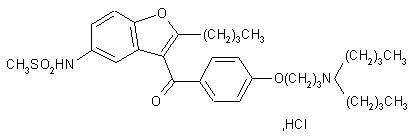
Dronedarone is extensively metabolized, mainly by CYP3A. The initial metabolic pathway includes N-debutylation to form the active N-debutyl metabolite, oxidative deamination to form the inactive propanoic acid metabolite, and direct oxidation. The metabolites undergo further metabolism to yield over 30 uncharacterized metabolites. The N-debutyl metabolite exhibits pharmacodynamic activity but is 1/10 to 1/3 as potent as dronedarone. Monoamine oxidases contribute partially to the metabolism of the active metabolite of dronedarone.
Excretion/Elimination
In a mass balance study with orally administered dronedarone (14C-labeled) approximately 6% of the labeled dose was excreted in urine, mainly as metabolites (no unchanged compound excreted in urine), and 84% was excreted in feces, mainly as metabolites. Dronedarone and its N-debutyl active metabolite accounted for less than 15% of the resultant radioactivity in the plasma.
After IV administration the plasma clearance of dronedarone ranges from 130 to 150 L/h. The elimination half-life of dronedarone ranges from 13 to 19 hours.
Special Populations
Gender
Dronedarone exposures are on average 30% higher in females than in males.
Race
Pharmacokinetic differences related to race were not formally assessed. However, based on a cross study comparison, following single dose administration (400 mg), Asian males (Japanese) have about a 2-fold higher exposure than Caucasian males. The pharmacokinetics of dronedarone in other races has not been assessed.
Elderly
Of the total number of subjects in clinical studies of dronedarone, 73% were 65 years of age and over and 34% were 75 and over. In patients aged 65 years old and above, dronedarone exposures are 23% higher than in patients less than 65 years old [see Use in Specific Populations (8.5)].
Hepatic impairment
In subjects with moderate hepatic impairment, the mean dronedarone exposure increased by 1.3 fold relative to subjects with normal hepatic function and the mean exposure of the N-debutyl metabolite decreased by about 50%. Pharmacokinetic data were significantly more variable in subjects with moderate hepatic impairment.
The effect of severe hepatic impairment on the pharmacokinetics of dronedarone was not assessed [see Contraindications (4)].
Renal impairment
Consistent with the low renal excretion of dronedarone, no pharmacokinetic difference was observed in subjects with mild or moderate renal impairment compared to subjects with normal renal function [see Use in Specific Populations (8.6)]. No pharmacokinetic difference was observed in patients with mild to severe renal impairment in comparison with patients with normal renal function.
Drug Interactions
Dronedarone is metabolized primarily by CYP3A and is a moderate inhibitor of CYP3A and CYP2D6. Dronedarone has no significant potential to inhibit CYP1A2, CYP2C9, CYP2C19, CYP2C8 and CYP2B6. It has the potential to inhibit P-glycoprotein (P-gp) transport. Dronedarone inhibits in vivo the tubular secretion of creatinine a substrate of the organic cation transporter (OCT2) [see Warnings and Precautions (5.9)].
In vitro dronedarone and the metabolites SR35021 and SR90154 show no significant potential to inhibit the organic anion transporters OAT1 and OAT3 or the organic cation transporter OCT1. However, in vitro data indicate that SR90154 is likely to inhibit the organic anion transporting polypeptides (OATP1B1, OATP1B3) in vivo.
Pharmacokinetic measures indicating the magnitude of these interactions are presented in Figure 1 (impact of coadministered drugs on dronedarone) and Figure 2 (impact of dronedarone on coadministered drugs).
Figure 1: The Impact of Coadministered Drugs on the Pharmacokinetics of Dronedarone and Recommendations for Dronedarone Coadministration or Dose Adjustment
Figure 2: The Impact of Dronedarone on Coadministered Drugs and Recommendations for Dose Adjustment of Coadministered Drug