Weeks 0 to 16 (Trials 1 to 4):
In DUPIXENT monotherapy trials (Trials 1, 2, and 4) through Week 16, the proportion of subjects who discontinued treatment because of adverse events was 1.9% in both the DUPIXENT 300 mg Q2W and placebo groups.
Table 1 summarizes the adverse reactions that occurred at a rate of at least 1% in the DUPIXENT 300 mg Q2W monotherapy groups, and in the DUPIXENT + TCS group, all at a higher rate than in their respective comparator groups during the first 16 weeks of treatment.
Table 1: Adverse Reactions Occurring in ≥1% of the DUPIXENT Monotherapy Group or the DUPIXENT + TCS Group in the Atopic Dermatitis Trials through Week 16 | DUPIXENT Monotherapy pooled analysis of Trials 1, 2, and 4 | DUPIXENT + TCS analysis of Trial 3 where subjects were on background TCS therapy |
|---|
| Adverse Reaction | DUPIXENT 300 mg Q2W DUPIXENT 600 mg at Week 0, followed by 300 mg every two weeks | Placebo | DUPIXENT 300 mg Q2W + TCS | Placebo + TCS |
|---|
| N=529
n (%) | N=517
n (%) | N=110
n (%) | N=315
n (%) |
|---|
| Injection site reactions | 51 (10) | 28 (5) | 11 (10) | 18 (6) |
| Conjunctivitis Conjunctivitis cluster includes conjunctivitis, allergic conjunctivitis, bacterial conjunctivitis, viral conjunctivitis, giant papillary conjunctivitis, eye irritation, and eye inflammation. | 51 (10) | 12 (2) | 10 (9) | 15 (5) |
| Blepharitis | 2 (<1) | 1 (<1) | 5 (5) | 2 (1) |
| Oral herpes | 20 (4) | 8 (2) | 3 (3) | 5 (2) |
| Keratitis Keratitis cluster includes keratitis, ulcerative keratitis, allergic keratitis, atopic keratoconjunctivitis, and ophthalmic herpes simplex. | 1 (<1) | 0 | 4 (4) | 0 |
| Eye pruritus | 3 (1) | 1 (<1) | 2 (2) | 2 (1) |
| Other herpes simplex virus infection Other herpes simplex virus infection cluster includes herpes simplex, genital herpes, herpes simplex otitis externa, and herpes virus infection, but excludes eczema herpeticum. | 10 (2) | 6 (1) | 1 (1) | 1 (<1) |
| Dry eye | 1 (<1) | 0 | 2 (2) | 1 (<1) |
Safety through Week 52 (Trial 3):
In the DUPIXENT with concomitant TCS trial (Trial 3) through Week 52, the proportion of subjects who discontinued treatment because of adverse events was 1.8% in DUPIXENT 300 mg Q2W + TCS group and 7.6% in the placebo + TCS group. Two subjects discontinued DUPIXENT because of adverse reactions: atopic dermatitis (1 subject) and exfoliative dermatitis (1 subject).
The safety profile of DUPIXENT + TCS through Week 52 was generally consistent with the safety profile observed at Week 16.
Specific Adverse Reactions
Conjunctivitis
During the 52-week treatment period of concomitant therapy trial (Trial 3), conjunctivitis was reported in 16% of the DUPIXENT 300 mg Q2W + TCS group (20 per 100 subject-years) and in 9% of the placebo + TCS group (10 per 100 subject-years) [see Warnings and Precautions (5.2)].
Eczema Herpeticum and Herpes Zoster
The rate of eczema herpeticum was similar in the placebo and DUPIXENT groups.
Herpes zoster was reported in <0.1% of the DUPIXENT groups (<1 per 100 subject-years) and in <1% of the placebo group (1 per 100 subject-years) in the 16-week monotherapy trials. In the 52-week DUPIXENT + TCS trial, herpes zoster was reported in 1% of the DUPIXENT + TCS group (1 per 100 subject-years) and 2% of the placebo + TCS group (2 per 100 subject-years).
Hypersensitivity Reactions
Hypersensitivity reactions were reported in <1% of DUPIXENT-treated subjects. These included serum sickness reaction, serum sickness-like reaction, and generalized urticaria [see Contraindications (4), Warnings and Precautions (5.1), and Adverse Reactions (6.2)].
Eosinophils
DUPIXENT-treated subjects had a greater mean initial increase from baseline in eosinophil count compared to subjects treated with placebo in the monotherapy trials. Eosinophil counts declined to near baseline levels by Week 16. The initial increase in eosinophils was not observed in the 52-week DUPIXENT + TCS trial.
In Trials 1, 2, and 3, the incidence of treatment-emergent eosinophilia (≥500 cells/mcL) was similar in DUPIXENT and placebo groups. In Trials 1, 2, and 3, treatment-emergent eosinophilia (≥5,000 cells/mcL) was reported in <1% of DUPIXENT-treated patients and none in placebo-treated patients. In most cases, eosinophil counts declined to near baseline during study treatment.
Risk Summary
There are no available data on DUPIXENT use in pregnant women to inform any drug associated risk. Human IgG antibodies are known to cross the placental barrier; therefore, DUPIXENT may be transmitted from the mother to the developing fetus. In an enhanced pre- and post-natal developmental study, no adverse developmental effects were observed in offspring born to pregnant monkeys after subcutaneous administration of a homologous antibody against interleukin-4-receptor alpha (IL-4Rα) during organogenesis through parturition at doses up to 10-times the maximum recommended human dose (MRHD) [see Data]. The estimated background risk of major birth defects and miscarriage for the indicated population is unknown. All pregnancies have a background risk of birth defect, loss or other adverse outcomes. In the U.S. general population, the estimated background risk of major birth defects and miscarriage in clinically recognized pregnancies is 2% to 4% and 15% to 20%, respectively.
Data
Animal Data
In an enhanced pre- and post-natal development toxicity study, pregnant cynomolgus monkeys were administered weekly subcutaneous doses of homologous antibody against IL-4Rα up to 10 times the MRHD (on a mg/kg basis of 100 mg/kg/week) from the beginning of organogenesis to parturition. No treatment-related adverse effects on embryofetal toxicity or malformations, or on morphological, functional, or immunological development were observed in the infants from birth through 6 months of age.
Risk Summary
There are no data on the presence of dupilumab in human milk, the effects on the breastfed infant, or the effects on milk production. Human IgG is known to be present in human milk. The effects of local gastrointestinal and limited systemic exposure to dupilumab on the breastfed infant are unknown. The developmental and health benefits of breastfeeding should be considered along with the mother's clinical need for DUPIXENT and any potential adverse effects on the breastfed child from DUPIXENT or from the underlying maternal condition.
Absorption
Following an initial subcutaneous (SC) dose of 600 mg, dupilumab reached peak mean ±SD concentrations (Cmax) of 70.1±24.1 mcg/mL by approximately 1 week post dose.
Steady-state concentrations were achieved by Week 16 following the administration of 600 mg starting dose and 300 mg dose either weekly (twice the recommended dosing frequency) or every other week. Across clinical trials, the mean ±SD steady-state trough concentrations ranged from 73.3±40.0 mcg/mL to 79.9±41.4 mcg/mL for 300 mg administered every 2 weeks and from 173±75.9 mcg/mL to 193±77.0 mcg/mL for 300 mg administered weekly.
The bioavailability of dupilumab following a SC dose is estimated to be 64%.
Distribution
The estimated total volume of distribution was approximately 4.8±1.3 L.
Elimination
The metabolic pathway of dupilumab has not been characterized. As a human monoclonal IgG4 antibody, dupilumab is expected to be degraded into small peptides and amino acids via catabolic pathways in the same manner as endogenous IgG. After the last steady-state dose of 300 mg Q2W or 300 mg QW dupilumab, the median times to non-detectable concentration (<78 ng/mL) are 10 and 13 weeks, respectively.
Dose Linearity
Dupilumab exhibited nonlinear target-mediated pharmacokinetics with exposures increasing in a greater than dose-proportional manner. The systemic exposure increased by 30-fold when the dose increased 8-fold following a single dose of dupilumab from 75 mg to 600 mg (i.e., 0.25-times to 2-times the recommended dose).
Weight
Dupilumab trough concentrations were lower in subjects with higher body weight.
Immunogenicity
Development of antibodies to dupilumab was associated with lower serum dupilumab concentrations. A few subjects who had high antibody titers also had no detectable serum dupilumab concentrations.
Specific Populations
Geriatric Patients
In subjects who are 65 years and older, the mean ±SD steady-state trough concentrations of dupilumab were 69.4±31.4 mcg/mL and 166±62.3 mcg/mL, respectively, for 300 mg administered every 2 weeks and weekly. No dose adjustment in this population is recommended.
Renal or Hepatic Impairment
No formal trial of the effect of hepatic or renal impairment on the pharmacokinetics of dupilumab was conducted.
Drug Interaction Studies
Cytochrome P450 Substrates
The effects of dupilumab on the pharmacokinetics of midazolam (metabolized by CYP3A4), warfarin (metabolized by CYP2C9), omeprazole (metabolized by CYP2C19), metoprolol (metabolized by CYP2D6), and caffeine (metabolized by CYP1A2) were evaluated in a study with 12-13 evaluable subjects with atopic dermatitis (a SC loading dose of 600 mg followed by 300 mg SC weekly for six weeks). No clinically significant changes in AUC were observed. The largest effect was observed for metoprolol (CYP2D6) with an increase in AUC of 29%.
Clinical Response at Week 16 (Trials 1, 2, and 3)
The results of the DUPIXENT monotherapy trials (Trials 1 and 2) and the DUPIXENT with concomitant TCS trial (Trial 3) are presented in Table 2.
Table 2: Efficacy Results of DUPIXENT With or Without Concomitant TCS at Week 16 (FAS) | Trial 1 | Trial 2 | Trial 3 |
|---|
| DUPIXENT 300 mg Q2W | Placebo | DUPIXENT 300 mg Q2W | Placebo | DUPIXENT 300 mg Q2W + TCS | Placebo + TCS |
|---|
| Number of subjects randomized (FAS) Full Analysis Set (FAS) includes all subjects randomized. | 224 | 224 | 233 | 236 | 106 | 315 |
| IGA 0 or 1 Responder was defined as a subject with IGA 0 or 1 ("clear" or "almost clear") with a reduction of ≥2 points on a 0-4 IGA scale. ,Subjects who received rescue treatment or with missing data were considered as non-responders. | 38% | 10% | 36% | 9% | 39% | 12% |
| EASI-75 | 51% | 15% | 44% | 12% | 69% | 23% |
| EASI-90 | 36% | 8% | 30% | 7% | 40% | 11% |
| Number of subjects with baseline Peak Pruritus NRS score ≥4 | 213 | 212 | 225 | 221 | 102 | 299 |
Peak Pruritus NRS
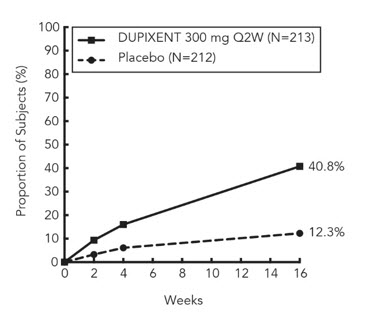
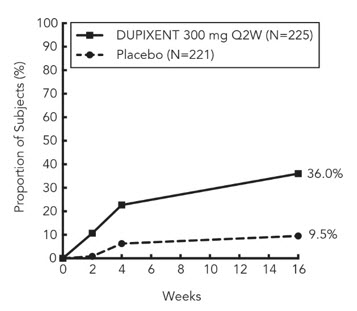
(≥4-point improvement) | 41% | 12% | 36% | 10% | 59% | 20% |
Figure 1: Proportion of Subjects with ≥4-point Improvement on the Pruritus NRS in Trial 1a and Trial 2a Studies (FAS)b| Trial 1 | Trial 2 |
|---|
| a In the primary analyses of the efficacy endpoints, subjects who received rescue treatment or with missing data were considered non-responders. |
| b Full Analysis Set (FAS) includes all subjects randomized. |
| |
In Trial 3, of the 421 subjects, 353 had been on study for 52 weeks at the time of data analysis. Of these 353 subjects, responders at Week 52 represent a mixture of subjects who maintained their efficacy from Week 16 (e.g., 53% of DUPIXENT IGA 0 or 1 responders at Week 16 remained responders at Week 52) and subjects who were non-responders at Week 16 who later responded to treatment (e.g., 24% of DUPIXENT IGA 0 or 1 non-responders at Week 16 became responders at Week 52). Results of supportive analyses of the 353 subjects in the DUPIXENT with concomitant TCS trial (Trial 3) are presented in Table 3.
Table 3: Efficacy Results (IGA 0 or 1) of DUPIXENT with Concomitant TCS at Week 16 and 52 | DUPIXENT
300 mg Q2W + TCS | Placebo + TCS |
|---|
| Number of Subjects In Trial 3, of the 421 randomized and treated subjects, 68 subjects (16%) had not been on study for 52 weeks at the time of data analysis. | 89 | 264 |
| Responder Responder was defined as a subject with IGA 0 or 1 ("clear" or "almost clear") with a reduction of ≥2 points on a 0-4 IGA scale. ,Subjects who received rescue treatment or with missing data were considered as non-responders. at Week 16 and 52 | 22% | 7% |
| Responder at Week 16 but Non-responder at Week 52 | 20% | 7% |
| Non-responder at Week 16 and Responder at Week 52 | 13% | 6% |
| Non-responder at Week 16 and 52 | 44% | 80% |
| Overall Responder, Rate at Week 52 | 36% | 13% |
Treatment effects in subgroups (weight, age, gender, race, and prior treatment, including immunosuppressants) in Trials 1, 2, and 3 were generally consistent with the results in the overall study population.
In Trials 1, 2, and 3, a third randomized treatment arm of DUPIXENT 300 mg QW did not demonstrate additional treatment benefit over DUPIXENT 300 mg Q2W.
Subjects in Trials 1 and 2 who had an IGA 0 or 1 with a reduction of ≥2 points were re-randomized into Trial 5. Trial 5 evaluated multiple DUPIXENT monotherapy dose regimens for maintaining treatment response. The study included subjects randomized to continue with DUPIXENT 300 mg Q2W (62 subjects) or switch to placebo (31 subjects) for 36 weeks. IGA 0 or 1 responses at Week 36 were as follows: 33 (53%) in the Q2W group and 3 (10%) in the placebo group.
Administration Instructions
Provide proper training to patients and/or caregivers on proper subcutaneous injection technique, including aseptic technique, and the preparation and administration of DUPIXENT prior to use. Advise patients to follow sharps disposal recommendations [see Instructions for Use].
Hypersensitivity
Advise patients to discontinue DUPIXENT and to seek immediate medical attention if they experience any symptoms of systemic hypersensitivity reactions [see Warnings and Precautions (5.1)].
Conjunctivitis and Keratitis
Advise patients to consult their healthcare provider if new onset or worsening eye symptoms develop [see Warnings and Precautions (5.2)].
Comorbid Asthma
Advise patients with comorbid asthma not to adjust or stop their asthma treatment without talking to their physicians [see Warnings and Precautions (5.3)].
REGENERON SANOFI GENZYME
Manufactured by:
Regeneron Pharmaceuticals, Inc.
Tarrytown, NY 10591
U.S. License No. 1760
Marketed by:
sanofi-aventis U.S. LLC (Bridgewater, NJ 08807) and
Regeneron Pharmaceuticals, Inc. (Tarrytown, NY 10591)
DUPIXENT® is a registered trademark of Sanofi Biotechnology
© 2017 Regeneron Pharmaceuticals, Inc. / sanofi-aventis U.S. LLC. All rights reserved.
Revised: April 2018
Initial U.S. Approval: 2017