Candidemia and other Candida infections (intra-abdominal abscess, and peritonitis)
The recommended dose is a single 200 mg loading dose of ERAXIS on Day 1, followed by 100 mg daily dose thereafter. Duration of treatment should be based on the patient's clinical response. In general, antifungal therapy should continue for at least 14 days after the last positive culture.
Esophageal Candidiasis
The recommended dose is a single 100 mg loading dose of ERAXIS on Day 1, followed by 50 mg daily dose thereafter. Patients should be treated for a minimum of 14 days and for at least 7 days following resolution of symptoms. Duration of treatment should be based on the patient's clinical response. Because of the risk of relapse of esophageal candidiasis in patients with HIV infections, suppressive antifungal therapy may be considered after a course of treatment.
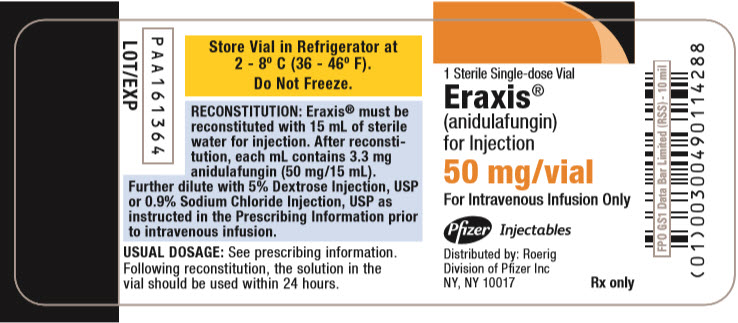
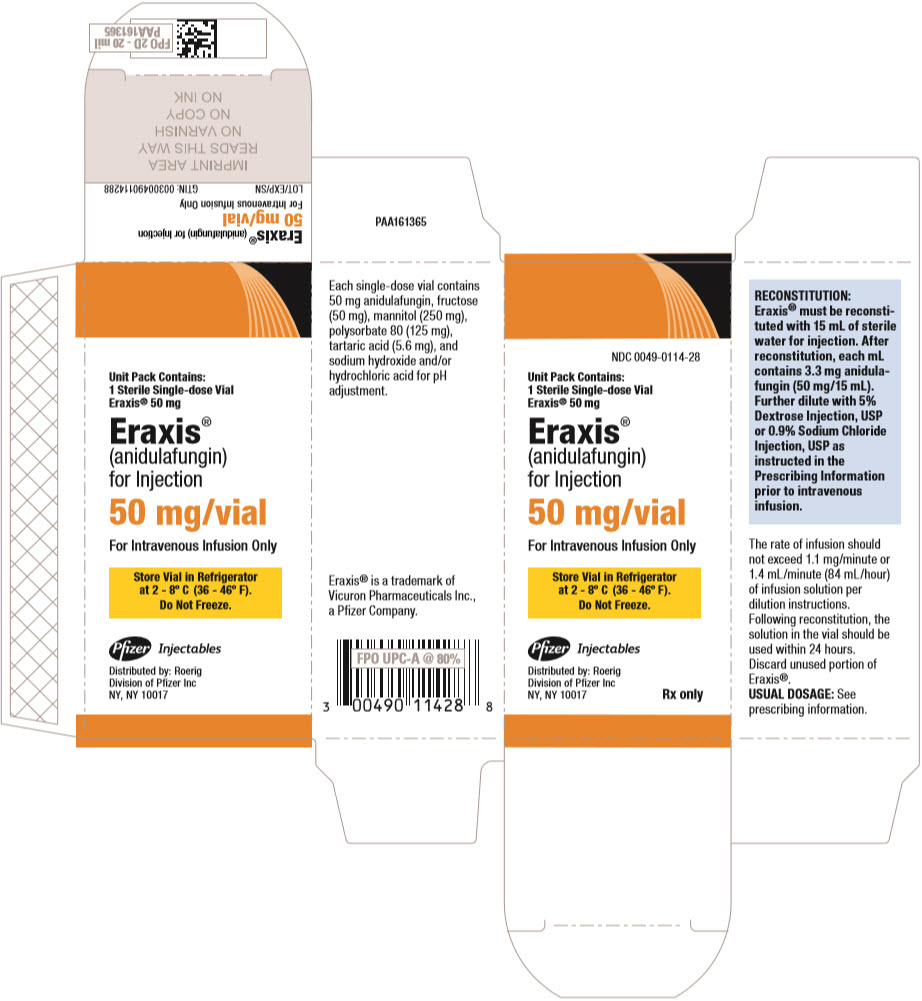
Reconstitution 50 mg/vial
Aseptically reconstitute each 50 mg vial with 15 mL of sterile Water for Injection to provide a concentration of 3.33 mg/mL. The reconstituted solution can be stored for up to 24 hours at temperatures up to 25°C (77°F) prior to dilution into the infusion solution.
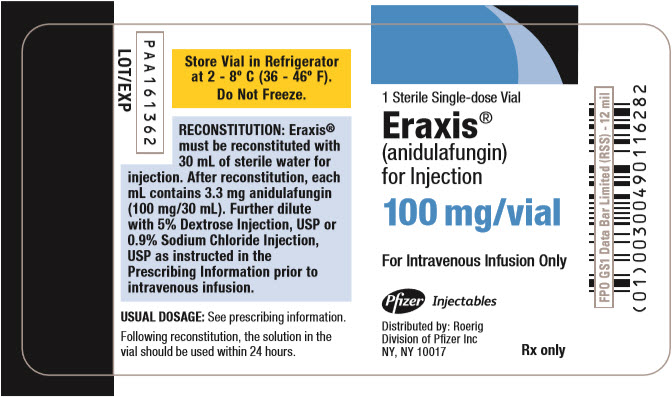
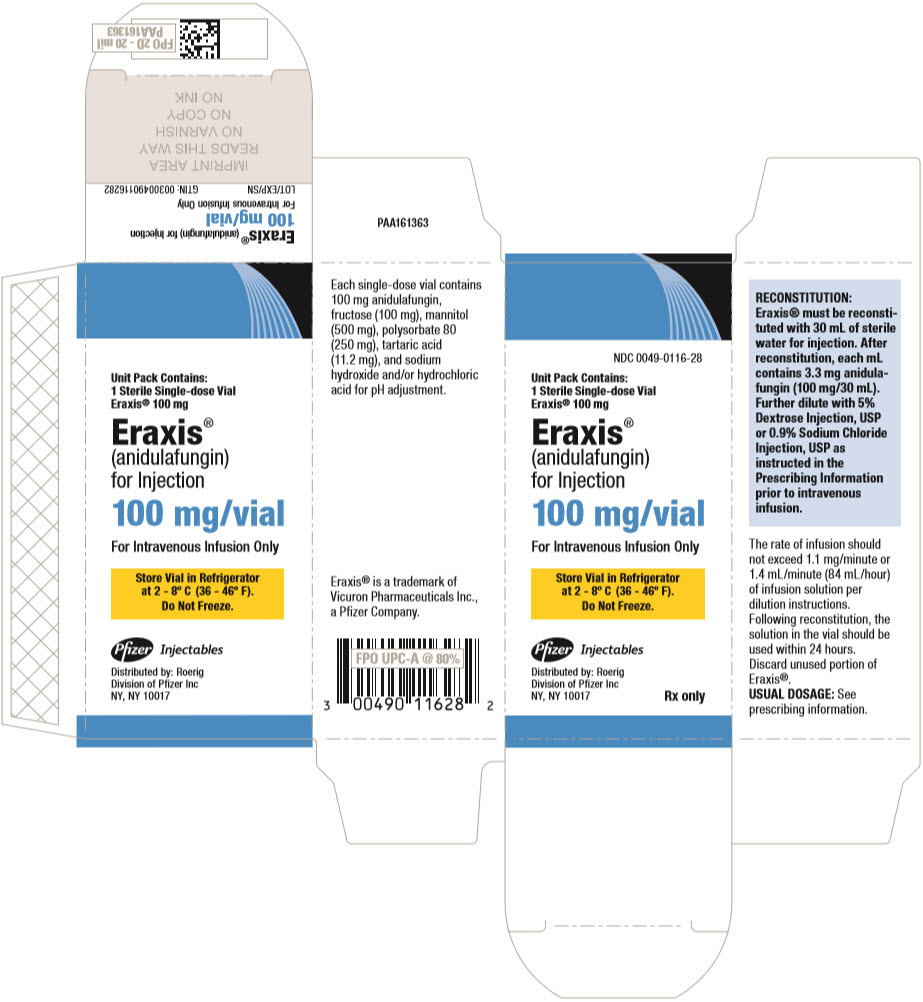
Reconstitution 100 mg/vial
Aseptically reconstitute each 100 mg vial with 30 mL of sterile Water for Injection to provide a concentration of 3.33 mg/mL. The reconstituted solution can be stored for up to 24 hours at temperatures up to 25°C (77°F) prior to dilution into the infusion solution.
Risk Summary
Based on findings from animal studies, ERAXIS can cause fetal harm when administered to a pregnant woman. There are no available human data on the use of ERAXIS in pregnant women to inform a drug-associated risk of adverse developmental outcomes. In animal reproduction studies fetal toxicity was observed in the presence of maternal toxicity when anidulafungin was administered to pregnant rabbits during organogenesis at 4 times the proposed therapeutic maintenance dose of 100 mg/day on the basis of relative body surface area [see Data]. Inform pregnant woman of the risk to the fetus.
The estimated background risk of major birth defects and miscarriage for the indicated populations are unknown. In the U.S. general population, the estimated background risk of major birth defects and miscarriage in clinically recognized pregnancies is 2–4% and 15–20% respectively.
Data
Animal Data
In a combined fertility and embryo-fetal development study in rats dosed with anidulafungin for 4 weeks prior to cohabitation and through cohabitation for males or for 2 weeks prior to cohabitation and continuing through gestation day 19 for females, there was no maternal or embryo-fetal toxicity at intravenous doses up to 20 mg/kg/day (equivalent to 2 times the proposed therapeutic maintenance dose of 100 mg/day on the basis of relative body surface area).
In a rabbit embryo-fetal development study, intravenous administration of anidulafungin (0, 5, 10, and 20 mg/kg/day) from gestation day 7 through 19, resulted in reduced fetal weights and incomplete ossification in the presence of maternal toxicity (decreased body weight gain) at 20 mg/kg/day (equivalent to 4 times the proposed therapeutic maintenance dose of 100 mg/day on the basis of relative body surface area).
In a pre- and postnatal development study, pregnant rats were intravenously administered anidulafungin at doses of 2, 6, or 20 mg/kg/day from gestation day 7 through lactation day 20. Maternal toxicity was observed at ≥6 mg/kg/day (clinical signs at ≥6 mg/kg/day and reduced body weight gain and food consumption during gestation at 20 mg/kg/day group). There were no effects on the viability or growth and development of the offspring. In this study, anidulafungin was detected in fetal plasma, indicating that it crossed the placental barrier.
Risk Summary
There are no data on the presence of anidulafungin in human milk, the effects on the breastfed infant or the effects on milk production. Anidulafungin was found in the milk of lactating rats [see Data]. The developmental and health benefits of breastfeeding should be considered along with the mother's clinical need for ERAXIS and any potential adverse effects on the breastfed child from ERAXIS or from the underlying maternal condition.
Data
Animal Data
Pregnant rats were intravenously administered anidulafungin at doses of 2, 6, or 20 mg/kg/day from gestation day 7 through lactation day 20. Milk samples were collected from 5 rats per group on lactation day 14 at approximately 1 hours post dose. Approximately dose-proportional anidulafungin concentrations were found in the milk of lactating rats.
General Pharmacokinetic Characteristics
The pharmacokinetics of anidulafungin following intravenous (IV) administration have been characterized in healthy subjects, special populations and patients. Systemic exposures of anidulafungin are dose-proportional and have low intersubject variability (coefficient of variation <25%) as shown in Table 4. The steady state was achieved on the first day after a loading dose (twice the daily maintenance dose) and the estimated plasma accumulation factor at steady state is approximately 2.
Table 4: Mean (%CV) Steady State Pharmacokinetic Parameters of Anidulafungin Following IV Administration of Anidulafungin Once Daily for 10 Days in Healthy Adult Subjects
PK ParameterParameters were obtained from separate studies | Anidulafungin IV Dosing Regimen (LD/MD, mg) LD/MD: loading dose/maintenance dose once daily |
|---|
| 70/35 Data were collected on Day 7 ,Safety and efficacy of these doses has not been established
(N=6) | 200/100
(N=10) | 260/130, See OVERDOSAGE
(N=10) |
|---|
| Cmax, ss = the steady state peak concentration |
| AUCss = the steady state area under concentration vs. time curve |
| CL = clearance |
| t1/2 = the terminal elimination half-life |
| Cmax, ss [mg/L] | 3.55 (13.2) | 8.6 (16.2) | 10.9 (11.7) |
| AUCss [mg∙h/L] | 42.3 (14.5) | 111.8 (24.9) | 168.9 (10.8) |
| CL [L/h] | 0.84 (13.5) | 0.94 (24.0) | 0.78 (11.3) |
| t1/2 [h] | 43.2 (17.7) | 52.0 (11.7) | 50.3 (9.7) |
The clearance of anidulafungin is about 1 L/h and anidulafungin has a terminal elimination half-life of 40–50 hours.
Distribution
The pharmacokinetics of anidulafungin following IV administration are characterized by a short distribution half-life (0.5–1 hour) and a volume of distribution of 30–50 L that is similar to total body fluid volume. Anidulafungin is extensively bound (>99%) to human plasma proteins.
Metabolism
Hepatic metabolism of anidulafungin has not been observed. Anidulafungin is not a clinically relevant substrate, inducer, or inhibitor of cytochrome P450 (CYP450) isoenzymes. It is unlikely that anidulafungin will have clinically relevant effects on the metabolism of drugs metabolized by CYP450 isoenzymes.
Anidulafungin undergoes slow chemical degradation at physiologic temperature and pH to a ring-opened peptide that lacks antifungal activity. The in vitro degradation half-life of anidulafungin under physiologic conditions is about 24 hours. In vivo, the ring-opened product is subsequently converted to peptidic degradants and eliminated.
Excretion
In a single-dose clinical study, radiolabeled (14C) anidulafungin was administered to healthy subjects. Approximately 30% of the administered radioactive dose was eliminated in the feces over 9 days, of which less than 10% was intact drug. Less than 1% of the administered radioactive dose was excreted in the urine. Anidulafungin concentrations fell below the lower limits of quantitation 6 days post-dose. Negligible amounts of drug-derived radioactivity were recovered in blood, urine, and feces 8 weeks post-dose.
Specific Populations
Patients with fungal infections
Population pharmacokinetic analyses from four clinical trials including 107 male and 118 female patients with fungal infections showed that the pharmacokinetic parameters of anidulafungin are not affected by age, race, or the presence of concomitant medications which are known metabolic substrates, inhibitors or inducers.
The pharmacokinetics of anidulafungin in patients with fungal infections are similar to those observed in healthy subjects. The pharmacokinetic parameters of anidulafungin estimated using population pharmacokinetic modeling following IV administration of a maintenance dose of 50 mg/day or 100 mg/day (following a loading dose) are presented in Table 5.
Table 5: Mean (%CV) Steady State Pharmacokinetic Parameters of Anidulafungin Following IV Administration of Anidulafungin in Patients with Fungal Infections Estimated Using Population Pharmacokinetic Modeling| PK Parameter All the parameters were estimated by population modeling using a two-compartment model with first order elimination; AUCss, Cmax,ss and Cmin,ss (steady state trough plasma concentration) were estimated using individual PK parameters and infusion rate of 1 mg/min to administer recommended doses of 50 and 100 mg/day. | Anidulafungin IV Dosing Regimen (LD/MD, mg) LD/MD: loading dose/daily maintenance dose |
|---|
| 100/50 | 200/100 |
|---|
| Cmax, ss [mg/L] | 4.2 (22.4) | 7.2 (23.3) |
| Cmin, ss [mg/L] | 1.6 (42.1) | 3.3 (41.8) |
| AUCss [mg∙h/L] | 55.2 (32.5) | 110.3 (32.5) |
| CL [L/h] | 1.0 (33.5) |
| t1/2, β [h] t1/2, β is the predominant elimination half-life that characterizes the majority of the concentration-time profile. | 26.5 (28.5) |
Gender
Dosage adjustments are not required based on gender. Plasma concentrations of anidulafungin in healthy men and women were similar. In multiple-dose patient studies, drug clearance was slightly faster (approximately 22%) in men.
Geriatric
Dosage adjustments are not required for geriatric patients. The population pharmacokinetic analysis showed that median clearance differed slightly between the elderly group (patients ≥65, median CL=1.07 L/h) and the non-elderly group (patients <65, median CL=1.22 L/h) and the range of clearance was similar.
Race
Dosage adjustments are not required based on race. Anidulafungin pharmacokinetics were similar among Whites, Blacks, Asians, and Hispanics.
HIV Status
Dosage adjustments are not required based on HIV status, irrespective of concomitant anti-retroviral therapy.
Hepatic Insufficiency
Anidulafungin is not hepatically metabolized. Anidulafungin pharmacokinetics were examined in subjects with Child-Pugh class A, B or C hepatic insufficiency. Anidulafungin concentrations were not increased in subjects with any degree of hepatic insufficiency. Though a slight decrease in AUC was observed in patients with Child-Pugh C hepatic insufficiency, it was within the range of population estimates noted for healthy subjects [see Use in Specific Populations (8.6)].
Renal Insufficiency
Anidulafungin has negligible renal clearance. In a clinical study of subjects with mild, moderate, severe or end stage (dialysis-dependent) renal insufficiency, anidulafungin pharmacokinetics were similar to those observed in subjects with normal renal function. Anidulafungin is not dialyzable and may be administered without regard to the timing of hemodialysis [see Use in Specific Populations (8.7)].
Pediatric
The pharmacokinetics of anidulafungin after daily doses were investigated in immunocompromised pediatric (2 through 11 years) and adolescent (12 through 17 years) patients with neutropenia. The steady state was achieved on the first day after administration of the loading dose (twice the maintenance dose), and the Cmax and AUCss increased in a dose-proportional manner. Concentrations and exposures following administration of maintenance doses of 0.75 and 1.5 mg/kg/day in this population were similar to those observed in adults following maintenance doses of 50 and 100 mg/day, respectively (as shown in Table 6).
Table 6: Mean (%CV) Steady State Pharmacokinetic Parameters of Anidulafungin Following IV Administration of Anidulafungin Once Daily in Pediatric Subjects
PK ParameterData were collected on Day 5 | Anidulafungin IV Dosing Regimen
(LD/MD, mg/kg)LD/MD: loading dose/daily maintenance dose |
|---|
| 1.5/0.75 | 3.0/1.5 |
|---|
| Age Group Safety and effectiveness has not been established in pediatric patients ≤16 years of age | 2–11 years
(N = 6) | 12–17 years
(N = 6) | 2–11 years
(N = 6) | 12–17 years
(N = 6) |
| Cmax, ss [mg/L] | 3.32 (50.0) | 4.35 (22.5) | 7.57 (34.2) | 6.88 (24.3) |
| AUCss [mg∙h/L] | 41.1 (38.4) | 56.2 (27.8) | 96.1 (39.5) | 102.9 (28.2) |
Cyclosporine (CYP3A4 substrate)
In a study in which 12 healthy adult subjects received 100 mg/day maintenance dose of anidulafungin following a 200 mg loading dose (on Days 1 to 8) and in combination with 1.25 mg/kg oral cyclosporine twice daily (on Days 5 to 8), the steady state Cmax of anidulafungin was not significantly altered by cyclosporine; the steady state AUC of anidulafungin was increased by 22%. A separate in vitro study showed that anidulafungin has no effect on the metabolism of cyclosporine [see Drug Interactions (7.1)].
Voriconazole (CYP2C19, CYP2C9, CYP3A4 inhibitor and substrate)
In a study in which 17 healthy subjects received 100 mg/day maintenance dose of anidulafungin following a 200 mg loading dose, 200 mg twice daily oral voriconazole (following two 400 mg loading doses) and both in combination, the steady state Cmax and AUC of anidulafungin and voriconazole were not significantly altered by co-administration [see Drug Interactions (7.2)].
Tacrolimus (CYP3A4 substrate)
In a study in which 35 healthy subjects received a single oral dose of 5 mg tacrolimus (on Day 1), 100 mg/day maintenance dose of anidulafungin following a 200 mg loading dose (on Days 4 to 12) and both in combination (on Day 13), the steady state Cmax and AUC of anidulafungin and tacrolimus were not significantly altered by co-administration [see Drug Interactions (7.3)].
Rifampin (potent CYP450 inducer)
The pharmacokinetics of anidulafungin were examined in 27 patients that were co-administered anidulafungin and rifampin. The population pharmacokinetic analysis showed that when compared to data from patients that did not receive rifampin, the pharmacokinetics of anidulafungin were not significantly altered by co-administration with rifampin [see Drug Interactions (7.4)].
Amphotericin B liposome for injection
The pharmacokinetics of anidulafungin were examined in 27 patients that were co-administered liposomal amphotericin B. The population pharmacokinetic analysis showed that when compared to data from patients that did not receive amphotericin B, the pharmacokinetics of anidulafungin were not significantly altered by co-administration with amphotericin B [see Drug Interactions (7.5)].
Resistance
Echinocandin resistance is due to point mutations within the genes (FKS1 and FKS2) encoding for subunits in the glucan synthase enzyme complex. There have been reports of Candida isolates with reduced susceptibility to anidulafungin, suggesting a potential for development of drug resistance. The clinical significance of this observation is not fully understood.
Antimicrobial Activity
Anidulafungin has been shown to be active against most isolates of the following microorganisms both in vitro and in clinical infections:
Candida albicans
Candida glabrata
Candida parapsilosis
Candida tropicalis
The following in vitro data are available, but their clinical significance is unknown. At least 90 percent of the following fungi exhibit an in vitro minimum inhibitory concentration (MIC) less than or equal to the susceptible breakpoint for anidulafungin against isolates of the following Candida species. However, the effectiveness of anidulafungin in treating clinical infections due to these fungi has not been established in adequate and well-controlled clinical trials:
Candida guilliermondii
Candida krusei
Susceptibility Testing Methods
Candida species:
The interpretive standards for anidulafungin against Candida species are applicable only to tests performed using Clinical Laboratory and Standards Institute (CLSI) broth dilution reference method M27 for MIC read at 24 hours.1,2
Dilution Techniques:
Quantitative methods are used to determine MICs. These MICs provide estimates of the susceptibility of Candida spp. to antifungal compound. The MICs should be determined using a standardized test method at 24 hours1, 2 (broth microdilution). The MIC values should be interpreted according to the criteria provided in Table 7.
Table 7: Susceptibility Interpretive CriteriaA report of Susceptible (S) indicates that the antimicrobial drug is likely to inhibit growth of the pathogen if the antimicrobial drug reaches the concentration usually achievable at the site of infection. A report of Intermediate (I) indicates that the result should be considered equivocal, and, if the microorganism is not fully susceptible to alternative, clinically feasible drugs, the test should be repeated. This category implies possible clinical applicability in body sites where the drugs are physiologically concentrated or when a high dosage of drug is used. This category also provides a buffer zone that prevents small uncontrolled technical factors from causing major discrepancies in interpretation. A report of Resistant (R) indicates that the antimicrobial is not likely to inhibit growth of the pathogen if the antimicrobial drug reaches the concentrations usually achievable at the infection site; other therapy should be selected.
for Anidulafungin against Candida species| Pathogen | Broth Microdilution MIC (mcg/mL) at 24 hours |
|---|
| Susceptible (S) | Intermediate (I) | Resistant (R) |
|---|
| C. albicans | ≤0.25 | 0.5 | >1 |
| C. glabrata | ≤0.12 | 0.25 | ≥0.5 |
| C. guilliermondii | ≤2 | 4 | ≥8 |
| C. krusei | ≤0.25 | 0.5 | ≥1 |
| C. parapsilosis | ≤2 | 4 | ≥8 |
| C. tropicalis | ≤0.25 | 0.5 | ≥1 |
Quality Control
Standardized susceptibility test procedures require the use of laboratory controls to monitor and ensure the accuracy and precision of supplies and reagents used in the assay, and the techniques of the individuals performing the tests.1,2 Standardized anidulafungin powder should provide the following range of MIC values noted in Table 8.
NOTE: Quality control microorganisms are specific strains of organisms with intrinsic biological properties relating to resistance mechanisms and their genetic expression within fungi; the specific strains used for microbiological control are not clinically significant.
Table 8: Acceptable Quality Control Ranges for Anidulafungin to be Used in Validation of Susceptibility Test Results| QC Strain | Microdilution
(MIC in mcg/mL) @ 24 hours |
|---|
| Candida parapsilosis ATCC 22019 | 0.25–2.0 |
| Candida krusei ATCC 6258 | 0.03–0.12 |
Unreconstituted vials
ERAXIS unreconstituted vials should be stored in a refrigerator at 2°C – 8°C (36°F – 46°F). Do not freeze.
Excursions for 96 hours up to 25°C (77°F) are permitted, and the vial can be returned to storage at 2°C – 8°C (36°F – 46°F).
Reconstituted solution
ERAXIS reconstituted solution can be stored at up to 25°C (77°F) for up to 24 hours.
Chemical and physical in-use stability of the reconstituted solution has been demonstrated for 24 hours at 25°C (77°F).
From a microbiological point of view, following good aseptic practices, the reconstituted solution can be utilized for up to 24 hours when stored at 25°C.
Infusion Solution
ERAXIS infusion solution can be stored at temperatures up to 25°C (77°F) for up to 48 hours or stored frozen for at least 72 hours.
Chemical and physical in-use stability of the infusion solution has been demonstrated for 48 hours at 25°C (77°F) or 72 hours when stored frozen.
From a microbiological point of view, following good aseptic practices, the infusion solution can be utilized for up to 48 hours from preparation when stored at 25°C.
LAB-0336-11.0