- Perform regular liver enzyme testing to monitor for liver enzyme elevations which may indicate immune-mediated hepatotoxicity:
- Monitor ALT and AST (transaminase) levels by testing weekly for 3 months following administration of HEMGENIX. Continue to monitor transaminases in all patients who developed liver enzyme elevations until liver enzymes return to baseline.
- In the event of ALT increase to above normal limits or to twice the patient`s baseline in the first 3 months post-dose, consider implementing a course of corticosteroids. For patients with clinically relevant ALT increases who need corticosteroid treatment, administer the recommended starting dose of 60 mg/day of oral prednisolone or prednisone, with a subsequent taper in response to normalization of the ALT levels (see Table 1):
Table 1. Prednisolone Treatment Applied in Clinical Studies With HEMGENIX:| Timeline | Medications equivalent to prednisolone may also be used. A combined immunosuppressant regimen or the use of other products can be considered in case of prednisolone treatment failure or contraindication. Prednisolone Oral Dose (mg/day) |
|---|
| Week 1 | 60 |
| Week 2 | 40 |
| Week 3 | 30 |
| Week 4 | 30 |
| Maintenance dose until ALT level returns to baseline level | 20 |
| Taper dose after ALT baseline level has been reached | Reduce daily dose by 5 mg/week |
In the clinical studies, the mean duration of corticosteroid use for elevated transaminases was 81.4 days [Standard Deviation (SD) 28.6] and ranged from 51 to 130 days [see Warnings and Precautions (5.2)].
- Monitor Factor IX activity (e.g., weekly for 3 months).
- Monitor patients regularly for their Factor IX activity, in particular when exogenous Factor IX is administered. It may take several weeks before improved hemostatic control becomes apparent after HEMGENIX infusion; therefore, continued hemostatic support with exogenous human Factor IX may be needed during the first weeks after HEMGENIX infusion [see Clinical Pharmacology (12.3)].
- The use of different assays may impact the test results; therefore, use the same assay and reagents to monitor patients over time, if feasible [see Monitoring Laboratory Tests (5.5)].
- Use of exogenous Factor IX concentrates before and after HEMGENIX administration may impede assessment of endogenous, HEMGENIX-derived Factor IX activity.
- Perform regular alpha-fetoprotein (AFP) level testing and abdominal ultrasound (e.g., annually) in patients with preexisting risk factors for hepatocellular carcinoma (e.g., in patients with cirrhosis, advanced hepatic fibrosis, hepatitis B or C, non-alcoholic fatty liver disease (NAFLD), chronic alcohol consumption, non-alcoholic steatohepatitis (NASH), and advanced age).
- Monitor patients for human Factor IX inhibitors. Post-dose inhibitor testing should be performed if bleeding is not controlled, or plasma Factor IX activity levels decrease [see Warnings and Precautions (5.5)].
Anti-AAV5 Antibody Study
Patients who intend to receive treatment with HEMGENIX are encouraged to enroll in a study to measure pre-existing anti-AAV5 neutralizing antibodies by calling CSL Behring at 1-800-504-5434. The study evaluates the effect of pre-existing anti-AAV5 neutralizing antibodies on the risk of bleeding.
Risk Summary
HEMGENIX is not intended for administration in women. No adverse effects on mating rate and fertility indices or fetal weights were observed in healthy naïve female mice mated with healthy male mice that were intravenously administered a predecessor of HEMGENIX product 6 days prior to mating. Vector DNA was not detected in the uterus, placenta, or fetus.
In the United States general population, the estimated background risk of major birth defects and miscarriage in clinically recognized pregnancies is 2 to 4% and 15 to 20%, respectively.
Risk Summary
HEMGENIX is not intended for administration in women.
Risk Summary
No clinical studies have been performed to evaluate the effects of HEMGENIX on fertility in humans. Twenty days after intravenous administration of a predecessor of HEMGENIX product in healthy male mice, vector DNA was detected in all reproductive tissues examined (epididymis, seminal vesicles, testes, and sperm). However, no differences were observed in mating rates and fertility indices in healthy naïve female mice following mating with the dosed males.
Factor IX activity
The mean Factor IX activity levels over time, as measured by one-stage [activated Partial Thromboplastin Time (aPTT)-based] assay are summarized in Table 3. Subjects achieved a mean (± SD) uncontaminated (i.e., excluding measurements within five half-lives of Factor IX replacement therapy) Factor IX activity levels of 39% (± 18.7), 41.5% (± 21.7), 36.9% (± 21.4) and 36.7 (± 19.0) of normal, respectively, at 6, 12, 18 and 24 months. The time to onset of Factor IX protein expression post-dose was detectable by first uncontaminated measurement at Week 3 in the clinical efficacy study (N = 54) [see Clinical Studies (14)].
Table 3: Summary of Uncontaminated Factor IX Activity Over Time Following Administration of 2 × 10¹³ gc/kg of HEMGENIX [FAS; One-Stage (aPTT-Based) Assay] | Factor IX Activity in % (One-stage) |
|---|
| Subject Number ( Contaminated and missing values are not shown here. Specifically, the number of subjects excluded for contamination with Factor IX replacement therapy at Week 3, Month 3, Month 6, Month 12, Month 18, and Month 24, were 10, 3, 3, 3, 3, 2, respectively n) | Median (Min, Max) | Mean (SD) |
|---|
| Abbreviations: SD = Standard Deviation; FAS = Full Analysis Set including all 54 subjects dosed; Min = Minimum; Max = Maximum. Uncontaminated Factor IX activity values exclude measurements within five half-lives of Factor IX replacement therapy. |
| Week 3 | 43 | 23.7 (4.9, 56.7) | 26.8 (12.7) |
| Month 3 | 51 | 33.8 (7.6, 91.0) | 36.8 (18.2) |
| Month 6 | 51 | 37.3 (8.2, 97.1) | 39.0 (18.7) |
| Month 12 | 50 | 39.9 (5.9, 113.0) | 41.5 (21.7) |
| Month 18 | 50 | 33.6 (4.5, 122.9) | 36.9 (21.4) |
| Month 24 | 50 | 33.9 (4.7, 99.2) | 36.7 (19.0) |
Pharmacodynamics in specific populations
Age
Limited data (N = 7) from 60 -75 years subgroup showed that the mean Factor IX activity levels were approximately up to 2-fold higher in this subgroup compared to 18 to < 40 years age subgroup (N = 31), but comparable to 40 to <60 years age subgroup (N = 15).
Hepatic Impairment
In the clinical efficacy study, subjects with varying degree of baseline liver pathology, specifically the degree of hepatic steatosis with the Controlled Attenuation Parameter (CAP) score of ≥S2 (≥260 decibels/m; range: 262 to 400; n = 12) versus <S2 (<260 decibels/m; range: 100 to 259; n = 28;) and missing score (n = 14) were compared [see Clinical Studies (14)]. The mean (± SD) uncontaminated Factor IX activity for <S2 versus ≥S2 subgroups at Months 6, 12, 18, and 24 post dose were 40.8 (±20.1) versus 34.5 (±13.7), 46.4 (±24.1) versus 32.6 (±18.6), 41.6 (±25.7) versus 29.2 (±13.7), and 40.2 (±19.8) versus 28.4 (±13.1), respectively.
Subjects with advanced liver impairment and advanced fibrosis (elastography of e.g., ≥9 kPA, or suggestive of or equal to METAVIR Stage 3 disease), were not studied.
Renal Impairment
In the clinical efficacy study, subjects with mild renal impairment (creatinine clearance (CLcr) = 60 to 89 mL/min defined by Cockcroft-Gault equation, n = 7) had about 37% higher Factor IX activity relative to those with normal renal function (CLcr ≥90 mL/min; n = 45) following HEMGENIX administration. One subject with moderate renal impairment (CLcr = 30 to 59 mL/min) had similar Factor IX activity as subjects with normal renal function.
HEMGENIX was not studied in subjects with severe renal impairment (CLcr = 15 to 29 mL/min) or end-stage renal disease (CLcr< 15 mL/min).
Vector Biodistribution (within the body) and Vector Shedding (excretion/secretion)
Nonclinical data
Biodistribution of HEMGENIX was evaluated after intravenous administration in healthy male mice and non-human primates (NHPs). The highest levels of vector DNA were detected in the liver and adrenal glands in both species. Vector DNA was also detected in all reproductive tissues examined (epididymis, seminal vesicles, and testes). In a mating study evaluating a predecessor of HEMGENIX, transmission of vector DNA to naïve female mice following mating with dosed males was not observed [see Nonclinical Toxicology (13.2)].
Clinical data
Following administration of the predecessor of HEMGENIX at doses of 5 ×10¹² (N = 5) and 2 × 10¹³ gc/kg (N = 5) in a clinical study, the pharmacokinetics of vector DNA in blood and viral shedding in saliva, nasal secretions, semen, urine, and feces were characterized. Clearance of vector DNA as confirmed by 3 subsequent measurements below limit of detection (LOD), was achieved in all subjects at both dose levels from all the matrices except for semen, where clearance was achieved in 9/10 subjects. One subject was unable to produce semen due to a historical medical condition and, therefore, shedding from semen could not be assessed. The maximum time to clearance of vector DNA was 22 weeks for urine, 26 weeks for saliva and nasal secretions, 40 weeks for feces, 52 weeks for semen, and 159 weeks for blood.
Subsequently, the pharmacokinetics of vector DNA in blood, and viral shedding in semen following HEMGENIX administration was characterized in 2 clinical studies.
In an initial clinical study (N = 3), clearance of vector DNA from semen and blood (i.e., confirmed with 3 subsequent measurements below LOD of vector DNA) was achieved in 2/3 subjects, and in all subjects, respectively, after 3 years post-administration. One subject did not return the required number of semen samples to assess the shedding status as per the definition of 3 subsequent measurements below LOD of vector DNA.
In the clinical efficacy study (N = 54), a total of 56% (30/54) of subjects achieved absence of vector DNA from blood and 69% (37/54) from semen by Month 24. Several subjects did not return the required number of blood and semen samples to assess the shedding status as per the definition of 3 subsequent measurements below LOD of vector DNA. Considering results obtained from 2 available consecutive samples below LOD, a total of 40/54 (74%) and 47/54 (87%) subjects were identified to have reached absence of vector DNA from blood and semen, respectively, at 24 months post-administration.
After dilution
- Once diluted, store HEMGENIX in the infusion bag protected from light.
- Store diluted HEMGENIX in the infusion bag at 15°C to 25°C (59°F to 77°F).
- Infuse the diluted product within 24 hours after the dose preparation [see Dosage and Administration (2.2)].
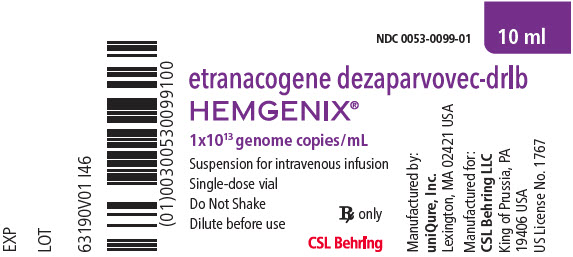
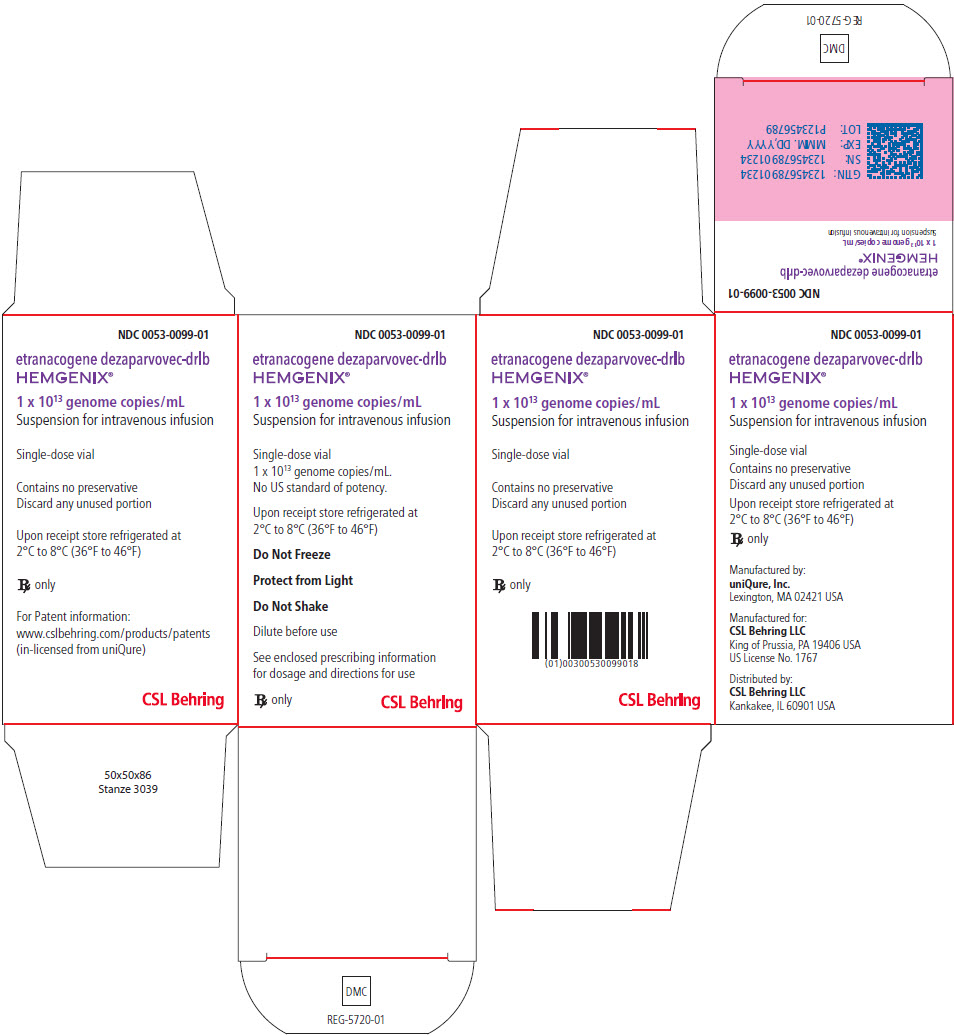
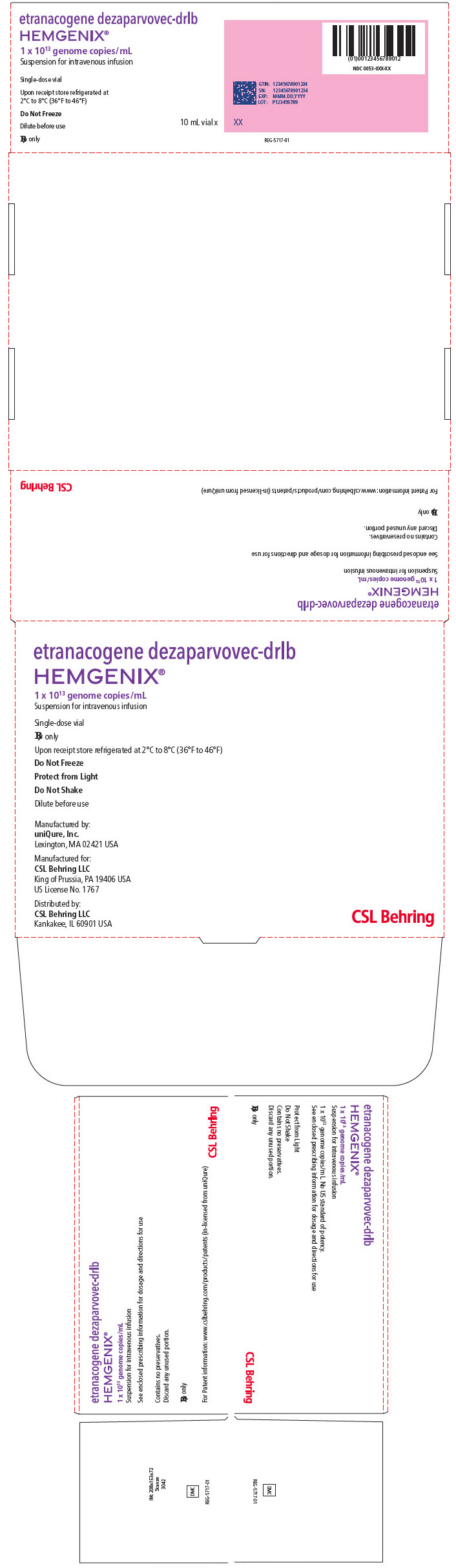
Manufactured by:
uniQure, Inc.
113 Hartwell Avenue
Lexington, MA 02421 USA
Manufactured for:
CSL Behring LLC
King of Prussia, PA 19406, USA
US License No. 1767
Distributed by:
CSL Behring LLC
Kankakee, IL 60901 USA
For Patent information: www.cslbehring.com/products/patents (in-licensed from uniQure)