Chronic Obstructive Pulmonary Disease (COPD) Exacerbations
In a retrospective analysis, during the 10-week blinded portion of the 24-week clinical trial, 6 subjects (20%) of the 30 treated with ZEMAIRA had a total of 7 exacerbations of their chronic obstructive pulmonary disease (COPD). Nine subjects (64%) of the 14 treated with Prolastin had a total of 11 exacerbations of their COPD. The observed difference between groups was 44% (95% confidence interval [CI] from 8% to 70%). Over the entire 24-week treatment period, of the 30 subjects in the ZEMAIRA treatment group, 7 subjects (23%) had a total of 11 exacerbations of their COPD.
In the RAPID study 25 serious exacerbations of COPD were reported in 15 ZEMAIRA subjects vs. 17 such events in 9 placebo subjects, corresponding to rates of 0.146 exacerbations per subject-year with ZEMAIRA and 0.115 exacerbations per subject-year with placebo, (ratio ZEMAIRA:Placebo [95% confidence interval]: 1.256 [0.457 - 3.454]).
Subjects who were randomized to ZEMAIRA in the 2-year RAPID trial who then entered and received open-label ZEMAIRA in the 2 year RAPID extension trial were in the "Early Start" group. Subjects who were randomized to Placebo in the 2-year RAPID trial who then entered and received open-label ZEMAIRA in the 2 year RAPID extension trial were in the "Delayed Start" group. During the RAPID Extension trial 37 serious exacerbations of COPD were reported in 19 subjects (25%) in the Early Start group, corresponding to rates of 0.25 exacerbations per subject-year. In comparison, 20 serious exacerbations were reported in 11 subjects (17%) in the Delayed Start group corresponding to rates of 0.16 exacerbations per subject-year (ratio Early: Delayed [95% confidence interval]: 1.58 [0.68 – 3.66], Table 3). Among the Early Start subjects who entered the RAPID extension trial (N = 76), the exposure adjusted incidence rate of serious exacerbations during the RAPID extension trial (years 3-4) was 0.25 compared to 0.12 for those subjects during the earlier RAPID trial (years 1-2), (ratio RAPID Extension:RAPID: 2.10 [95% confidence interval: 1.21 – 3.67]). Among the Delayed Start subjects who entered the RAPID extension trial (N = 64), the exposure adjusted incidence rate of serious exacerbations during the RAPID extension trial (years 3-4) was 0.16 compared to 0.10 for those subjects during the earlier RAPID trial (years 1-2), (ratio RAPID Extension:RAPID: 1.56 [95% confidence interval: 0.80 – 3.03]).
Table 3. Comparison of Exposure-Adjusted Incidence Rates (EAIR) for Serious COPD Exacerbations Occurring in the RAPID study between ZEMAIRA and Placebo subjects and in the RAPID Extension Studies between Early Start and Delayed Start subjects| Serious COPD Exacerbations Episode = Serious exacerbations of COPD identified by investigators as meeting the Anthonisen criteria1 plus Serious Adverse Event (SAE) terms COPD, Condition Aggravated, Bronchitis, Lower Respiratory Tract Infection, Pneumonia. Serious exacerbation events that overlap or occur within 1 day of one another were counted as single exacerbation episodes. | Episode | n | % | EAIR
(95% CI) | Episode | n | % | EAIR
95% CI | Treatment Ratio for EAIR
(95% CI) |
|---|
N = total number of safety subjects, n = number of subjects within a category, % = (n/N)*100, CI = Confidence Interval.
Subject time at risk: ZEMAIRA = 171.14 years, Placebo = 147.75 years, Early Start Group = 146.46 years, Delay Start Group = 124.71 years.
EAIR = Exposure-Adjusted Incidence Rate (events/subject time at risk). The point estimates and confidence intervals for EAIR values were calculated using negative binomial models. |
RAPID Study
(Years 1 – 2) | ZEMAIRA (N = 93) | Placebo (N = 87) | ZEMAIRA: Placebo |
| 25 | 15 | 16.1 | 0.15 (0.10-0.22) | 17 | 9 | 10.3 | 0.12 (0.07-0.18) | 1.26 (0.46 - 3.45) |
Extension Study
(Years 3-4) | Early Start Early Start Group subjects were randomized to ZEMAIRA during the double-blind RAPID trial (years 1-2) and received open-label ZEMAIRA during the RAPID extension trial (years 3-4). (N = 76) | Delayed Start Delayed Start Group subjects were randomized to Placebo during the double-blind RAPID trial (years 1-2) and received open-label ZEMAIRA during the RAPID extension trial (years 3-4). (N = 64) | Early: Delayed |
| 37 | 19 | 25.0 | 0.25 (0.18 – 0.35) | 20 | 11 | 17.2 | 0.16 (0.10 – 0.25) | 1.58 (0.68 – 3.66) |
In the 24-week double-blind trial, ZEMAIRA-treated subjects were tested for HAV, HBV, HCV, HIV, and parvovirus B19 (B19V), and no evidence of virus transmission was observed.
Risk Summary
No animal reproduction studies have been conducted with Zemaira and its safety for use in human pregnancy has not been established in controlled clinical trials. Since alpha1-proteinase inhibitor is an endogenous human protein, it is considered unlikely that Zemaira will cause harm to the fetus when given at recommended doses. However, Zemaira should be given with caution to pregnant women. In the U.S. general population, the estimated background risk of major birth defect and miscarriage in clinically recognized pregnancies is 2-4% and 15-20%, respectively.
Risk Summary
There is no information regarding the excretion of ZEMAIRA in human milk, the effect on the breastfed infant, or the effects on milk production. The developmental and health benefits of breastfeeding should be considered along with the mother's clinical need for ZEMAIRA and any potential adverse effects on the breastfed infant from ZEMAIRA or from the underlying maternal condition.
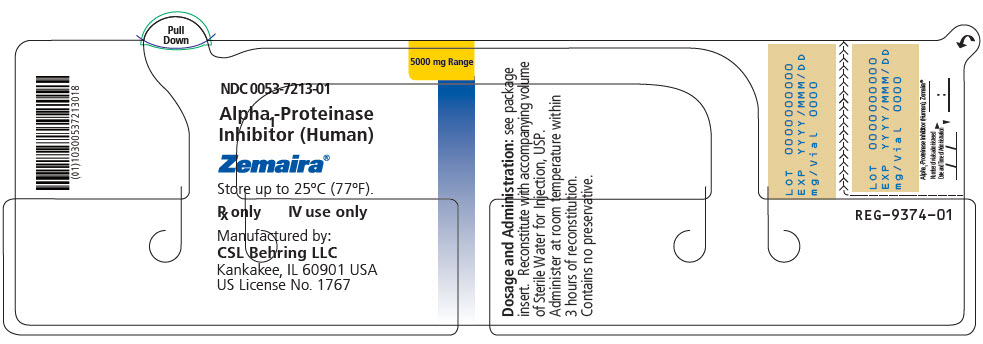
Manufactured by:
CSL Behring LLC
Kankakee, IL 60901 USA
US License No. 1767
For patent information: http://www.cslbehring.com/products/patents
Prolastin is a registered trademark of Grifols Therapeutics Inc.
Mix2Vial® is a registered trademark of West Pharma. Services IL, Ltd., a subsidiary of West Pharmaceuticals Services, Inc.