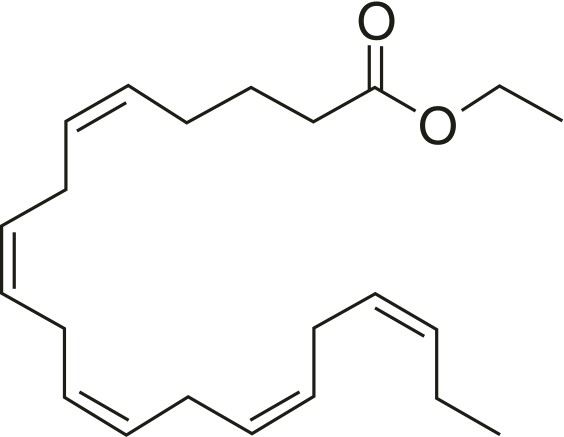
Absorption
After oral administration, icosapent ethyl is de-esterified during the absorption process and the active metabolite EPA is absorbed in the small intestine and enters the systemic circulation mainly via the thoracic duct lymphatic system. Peak plasma concentrations of EPA were reached approximately 5 hours following oral doses of icosapent ethyl.
Icosapent ethyl was administered with or following a meal in all clinical studies; no food effect studies were performed. Take icosapent ethyl with or following a meal.
Distribution
The mean volume of distribution at steady state of EPA is approximately 88 liters. The majority of EPA circulating in plasma is incorporated in phospholipids, triglycerides and cholesteryl esters, and <1% is present as the unesterified fatty acid. Greater than 99% of unesterified EPA is bound to plasma proteins.
Elimination
Metabolism
EPA is mainly metabolized by the liver via beta-oxidation similar to dietary fatty acids. Beta oxidation splits the long carbon chain of EPA into acetyl Coenzyme A, which is converted into energy via the Krebs cycle. Cytochrome P450-mediated metabolism is a minor pathway of elimination of EPA.
Excretion
The total plasma clearance of EPA at steady state is 684 mL/hr. The plasma elimination half-life (t1/2) of EPA is approximately 89 hours. Icosapent ethyl does not undergo renal excretion.
Specific Populations
Gender
When administered icosapent ethyl in clinical trials, plasma total EPA concentrations did not differ significantly between men and women.
Pediatric
The pharmacokinetics of icosapent ethyl has not been studied in pediatric patients.
Hepatic or Renal Impairment
Icosapent ethyl has not been studied in patients with renal or hepatic impairment.
Drug Interaction Studies
Omeprazole: In a drug-drug interaction study with 28 healthy adult subjects, icosapent ethyl 4 g/day at steady-state did not significantly change the steady-state AUCτ or Cmax of omeprazole when co-administered at 40 mg/day to steady-state.
Rosiglitazone: In a drug-drug interaction study with 28 healthy adult subjects, icosapent ethyl 4 g/day at steady-state did not significantly change the single dose AUC or Cmax of rosiglitazone at 8 mg.
Warfarin: In a drug-drug interaction study with 25 healthy adult subjects, icosapent ethyl 4 g/day at steady-state did not significantly change the single dose AUC or Cmax of R- and S-warfarin or the anti-coagulation pharmacodynamics of warfarin when co-administered as racemic warfarin at 25 mg.
Atorvastatin: In a drug-drug interaction study of 26 healthy adult subjects, icosapent ethyl 4 g/day at steady-state did not significantly change the steady-state AUCτ or Cmax of atorvastatin, 2-hydroxyatorvastatin, or 4-hydroxyatorvastatin when co-administered with atorvastatin 80 mg/day at steady-state.