Butalbital, Acetaminophen, Caffeine And Codeine Phosphate Capsule
FDA Label NDC 0054-0650

52 label sections · Submitted to the FDA by Hikma Pharmaceuticals Usa Inc. · Indications, Dosage, Usage, and Precautions

Structured Product Label

The following Structured Product Label (SPL) was submitted to the FDA by Hikma Pharmaceuticals Usa Inc. for the product Butalbital, Acetaminophen, Caffeine And Codeine Phosphate (NDC 0054-0650). This document serves as the official prescribing information, containing essential scientific data and clinical materials required for healthcare providers and patients.

This specific version of the label includes detailed information regarding warning: serious and life-threatening risks from use of butalbital, acetaminophen, caffeine, and codeine phosphate capsules, 1 indications and usage, 2.1 important dosage and administration instructions, 2.2 patient access to an opioid overdose reversal agent for the emergency treatment of opioid overdose, 2.3 dosing information, 2.4 titration and maintenance of therapy, 2.5 safe reduction or discontinuation of butalbital, acetaminophen, caffeine, and codeine phosphate capsules, 3 dosage forms and strengths, and other regulatory disclosures. Use the navigation below to review specific sections of the FDA submission.

Label Section Quick Index

2.2 Patient Access To An Opioid Overdose Reversal Agent For The Emergency Treatment Of Opioid Overdose

Inform patients and caregivers about opioid overdose reversal agents (e.g., naloxone, nalmefene). Discuss the importance of having access to an opioid overdose reversal agent, especially if the patient has risk factors for overdose (e.g., concomitant use of CNS depressants, a history of opioid use disorder, or prior opioid overdose) or if there are household members (including children) or other close contacts at risk for accidental ingestion or opioid overdose. The presence of risk factors for overdose should not prevent the management of pain in any patient [see Warnings and Precautions (5.1, 5.2, 5.3)].

Discuss the options for obtaining an opioid overdose reversal agent (e.g., prescription, over-the-counter, or as part of a community-based program) [see Warnings and Precautions (5.2)].

There are important differences among the opioid overdose reversal agents, such as route of administration, product strength, approved patient age range, and pharmacokinetics. Be familiar with these differences, as outlined in the approved labeling for those products, prior to recommending or prescribing such an agent.

2.4 Titration And Maintenance Of Therapy

Individually titrate Butalbital, Acetaminophen, Caffeine, and Codeine Phosphate Capsules to a dose that provides adequate analgesia and minimizes adverse reactions. Continually reevaluate patients receiving Butalbital, Acetaminophen, Caffeine, and Codeine Phosphate Capsules to assess the maintenance of pain control, signs and symptoms of opioid withdrawal, and other adverse reactions, as well as to reassess for the development of addiction, abuse, or misuse [see Warnings and Precautions (5.1, 5.18)]. Frequent communication is important among the prescriber, other members of the healthcare team, the patient, and the caregiver/family during periods of changing analgesic requirements, including initial titration.

If the level of pain increases after dosage stabilization, attempt to identify the source of increased pain before increasing the Butalbital, Acetaminophen, Caffeine, and Codeine Phosphate Capsules dosage. If after increasing the dosage, unacceptable opioid-related adverse reactions are observed (including an increase in pain after a dosage increase), consider reducing the dosage [see Warnings and Precautions (5)]. Adjust the dosage to obtain an appropriate balance between management of pain and opioid-related adverse reactions.

2.5 Safe Reduction Or Discontinuation Of Butalbital, Acetaminophen, Caffeine, And Codeine Phosphate Capsules

Do not rapidly reduce or abruptly discontinue Butalbital, Acetaminophen, Caffeine, and Codeine Phosphate Capsules in patients who may be physically dependent on opioids. Rapid reduction or abrupt discontinuation of opioid analgesics in patients who are physically dependent on opioids has resulted in serious withdrawal symptoms, uncontrolled pain, and suicide. Rapid reduction or abrupt discontinuation has also been associated with attempts to find other sources of opioid analgesics, which may be confused with drug-seeking for abuse. Patients may also attempt to treat their pain or withdrawal symptoms with illicit opioids, such as heroin, and other substances.

When a decision has been made to decrease the dose or discontinue therapy in an opioid-dependent patient taking Butalbital, Acetaminophen, Caffeine, and Codeine Phosphate Capsules, there are a variety of factors that should be considered, including the total daily dose of opioid (including Butalbital, Acetaminophen, Caffeine, and Codeine Phosphate Capsules) the patient has been taking, the duration of treatment, the type of pain being treated, and the physical and psychological attributes of the patient. It is important to ensure ongoing care of the patient and to agree on an appropriate tapering schedule and follow-up plan so that patient and provider goals and expectations are clear and realistic. When opioid analgesics are being discontinued due to a suspected substance use disorder, evaluate and treat the patient, or refer for evaluation and treatment of the substance use disorder. Treatment should include evidence-based approaches, such as medication-assisted treatment of opioid use disorder. Complex patients with co-morbid pain and substance use disorders may benefit from referral to a specialist.

There are no standard opioid tapering schedules that are suitable for all patients. Good clinical practice dictates a patient-specific plan to taper the dose of the opioid gradually. For patients on Butalbital, Acetaminophen, Caffeine, and Codeine Phosphate Capsules who are physically opioid-dependent, initiate the taper by a small enough increment (e.g., no greater than 10% to 25% of the total daily dose) to avoid withdrawal symptoms, and proceed with dose-lowering at an interval of every 2 to 4 weeks. Patients who have been taking opioids for briefer periods of time may tolerate a more rapid taper.

It may be necessary to provide the patient with lower dosage strengths to accomplish a successful taper. Reassess the patient frequently to manage pain and withdrawal symptoms, should they emerge. Common withdrawal symptoms include restlessness, lacrimation, rhinorrhea, yawning, perspiration, chills, myalgia, and mydriasis. Other signs and symptoms also may develop, including irritability, anxiety, backache, joint pain, weakness, abdominal cramps, insomnia, nausea, anorexia, vomiting, diarrhea, or increased blood pressure, respiratory rate, or heart rate. If withdrawal symptoms arise, it may be necessary to pause the taper for a period of time or raise the dose of the opioid analgesic to the previous dose, and then proceed with a slower taper. In addition, evaluate patients for any changes in mood, emergence of suicidal thoughts, or use of other substances.

When managing patients taking opioid analgesics, particularly those who have been treated for an extended period of time and/or with high doses for chronic pain, ensure that a multimodal approach to pain management, including mental health support (if needed), is in place prior to initiating an opioid analgesic taper. A multimodal approach to pain management may optimize the treatment of chronic pain, as well as assist with the successful tapering of the opioid analgesic [see Warnings and Precautions (5.18), Drug Abuse and Dependence (9.3)].

5.7 Risks Of Interactions With Drugs Affecting Cytochrome P450 Isoenzymes

The effects of concomitant use or discontinuation of cytochrome P450 3A4 inducers, 3A4 inhibitors, or 2D6 inhibitors with codeine are complex. Use of cytochrome P450 3A4 inducers, 3A4 inhibitors, or 2D6 inhibitors with Butalbital, Acetaminophen, Caffeine, and Codeine Phosphate Capsules require careful consideration of the effects on codeine and the active metabolite, morphine.

  • Cytochrome P450 3A4 Interaction
  •  The concomitant use of Butalbital, Acetaminophen, Caffeine, and Codeine Phosphate Capsules with all cytochrome P450 3A4 inhibitors, such as macrolide antibiotics (e.g., erythromycin), azole-antifungal agents (e.g., ketoconazole), and protease inhibitors (e.g., ritonavir) or discontinuation of a cytochrome P450 3A4 inducer such as rifampin, carbamazepine, and phenytoin, may result in an increase in codeine plasma concentrations with subsequently greater metabolism by cytochrome P450 2D6, resulting in greater morphine levels, which could increase or prolong adverse reactions and may cause potentially fatal respiratory depression.
  •  The concomitant use of Butalbital, Acetaminophen, Caffeine, and Codeine Phosphate Capsules with all cytochrome P450 3A4 inducers or discontinuation of a cytochrome P450 3A4 inhibitor may result in lower codeine levels, greater norcodeine levels, and less metabolism via 2D6 with resultant lower morphine levels. This may be associated with a decrease in efficacy, and in some patients, may result in signs and symptoms of opioid withdrawal.
  •  Evaluate patients receiving Butalbital, Acetaminophen, Caffeine, and Codeine Phosphate Capsules and any CYP3A4 inhibitor or inducer at frequent intervals for signs and symptoms that may reflect opioid toxicity and opioid withdrawal when Butalbital, Acetaminophen, Caffeine, and Codeine Phosphate Capsules are used in conjunction with inhibitors and inducers of CYP3A4.
  •  If concomitant use of a CYP3A4 inhibitor is necessary or if a CYP3A4 inducer is discontinued, consider dosage reduction of Butalbital, Acetaminophen, Caffeine, and Codeine Phosphate Capsules until stable drug effects are achieved. Evaluate patients at frequent intervals for respiratory depression and sedation.
  •  If concomitant use of a CYP3A4 inducer is necessary or if a CYP3A4 inhibitor is discontinued, consider increasing the Butalbital, Acetaminophen, Caffeine, and Codeine Phosphate Capsules dosage until stable drug effects are achieved. Evaluate patients at frequent intervals for signs of opioid withdrawal [see Drug Interactions (7)].
  • Risks of Concomitant Use or Discontinuation of Cytochrome P450 2D6 Inhibitors
  •  The concomitant use of Butalbital, Acetaminophen, Caffeine, and Codeine Phosphate Capsules with all cytochrome P450 2D6 inhibitors (e.g., amiodarone, quinidine) may result in an increase in codeine plasma concentrations and a decrease in active metabolite morphine plasma concentration which could result in an analgesic efficacy reduction or symptoms of opioid withdrawal.
  •  Discontinuation of a concomitantly used cytochrome P450 2D6 inhibitor may result in a decrease in codeine plasma concentration and an increase in active metabolite morphine plasma concentration which could increase or prolong adverse reactions and may cause potentially fatal respiratory depression.
  •  Evaluate patients receiving Butalbital, Acetaminophen, Caffeine, and Codeine Phosphate Capsules and any CYP2D6 inhibitor at frequent intervals for signs and symptoms that may reflect opioid toxicity and opioid withdrawal when Butalbital, Acetaminophen, Caffeine, and Codeine Phosphate Capsules are used in conjunction with inhibitors of CYP2D6.
  •  If concomitant use with a CYP2D6 inhibitor is necessary, evaluate patients at frequent intervals for signs of reduced efficacy or opioid withdrawal and consider increasing the Butalbital, Acetaminophen, Caffeine, and Codeine Phosphate Capsules dosage. After stopping use of a CYP2D6 inhibitor, consider reducing the Butalbital, Acetaminophen, Caffeine, and Codeine Phosphate Capsules dosage and evaluate patients at frequent intervals for signs and symptoms of respiratory depression or sedation [see Drug Interactions (7)].

5.9 Opioid-Induced Hyperalgesia And Allodynia

Opioid-Induced Hyperalgesia (OIH) occurs when an opioid analgesic paradoxically causes an increase in pain, or an increase in sensitivity to pain. This condition differs from tolerance, which is the need for increasing doses of opioids to maintain a defined effect [see Dependence (9.3)].

Symptoms of OIH include (but may not be limited to) increased levels of pain upon opioid dosage increase, decreased levels of pain upon opioid dosage decrease, or pain from ordinarily non-painful stimuli (allodynia). These symptoms may suggest OIH only if there is no evidence of underlying disease progression, opioid tolerance, opioid withdrawal, or addictive behavior.

Cases of OIH have been reported, both with short-term and longer-term use of opioid analgesics. Though the mechanism of OIH is not fully understood, multiple biochemical pathways have been implicated. Medical literature suggests a strong biologic plausibility between opioid analgesics and OIH and allodynia. If a patient is suspected to be experiencing OIH, carefully consider appropriately decreasing the dose of the current opioid analgesic or opioid rotation (safely switching the patient to a different opioid moiety) [see Dosage and Administration (2.5), Warnings and Precautions (5.18)].

Spl Medguide

Medication Guide

Butalbital, Acetaminophen, Caffeine, and Codeine Phosphate Capsules, CIII

Butalbital, Acetaminophen, Caffeine, and Codeine Phosphate Capsules are:

  • A strong prescription pain medicine that contains an opioid (narcotic) that is indicated for the relief of the symptom complex of tension (or muscle contraction) headache, when other pain treatments such as non-opioid pain medicines do not treat your pain well enough or you cannot tolerate them.
  • An opioid pain medicine that can put you at risk for overdose and death. Even if you take your dose correctly as prescribed you are at risk for opioid addiction, abuse, and misuse that can lead to death.

Important information about Butalbital, Acetaminophen, Caffeine, and Codeine Phosphate Capsules:

  • Get emergency help or call 911 right away if you take too much Butalbital, Acetaminophen, Caffeine, and Codeine Phosphate Capsules (overdose). When you first start taking Butalbital, Acetaminophen, Caffeine, and Codeine Phosphate Capsules, when your dose is changed, or if you take too much (overdose), serious or life-threatening breathing problems that can lead to death may occur. Ask your healthcare provider about medicines like naloxone or nalmefene that can be used in an emergency to reverse an opioid overdose.
  • Taking Butalbital, Acetaminophen, Caffeine, and Codeine Phosphate Capsules with other opioid medicines, benzodiazepines, gabapentinoids (gabapentin or pregabalin), alcohol, or other central nervous system depressants (including street drugs) can cause severe drowsiness, decreased awareness, breathing problems, coma, and death.
  • Never give anyone else your Butalbital, Acetaminophen, Caffeine, and Codeine Phosphate Capsules. They could die from taking it. Selling or giving away Butalbital, Acetaminophen, Caffeine, and Codeine Phosphate Capsules is against the law.
  • Store Butalbital, Acetaminophen, Caffeine, and Codeine Phosphate Capsules securely, out of sight and reach of children, and in a location not accessible by others, including visitors to the home.
  • Get emergency help right away if you take more than 4,000 mg of acetaminophen in 1 day. Taking Butalbital, Acetaminophen, Caffeine, and Codeine Phosphate Capsules with other products that contain acetaminophen can lead to serious liver problems and death.

Important Information Guiding Use in Pediatric Patients:

  • Do not give Butalbital, Acetaminophen, Caffeine, and Codeine Phosphate Capsules to a child younger than 12 years of age.
  • Do not give Butalbital, Acetaminophen, Caffeine, and Codeine Phosphate Capsules to a child younger than 18 years of age after surgery to remove the tonsils and/or adenoids.
  • Avoid giving Butalbital, Acetaminophen, Caffeine, and Codeine Phosphate Capsules to children between 12 to 18 years of age who have risk factors for breathing problems such as obstructive sleep apnea, obesity, or underlying lung problems.

Do not take Butalbital, Acetaminophen, Caffeine, and Codeine Phosphate Capsules if you have:

  • severe asthma, trouble breathing, or other lung problems.
  • a bowel blockage or have narrowing of the stomach or intestines.

Before taking Butalbital, Acetaminophen, Caffeine, and Codeine Phosphate Capsules, tell your healthcare provider if you have a history of:

  • head injury, seizures
  • problems urinating
  • liver, kidney, thyroid problems
  • pancreas or gall bladder problems
  • abuse of street or prescription drugs, alcohol addiction, opioid overdose, or mental health problems
  • have been told by your healthcare provider that you are a “rapid metabolizer” of certain medicines

Tell your healthcare provider if you are:

  • Noticing your pain getting worse. If your pain gets worse after you take Butalbital, Acetaminophen, Caffeine, and Codeine Phosphate Capsules, do not take more of Butalbital, Acetaminophen, Caffeine, and Codeine Phosphate Capsules without first talking to your healthcare provider. Talk to your healthcare provider if the pain that you have increases, if you feel more sensitive to pain, or if you have new pain after taking Butalbital, Acetaminophen, Caffeine, and Codeine Phosphate Capsules.
  • pregnant or planning to become pregnant. Use of Butalbital, Acetaminophen, Caffeine, and Codeine Phosphate Capsules for an extended period of time during pregnancy can cause withdrawal symptoms in your newborn baby that could be life-threatening if not recognized and treated.
  • breastfeeding. Not recommended during treatment with Butalbital, Acetaminophen, Caffeine, and Codeine Phosphate Capsules; may harm your baby.
  • living in a household where there are small children or someone who has abused street or prescription drugs.
  • taking prescription or over-the-counter medicines, vitamins, or herbal supplements. Taking Butalbital, Acetaminophen, Caffeine, and Codeine Phosphate Capsules with certain other medicines can cause serious side effects that could lead to death.

When taking Butalbital, Acetaminophen, Caffeine, and Codeine Phosphate Capsules:

  • Do not change your dose. Take Butalbital, Acetaminophen, Caffeine, and Codeine Phosphate Capsules exactly as prescribed by your healthcare provider. Use the lowest dose possible for the shortest time needed.
  • For acute (short-term) pain, you may only need to take Butalbital, Acetaminophen, Caffeine, and Codeine Phosphate Capsules for a few days. You may have some Butalbital, Acetaminophen, Caffeine, and Codeine Phosphate Capsules left over that you did not use. See disposal information at the bottom of this section for directions on how to safely throw away (dispose of) your unused Butalbital, Acetaminophen, Caffeine, and Codeine Phosphate Capsules.
  • Take your prescribed dose of 1 or 2 capsules every 4 hours. Total daily dosage should not exceed 6 capsules. Do not take more than your prescribed dose. If you miss a dose, take your next dose at your usual time.
  • Call your healthcare provider if the dose you are taking does not control your pain.
  • If you have been taking Butalbital, Acetaminophen, Caffeine, and Codeine Phosphate Capsules regularly, do not stop taking Butalbital, Acetaminophen, Caffeine, and Codeine Phosphate Capsules without talking to your healthcare provider.
  • After you stop taking Butalbital, Acetaminophen, Caffeine, and Codeine Phosphate Capsules, dispose the unused Butalbital, Acetaminophen, Caffeine, and Codeine Phosphate Capsules in accordance with the local state guidelines and/or regulations.
  • Dispose of expired, unwanted, or unused Butalbital, Acetaminophen, Caffeine, and Codeine Phosphate Capsules by taking your drug to an authorized DEA-registered collector or drug take-back program. If one is not available, you can dispose of Butalbital, Acetaminophen, Caffeine, and Codeine Phosphate Capsules by mixing the product with dirt, cat litter, or coffee grounds; placing the mixture in a sealed plastic bag, and throwing the bag in your trash. Visit www.fda.gov/drugdisposal for additional information on disposal of unused medicines.

While taking Butalbital, Acetaminophen, Caffeine, and Codeine Phosphate Capsules DO NOT:

  • Drive or operate heavy machinery, until you know how Butalbital, Acetaminophen, Caffeine, and Codeine Phosphate Capsules affect you. Butalbital, Acetaminophen, Caffeine, and Codeine Phosphate Capsules can make you sleepy, dizzy, or lightheaded.
  • Drink alcohol or use prescription or over-the-counter medicines that contain alcohol. Using products containing alcohol during treatment with Butalbital, Acetaminophen, Caffeine, and Codeine Phosphate Capsules may cause you to overdose and die.

The possible side effects of Butalbital, Acetaminophen, Caffeine, and Codeine Phosphate Capsules:

  • constipation, nausea, sleepiness, vomiting, tiredness, headache, dizziness, abdominal pain. Call your healthcare provider if you have any of these symptoms and they are severe.
  • Get emergency medical help or call 911 right away if you:

    • have trouble breathing, shortness of breath, fast heartbeat, chest pain, swelling of your face, tongue, or throat, extreme drowsiness, light-headedness when changing positions, feeling faint, agitation, high body temperature, trouble walking, stiff muscles, or mental changes such as confusion.
    • are a nursing mother taking Butalbital, Acetaminophen, Caffeine, and Codeine Phosphate Capsules, and your breastfeeding baby has increased sleepiness, confusion, difficulty breathing, shallow breathing, limpness, or difficulty breastfeeding.
    • These are not all the possible side effects of Butalbital, Acetaminophen, Caffeine, and Codeine Phosphate Capsules. Call your doctor for medical advice about side effects. You may report side effects to FDA at 1-800-FDA-1088. For more information go to dailymed.nlm.nih.gov

      Distributed by:

      Hikma Pharmaceuticals USA Inc.

      Berkeley Heights, NJ 07922

      C50001007/03

      Revised January 2026

      This Medication Guide has been approved by the U.S. Food and Drug Administration.

Package/Label Principal Display Panel

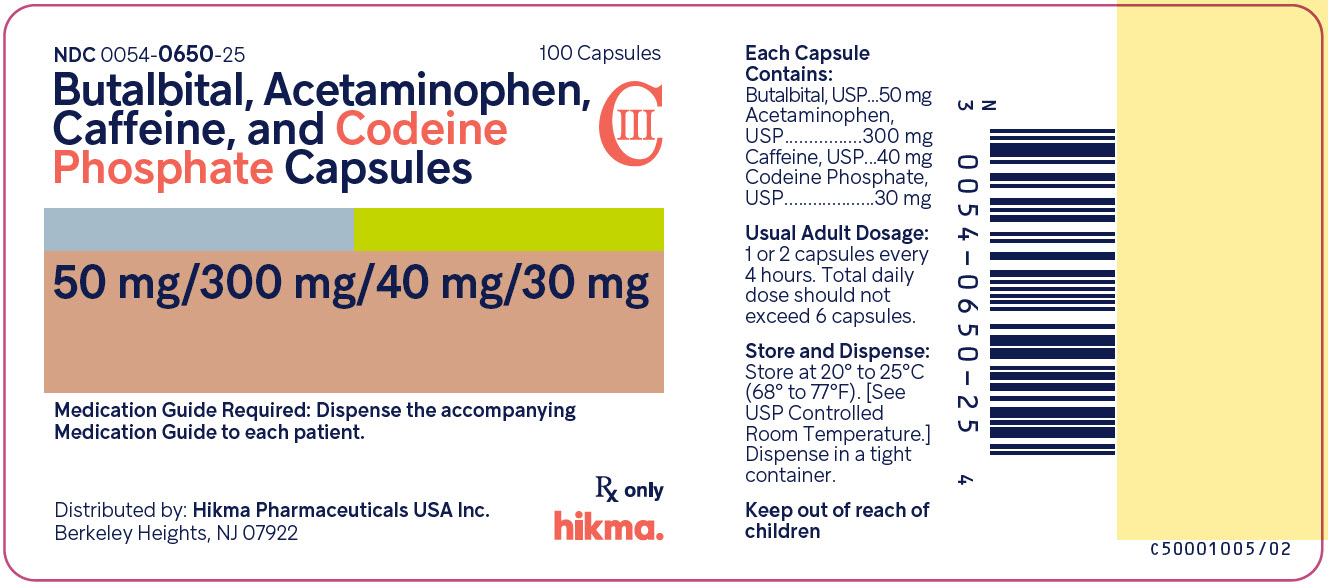
NDC 0054-0650-25 100 Capsules
Butalbital, Acetaminophen,
Caffeine, and Codeine
Phosphate Capsules
CIII
50 mg/300 mg/40 mg/30 mg
Rx only

50mg-300mg-40mg-30mg Bottle Label Image (300mg Bottle Label)

50mg-300mg-40mg-30mg Bottle Label Image (300mg Bottle Label)

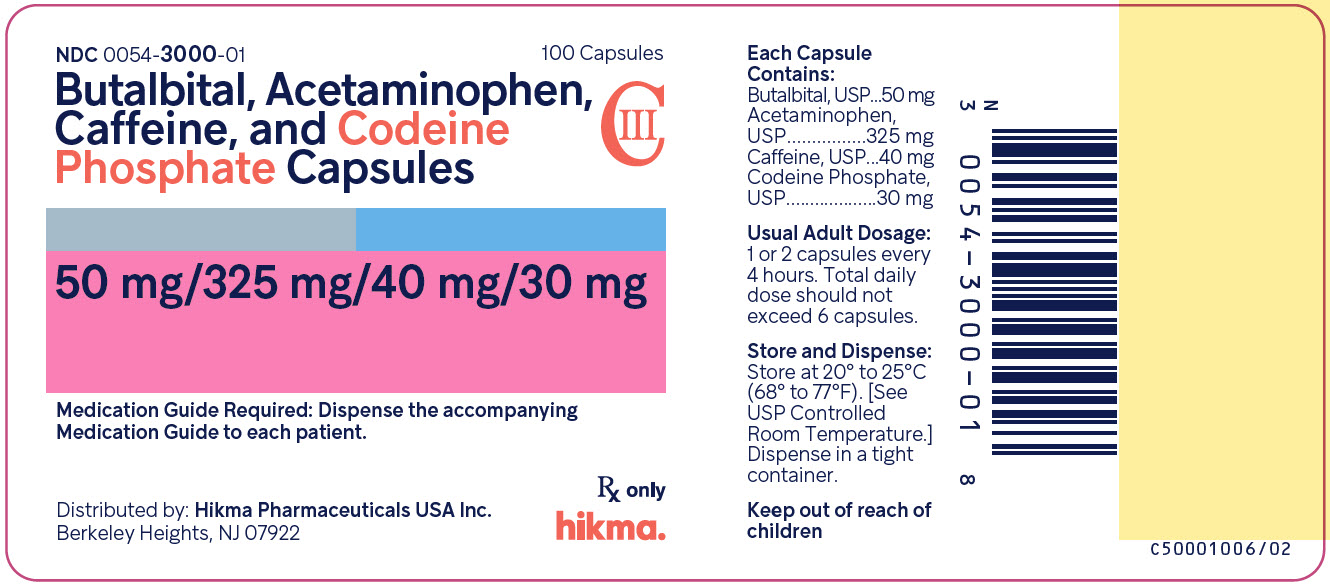
NDC 0054-3000-01 100 Capsules
Butalbital, Acetaminophen,
Caffeine, and Codeine
Phosphate Capsules
CIII
50 mg/325 mg/40 mg/30 mg
Rx only

50mg-325mg-40mg-30mg Bottle Label Image (325mg Bottle Label)

50mg-325mg-40mg-30mg Bottle Label Image (325mg Bottle Label)

* Please review the disclaimer below.