Progesterone Capsule
Product Images NDC 0054-0830
View Photos of Packaging, Regulatory Labels, and Product Appearance
Product Visual Gallery
This gallery contains 12 technical images submitted to the FDA as part of the official labeling for Progesterone (NDC 0054-0830). Unlike standard consumer photos, these assets often include clinical data figures, molecular chemical structures, and official manufacturer packaging layouts.
As provided by Hikma Pharmaceuticals Usa Inc, these visuals offer a comprehensive scientific overview of the product's physical and chemical identity, aiding pharmacists and researchers in product verification and study.
Product Images & Figures Index
Table 1 (Progesterone Capsules 02)
This is information regarding the Pharmacokinetic Parameters of Progesterone, showing data for different dosages of Progesterone capsules. The table includes parameters such as Cmax, Tmax, and AUC values for daily doses of 100mg, 200mg, and 300mg. The data provides insight into how the drug is absorbed, distributed, metabolized, and eliminated in the body at different dosage levels.*
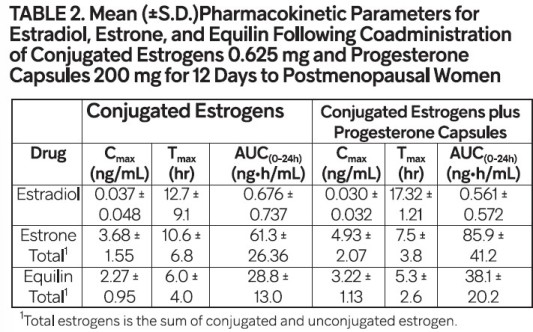
Table 2 (Progesterone Capsules 03)
This text provides a table showing the mean pharmacokinetic parameters for Estradiol, Estrone, and Equilin in postmenopausal women after the coadministration of Conjugated Estrogens 0.625mg and Progesterone Capsules 200mg for 12 days. It includes data on parameters such as AUC (Area Under the Curve) and drug levels in ng/mL over certain time intervals. The table also clarifies that total estrogens consist of both conjugated and unconjugated estrogen levels.*
Table 3 (Progesterone Capsules 04)
This is a table displaying the incidence of endometrial hyperplasia in women who received 3 years of treatment with different hormonal regimens. The treatments included Conjugated Estrogens (0.625 mg) alone, Conjugated Estrogens (0.625 mg) + Progesterone (alone) capsules (200 mg), and Placebo. The table shows the number and percentage of patients in each treatment group who were diagnosed with different types of hyperplasia, including Simple Hyperplasia, Atypical Hyperplasia, and Adenocarcinoma. The text also notes the order of severity based on the diagnoses, with Adenocarcinoma being the most advanced result.*
Figure 1 (Progesterone Capsules 05)
This is a graph labeled "FIGURE 1 Time to Hyperplasia in Women Receiving up to 3 Months of Treatment". The graph shows data related to the time it takes for hyperplasia to occur in women undergoing treatment for up to 3 months. It appears to display the number of patients remaining at each time interval.*
Table 4 (Progesterone Capsules 06)
This table provides information on the discontinuation rate due to hyperplasia over 36 months of treatment with conjugated progesterone and placebo. The most advanced biopsy results include adenocarcinoma, atypical hyperplasia, complex hyperplasia, and simple hyperplasia. It shows the number and percentage of patients in each category for each treatment group.*
Table 5 (Progesterone Capsules 07)
This text provides a detailed table showing the relative and absolute risks observed in the Estrogen Plus Progestin Substudy of WHI over an average of 5.6 years. It includes information on various health events such as coronary heart disease events, strokes, venous thrombosis, fractures, cancers, and mortality rates. The data is presented as relative risk, absolute risk per 10,000 women-years, and confidence intervals. The table also mentions the Global Index, which is a combination of specific health events. The information presented here is adapted from multiple publications related to the WHI study and provides valuable insights into the risks associated with estrogen plus progestin use.*
Table 6 (Progesterone Capsules 08)
This is a table showing adverse reactions reported in a 875-patient placebo-controlled trial in postmenopausal individuals over a 3-year period. Adverse reactions include headache, breast tenderness, joint pain, depression, dizziness, abdominal bloating, abdominal pain, vaginal discharge, nausea/vomiting, and worry.*
Table 6 (Progesterone Capsules 09)
This text contains a list of potential symptoms, conditions, and medical procedures related to chest pain, diarrhea, night sweats, breast pain, swelling of hands and feet, vaginal dryness, constipation, breast carcinoma, breast excisional biopsy, and cholecystectomy. It also includes some unclear abbreviations at the end.*
Table 7 (Progesterone Capsules 0a)
This is a table showing the adverse reactions reported in patients using 400mg/day in a placebo-controlled trial with estrogen-primed postmenopausal women. The table lists various adverse experiences along with the percentage of patients affected by each reaction. Common reactions include abdominal pain, fatigue, diarrhea, and headache. This data can be used to assess the frequency and types of adverse effects associated with the use of progesterone capsules.*
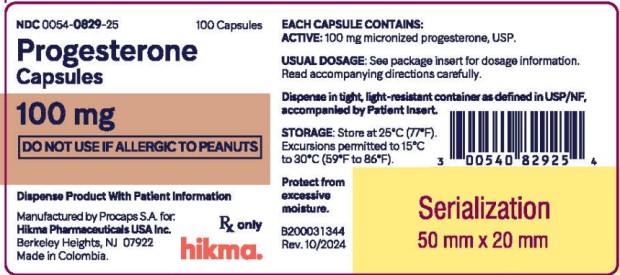
Ndc 0054-0829-25progesteronecapsules100 mgdo Not Use If Allergic To Peanuts100 Capsules (Progesterone Capsules 0b)
This description includes information about a progesterone capsule with a dosage of 100 mg, with a caution for individuals allergic to peanuts. It also mentions the manufacturer being Procaps SA for Hikma Pharmaceuticals USA Inc. The usual dosage instructions and storage conditions are provided, along with details on the active ingredient and the need to dispense the product with patient information.*
Ndc 0054-0830-25progesteronecapsules200 mgdo Not Use If Allergic To Peanuts100 Capsules (Progesterone Capsules 0c)
Description: The text provides information about NDC0054-0830-25 capsules, each containing 200 mg micronized progesterone, USP, with a usual dosage recommended. It is advised to store the capsules in a tight, light-resistant container at temperatures between 15°C to 30°C (59°F to 86°F) as per USP/NF guidelines. The text also mentions serialization details and a revision date of October 2024.*
* These product label images have been analyzed using experimental machine learning. Please verify findings with the primary label text.