Previously Untreated ALK-Positive Metastatic NSCLC - Study 1
The data in Table 3 are derived from 340 patients with ALK-positive metastatic NSCLC who had not received previous systemic treatment for advanced disease who received treatment in a randomized, multicenter, open-label, active-controlled trial (Study 1). Patients in the XALKORI arm (n=171) received XALKORI 250 mg orally twice daily until documented disease progression, intolerance to therapy, or the investigator determined that the patient was no longer experiencing clinical benefit. A total of 169 patients in the chemotherapy arm received pemetrexed 500 mg/m2 in combination with cisplatin 75 mg/m2 (n=91) or carboplatin at a dose calculated to produce an area under the concentration-time curve (AUC) of 5 or 6 mg min/mL (n=78). Chemotherapy was given by intravenous infusion every 3 weeks for up to 6 cycles, in the absence of dose-limiting chemotherapy-related toxicities. After 6 cycles, patients remained on study with no additional anticancer treatment, and tumor assessments continued until documented disease progression.
The median duration of study treatment was 10.9 months for patients in the XALKORI arm and 4.1 months for patients in the chemotherapy arm. Median duration of treatment was 5.2 months for patients who received XALKORI after cross over from chemotherapy. Across the 340 patients who were treated in Study 1, the median age was 53 years; 16% of patients were older than 65 years. A total of 62% of patients were female and 46% were Asian.
Serious adverse events were reported in 58 patients (34%) treated with XALKORI. The most frequent serious adverse events reported in patients treated with XALKORI were dyspnea (4.1%) and pulmonary embolism (2.9%). Fatal adverse events in XALKORI-treated patients occurred in 2.3% patients, consisting of septic shock, acute respiratory failure, and diabetic ketoacidosis.
Dose reductions due to adverse reactions were required in 6.4% of XALKORI-treated patients. The most frequent adverse reactions that led to dose reduction in these patients were nausea (1.8%) and elevated transaminases (1.8%).
Permanent discontinuation of XALKORI treatment for adverse reactions was 8.2%. The most frequent adverse reactions that led to permanent discontinuation in XALKORI-treated patients were elevated transaminases (1.2%), hepatotoxicity (1.2%), and ILD (1.2%).
Tables 3 and 4 summarize common adverse reactions and laboratory abnormalities in XALKORI-treated patients.
Table 3. Adverse Reactions Reported at a Higher Incidence (≥5% Higher for All Grades or ≥2% Higher for Grades 3–4) with XALKORI than Chemotherapy in Study 1Adverse reactions were graded using NCI CTCAE version 4.0.
Includes cases reported within the clustered terms:
| Adverse Reaction | XALKORI
(N=171) | Chemotherapy (Pemetrexed/Cisplatin or Pemetrexed/Carboplatin)
(N=169) |
|---|
All Grades
(%) | Grade 3–4
(%) | All Grades
(%) | Grade 3–4
(%) |
|---|
| Cardiac Disorders | | | | |
| Electrocardiogram QT prolonged | 6 | 2 | 2 | 0 |
| Bradycardia Bradycardia (Bradycardia, Sinus bradycardia). | 14 | 1 | 1 | 0 |
| Eye Disorders | | | | |
| Vision disorder Vision Disorder (Diplopia, Photophobia, Photopsia, Reduced visual acuity, Blurred vision, Vitreous floaters, Visual impairment). | 71 | 1 | 10 | 0 |
| Gastrointestinal Disorders | | | | |
| Vomiting | 46 | 2 | 36 | 3 |
| Diarrhea | 61 | 2 | 13 | 1 |
| Constipation | 43 | 2 | 30 | 0 |
| Dyspepsia | 14 | 0 | 2 | 0 |
| Dysphagia | 10 | 1 | 2 | 1 |
| Abdominal pain Abdominal pain (Abdominal discomfort, Abdominal pain, Lower abdominal pain, Upper abdominal pain, Abdominal tenderness). | 26 | 0 | 12 | 0 |
| Esophagitis Esophagitis (Esophagitis, Esophageal ulcer). | 6 | 2 | 1 | 0 |
| General Disorders and Administration Site Conditions | | | | |
| Edema Edema (Edema, Peripheral edema, Face edema, Generalized edema, Local swelling, Periorbital edema). | 49 | 1 | 12 | 1 |
| Pyrexia | 19 | 0 | 11 | 1 |
| Infections and Infestations | | | | |
| Upper respiratory infection Upper respiratory infection (Nasopharyngitis, Pharyngitis, Rhinitis, Upper respiratory tract infection). | 32 | 0 | 12 | 1 |
| Investigations | | | | |
| Increased weight | 8 | 1 | 2 | 0 |
| Musculoskeletal and Connective Tissue Disorders | | | | |
| Pain in extremity | 16 | 0 | 7 | 0 |
| Muscle spasm | 8 | 0 | 2 | 1 |
| Nervous System Disorders | | | | |
| Dizziness Dizziness (Balance disorder, Dizziness, Postural dizziness, Presyncope). | 18 | 0 | 10 | 1 |
| Dysgeusia | 26 | 0 | 5 | 0 |
| Headache | 22 | 1 | 15 | 0 |
Additional adverse reactions occurring at an overall incidence between 1% and 60% in patients treated with XALKORI included nausea (56%), decreased appetite (30%), fatigue (29%), neuropathy (21%; gait disturbance, hypoesthesia, muscular weakness, neuralgia, neuropathy peripheral, paresthesia, peripheral sensory neuropathy, polyneuropathy, sensory disturbance), rash (11%), renal cyst (5%), ILD (1%; ILD, pneumonitis), syncope (1%), and decreased blood testosterone (1%; hypogonadism).
Table 4. Laboratory Abnormalities with Grade 3 or 4 Incidence of ≥4% in XALKORI-Treated Patients in Study 1| Laboratory Abnormality | XALKORI | Chemotherapy |
|---|
| Any Grade
(%) | Grade 3–4
(%) | Any Grade
(%) | Grade 3–4
(%) |
|---|
| Additional laboratory test abnormality in patients treated with XALKORI was an increase in creatinine (Any Grade: 99%; Grade 3: 2%; Grade 4: 0%) compared to the chemotherapy arm (Any Grade: 92%; Grade 3: 0%; Grade 4: 1%). |
| Hematology | | | | |
| Neutropenia | 52 | 11 | 59 | 16 |
| Lymphopenia | 48 | 7 | 53 | 13 |
| Chemistry | | | | |
| ALT elevation | 79 | 15 | 33 | 2 |
| AST elevation | 66 | 8 | 28 | 1 |
| Hypophosphatemia | 32 | 10 | 21 | 6 |
Previously Treated ALK-Positive Metastatic NSCLC - Study 2
The data in Table 5 are derived from 343 patients with ALK-positive metastatic NSCLC enrolled in a randomized, multicenter, active-controlled, open-label trial (Study 2). Patients in the XALKORI arm (n=172) received XALKORI 250 mg orally twice daily until documented disease progression, intolerance to therapy, or the investigator determined that the patient was no longer experiencing clinical benefit. A total of 171 patients in the chemotherapy arm received pemetrexed 500 mg/m2 (n=99) or docetaxel 75 mg/m2 (n=72) by intravenous infusion every 3 weeks until documented disease progression, intolerance to therapy, or the investigator determined that the patient was no longer experiencing clinical benefit. Patients in the chemotherapy arm received pemetrexed unless they had received pemetrexed as part of first-line or maintenance treatment.
The median duration of study treatment was 7.1 months for patients who received XALKORI and 2.8 months for patients who received chemotherapy. Across the 347 patients who were randomized to study treatment (343 received at least 1 dose of study treatment), the median age was 50 years; 14% of patients were older than 65 years. A total of 56% of patients were female and 45% of patients were Asian.
Serious adverse reactions were reported in 64 patients (37.2%) treated with XALKORI and 40 patients (23.4%) in the chemotherapy arm. The most frequent serious adverse reactions reported in patients treated with XALKORI were pneumonia (4.1%), pulmonary embolism (3.5%), dyspnea (2.3%), and ILD (2.9%). Fatal adverse reactions in XALKORI-treated patients in Study 2 occurred in 9 (5%) patients, consisting of: acute respiratory distress syndrome, arrhythmia, dyspnea, pneumonia, pneumonitis, pulmonary embolism, ILD, respiratory failure, and sepsis.
Dose reductions due to adverse reactions were required in 16% of XALKORI-treated patients. The most frequent adverse reactions that led to dose reduction in the patients treated with XALKORI were ALT elevation (7.6%) including some patients with concurrent AST elevation, QTc prolongation (2.9%), and neutropenia (2.3%).
XALKORI was discontinued for adverse reactions in 15% of patients. The most frequent adverse reactions that led to discontinuation of XALKORI were ILD (1.7%), ALT and AST elevation (1.2%), dyspnea (1.2%), and pulmonary embolism (1.2%).
Tables 5 and 6 summarize common adverse reactions and laboratory abnormalities in XALKORI-treated patients.
Table 5. Adverse Reactions Reported at a Higher Incidence (≥5% Higher for All Grades or ≥2% Higher for Grades 3/4) with XALKORI than Chemotherapy in Study 2Adverse reactions were graded using NCI CTCAE version 4.0.
Includes cases reported within the clustered terms:
| Adverse Reaction | XALKORI
(N=172) | Chemotherapy
(Pemetrexed or Docetaxel)
(N=171) |
|---|
| All Grades
(%) | Grade 3–4
(%) | All Grades
(%) | Grade 3–4
(%) |
|---|
| Nervous System Disorders | | | | |
| Dizziness Dizziness (Balance disorder, Dizziness, Postural dizziness). | 22 | 1 | 8 | 0 |
| Dysgeusia | 26 | 0 | 9 | 0 |
| Syncope | 3 | 3 | 0 | 0 |
| Eye Disorders | | | | |
| Vision disorder Vision Disorder (Diplopia, Photophobia, Photopsia, Blurred vision, Reduced visual acuity, Visual impairment, Vitreous floaters). | 60 | 0 | 9 | 0 |
| Cardiac Disorders | | | | |
| Electrocardiogram QT prolonged | 5 | 3 | 0 | 0 |
| Bradycardia Bradycardia (Bradycardia, Sinus bradycardia). | 5 | 0 | 0 | 0 |
| Investigations | | | | |
| Decreased weight | 10 | 1 | 4 | 0 |
| Gastrointestinal Disorders | | | | |
| Vomiting | 47 | 1 | 18 | 0 |
| Nausea | 55 | 1 | 37 | 1 |
| Diarrhea | 60 | 0 | 19 | 1 |
| Constipation | 42 | 2 | 23 | 0 |
| Dyspepsia | 8 | 0 | 3 | 0 |
| Infections and Infestations | | | | |
| Upper respiratory infection Upper respiratory infection (Laryngitis, Nasopharyngitis, Pharyngitis, Rhinitis, Upper respiratory tract infection). | 26 | 0 | 13 | 1 |
| Respiratory, Thoracic and Mediastinal Disorders | | | | |
| Pulmonary embolism Pulmonary embolism (Pulmonary artery thrombosis, Pulmonary embolism). | 6 | 5 | 2 | 2 |
| General Disorders and Administration Site Conditions | | | | |
| Edema Edema (Face edema, Generalized edema, Local swelling, Localized edema, Edema, Peripheral edema, Periorbital edema). | 31 | 0 | 16 | 0 |
Additional adverse reactions occurring at an overall incidence between 1% and 30% in patients treated with XALKORI included decreased appetite (27%), fatigue (27%), neuropathy (19%; dysesthesia, gait disturbance, hypoesthesia, muscular weakness, neuralgia, peripheral neuropathy, paresthesia, peripheral sensory neuropathy, polyneuropathy, burning sensation in skin), rash (9%), ILD (4%; acute respiratory distress syndrome, ILD, pneumonitis), renal cyst (4%), esophagitis (2%), hepatic failure (1%), and decreased blood testosterone (1%; hypogonadism).
Table 6. Laboratory Abnormalities with Grade 3 or 4 Incidence of ≥4% in XALKORI-Treated Patients in Study 2| Laboratory Abnormality | XALKORI | Chemotherapy |
|---|
| Any Grade
(%) | Grade 3–4
(%) | Any Grade
(%) | Grade 3–4
(%) |
|---|
| Additional laboratory test abnormality in patients treated with XALKORI was an increase in creatinine (Any Grade: 96%; Grade 3: 1%; Grade 4: 0%) compared to the chemotherapy arm (Any Grade: 72%; Grade 3: 0%; Grade 4: 0%). |
| Hematology | | | | |
| Neutropenia | 49 | 12 | 28 | 12 |
| Lymphopenia | 51 | 9 | 60 | 25 |
| Chemistry | | | | |
| ALT elevation | 76 | 17 | 38 | 4 |
| AST elevation | 61 | 9 | 33 | 0 |
| Hypokalemia | 18 | 4 | 10 | 1 |
| Hypophosphatemia | 28 | 5 | 25 | 6 |
ROS1-Positive Metastatic NSCLC - Study 3
The safety profile of XALKORI from Study 3, which was evaluated in 50 patients with ROS1-positive metastatic NSCLC, was generally consistent with the safety profile of XALKORI evaluated in patients with ALK-positive metastatic NSCLC (n=1669). Vision disorders occurred in 92% of patients in Study 3; 90% were Grade 1 and 2% were Grade 2. The median duration of exposure to XALKORI was 34.4 months.
Description of Selected Adverse Drug Reactions
Vision disorders
Vision disorders, most commonly visual impairment, photopsia, blurred vision, or vitreous floaters, occurred in 1084 (63.1%) of 1719 patients. The majority (95%) of these patients had Grade 1 visual adverse reactions. There were 13 (0.8%) patients with Grade 3 and 4 (0.2%) patients with Grade 4 visual impairment.
Based on the Visual Symptom Assessment Questionnaire (VSAQ-ALK), patients treated with XALKORI in Studies 1 and 2 reported a higher incidence of visual disturbances compared to patients treated with chemotherapy. The onset of vision disorder generally was within the first week of drug administration. The majority of patients on the XALKORI arms in Studies 1 and 2 (>50%) reported visual disturbances which occurred at a frequency of 4–7 days each week, lasted up to 1 minute, and had mild or no impact (scores 0 to 3 out of a maximum score of 10) on daily activities as captured in the VSAQ-ALK questionnaire.
Neuropathy
Neuropathy, most commonly sensory in nature, occurred in 435 (25%) of 1719 patients. Most events (95%) were Grade 1 or Grade 2 in severity.
Renal cysts
Renal cysts were experienced by 52 (3%) of 1719 patients.
The majority of renal cysts in XALKORI-treated patients were complex. Local cystic invasion beyond the kidney occurred, in some cases with imaging characteristics suggestive of abscess formation. However, across clinical trials no renal abscesses were confirmed by microbiology tests.
Renal impairment
The estimated glomerular filtration rate (eGFR) decreased from a baseline median of 96.42 mL/min/1.73 m2 (n=1681) to a median of 80.23 mL/min/1.73 m2 at 2 weeks (n=1499) in patients with ALK-positive advanced NSCLC who received XALKORI in clinical trials. No clinically relevant changes occurred in median eGFR from 12 to 104 weeks of treatment. Median eGFR slightly increased (83.02 mL/min/1.73 m2) 4 weeks after the last dose of XALKORI. Overall, 76% of patients had a decrease in eGFR to <90 mL/min/1.73 m2, 38% had a decrease to eGFR to <60 mL/min/1.73 m2, and 3.6% had a decrease to eGFR to <30 mL/min/1.73 m2.
Risk Summary
Based on its mechanism of action, XALKORI can cause fetal harm when administered to a pregnant woman [see Clinical Pharmacology (12.1)]. There are no available data on the use of XALKORI during pregnancy. In animal reproduction studies, oral administration of crizotinib in pregnant rats during organogenesis at exposures similar to those expected with the maximum recommended human dose resulted in embryotoxicity and fetotoxicity [see Data]. Advise pregnant women of the potential risk to a fetus.
The estimated background risk of major birth defects and miscarriage for the indicated population is unknown. In the U.S. general population, the estimated background risk of major birth defects and miscarriage in clinically recognized pregnancies is 2 to 4% and 15 to 20%, respectively.
Data
Animal Data
Crizotinib was administered to pregnant rats and rabbits during organogenesis to study the effects on embryo-fetal development. Postimplantation loss was increased at doses ≥50 mg/kg/day (approximately 0.6 times the recommended human dose based on AUC) in rats. No teratogenic effects were observed in rats at doses up to the maternally toxic dose of 200 mg/kg/day (approximately 2.7 times the recommended human dose based on AUC) or in rabbits at doses of up to 60 mg/kg/day (approximately 1.6 times the recommended human dose based on AUC), though fetal body weights were reduced at these doses.
Risk Summary
There is no information regarding the presence of crizotinib in human milk, the effects on the breastfed infant, or the effects on milk production. Because of the potential for adverse reactions in breastfed infants, do not breastfeed during treatment with XALKORI and for 45 days after the final dose.
Contraception
Females
XALKORI can cause fetal harm when administered to a pregnant woman [see Use in Specific Populations (8.1)]. Advise females of reproductive potential to use effective contraception during treatment with XALKORI and for at least 45 days after the final dose.
Males
Because of the potential for genotoxicity, advise males with female partners of reproductive potential to use condoms during treatment with XALKORI and for at least 90 days after the final dose [see Nonclinical Toxicology (13.1)].
Infertility
Based on reproductive organ findings in animals, XALKORI may cause reduced fertility in females and males of reproductive potential. It is not known whether these effects on fertility are reversible [see Nonclinical Toxicology (13.1)].
Animal Data
Decreased bone formation in growing long bones was observed in immature rats at 150 mg/kg/day following once daily dosing for 28 days (approximately 5.4 times the recommended human dose based on AUC). Other toxicities of potential concern to pediatric patients have not been evaluated in juvenile animals.
Cardiac electrophysiology
In an ECG substudy conducted in 52 patients with ALK-positive NSCLC who received crizotinib 250 mg twice daily, the maximum mean QTcF (corrected QT by the Fridericia method) change from baseline was 12.3 ms (2-sided 90% upper CI: 19.5 ms). An exposure-QT analysis suggested a crizotinib plasma concentration-dependent increase in QTcF [see Warnings and Precautions (5.3)].
Absorption
Following a single oral dose, crizotinib was absorbed with median time to achieve peak concentration of 4 to 6 hours. Following crizotinib 250 mg twice daily, steady state was reached within 15 days and remained stable, with a median accumulation ratio of 4.8. Steady-state systemic exposure [observed minimum concentration (Cmin) and AUC] appeared to increase in a greater than dose-proportional manner over the dose range of 200–300 mg twice daily.
The mean absolute bioavailability of crizotinib was 43% (range: 32% to 66%) following a single 250 mg oral dose.
A high-fat meal reduced crizotinib AUC from time zero to infinity (AUCinf) and maximum observed plasma concentration (Cmax) by approximately 14%. XALKORI can be administered with or without food [see Dosage and Administration (2.2)].
Distribution
The geometric mean volume of distribution (Vss) of crizotinib was 1772 L following intravenous administration of a 50 mg dose, indicating extensive distribution into tissues from the plasma.
Binding of crizotinib to human plasma proteins in vitro is 91% and is independent of drug concentration. In vitro studies suggested that crizotinib is a substrate for P-glycoprotein (P-gp). The blood-to-plasma concentration ratio is approximately 1.
Elimination
Following single doses of crizotinib, the mean apparent plasma terminal half-life of crizotinib was 42 hours in patients.
Following the administration of a single 250 mg radiolabeled crizotinib dose to healthy subjects, 63% and 22% of the administered dose was recovered in feces and urine, respectively. Unchanged crizotinib represented approximately 53% and 2.3% of the administered dose in feces and urine, respectively.
The mean apparent clearance (CL/F) of crizotinib was lower at steady state (60 L/h) after 250 mg twice daily than after a single 250 mg oral dose (100 L/h), which was likely due to auto-inhibition of CYP3A by crizotinib after multiple dosing.
Metabolism
Crizotinib is predominantly metabolized by CYP3A4/5. The primary metabolic pathways in humans were oxidation of the piperidine ring to crizotinib lactam and O-dealkylation, with subsequent Phase 2 conjugation of O-dealkylated metabolites.
Specific populations
Hepatic impairment: Crizotinib is extensively metabolized in the liver. Following crizotinib 250 mg twice daily dosing, patients with mild hepatic impairment (n=10) showed similar systemic crizotinib exposure at steady state compared to patients with normal hepatic function (n=8), with geometric mean ratios of 91.1% for AUC and 91.2%, for Cmax.
Following crizotinib 200 mg twice daily dosing, patients with moderate hepatic impairment (n=8) showed higher systemic crizotinib exposure at steady state compared to patients with normal hepatic function (n=9) at the same dose level, with geometric mean ratios of 150% for AUC and 144% for Cmax. The systemic crizotinib exposure in patients with moderate hepatic impairment at the dose of 200 mg twice daily was comparable to that observed from patients with normal hepatic function at a dose of 250 mg twice daily, with geometric mean ratios of 114% for AUC and 109% for Cmax [see Dosage and Administration (2.2) and Use in Specific Populations (8.6)].
The systemic crizotinib exposure in patients with severe hepatic impairment at the dose of 250 mg once daily was lower than that observed from patients with normal hepatic function at a dose of 250 mg twice daily, with geometric mean ratios of 64.7% for AUC and 72.6% for Cmax [see Dosage and Administration (2.2) and Use in Specific Populations (8.6)].
Renal impairment: The pharmacokinetics of crizotinib were evaluated using the population pharmacokinetic analysis in patients with mild (CLcr 60–89 mL/min, n=433) and moderate (CLcr 30–59 mL/min, n=137) renal impairment. Mild or moderate renal impairment has no clinically relevant effect on the exposure of crizotinib.
A study was conducted in 7 patients with severe renal impairment (CLcr <30 mL/min) who did not require dialysis and 8 patients with normal renal function (CLcr ≥90 mL/min). All patients received a single 250 mg oral dose of XALKORI. The mean AUCinf for crizotinib increased by 79% and the mean Cmax increased by 34% in patients with severe renal impairment compared to those with normal renal function. Similar changes in AUCinf and Cmax were observed for the active metabolite of crizotinib [see Dosage and Administration (2.2) and Use in Specific Populations (8.7)].
Ethnicity: No clinically relevant difference in the exposure of crizotinib between Asian patients (n=523) and non-Asian patients (n=691).
Age: Age has no effect on the exposure of crizotinib based on the population pharmacokinetic analysis.
Body weight and gender: No clinically relevant effect of body weight or gender on the exposure of crizotinib based on the population pharmacokinetic analysis.
Drug interactions
Effect of Other Drugs on Crizotinib
Strong CYP3A inhibitors: Coadministration of a single 150 mg oral dose of crizotinib with ketoconazole (200 mg twice daily), a strong CYP3A inhibitor, increased crizotinib AUCinf and Cmax values by 216% and 44%, respectively, compared to crizotinib alone. Coadministration of crizotinib (250 mg once daily) with itraconazole (200 mg once daily), a strong CYP3A inhibitor, increased crizotinib steady-state AUC and Cmax by 57% and 33%, respectively, compared to crizotinib alone [see Drug Interactions (7.1)].
Strong CYP3A inducers: Coadministration of crizotinib (250 mg twice daily) with rifampin (600 mg once daily), a strong CYP3A inducer, decreased crizotinib steady-state AUC and Cmax by 84% and 79%, respectively, compared to crizotinib alone [see Drug Interactions (7.2)].
Gastric pH elevating medications: In healthy subjects, coadministration of a single 250 mg oral dose of crizotinib following administration of esomeprazole 40 mg daily for 5 days did not result in a clinically relevant change in crizotinib exposure (AUCinf decreased by 10% and no change in Cmax).
Effect of Crizotinib on Other Drugs
CYP3A substrates: Coadministration of crizotinib (250 mg twice daily for 28 days) in patients increased the AUCinf of oral midazolam 3.7-fold compared to midazolam alone, suggesting that crizotinib is a moderate inhibitor of CYP3A [see Drug Interactions (7.3)].
Other CYP substrates: In vitro studies suggest that clinical drug-drug interactions as a result of crizotinib-mediated inhibition of the metabolism of substrates for CYP1A2, CYP2C8, CYP2C9, CYP2C19, or CYP2D6 are unlikely to occur.
Crizotinib is an inhibitor of CYP2B6 in vitro. Therefore, crizotinib may increase plasma concentrations of coadministered drugs that are predominantly metabolized by CYP2B6.
An in vitro study suggests that clinical drug-drug interactions as a result of crizotinib-mediated induction of the metabolism of substrates for CYP1A2, CYP2B6, CYP2C8, CYP2C9, CYP2C19, or CYP3A are unlikely to occur.
UGT substrates: In vitro studies suggest that clinical drug-drug interactions as a result of crizotinib-mediated inhibition of the metabolism of drugs that are substrates for uridine diphosphate glucuronosyltransferase (UGT)1A1, UGT1A4, UGT1A6, UGT1A9 or UGT2B7 are unlikely to occur.
Substrates of transporters: Crizotinib inhibited P-gp in vitro at clinically relevant concentrations. Therefore, crizotinib has the potential to increase plasma concentrations of coadministered drugs that are substrates of P-gp.
Crizotinib inhibited the hepatic uptake transporter, organic cation transporter (OCT) 1, and renal uptake transporter, OCT2, in vitro at clinically relevant concentrations. Therefore, crizotinib has the potential to increase plasma concentrations of coadministered drugs that are substrates of OCT1 or OCT2.
Crizotinib did not inhibit the human hepatic uptake transport proteins, organic anion transporting polypeptides (OATP) B1 or OATP1B3, or the renal uptake transport proteins organic anion transporter (OAT) 1 or OAT3 in vitro at clinically relevant concentrations.
Other transporters: Crizotinib did not inhibit the hepatic efflux bile salt export pump transporter (BSEP) in vitro at clinically relevant concentrations.
Previously Untreated ALK-Positive Metastatic NSCLC - Study 1
The efficacy and safety of XALKORI for the treatment of patients with ALK-positive metastatic NSCLC, who had not received previous systemic treatment for advanced disease, was demonstrated in a randomized, multicenter, open-label, active-controlled study (Study 1). Patients were required to have ALK-positive NSCLC as identified by the FDA-approved assay, Vysis ALK Break-Apart fluorescence in situ hybridization (FISH) Probe Kit, prior to randomization. The major efficacy outcome measure was progression-free survival (PFS) according to Response Evaluation Criteria in Solid Tumors (RECIST) version 1.1 as assessed by independent radiology review (IRR) committee. Additional efficacy outcome measures included objective response rate (ORR) as assessed by IRR, duration of response (DOR), and overall survival (OS). Patient-reported lung cancer symptoms were assessed at baseline and periodically during treatment.
Patients were randomized to receive XALKORI (n=172) or chemotherapy (n=171). Randomization was stratified by Eastern Cooperative Oncology Group (ECOG) performance status (0–1, 2), race (Asian, non-Asian), and brain metastases (present, absent). Patients in the XALKORI arm received XALKORI 250 mg orally twice daily until documented disease progression, intolerance to therapy, or the investigator determined that the patient was no longer experiencing clinical benefit. Chemotherapy consisted of pemetrexed 500 mg/m2 with cisplatin 75 mg/m2 or carboplatin AUC of 5 or 6 mg∙min/mL by intravenous infusion every 3 weeks for up to 6 cycles. Patients in the chemotherapy arm were not permitted to receive maintenance chemotherapy. At the time of documented disease progression, as per independent radiology review, patients randomized to chemotherapy were offered XALKORI.
The demographic characteristics of the overall study population were 62% female, median age of 53 years, baseline ECOG performance status 0 or 1 (95%), 51% White and 46% Asian, 4% current smokers, 32% past smokers, and 64% never smokers. The disease characteristics of the overall study population were metastatic disease in 98% of patients, 92% of patients' tumors were classified as adenocarcinoma histology, 27% of patients had brain metastases, and 7% received systemic chemotherapy as adjuvant or neoadjuvant therapy. Of those randomized to chemotherapy, 70% received XALKORI after IRR documented progression.
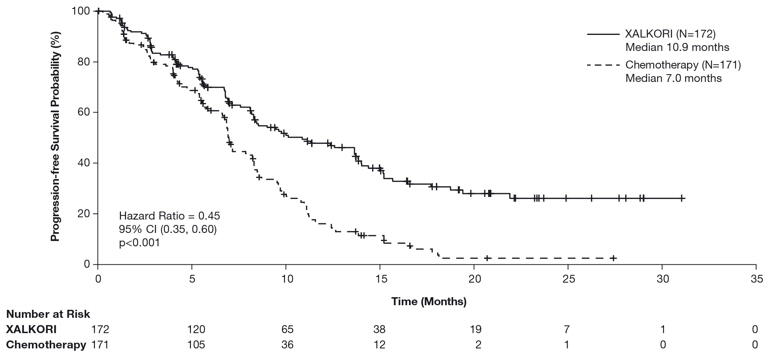
Study 1 demonstrated a statistically significant improvement in PFS in the patients treated with XALKORI. The OS analysis conducted at the time of the PFS analysis did not suggest a difference in survival between arms. Table 7 and Figure 1 summarize the efficacy results. Exploratory patient-reported symptom measures of baseline and post-treatment dyspnea, cough, and chest pain suggested a delay in time to development of or worsening of dyspnea, but not cough or chest pain, in patients treated with XALKORI as compared to chemotherapy. The patient-reported delay in onset or worsening of dyspnea may be an overestimation, because patients were not blinded to treatment assignment.
Table 7. Previously Untreated ALK-Positive Metastatic NSCLC - Efficacy Results | XALKORI
(N=172) | Chemotherapy
(N=171) |
|---|
| HR=hazard ratio; CI=confidence interval; IRR=independent radiology review; NR=not reached; CR=complete response; PR=partial response. |
| Progression-Free Survival (Based on IRR) | | |
| Number of Events (%) | 100 (58%) | 137 (80%) |
| Progressive Disease | 89 (52%) | 132 (77%) |
| Death | 11 (6%) | 5 (3%) |
| Median, Months (95% CI) | 10.9 (8.3, 13.9) | 7.0 (6.8, 8.2) |
| HR (95% CI) Based on the Cox proportional hazards stratified analysis. | 0.45 (0.35, 0.60) |
| p-value Based on the stratified log-rank test. | <0.001 |
| Overall Survival | | |
| Number of Events (%) | 44 (26%) | 46 (27%) |
| Median, Months (95% CI) | NR | NR |
| HR (95% CI) | 0.82 (0.54, 1.26) |
| p-value | 0.36 |
| Tumor Responses (Based on IRR) | | |
| Objective Response Rate % (95% CI) | 74% (67, 81) | 45% (37, 53) |
| CR, n (%) | 3 (1.7%) | 2 (1.2%) |
| PR, n (%) | 125 (73%) | 75 (44%) |
| p-value Based on the stratified Cochran-Mantel-Haenszel test. | <0.001 |
| Duration of Response |
| Median, Months (95% CI) | 11.3 (8.1, 13.8) | 5.3 (4.1, 5.8) |
| Figure 1. Kaplan-Meier Curves of Progression-Free Survival as Assessed by IRR in Study 1 |
|---|
|
Previously Treated ALK-Positive Metastatic NSCLC - Study 2
The efficacy and safety of XALKORI as monotherapy for the treatment of 347 patients with ALK-positive metastatic NSCLC, previously treated with 1 platinum-based chemotherapy regimen, were demonstrated in a randomized, multicenter, open-label, active-controlled study (Study 2). The major efficacy outcome was PFS according to RECIST version 1.1 as assessed by IRR. Additional efficacy outcomes included ORR as assessed by IRR, DOR, and OS.
Patients were randomized to receive XALKORI 250 mg orally twice daily (n=173) or chemotherapy (n=174). Chemotherapy consisted of pemetrexed 500 mg/m2 (if pemetrexed-naïve; n=99) or docetaxel 75 mg/m2 (n=72) intravenously (IV) every 21 days. Patients in both treatment arms continued treatment until documented disease progression, intolerance to therapy, or the investigator determined that the patient was no longer experiencing clinical benefit. Randomization was stratified by ECOG performance status (0–1, 2), brain metastases (present, absent), and prior EGFR tyrosine kinase inhibitor treatment (yes, no). Patients were required to have ALK-positive NSCLC as identified by the FDA-approved assay, Vysis ALK Break-Apart FISH Probe Kit, prior to randomization. At the time of the final analysis of overall survival, 154 (89%) patients randomized to the chemotherapy arm subsequently received XALKORI.
The demographic characteristics of the overall study population were 56% female, median age of 50 years, baseline ECOG performance status 0 or 1 (90%), 52% White and 45% Asian, 4% current smokers, 33% past smokers, and 63% never smokers. The disease characteristics of the overall study population were metastatic disease in at least 95% of patients and at least 93% of patients' tumors were classified as adenocarcinoma histology.
Study 2 demonstrated a statistically significant improvement in PFS in the patients treated with XALKORI. Table 8 and Figure 2 summarize the efficacy results.
Table 8. Previously Treated ALK-Positive Metastatic NSCLC - Efficacy Results | XALKORI
(N=173) | Chemotherapy
(N=174) |
|---|
| HR=hazard ratio; CI=confidence interval; IRR=independent radiology review; CR=complete response; PR=partial response. |
| Progression-Free Survival (Based on IRR) | | |
| Number of Events (%) | 100 (58%) | 127 (73%) |
| Progressive Disease | 84 (49%) | 119 (68%) |
| Death | 16 (9%) | 8 (5%) |
| Median, Months (95% CI) | 7.7 (6.0, 8.8) | 3.0 For pemetrexed, the median PFS was 4.2 months. For docetaxel, the median PFS was 2.6 months. (2.6, 4.3) |
| HR (95% CI) Based on the Cox proportional hazards stratified analysis. | 0.49 (0.37, 0.64) |
| p-value Based on the stratified log-rank test. | <0.001 |
| Overall Survival | | |
| Number of Events (%) | 116 (67%) | 126 (72%) |
| Median, Months (95% CI) | 21.7 (18.9,30.5) | 21.9 (16.8,26.0) |
| HR (95% CI) | 0.85 (0.66, 1.10) |
| p-value | 0.229 |
| Tumor Responses (Based on IRR) | | |
| Objective Response Rate % (95% CI) | 65% (58, 72) | 20% (14, 26) |
| CR, n (%) | 1 (0.6%) | 0 |
| PR, n (%) | 112 (65%) | 34 (20%) |
| p-value Based on the stratified Cochran-Mantel-Haenszel test. | <0.001 |
| Duration of Response |
| Median, Months (95% CI) | 7.4 (6.1, 9.7) | 5.6 (3.4, 8.3) |
| Figure 2. Kaplan-Meier Curves of Progression-Free Survival as Assessed by IRR in Study 2 |
|---|
|
Hepatotoxicity
Inform patients to immediately report symptoms of hepatotoxicity [see Warnings and Precautions (5.1)].
Interstitial Lung Disease (Pneumonitis)
Advise patients to immediately report any new or worsening pulmonary symptoms [see Warnings and Precautions (5.2)].
Bradycardia
Advise patients to report any symptoms of bradycardia and to inform their healthcare provider about the use of any heart or blood pressure medications [see Warnings and Precautions (5.4)].
Severe Visual Loss
Inform patients of the potential risk of severe visual loss and to immediately contact their healthcare provider if they develop severe visual loss. Inform patients that visual changes such as perceived flashes of light, blurry vision, light sensitivity, and floaters are commonly reported adverse events and may occur while driving or operating machinery. The onset of visual disorders most commonly occurs during the first week of treatment [see Warnings and Precautions (5.5) and Adverse Reactions (6)].
Drug Interactions
Inform patients to avoid grapefruit or grapefruit juice while taking XALKORI. Advise patients to inform their healthcare providers of all concomitant medications, including prescription medicines, over-the-counter drugs, vitamins, and herbal products [see Drug Interactions (7)].
Dosing and Administration
Advise patients to take XALKORI with or without food and swallow XALKORI capsules whole.
If a patient misses a dose, advise the patient to take it as soon as remembered unless it is less than 6 hours until the next dose, in which case, advise the patient not to take the missed dose. If a patient vomits after taking a dose of XALKORI, advise the patient not to take an extra dose, but to take the next dose at the regular time.
Embryo-Fetal Toxicity
Advise females of reproductive potential of the potential risk to a fetus and to inform their healthcare provider of a known or suspected pregnancy [see Warnings and Precautions (5.6) and Use in Specific Populations (8.1)]. Advise females of reproductive potential to use effective contraception during treatment with XALKORI and for at least 45 days after the final dose [see Use in Specific Populations (8.3)].
Females and Males of Reproductive Potential
Advise females and males of reproductive potential of the potential for reduced fertility from XALKORI [see Use in Specific Populations (8.3) and Nonclinical Toxicology (13.1)].
Advise male patients with female partners of reproductive potential to use condoms during treatment with XALKORI and for at least 90 days after the final dose [see Use in Specific Populations (8.3) and Nonclinical Toxicology (13.1)].
Lactation
Advise females not to breastfeed during treatment with XALKORI and for 45 days after the final dose [see Use in Specific Populations (8.2)].
Infertility
Advise females and males of reproductive potential of the potential for reduced fertility from XALKORI [see Use in Specific Populations (8.3)].
This product's labeling may have been updated. For full prescribing information, please visit www.XALKORI.com.
LAB-0440-19.0