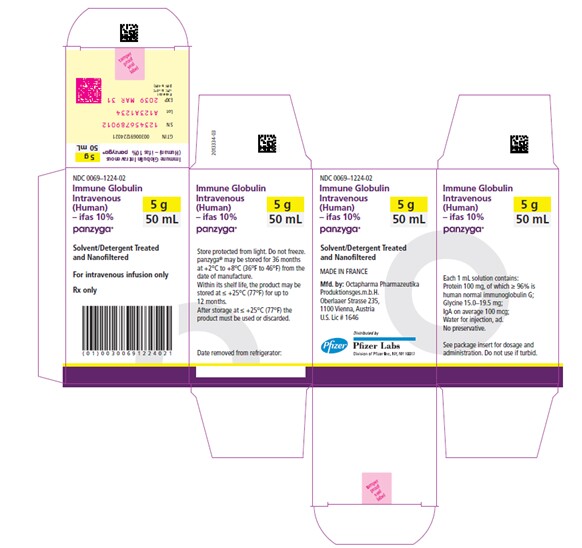
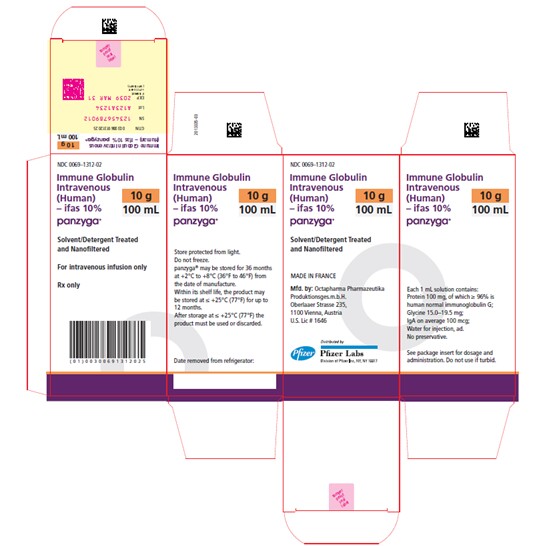
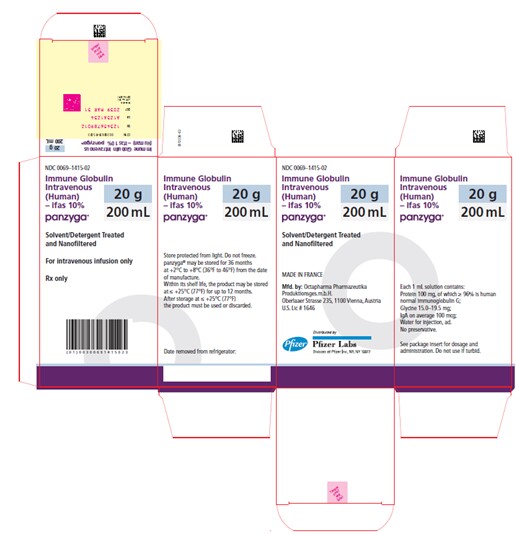
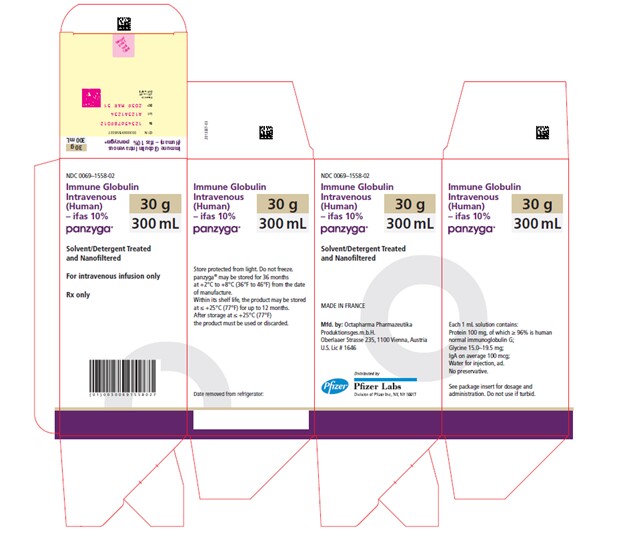
Immune Globulin Intravenous (Human), PANZYGA, is a solvent/detergent (S/D)-treated, sterile preparation of highly purified immunoglobulin G (IgG) derived from large pools of human plasma. PANZYGA is a solution for infusion to be administered intravenously.
This preparation contains approximately 100 mg of protein per mL (10%), of which not less than 96% is normal human immunoglobulin G. PANZYGA contains not more than 3% aggregates, not less than 90% monomers and dimers, and not more than 3% fragments. On average, the product contains 100 µg/mL of IgA, and lower amounts of IgM.
PANZYGA contains only trace amounts of sodium, and the pH is between 4.5 and 5.0. The osmolality is in the range of 240-310 mosmol/kg.
The manufacturing process for PANZYGA isolates IgG without additional chemical or enzymatic modification, and the Fc portion is maintained intact. PANZYGA contains the IgG antibody activities present in the donor population. IgG subclasses are fully represented with the following approximate percents of total IgG: IgG
1
is 65%, IgG
2
is 28%, IgG
3
is 3% and IgG
4
is 4%.
PANZYGA contains a broad spectrum of IgG antibodies against bacterial and viral agents that are capable of opsonization and neutralization of microbes and toxins. PANZYGA contains glycine (15.0-19.5 mg/mL), but no preservatives or sucrose.
All units of human plasma used in the manufacture of PANZYGA are provided by FDA-approved blood and plasma establishments, and are tested by FDA-licensed serological tests for HBsAg, antibodies to HCV and HIV and Nucleic Acid Test (NAT) for HCV and HIV1 and found to be non-reactive (negative).
The product is manufactured by the cold ethanol fractionation process followed by purification methodologies, as well as S/D treatment and nanofiltration (20 nm). The S/D mixture used is composed of tri-n-butyl phosphate (TNBP, solvent) and Triton X-100 (Octoxynol, detergent). The PANZYGA manufacturing process shows significant viral reduction and inactivation, demonstrated by in vitro infectivity studies (Table 3). The virus safety of PANZYGA is achieved through a combination of various process steps, including S/D treatment, ion-exchange chromatography, and nanofiltration (20 nm).
Table 3 shows the virus clearance during the manufacturing process for PANZYGA, expressed as the mean log
10
reduction factor (LRF).
Table 3: Virus Reduction by PANZYGA Manufacturing Process
HIV-1: Human Immunodeficiency Virus – 1, a model for HIV-1 and HIV-2;
PRV: Pseudorabies Virus, a model for large enveloped DNA viruses (eg, herpes virus);
BVDV: Bovine Viral Diarrhea Virus, a model for e.g., Hepatitis C virus (HCV) and West-Nile virus (WNV);
MEV: Mouse Encephalomyelitis virus, a model for Hepatitis A virus (HAV);
PPV: Porcine Parvovirus, a model for Human Parvovirus B19;
n.a.: not applicable;
n.d: not done.
Additionally, the manufacturing process was investigated for its capacity to decrease the infectivity of an experimental agent of transmissible spongiform encephalopathy (TSE), considered as a model for the vCJD and CJD agents. [
10
]
Several of the individual production steps in the PANZYGA manufacturing process were shown to decrease TSE infectivity of that experimental model agent. TSE reduction steps include ion-exchange chromatography and nanofiltration, which together give a total of at least 10.4 log10 decrease of infectivity. These studies provide reasonable assurance that low levels of CJD/vCJD agent infectivity, if present in the starting material, would be removed.