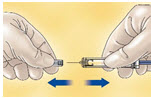
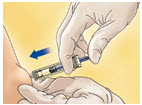
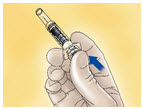
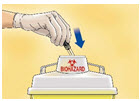
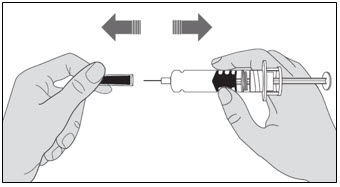
- The safety system can only be activated once the syringe has been emptied.
- Activation of the safety system must be done only after removing the needle from the patient's skin.
- Do not replace the needle shield after injection.
- The safety system should not be sterilized.
Activation of the safety system may cause minimal splatter of fluid. For optimal safety, activate the system while orienting it downwards away from yourself and others.
Intravenous (Bolus) Injection Technique
Use the multiple-dose vial for intravenous injections. Administer Lovenox through an intravenous line. Do not mix or coadminister Lovenox with other medications. Flush the intravenous access device with a sufficient volume of saline or dextrose solution prior to and following the intravenous bolus administration of Lovenox, to prevent mixing of drugs. Lovenox is compatible with normal saline solution (0.9%) or 5% dextrose in water.
Hemorrhage
The following rates of major bleeding events have been reported during clinical trials with Lovenox (see Tables 2 to 7).
Table 2: Major Bleeding Episodes Following Abdominal and Colorectal SurgeryBleeding complications were considered major: (1) if the hemorrhage caused a significant clinical event, or (2) if accompanied by a hemoglobin decrease ≥2 g/dL or transfusion of 2 or more units of blood products. Retroperitoneal, intraocular, and intracranial hemorrhages were always considered major.
| Dosing Regimen |
|---|
| Indications | Lovenox
40 mg daily subcutaneously | Heparin
5000 U q8h subcutaneously |
|---|
| Abdominal Surgery | n=555
23 (4%) | n=560
16 (3%) |
| Colorectal Surgery | n=673
28 (4%) | n=674
21 (3%) |
Table 3: Major Bleeding Episodes Following Hip or Knee Replacement SurgeryBleeding complications were considered major: (1) if the hemorrhage caused a significant clinical event, or (2) if accompanied by a hemoglobin decrease ≥2 g/dL or transfusion of 2 or more units of blood products. Retroperitoneal and intracranial hemorrhages were always considered major. In the knee replacement surgery trials, intraocular hemorrhages were also considered major hemorrhages.
| Dosing Regimen |
|---|
| Indications | Lovenox
40 mg daily subcutaneously | Lovenox
30 mg q12h subcutaneously | Heparin
15,000 U/24h subcutaneously |
|---|
| Hip Replacement Surgery without Extended Prophylaxis Lovenox 30 mg every 12 hours subcutaneously initiated 12 to 24 hours after surgery and continued for up to 14 days after surgery | | n=786
31 (4%) | n=541
32 (6%) |
| Hip Replacement Surgery with Extended Prophylaxis | | | |
| Peri-operative Period Lovenox 40 mg subcutaneously once a day initiated up to 12 hours prior to surgery and continued for up to 7 days after surgery | n=288
4 (2%) | | |
| Extended Prophylaxis Period Lovenox 40 mg subcutaneously once a day for up to 21 days after discharge | n=221
0 (0%) | | |
| Knee Replacement Surgery without Extended Prophylaxis | | n=294
3 (1%) | n=225
3 (1%) |
NOTE: At no time point were the 40 mg once a day pre-operative and the 30 mg every 12 hours postoperative hip replacement surgery prophylactic regimens compared in clinical trials. Injection site hematomas during the extended prophylaxis period after hip replacement surgery occurred in 9% of the Lovenox patients versus 1.8% of the placebo patients.
Table 4: Major Bleeding Episodes in Medical Patients with Severely Restricted Mobility During Acute IllnessBleeding complications were considered major: (1) if the hemorrhage caused a significant clinical event, (2) if the hemorrhage caused a decrease in hemoglobin of ≥2 g/dL or transfusion of 2 or more units of blood products. Retroperitoneal and intracranial hemorrhages were always considered major although none were reported during the trial.
| Dosing Regimen |
|---|
| Indication | Lovenox The rates represent major bleeding on study medication up to 24 hours after last dose.
20 mg daily subcutaneously | Lovenox
40 mg daily subcutaneously | Placebo |
|---|
| Medical Patients During Acute Illness | n=351
1 (<1%) | n=360
3 (<1%) | n=362
2 (<1%) |
Table 5: Major Bleeding Episodes in Deep Vein Thrombosis with or without Pulmonary Embolism TreatmentBleeding complications were considered major: (1) if the hemorrhage caused a significant clinical event, or (2) if accompanied by a hemoglobin decrease ≥2 g/dL or transfusion of 2 or more units of blood products. Retroperitoneal, intraocular, and intracranial hemorrhages were always considered major.
| Dosing Regimen All patients also received warfarin sodium (dose-adjusted according to PT to achieve an INR of 2.0 to 3.0) commencing within 72 hours of Lovenox or standard heparin therapy and continuing for up to 90 days. |
|---|
| Indication | Lovenox
1.5 mg/kg daily subcutaneously | Lovenox
1 mg/kg q12h subcutaneously | Heparin
aPTT Adjusted Intravenous Therapy |
|---|
| Treatment of DVT and PE | n=298
5 (2%) | n=559
9 (2%) | n=554
9 (2%) |
Table 6: Major Bleeding Episodes in Unstable Angina and Non–Q-Wave Myocardial Infarction | Dosing Regimen |
|---|
| Indication | Lovenox The rates represent major bleeding on study medication up to 12 hours after dose.
1 mg/kg q12h subcutaneously | Heparin
aPTT Adjusted Intravenous Therapy |
|---|
| Unstable Angina and Non–Q-Wave MI Aspirin therapy was administered concurrently (100 to 325 mg per day). ,Bleeding complications were considered major: (1) if the hemorrhage caused a significant clinical event, or (2) if accompanied by a hemoglobin decrease by ≥3 g/dL or transfusion of 2 or more units of blood products. Intraocular, retroperitoneal, and intracranial hemorrhages were always considered major. | n=1578
17 (1%) | n=1529
18 (1%) |
Table 7: Major Bleeding Episodes in Acute ST-Segment Elevation Myocardial Infarction | Dosing Regimen |
|---|
| Indication | Lovenox The rates represent major bleeding (including ICH) up to 30 days
Initial 30 mg intravenous bolus followed by 1 mg/kg q12h subcutaneously | Heparin
aPTT Adjusted Intravenous Therapy |
|---|
| Acute ST-Segment Elevation Myocardial Infarction | n=10176
n (%) | n=10151
n (%) |
| Major bleeding (including ICH) Bleedings were considered major if the hemorrhage caused a significant clinical event associated with a hemoglobin decrease by ≥5 g/dL. ICH were always considered major. | 211 (2.1) | 138 (1.4) |
| Intracranial hemorrhages (ICH) | 84 (0.8) | 66 (0.7) |
Elevations of Serum Aminotransferases
Asymptomatic increases in aspartate (AST [SGOT]) and alanine (ALT [SGPT]) aminotransferase levels greater than three times the upper limit of normal of the laboratory reference range have been reported in up to 6.1% and 5.9% of patients, respectively, during treatment with Lovenox.
Since aminotransferase determinations are important in the differential diagnosis of myocardial infarction, liver disease, and pulmonary emboli, elevations that might be caused by drugs like Lovenox should be interpreted with caution.
Local Reactions
Local irritation, pain, hematoma, ecchymosis, and erythema may follow subcutaneous injection of Lovenox.
Adverse Reactions in Patients Receiving Lovenox for Prophylaxis or Treatment of DVT, PE
Other adverse reactions that were thought to be possibly or probably related to treatment with Lovenox, heparin, or placebo in clinical trials with patients undergoing hip or knee replacement surgery, abdominal or colorectal surgery, or treatment for DVT and that occurred at a rate of at least 2% in the Lovenox group, are provided below (see Tables 8 to 11).
Table 8: Adverse Reactions Occurring at ≥2% Incidence in Lovenox-Treated Patients Undergoing Abdominal or Colorectal Surgery | Dosing Regimen |
|---|
| Lovenox
40 mg daily subcutaneously
n=1228
% | Heparin
5000 U q8h subcutaneously
n=1234
% |
|---|
| Adverse Reaction | Severe | Total | Severe | Total |
|---|
| Hemorrhage | <1 | 7 | <1 | 6 |
| Anemia | <1 | 3 | <1 | 3 |
| Ecchymosis | 0 | 3 | 0 | 3 |
Table 9: Adverse Reactions Occurring at ≥2% Incidence in Lovenox-Treated Patients Undergoing Hip or Knee Replacement Surgery | Dosing Regimen |
|---|
| Lovenox
40 mg daily subcutaneously | Lovenox
30 mg q12h subcutaneously | Heparin
15,000 U/24h subcutaneously | Placebo
q12h subcutaneously |
|---|
| Peri-operative Period | Extended Prophylaxis Period | | | |
|---|
| n=288 Data represent Lovenox 40 mg subcutaneously once a day initiated up to 12 hours prior to surgery in 288 hip replacement surgery patients who received Lovenox peri-operatively in an unblinded fashion in one clinical trial.
% | n=131 Data represent Lovenox 40 mg subcutaneously once a day given in a blinded fashion as extended prophylaxis at the end of the peri-operative period in 131 of the original 288 hip replacement surgery patients for up to 21 days in one clinical trial.
% | n=1080
% | n=766
% | n=115
% |
|---|
| Adverse Reaction | Severe | Total | Severe | Total | Severe | Total | Severe | Total | Severe | Total |
|---|
| Fever | 0 | 8 | 0 | 0 | <1 | 5 | <1 | 4 | 0 | 3 |
| Hemorrhage | <1 | 13 | 0 | 5 | <1 | 4 | 1 | 4 | 0 | 3 |
| Nausea | | | | | <1 | 3 | <1 | 2 | 0 | 2 |
| Anemia | 0 | 16 | 0 | <2 | <1 | 2 | 2 | 5 | <1 | 7 |
| Edema | | | | | <1 | 2 | <1 | 2 | 0 | 2 |
| Peripheral edema | 0 | 6 | 0 | 0 | <1 | 3 | <1 | 4 | 0 | 3 |
Table 10: Adverse Reactions Occurring at ≥2% Incidence in Lovenox-Treated Medical Patients with Severely Restricted Mobility During Acute Illness | Dosing Regimen |
|---|
| Adverse Reaction | Lovenox
40 mg daily subcutaneously
n=360
% | Placebo
daily subcutaneously
n=362
% |
|---|
| Dyspnea | 3.3 | 5.2 |
| Thrombocytopenia | 2.8 | 2.8 |
| Confusion | 2.2 | 1.1 |
| Diarrhea | 2.2 | 1.7 |
| Nausea | 2.5 | 1.7 |
Table 11: Adverse Reactions Occurring at ≥2% Incidence in Lovenox-Treated Patients Undergoing Treatment of Deep Vein Thrombosis with or without Pulmonary Embolism | Dosing Regimen |
|---|
| Lovenox
1.5 mg/kg daily subcutaneously
n=298
% | Lovenox
1 mg/kg q12h subcutaneously
n=559
% | Heparin
aPTT Adjusted Intravenous Therapy
n=544
% |
|---|
| Adverse Reaction | Severe | Total | Severe | Total | Severe | Total |
|---|
| Injection Site Hemorrhage | 0 | 5 | 0 | 3 | <1 | <1 |
| Injection Site Pain | 0 | 2 | 0 | 2 | 0 | 0 |
| Hematuria | 0 | 2 | 0 | <1 | <1 | 2 |
Adverse Events in Lovenox-Treated Patients with Unstable Angina or Non–Q-Wave Myocardial Infarction
Non-hemorrhagic clinical events reported to be related to Lovenox therapy occurred at an incidence of ≤1%.
Non-major hemorrhagic events, primarily injection site ecchymosis and hematomas, were more frequently reported in patients treated with subcutaneous Lovenox than in patients treated with intravenous heparin.
Serious adverse events with Lovenox or heparin in a clinical trial in patients with unstable angina or non–Q-wave myocardial infarction that occurred at a rate of at least 0.5% in the Lovenox group are provided below (see Table 12).
Table 12: Serious Adverse Events Occurring at ≥0.5% Incidence in Lovenox-Treated Patients with Unstable Angina or Non–Q-Wave Myocardial Infarction | Dosing Regimen |
|---|
| Lovenox
1 mg/kg q12h subcutaneously | Heparin
aPTT Adjusted Intravenous Therapy |
|---|
| Adverse Event | n=1578
n (%) | n=1529
n (%) |
|---|
| Atrial fibrillation | 11 (0.70) | 3 (0.20) |
| Heart failure | 15 (0.95) | 11 (0.72) |
| Lung edema | 11 (0.70) | 11 (0.72) |
| Pneumonia | 13 (0.82) | 9 (0.59) |
Adverse Reactions in Lovenox-Treated Patients with Acute ST-Segment Elevation Myocardial Infarction
In a clinical trial in patients with acute ST-segment elevation myocardial infarction, thrombocytopenia occurred at a rate of 1.5%.
Risk Summary
Placental transfer of enoxaparin was observed in the animal studies. Human data from a retrospective cohort study, which included 693 live births, suggest that enoxaparin does not increase the risk of major developmental abnormalities [see Data]. Based on animal data, Lovenox is not predicted to increase the risk of major developmental abnormalities (see Data).
Adverse outcomes in pregnancy occur regardless of the health of the mother or the use of medications. The estimated background risk of major birth defects and miscarriage for the indicated populations is unknown. In the U.S. general population, the estimated background risk of major birth defects and miscarriage in clinically recognized pregnancies is 2% to 4% and 15% to 20%, respectively.
Clinical Considerations
Pregnancy alone confers an increased risk for thromboembolism that is even higher for women with thromboembolic disease and certain high risk pregnancy conditions. While not adequately studied, pregnant women with mechanical prosthetic heart valves may be at even higher risk for thrombosis [see Warnings and Precautions (5.7) and Use in Specific Populations (8.6)]. Pregnant women with thromboembolic disease, including those with mechanical prosthetic heart valves and those with inherited or acquired thrombophilias, have an increased risk of other maternal complications and fetal loss regardless of the type of anticoagulant used.
All patients receiving anticoagulants, including pregnant women, are at risk for bleeding. Pregnant women receiving Lovenox should be carefully monitored for evidence of bleeding or excessive anticoagulation. Consideration for use of a shorter acting anticoagulant should be specifically addressed as delivery approaches [see Boxed Warning]. Hemorrhage can occur at any site and may lead to death of mother and/or fetus. Pregnant women should be apprised of the potential hazard to the fetus and the mother if Lovenox is administered during pregnancy.
It is not known if monitoring of anti-Factor Xa activity and dose adjustment (by weight or anti-Factor Xa activity) of Lovenox affect the safety and the efficacy of the drug during pregnancy.
Cases of "gasping syndrome" have occurred in premature infants when large amounts of benzyl alcohol have been administered (99–405 mg/kg/day). The multiple-dose vial of Lovenox contains 15 mg benzyl alcohol per 1 mL as a preservative [see Warnings and Precautions (5.8)].
Data
Human data
There are no adequate and well-controlled studies in pregnant women. A retrospective study reviewed the records of 604 women who used Lovenox during pregnancy. A total of 624 pregnancies resulted in 693 live births. There were 72 hemorrhagic events (11 serious) in 63 women. There were 14 cases of neonatal hemorrhage. Major congenital anomalies in live births occurred at rates (2.5%) similar to background rates.
There have been postmarketing reports of fetal death when pregnant women received Lovenox. Causality for these cases has not been determined. Insufficient data, the underlying disease, and the possibility of inadequate anticoagulation complicate the evaluation of these cases.
A clinical study using Lovenox in pregnant women with mechanical prosthetic heart valves has been conducted [see Warnings and Precautions (5.7)].
Animal data
Teratology studies have been conducted in pregnant rats and rabbits at subcutaneous doses of enoxaparin up to 15 times the recommended human dose (by comparison with 2 mg/kg as the maximum recommended daily dose). There was no evidence of teratogenic effects or fetotoxicity due to enoxaparin. Because animal reproduction studies are not always predictive of human response, this drug should be used during pregnancy only if clearly needed.
Risk Summary
It is unknown whether Lovenox is excreted in human milk. In lactating rats, the passage of enoxaparin or its metabolites in the milk is very limited. There is no information available on the effect of enoxaparin or its metabolites on the breastfed child, or on the milk production. The developmental and health benefits of breastfeeding should be considered along with the mother's clinical need for Lovenox and any potential adverse effects on the breastfed child from Lovenox or from the underlying maternal condition.
Prevention of Deep Vein Thrombosis in Hip, Knee and Abdominal Surgery; Treatment of Deep Vein Thrombosis, Prevention of Ischemic Complications of Unstable Angina and Non–Q-Wave Myocardial Infarction
Over 2800 patients, 65 years and older, have received Lovenox in clinical trials. The efficacy of Lovenox in the geriatric (≥65 years) was similar to that seen in younger patients (<65 years). The incidence of bleeding complications was similar between geriatric and younger patients when 30 mg every 12 hours or 40 mg once a day doses of Lovenox were employed. The incidence of bleeding complications was higher in geriatric patients as compared to younger patients when Lovenox was administered at doses of 1.5 mg/kg once a day or 1 mg/kg every 12 hours. The risk of Lovenox-associated bleeding increased with age. Serious adverse events increased with age for patients receiving Lovenox. Other clinical experience (including postmarketing surveillance and literature reports) has not revealed additional differences in the safety of Lovenox between geriatric and younger patients. Careful attention to dosing intervals and concomitant medications (especially antiplatelet medications) is advised. Lovenox should be used with care in geriatric patients who may show delayed elimination of enoxaparin. Monitoring of geriatric patients with low body weight (<45 kg) and those predisposed to decreased renal function should be considered [see Warnings and Precautions (2.6) and Clinical Pharmacology (12.3)].
Treatment of Acute ST-Segment Elevation Myocardial Infarction
In the clinical study for treatment of acute ST-segment elevation myocardial infarction, there was no evidence of difference in efficacy between patients ≥75 years of age (n=1241) and patients less than 75 years of age (n=9015). Patients ≥75 years of age did not receive a 30 mg intravenous bolus prior to the normal dosage regimen and had their subcutaneous dose adjusted to 0.75 mg/kg every 12 hours [see Dosage and Administration (2.4)]. The incidence of bleeding complications was higher in patients ≥65 years of age as compared to younger patients (<65 years).
Absorption
Pharmacokinetic trials were conducted using the 100 mg/mL formulation. Maximum anti-Factor Xa and anti-thrombin (anti-Factor IIa) activities occur 3 to 5 hours after subcutaneous injection of enoxaparin. Mean peak anti-Factor Xa activity was 0.16 IU/mL (1.58 mcg/mL) and 0.38 IU/mL (3.83 mcg/mL) after the 20 mg and the 40 mg clinically tested subcutaneous doses, respectively. Mean (n=46) peak anti-Factor Xa activity was 1.1 IU/mL at steady state in patients with unstable angina receiving 1 mg/kg subcutaneously every 12 hours for 14 days. Mean absolute bioavailability of enoxaparin, after 1.5 mg/kg given subcutaneously, based on anti-Factor Xa activity is approximately 100% in healthy subjects.
A 30 mg intravenous bolus immediately followed by 1 mg/kg subcutaneously every 12 hours provided initial peak anti-Factor Xa levels of 1.16 IU/mL (n=16) and average exposure corresponding to 84% of steady-state levels. Steady state is achieved on the second day of treatment.
Enoxaparin pharmacokinetics appears to be linear over the recommended dosage ranges [see Dosage and Administration (2)]. After repeated subcutaneous administration of 40 mg once daily and 1.5 mg/kg once-daily regimens in healthy volunteers, the steady state is reached on day 2 with an average exposure ratio about 15% higher than after a single dose. Steady-state enoxaparin activity levels are well predicted by single-dose pharmacokinetics. After repeated subcutaneous administration of the 1 mg/kg twice-daily regimen, the steady state is reached from day 4 with mean exposure about 65% higher than after a single dose and mean peak and trough levels of about 1.2 and 0.52 IU/mL, respectively. Based on enoxaparin sodium pharmacokinetics, this difference in steady state is expected and within the therapeutic range.
Although not studied clinically, the 150 mg/mL concentration of enoxaparin sodium is projected to result in anticoagulant activities similar to those of 100 mg/mL and 200 mg/mL concentrations at the same enoxaparin dose. When a daily 1.5 mg/kg subcutaneous injection of enoxaparin sodium was given to 25 healthy male and female subjects using a 100 mg/mL or a 200 mg/mL concentration the following pharmacokinetic profiles were obtained (see Table 13).
Table 13: Pharmacokinetic ParametersMeans ±SD at Day 5 and 90% Confidence Interval (CI) of the ratio
After 5 Days of 1.5 mg/kg Subcutaneous Once-Daily Doses of Enoxaparin Sodium Using 100 mg/mL or 200 mg/mL Concentrations | Concentration | Anti-Xa | Anti-IIa | Heptest | aPTT |
|---|
Amax
(IU/mL or Δ sec) | 100 mg/mL | 1.37 (±0.23) | 0.23 (±0.05) | 105 (±17) | 19 (±5) |
| 200 mg/mL | 1.45 (±0.22) | 0.26 (±0.05) | 111 (±17) | 22 (±7) |
| 90% CI | 102%–110% | | 102%–111% | |
| tmax Median (range) (h) | 100 mg/mL | 3 (2–6) | 4 (2–5) | 2.5 (2–4.5) | 3 (2–4.5) |
| 200 mg/mL | 3.5 (2–6) | 4.5 (2.5–6) | 3.3 (2–5) | 3 (2–5) |
AUC (ss)
(h*IU/mL or h* Δ sec) | 100 mg/mL | 14.26 (±2.93) | 1.54 (±0.61) | 1321 (±219) | |
| 200 mg/mL | 15.43 (±2.96) | 1.77 (±0.67) | 1401 (±227) | |
| 90% CI | 105%–112% | | 103%–109% | |
Distribution
The volume of distribution of anti-Factor Xa activity is about 4.3 L.
Elimination
Following intravenous dosing, the total body clearance of enoxaparin is 26 mL/min. After intravenous dosing of enoxaparin labeled with the gamma-emitter, 99mTc, 40% of radioactivity and 8 to 20% of anti-Factor Xa activity were recovered in urine in 24 hours. Elimination half-life based on anti-Factor Xa activity was 4.5 hours after a single subcutaneous dose to about 7 hours after repeated dosing. Significant anti-Factor Xa activity persists in plasma for about 12 hours following a 40 mg subcutaneous once a day dose.
Following subcutaneous dosing, the apparent clearance (CL/F) of enoxaparin is approximately 15 mL/min.
Metabolism
Enoxaparin sodium is primarily metabolized in the liver by desulfation and/or depolymerization to lower molecular weight species with much reduced biological potency. Renal clearance of active fragments represents about 10% of the administered dose and total renal excretion of active and non-active fragments 40% of the dose.
Special Populations
Gender
Apparent clearance and Amax derived from anti-Factor Xa values following single subcutaneous dosing (40 mg and 60 mg) were slightly higher in males than in females. The source of the gender difference in these parameters has not been conclusively identified; however, body weight may be a contributing factor.
Geriatric
Apparent clearance and Amax derived from anti-Factor Xa values following single and multiple subcutaneous dosing in geriatric subjects were close to those observed in young subjects. Following once a day subcutaneous dosing of 40 mg enoxaparin, the Day 10 mean area under anti-Factor Xa activity versus time curve (AUC) was approximately 15% greater than the mean Day 1 AUC value [see Dosage and Administration (2.4) and Use in Specific Populations (8.5)].
Renal impairment
A linear relationship between anti-Factor Xa plasma clearance and creatinine clearance at steady state has been observed, which indicates decreased clearance of enoxaparin sodium in patients with reduced renal function. Anti-Factor Xa exposure represented by AUC, at steady state, is marginally increased in patients with creatinine clearance 50 to 80 mL/min and patients with creatinine clearance 30 to <50 mL/min renal impairment after repeated subcutaneous 40 mg once-daily doses. In patients with severe renal impairment (creatinine clearance <30 mL/min), the AUC at steady state is significantly increased on average by 65% after repeated subcutaneous 40 mg once-daily doses [see Dosage and Administration (2.3) and Use in Specific Populations (8.7)].
Hemodialysis
In a single study, elimination rate appeared similar but AUC was two-fold higher than control population, after a single 0.25 or 0.5 mg/kg intravenous dose.
Hepatic impairment
Studies with Lovenox in patients with hepatic impairment have not been conducted and the impact of hepatic impairment on the exposure to enoxaparin is unknown.
Weight
After repeated subcutaneous 1.5 mg/kg once-daily dosing, mean AUC of anti-Factor Xa activity is marginally higher at steady state in obese healthy volunteers (BMI 30–48 kg/m2) compared to non-obese control subjects, while Amax is not increased.
When non–weight-adjusted dosing was administered, it was found after a single-subcutaneous 40 mg dose, that anti-Factor Xa exposure is 52% higher in low-weight women (<45 kg) and 27% higher in low-weight men (<57 kg) when compared to normal weight control subjects [see Use in Specific Populations (8.8)].
Pharmacokinetic Interaction
No pharmacokinetic interaction was observed between Lovenox and thrombolytics when administered concomitantly.
sanofi-aventis U.S. LLC
Bridgewater, NJ 08807
A SANOFI COMPANY
© 2018 sanofi-aventis U.S. LLC