Exelon Patch, Extended Release
Product Images NDC 0078-0502

View Photos of Packaging, Regulatory Labels, and Product Appearance

Product Visual Gallery

This gallery contains 20 technical images submitted to the FDA as part of the official labeling for Exelon (NDC 0078-0502). Unlike standard consumer photos, these assets often include clinical data figures, molecular chemical structures, and official manufacturer packaging layouts.

As provided by Novartis Pharmaceuticals Corporation, these visuals offer a comprehensive scientific overview of the product's physical and chemical identity, aiding pharmacists and researchers in product verification and study.

FDA Label Image

Rivastigmine Chemical Structure (Exelon Patch 01)

Rivastigmine Chemical Structure (Exelon Patch 01)
Chemical structure of rivastigmine, the active ingredient in Exelon transdermal patches. The diagram shows the molecular arrangement including aromatic rings and functional groups characteristic of rivastigmine.*
FDA Label Image

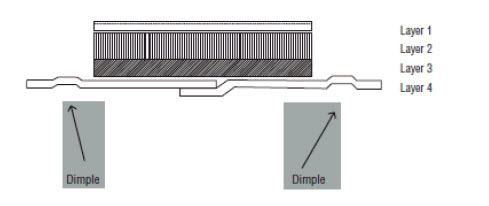
Figure 1: Cross Section Of The Exelon Patch (Exelon Patch 02)

Figure 1: Cross Section Of The Exelon Patch (Exelon Patch 02)
An instructional diagram showing a cross-sectional view of a four-layer rivastigmine transdermal patch labeled "Exelon." Layers are numbered from 1 to 4, and two areas marked "Dimple" are highlighted beneath the patch, indicating key features of its structure.*
FDA Label Image

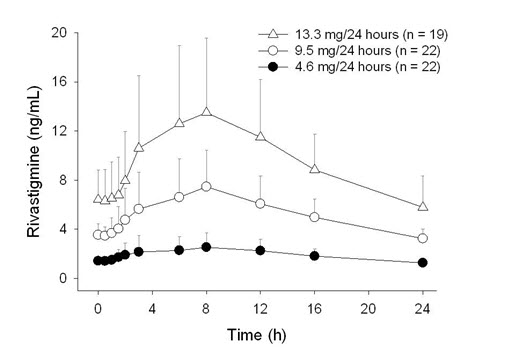
Figure 2: Rivastigmine Plasma Concentrations Following Dermal 24-hour Patch Application (Exelon Patch 03)

Figure 2: Rivastigmine Plasma Concentrations Following Dermal 24-hour Patch Application (Exelon Patch 03)
A line graph depicting plasma concentration of rivastigmine (ng/mL) over 24 hours after application of Exelon transdermal patches in three strengths: 13.3 mg/24h, 9.5 mg/24h, and 4.6 mg/24h. Concentrations increase, peak, and then gradually decline for each dose, with higher doses showing higher plasma levels. Error bars indicate variability.*
FDA Label Image

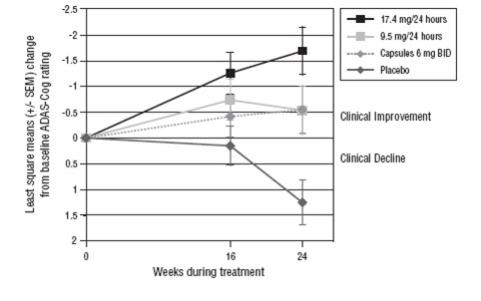
Figure 3: Time Course Of The Change From Baseline In Adas-cog Score For Patients Observed At Each Time Point (Exelon Patch 04)

Figure 3: Time Course Of The Change From Baseline In Adas-cog Score For Patients Observed At Each Time Point (Exelon Patch 04)
A line chart depicting least square means of change from baseline ADCS CDR cog rating over 24 weeks of treatment with rivastigmine patch at 17.4 mg/24 hours, 9.5 mg/24 hours, rivastigmine capsules 6 mg BID, and placebo. The y-axis shows clinical improvement versus decline; the x-axis shows weeks during treatment (0, 16, 24).*
FDA Label Image

Figure 4: Distribution Of Adcs-cgic Scores For Patients Completing The Study (Exelon Patch 05)

Figure 4: Distribution Of Adcs-cgic Scores For Patients Completing The Study (Exelon Patch 05)
A bar chart showing the distribution of patients by ADCS-CGIC ratings, comparing four groups: 17.4 mg/24 hours, 9.5 mg/24 hours, capsules 6 mg BID, and placebo. The y-axis represents the percentage of patients and the x-axis categories range from "Markedly Improved" to "Markedly Worse." The chart illustrates varying patient outcomes across treatment types.*
FDA Label Image

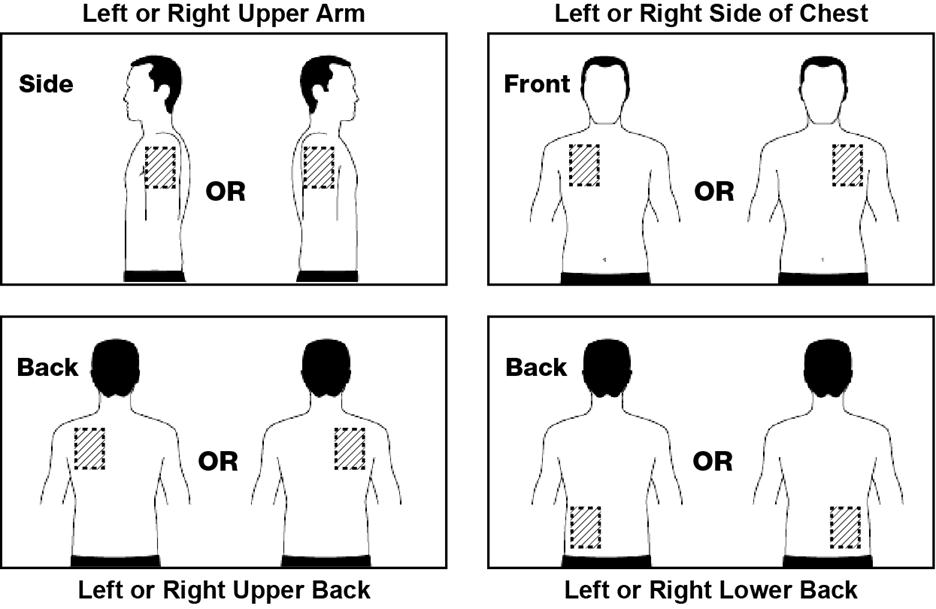
Figure Aapply One Patch To Only One Of The Following Possible Sites Each Day (Exelon Patch 06)

Figure Aapply One Patch To Only One Of The Following Possible Sites Each Day (Exelon Patch 06)
An instructional diagram illustrating the components of an Exelon Patch (rivastigmine transdermal system) package. It shows the pouch packaging labeled Exelon Patch, the patch itself with protective liners, and a detailed view of the patch's adhesive side containing medicine and the outside backing. The labeler is Novartis Pharmaceuticals Corporation.*
FDA Label Image

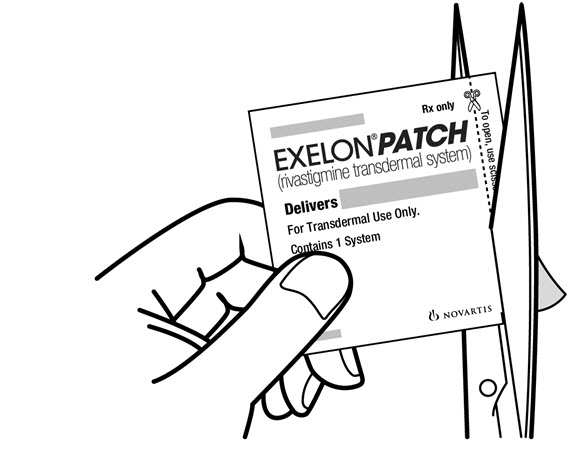
Cut The Pouch Along The Dotted Line And Remove The Patch. (Exelon Patch 07)

Cut The Pouch Along The Dotted Line And Remove The Patch. (Exelon Patch 07)
Instructional diagram showing recommended application sites for Exelon patches on the body. The image highlights four areas for patch placement: left or right upper arm, left or right side of chest (front), left or right upper back, and left or right lower back, each marked with a hatched rectangular area on illustrated human figures from side, front, and back views.*
FDA Label Image

A Protective Liner Covers The Adhesive Side Of The Patch. Peel Off One Side Of The Protective Liner And Do Not Touch The Sticky Part Of The Patch With The Fingers. (Exelon Patch 08)

A Protective Liner Covers The Adhesive Side Of The Patch. Peel Off One Side Of The Protective Liner And Do Not Touch The Sticky Part Of The Patch With The Fingers. (Exelon Patch 08)
An instructional illustration showing a hand holding an unopened Exelon Patch (rivastigmine transdermal system) single-use pouch being cut open with scissors. The pouch displays the product name, usage instructions for transdermal application, and branding by Novartis.*
FDA Label Image

Put The Sticky Side Of The Patch On The Upper Or Lower Back, Upper Arm Or Chest And Then Peel Off The Second Side Of The Protective Liner. (Exelon Patch 09)

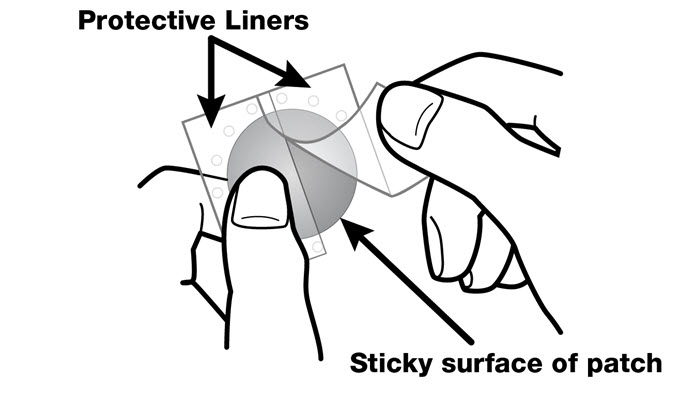
Put The Sticky Side Of The Patch On The Upper Or Lower Back, Upper Arm Or Chest And Then Peel Off The Second Side Of The Protective Liner. (Exelon Patch 09)
An instructional illustration showing two hands peeling protective liners from a round transdermal patch to expose the sticky surface. The image highlights the step of removing protective liners before applying the patch to the skin.*
FDA Label Image

Press The Patch Firmly In Place With The Hand To Make Sure That The Edges Stick Well. (Exelon Patch 0a)

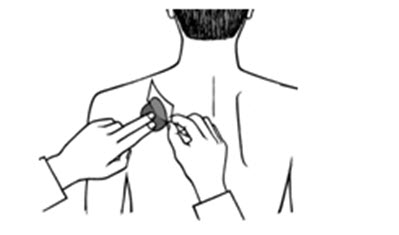
Press The Patch Firmly In Place With The Hand To Make Sure That The Edges Stick Well. (Exelon Patch 0a)
An instructional illustration showing the application of a transdermal patch to the upper back of a person. The image depicts hands placing the patch on the skin, indicating correct placement technique.*
FDA Label Image

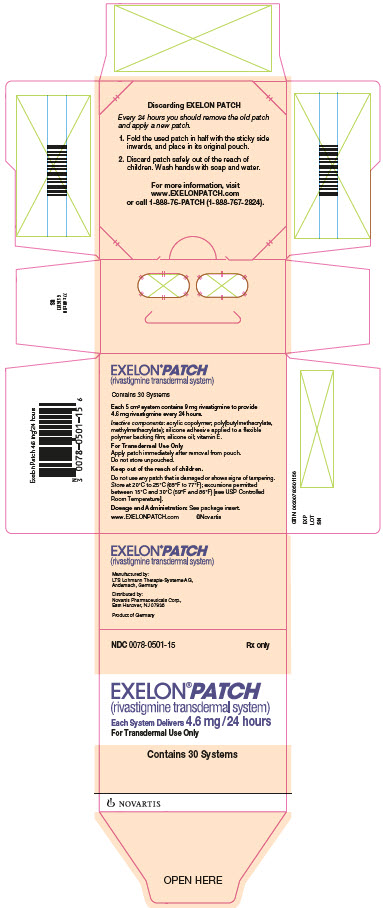
Principal Display Panelpackage Label – 4.6 mg / 24 Hoursrx Only Ndc 0078-0501-15exelon® Patch(rivastigmine Transdermal System) Each System Delivers 4.6 mg/24 Hoursfor Transdermal Use Onlycontains 30 Systems (Exelon Patch 0b)

Principal Display Panelpackage Label – 4.6 mg / 24 Hoursrx Only		Ndc 0078-0501-15exelon® Patch(rivastigmine Transdermal System) Each System Delivers 4.6 mg/24 Hoursfor Transdermal Use Onlycontains 30 Systems (Exelon Patch 0b)
Exelon Patch 4.6 mg/24 hours transdermal system carton packaging label. The label includes directions for patch disposal, contents listing 30 systems with rivastigmine as the active ingredient, manufacturer information from Novartis Pharmaceuticals Corporation, and storage instructions. The label displays usage warnings and has a Novartis logo at the bottom.*
FDA Label Image

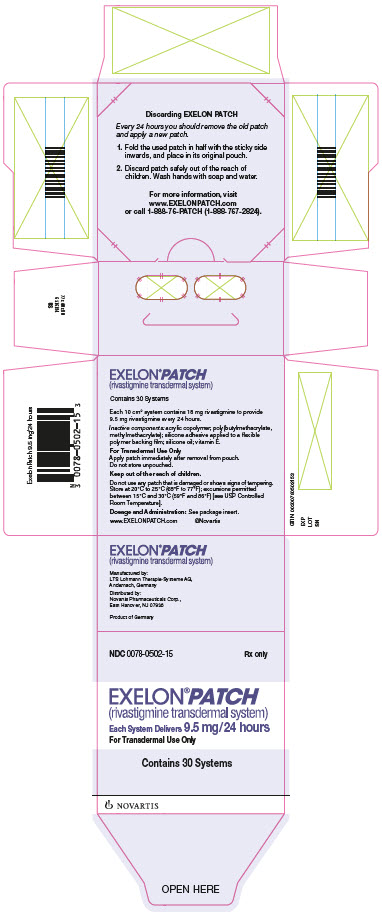
Principal Display Panelpackage Label – 9.5 mg / 24 Hoursrx Only Ndc 0078-0502-15exelon® Patch(rivastigmine Transdermal System) Each System Delivers 9.5 mg/24 Hoursfor Transdermal Use Onlycontains 30 Systems (Exelon Patch 0c)

Principal Display Panelpackage Label – 9.5 mg / 24 Hoursrx Only		Ndc 0078-0502-15exelon® Patch(rivastigmine Transdermal System) Each System Delivers 9.5 mg/24 Hoursfor Transdermal Use Onlycontains 30 Systems (Exelon Patch 0c)
Box label for Exelon Patch 9.5 mg/24 hours (rivastigmine transdermal system) by Novartis Pharmaceuticals Corporation. The label states the box contains 30 extended-release transdermal patches, provides dosage and disposal instructions, and includes manufacturer information. The patch delivery system is noted for transdermal use only.*
FDA Label Image

Figure 5 Time Course Of The Change From Double-blind Baseline In Adcs-iadl Score For Patients Observed At Each Time Point In Study 2 (Exelon Patch 0d)

Figure 5 Time Course Of The Change From Double-blind Baseline In Adcs-iadl Score For Patients Observed At Each Time Point In Study 2 (Exelon Patch 0d)
A line graph comparing ADC-S-ADL change from baseline over 48 weeks between Exelon Patch 13.3 mg/24h and 9.5 mg/24h. The y-axis represents change from baseline with clinical improvement at the top and decline at the bottom. The 13.3 mg/24h patch shows less decline over time compared to the 9.5 mg/24h patch, with several statistically significant differences (p<0.05) noted.*
FDA Label Image

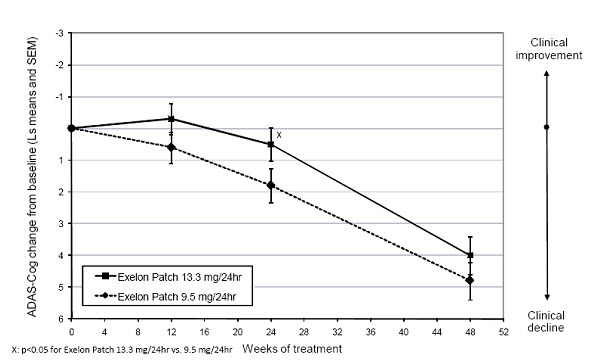
Figure 6 Time Course Of The Change From Double-blind Baseline In Adas-cog Score For Patients Observed At Each Time Point In Study 2 (Exelon Patch 0e)

Figure 6 Time Course Of The Change From Double-blind Baseline In Adas-cog Score For Patients Observed At Each Time Point In Study 2 (Exelon Patch 0e)
A line graph depicting ADAS-Cog change from baseline (least squares means and SEM) over weeks of treatment for Exelon Patch 13.3 mg/24hr and 9.5 mg/24hr. The graph shows clinical improvement and decline on the vertical axis, with greater decline over time, and includes statistical significance markers at 24 weeks favoring the 13.3 mg/24hr dose.*
FDA Label Image

Principal Display Panelpackage Label – 13.3 mg / 24 Hoursrx Only Ndc 0078-0503-15exelon® Patch(rivastigmine Transdermal System) Each System Delivers 13.3 mg/24 Hoursfor Transdermal Use Onlycontains 30 Systems (Exelon Patch 0f)

Principal Display Panelpackage Label – 13.3 mg / 24 Hoursrx Only		Ndc 0078-0503-15exelon® Patch(rivastigmine Transdermal System) Each System Delivers 13.3 mg/24 Hoursfor Transdermal Use Onlycontains 30 Systems (Exelon Patch 0f)
Packaging label for Exelon Patch 13.3 mg/24h, a rivastigmine transdermal extended-release system. The label states each system delivers 13.3 mg/24 hours and the package contains 30 systems. It includes directions for patch application and safety instructions. The labeler is Novartis Pharmaceuticals Corporation.*
FDA Label Image

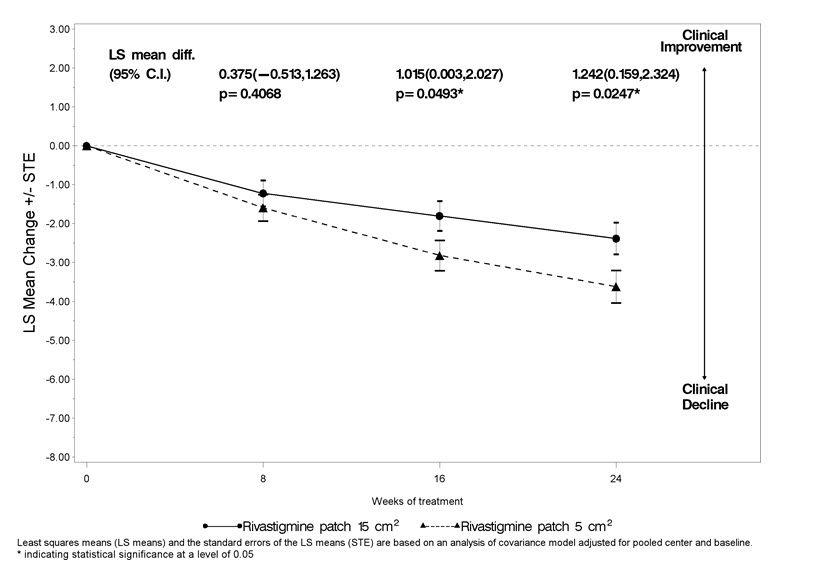
Figure 7 Time Course Of The Change From Baseline In Sib Score For Patients Observed At Each Time Point (modified Full Analysis Set – Locf) (Exelon Patch 0g)

Figure 7 Time Course Of The Change From Baseline In Sib Score For Patients Observed At Each Time Point (modified Full Analysis Set – Locf) (Exelon Patch 0g)
A line graph comparing least squares mean changes over 24 weeks of treatment between two rivastigmine patch sizes (15 cm² and 5 cm²). The y-axis shows LS mean change plus or minus standard error, indicating clinical improvement or decline. The 15 cm² patch shows clinical improvement over time, while the 5 cm² patch exhibits clinical decline. Statistical significance is noted at weeks 16 and 24 for the 15 cm² patch.*
FDA Label Image

Figure 8 Time Course Of The Change From Baseline In Adcs-adl-siv Score For Patients Observed At Each Time Point (modified Full Analysis Set – Locf) (Exelon Patch 0h)

Figure 8 Time Course Of The Change From Baseline In Adcs-adl-siv Score For Patients Observed At Each Time Point (modified Full Analysis Set – Locf) (Exelon Patch 0h)
A line graph comparing LS mean changes in clinical outcomes over 24 weeks of treatment for rivastigmine patches of two sizes, 15 cm² and 5 cm². The y-axis represents LS mean change with confidence intervals, and the x-axis shows weeks of treatment at 0, 8, 16, and 24 weeks. The graph shows statistical significance annotations for weeks 16 and 24.*
FDA Label Image

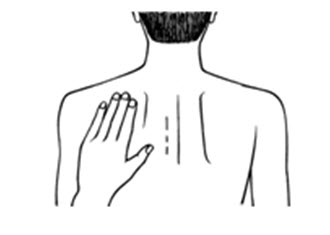
Figure F (Exelon Patch 0i)

Figure F (Exelon Patch 0i)
An instructional line drawing showing the upper back and neck of a person, with a hand positioned to apply a patch to the skin between the shoulder blades, illustrating the proper placement site for a transdermal patch.*
FDA Label Image

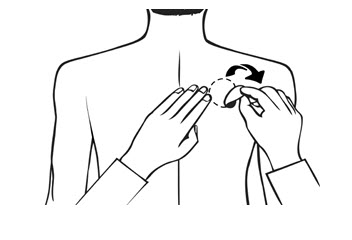
Figure G (Exelon Patch 0j)

Figure G (Exelon Patch 0j)
An instructional illustration showing a person applying a transdermal patch to the upper chest area. One hand is holding the patch while the other hand is peeling off the backing, indicated by an arrow showing the direction of removal. The illustration highlights the correct placement and handling of the patch on the skin.*
FDA Label Image

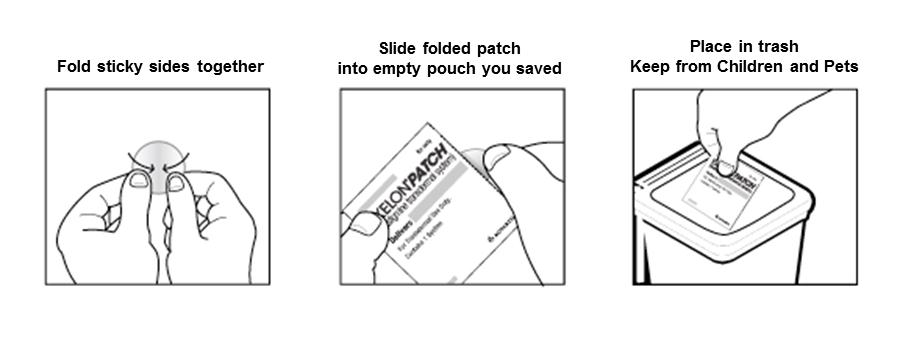
Figure H (Exelon Patch 0k)

Figure H (Exelon Patch 0k)
Illustration showing three-step instructions for safe disposal of an Exelon rivastigmine extended-release transdermal patch: folding sticky sides together, sliding the folded patch into its empty pouch, and placing the pouch into a trash receptacle while keeping it away from children and pets.*

* About these descriptions: Image descriptions on this page are generated by automated AI analysis of the product label images from the manufacturer's FDA label submission (SPL). They are provided for reference only and may contain errors or omissions. Always rely on the printed label itself and the official FDA labeling, and consult a pharmacist or healthcare professional with any questions about this product.