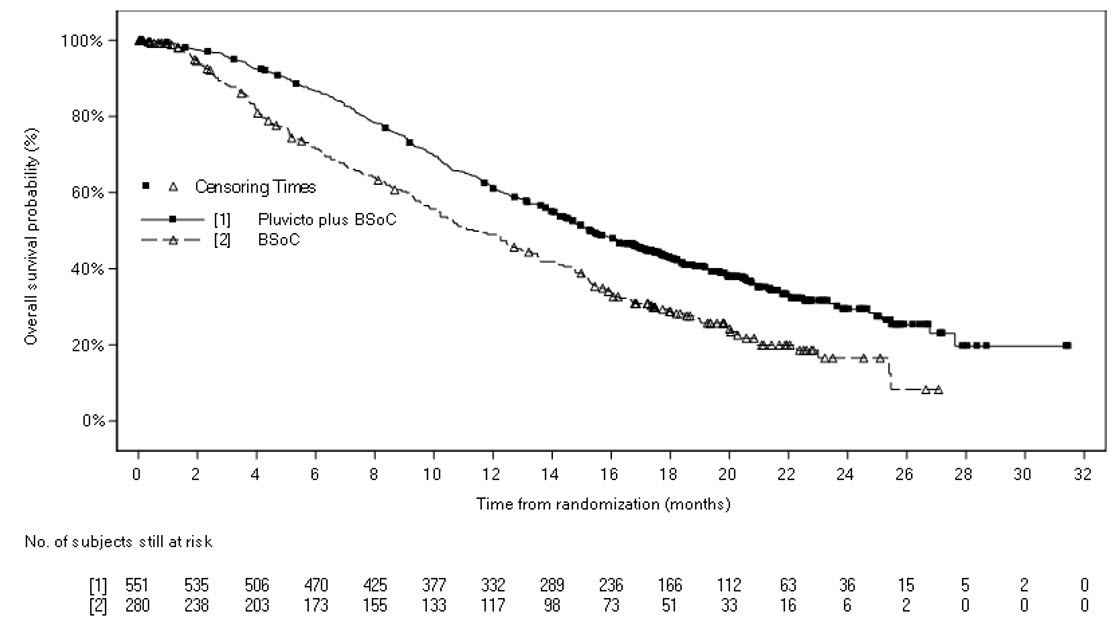
Because clinical trials are conducted under widely varying conditions, adverse reaction rates observed in the clinical trials of a drug cannot be directly compared to rates in the clinical trials of another drug and may not reflect the rates observed in practice.
In the pooled safety population for the PSMAfore and VISION studies (N = 756), the most common (≥ 20%) adverse reactions, including laboratory abnormalities, were decreased lymphocytes (83%), decreased hemoglobin (65%), fatigue (49%), dry mouth (46%), decreased platelets (40%), decreased estimated glomerular filtration rate (37%), nausea (35%), decreased neutrophils (31%), decreased calcium (29%), decreased sodium (27%), increased aspartate aminotransferase (26%), increased alkaline phosphatase (24%), arthralgia (22%), decreased appetite (21%), increased potassium (21%), constipation (21%), and back pain (21%).
PSMAfore
The safety of PLUVICTO was evaluated in the PSMAfore study in patients with progressive, PSMA-positive mCRPC previously treated with ARPI therapy, for whom it was considered appropriate to delay taxane-based chemotherapy by the investigator [see Clinical Studies (14.1)]. Patients received at least one dose of either PLUVICTO 7.4 GBq (200 mCi) administered every 6 weeks (N = 227) or a change in ARPI (N = 232). The median duration of exposure to PLUVICTO was 8.4 months (range, 0.4 to 11.6), and the median number of doses of PLUVICTO received was 6 (range, 1 to 6). The median cumulative administered activity of PLUVICTO was 42.4 GBq (range, 7.0 to 45.4).
Serious adverse reactions occurred in 20% of patients who received PLUVICTO. Serious adverse reactions in > 1% of patients who received PLUVICTO included anemia (1.8%), urinary tract infection (1.8%), hemorrhage (1.3%), and sepsis (1.3%).
Fatal adverse reactions occurred in 1.8% of patients who received PLUVICTO, including COVID-19 pneumonia, cardiac arrest, intestinal ischemia, and sepsis (0.4% each).
PLUVICTO was permanently discontinued due to adverse reactions in 6% of patients. Adverse reactions leading to permanent discontinuation of PLUVICTO in ≥ 1% of patients who received PLUVICTO were thrombocytopenia (1.8%) and dry mouth (1.3%).
Adverse reactions leading to a dose interruption of PLUVICTO occurred in 12% of patients. The most frequent (≥ 1%) adverse reactions leading to a dose interruption of PLUVICTO in patients who received PLUVICTO were COVID-19 (3.1%) and anemia (1.8%).
Adverse reactions leading to a dose reduction of PLUVICTO occurred in 3.5% of patients. The most frequent (≥ 0.5%) adverse reaction leading to a dose reduction of PLUVICTO in patients who received PLUVICTO was dry mouth (0.9%).
Table 3 and Table 4 summarize the incidence of adverse reactions and laboratory abnormalities, respectively, in PSMAfore.
Table 3: Adverse Reactions (≥ 10%) in Patients With PSMA-Positive mCRPC Who Received PLUVICTO in PSMAforeAbbreviation: ARPI, androgen receptor pathway inhibitor.
aIncludes multiple similar terms. |
| Adverse reactions | PLUVICTO
(N = 227) | ARPI
(N = 232) |
All Grades
(%) | Grades 3 or 4
(%) | All Grades
(%) | Grades 3 or 4
(%) |
| Gastrointestinal disorders |
| Dry moutha | 61
| 0.9
| 2.6
| 0
|
| Nausea | 32
| 0
| 12
| 0.4
|
| Constipation | 22
| 0.4
| 14
| 0
|
| Diarrhea
| 17
| 0
| 9
| 0.4
|
| Vomiting | 11
| 0
| 4.7
| 0
|
| General disorders |
| Fatiguea | 53
| 1.3
| 53
| 5
|
| Metabolism and nutrition disorders |
| Decreased appetite
| 22
| 0
| 19
| 0.4
|
| Musculoskeletal and connective tissue disorders |
| Arthralgia
| 20
| 0
| 23
| 0.4
|
| Back pain
| 14
| 1.3
| 20
| 2.6
|
Clinically relevant adverse reactions in < 10% of patients who received PLUVICTO included dysgeusia, abdominal pain, peripheral edema, headache, acute kidney injury, weight decreased, urinary tract infection, dry eye, dizziness, dry skin, oral fungal infection, gastroesophageal reflux disease, pyrexia, vertigo, stomatitis, dysphagia, esophagitis, pancytopenia, and bone marrow failure.
Table 4: Select Laboratory Abnormalities (≥ 10%) That Worsened From Baseline in Patients With PSMA-Positive mCRPC Who Received PLUVICTO or Change in ARPI (Between Arm Difference of ≥ 5% All Grades) in PSMAforeAbbreviation: ARPI, androgen receptor pathway inhibitor.
aThe denominator used to calculate the rate for each laboratory parameter was based on 226 patients with a baseline value and at least one post-treatment value.
bThe denominator used to calculate the rate for each laboratory parameter varied from 231 to 232 based on the number of patients with a baseline value and at least one post-treatment value.
cNo Grade 4 laboratory abnormalities worsening from baseline were reported.
|
| Laboratory abnormalities | PLUVICTOa | ARPIb |
All Grades
(%) | Grades 3 or 4
(%) | All Grades
(%) | Grades 3 or 4
(%) |
| Hematology |
| Decreased lymphocytes
| 78
| 27
| 57
| 12
|
| Decreased hemoglobin
| 67
| 7c | 50
| 7c |
| Decreased neutrophils
| 38
| 3.5
| 18
| 1.3
|
| Decreased platelets
| 30
| 2.7
| 11
| 1.7
|
| Chemistry |
| Increased alkaline phosphatase
| 31
| 8
| 50
| 10c |
| Decreased estimated glomerular filtration rate (eGFR) | 23
| 0.9c | 22
| 3.5
|
| Increased magnesium
| 19
| 0.9c | 28
| 0c |
| Decreased calcium
| 18
| 0.9
| 11
| 0.9
|
| Decreased sodium
| 11
| 0c | 18
| 0c |
| Decreased potassium
| 6
| 0.9c | 18
| 2.6
|
VISION
The safety of PLUVICTO was evaluated in the VISION study in patients with progressive, PSMA-positive mCRPC previously treated with ARPI therapy and taxane-based chemotherapy [see Clinical Studies (14.2)]. Patients received at least one dose of either PLUVICTO 7.4 GBq (200 mCi) administered every 6 weeks plus BSoC (N = 529) or BSoC alone (N = 205). The median duration of exposure to PLUVICTO plus BSoC was 7.8 months (range, 0.3 to 36.5). Among patients who received PLUVICTO plus BSoC, the median number of doses of PLUVICTO received was 5 (range, 1 to 6). The median cumulative administered activity of PLUVICTO was 37.5 GBq (range, 7.0 to 48.3).
Serious adverse reactions occurred in 37% of patients who received PLUVICTO plus BSoC. Serious adverse reactions in > 1% of patients who received PLUVICTO plus BSoC included musculoskeletal pain (4%), hemorrhage (4%), sepsis (3.2%), urinary tract infection (3%), anemia (2.8%), acute kidney injury (1.9%), pneumonia (1.7%), pyrexia (1.5%), pancytopenia (1.3%), spinal cord compression (1.1%), and pulmonary embolism (1.1%).
Fatal adverse reactions occurred in 3% of patients who received PLUVICTO plus BSoC, including sepsis (0.9%), pancytopenia (0.6%), hepatic failure (0.4%), intracranial hemorrhage (0.2%), subdural hematoma (0.2%), ischemic stroke (0.2%), COVID-19 (0.2%), and aspiration pneumonia (0.2%).
PLUVICTO was permanently discontinued due to adverse reactions in 12% of patients. Adverse reactions leading to permanent discontinuation of PLUVICTO in ≥ 1% of patients who received PLUVICTO plus BSoC were anemia (2.8%), thrombocytopenia (2.8%), and leukopenia (including neutropenia) (1.7%).
Adverse reactions leading to a dose interruption of PLUVICTO occurred in 16% of patients. The most frequent (≥ 3%) adverse reactions leading to a dose interruption of PLUVICTO in patients who received PLUVICTO plus BSoC were anemia (5%) and thrombocytopenia (3.6%).
Adverse reactions leading to a dose reduction of PLUVICTO occurred in 6% of patients. The most frequent (≥ 1%) adverse reactions leading to a dose reduction of PLUVICTO in patients who received PLUVICTO plus BSoC were thrombocytopenia (1.9%) and anemia (1.3%).
Table 5 and Table 6 summarize the incidence of adverse reactions and laboratory abnormalities, respectively, in VISION.
Table 5: Adverse Reactions (≥ 10%) in Patients With PSMA-Positive mCRPC Who Received PLUVICTO Plus BSoC in VISIONAbbreviation: BSoC, best standard of care.
aIncludes multiple similar terms.
|
| Adverse reactions | PLUVICTO plus BSoC
(N = 529) | BSoC
(N = 205) |
All Grades
(%) | Grades 3 or 4
(%) | All Grades
(%) | Grades 3 or 4
(%) |
| General disorders |
| Fatiguea | 48
| 7
| 29
| 2.4
|
| Decreased appetite | 21
| 1.9
| 15
| 0.5
|
| Weight decreased | 11
| 0.4
| 10
| 0.5
|
| Peripheral edemaa | 10
| 0.4
| 7
| 1
|
| Gastrointestinal disorders |
| Dry moutha | 39
| 0
| 1
| 0
|
| Nausea
| 36
| 1.3
| 17
| 0.5
|
| Constipation
| 20
| 1.1
| 11
| 0.5
|
| Vomitinga | 19
| 0.9
| 6
| 0.5
|
| Diarrhea
| 19
| 0.8
| 2.9
| 0.5
|
| Abdominal paina | 12
| 1.3
| 6
| 0.5
|
| Musculoskeletal and connective tissue disorders |
| Back pain
| 24
| 3.6
| 15
| 3.9
|
| Arthralgia
| 22
| 1.1
| 13
| 0.5
|
| Bone pain
| 11
| 2.5
| 8
| 2.4
|
| Renal and urinary disorders |
| Urinary tract infectiona | 12
| 3.8
| 1
| 0.5
|
Clinically relevant adverse reactions in < 10% of patients who received PLUVICTO plus BSoC included acute kidney injury, dizziness, dysgeusia, headache, pyrexia, dry eye, oral fungal infection, vertigo, gastroesophageal reflux disease, stomatitis, pancytopenia, dry skin, dysphagia, esophagitis, and bone marrow failure.
Table 6: Select Laboratory Abnormalities (≥ 10%) That Worsened From Baseline in Patients With PSMA-Positive mCRPC Who Received PLUVICTO Plus BSoC (Between Arm Difference of ≥ 5% All Grades) in VISIONAbbreviation: BSoC, best standard of care.
aThe denominator used to calculate the rate for each laboratory parameter varied from 506 to 529 based on the number of patients with a baseline value and at least one post-treatment value.
bThe denominator used to calculate the rate for each laboratory parameter varied from 194 to 198 based on the number of patients with a baseline value and at least one post-treatment value.
cNo Grade 4 laboratory abnormalities worsening from baseline were reported.
|
| Laboratory abnormalities | PLUVICTO plus BSoCa | BSoCb |
All Grades
(%) | Grades 3 or 4
(%) | All Grades
(%) | Grades 3 or 4
(%) |
| Hematology |
| Decreased lymphocytes
| 85
| 47
| 51
| 18
|
| Decreased hemoglobin
| 64
| 15c | 34
| 7c |
| Decreased platelets
| 45
| 9
| 20
| 2.5
|
| Decreased neutrophils
| 28
| 4.7
| 9
| 0.5
|
| Chemistry |
| Decreased estimated glomerular filtration rate (eGFR)
| 43
| 3.6
| 28
| 2.5
|
| Decreased sodium
| 34
| 0.6c | 23
| 1
|
| Decreased calcium
| 34
| 1.9
| 18
| 1.5
|
| Increased aspartate aminotransferase (AST)
| 29
| 1.1
| 18
| 1c |
| Increased potassium
| 24
| 0.6
| 18
| 0.5c |
| Increased sodium
| 11
| 0c | 5
| 0c |