The effectiveness of Sandimmune (Cyclosporine Capsules USP) and Cyclosporine Capsules USP MODIFIED in the treatment of severe rheumatoid arthritis was evaluated in 5 clinical studies involving a total of 728 cyclosporine treated patients and 273 placebo treated patients.
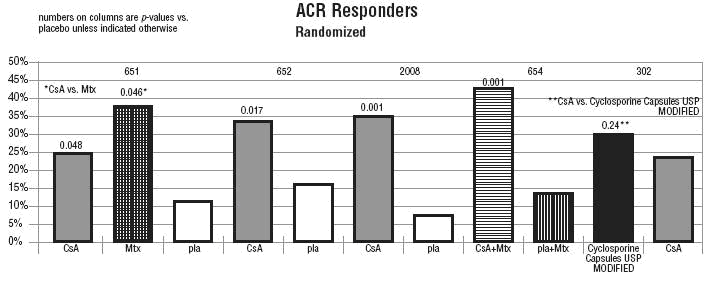
A summary of the results is presented for the “responder” rates per treatment group, with a responder being defined as a patient having completed the trial with a 20% improvement in the tender and the swollen joint count and a 20% improvement in 2 of 4 of investigator global, patient global, disability, and erythrocyte sedimentation rates (ESR) for the Studies 651 and 652 and 3 of 5 of investigator global, patient global, disability, visual analog pain, and ESR for Studies 2008, 654 and 302.
Study 651 enrolled 264 patients with active rheumatoid arthritis with at least 20 involved joints, who had failed at least one major RA drug, using a 3:3:2 randomization to one of the following three groups: (1) cyclosporine dosed at 2.5 to 5 mg/kg/day, (2) methotrexate at 7.5 to 15 mg/week, or (3) placebo. Treatment duration was 24 weeks. The mean cyclosporine dose at the last visit was 3.1 mg/kg/day. See graph below.
Study 652 enrolled 250 patients with active RA with > 6 active painful or tender joints who had failed at least one major RA drug. Patients were randomized using a 3:3:2 randomization to 1 of 3 treatment arms: (1) 1.5 to 5 mg/kg/day of cyclosporine, (2) 2.5 to 5 mg/kg/day of cyclosporine, and (3) placebo. Treatment duration was 16 weeks. The mean cyclosporine dose for group 2 at the last visit was 2.92 mg/kg/day. See graph below.
Study 2008 enrolled 144 patients with active RA and > 6 active joints who had unsuccessful treatment courses of aspirin and gold or Penicillamine. Patients were randomized to 1 of 2 treatment groups (1) cyclosporine 2.5 to 5 mg/kg/day with adjustments after the first month to achieve a target trough level and (2) placebo. Treatment duration was 24 weeks. The mean cyclosporine dose at the last visit was 3.63 mg/kg/day. See graph below.
Study 654 enrolled 148 patients who remained with active joint counts of 6 or more despite treatment with maximally tolerated methotrexate doses for at least three months. Patients continued to take their current dose of methotrexate and were randomized to receive, in addition, one of the following medications: (1) cyclosporine 2.5 mg/kg/day with dose increases of 0.5 mg/kg/day at weeks 2 and 4 if there was no evidence of toxicity and further increases of 0.5 mg/kg/day at weeks 8 and 16 if a < 30% decrease in active joint count occurred without any significant toxicity; dose decreases could be made at any time for toxicity or (2) placebo. Treatment duration was 24 weeks. The mean cyclosporine dose at the last visit was 2.8 mg/kg/day (range: 1.3 to 4.1). See graph below.
Study 302 enrolled 299 patients with severe active RA, 99% of whom were unresponsive or intolerant to at least one prior major RA drug. Patients were randomized to 1 of 2 treatment groups (1) Cyclosporine Capsules USP MODIFIED and (2) cyclosporine, both of which were started at 2.5 mg/kg/day and increased after 4 weeks for inefficacy in increments of 0.5 mg/kg/day to a maximum of 5 mg/kg/day and decreased at any time for toxicity. Treatment duration was 24 weeks. The mean cyclosporine dose at the last visit was 2.91 mg/kg/day (range: 0.72 to 5.17) for Cyclosporine Capsules USP MODIFIED and 3.27 mg/kg/day (range: 0.73 to 5.68) for cyclosporine. See graph below.
Cyclosporine Capsules USP MODIFIED are indicated for the treatment of patients with severe active, rheumatoid arthritis where the disease has not adequately responded to methotrexate. Cyclosporine Capsules USP MODIFIED can be used in combination with methotrexate in rheumatoid arthritis patients who do not respond adequately to methotrexate alone.
Rheumatoid arthritis patients with abnormal renal function, uncontrolled hypertension, or malignancies should not receive Cyclosporine Capsules USP MODIFIED.
Cyclosporine nephropathy was detected in renal biopsies of 6 out of 60 (10%) rheumatoid arthritis patients after the average treatment duration of 19 months. Only one patient, out of these 6 patients, was treated with a dose ≤ 4 mg/kg/day. Serum creatinine improved in all but one patient after discontinuation of cyclosporine. The “maximal creatinine increase” appears to be a factor in predicting cyclosporine nephropathy.
There is a potential, as with other immunosuppressive agents, for an increase in the occurrence of malignant lymphomas with cyclosporine. It is not clear whether the risk with cyclosporine is greater than that in rheumatoid arthritis patients or in rheumatoid arthritis patients on cytotoxic treatment for this indication. Five cases of lymphoma were detected: four in a survey of approximately 2,300 patients treated with cyclosporine for rheumatoid arthritis, and another case of lymphoma was reported in a clinical trial. Although other tumors (12 skin cancers, 24 solid tumors of diverse types, and 1 multiple myeloma) were also reported in this survey, epidemiologic analyses did not support a relationship to cyclosporine other than for malignant lymphomas.
Patients should be thoroughly evaluated before and during Cyclosporine Capsules USP MODIFIED treatment for the development of malignancies. Moreover, use of Cyclosporine Capsules USP MODIFIED therapy with other immunosuppressive agents may induce an excessive immunosuppression which is known to increase the risk of malignancy.
The principal adverse reactions associated with the use of cyclosporine in rheumatoid arthritis are renal dysfunction (see WARNINGS), hypertension (see PRECAUTIONS), headache, gastrointestinal disturbances, and hirsutism/hypertrichosis.
In rheumatoid arthritis patients treated in clinical trials within the recommended dose range, cyclosporine therapy was discontinued in 5.3% of the patients because of hypertension and in 7% of the patients because of increased creatinine. These changes are usually reversible with timely dose decrease or drug discontinuation. The frequency and severity of serum creatinine elevations increase with dose and duration of cyclosporine therapy. These elevations are likely to become more pronounced without dose reduction or discontinuation.
The following adverse events occurred in controlled clinical trials:
Cyclosporine Capsules USP MODIFIED / Sandimmune (Cyclosporine Capsules USP) Rheumatoid Arthritis
Percentage of Patients with Adverse Events ≥ 3% in any Cyclosporine Treated Group | | Studies
651 + 652 + 2008 | Study
302 | Study
654 | Study
654 | Study
302 | Studies
651 + 652 + 2008 |
Body System | Preferred Term | Sandimmune1 (Cyclosporine Capsules USP) (N = 269) | Sandimmune (Cyclosporine Capsules USP) (N = 155) | Methotrexate & Sandimmune (Cyclosporine Capsules USP) (N = 74) | Methotrexate & Placebo
(N = 73) | Cyclosporine Capsules USP MODIFIED
(N = 143) | Placebo
(N = 201) |
Autonomic Nervous System Disorders |
| Flushing | 2% | 2% | 3% | 0% | 5% | 2% |
Body As a Whole-General Disorders |
| Accidental trauma | 0% | 1% | 10% | 4% | 4% | 0% |
| Edema NOS2 | 5% | 14% | 12% | 4% | 10% | < 1% |
| Fatigue | 6% | 3% | 8% | 12% | 3% | 7% |
| Fever | 2% | 3% | 0% | 0% | 2% | 4% |
| Influenza-like symptoms | < 1% | 6% | 1% | 0% | 3% | 2% |
| Pain | 6% | 9% | 10% | 15% | 13% | 4% |
| Rigors | 1% | 1% | 4% | 0% | 3% | 1% |
Cardiovascular Disorders |
| Arrhythmia | 2% | 5% | 5% | 6% | 2% | 1% |
| Chest pain | 4% | 5% | 1% | 1% | 6% | 1% |
| Hypertension | 8% | 26% | 16% | 12% | 25% | 2% |
Central and Peripheral Nervous System Disorders |
| Dizziness | 8% | 6% | 7% | 3% | 8% | 3% |
| Headache | 17% | 23% | 22% | 11% | 25% | 9% |
| Migraine | 2% | 3% | 0% | 0% | 3% | 1% |
| Paresthesia | 8% | 7% | 8% | 4% | 11% | 1% |
| Tremor | 8% | 7% | 7% | 3% | 13% | 4% |
Gastrointestinal System Disorders |
| Abdominal pain | 15% | 15% | 15% | 7% | 15% | 10% |
| Anorexia | 3% | 3% | 1% | 0% | 3% | 3% |
| Diarrhea | 12% | 12% | 18% | 15% | 13% | 8% |
| Dyspepsia | 12% | 12% | 10% | 8% | 8% | 4% |
| Flatulence | 5% | 5% | 5% | 4% | 4% | 1% |
| Gastrointestinal disorder NOS2 | 0% | 2% | 1% | 4% | 4% | 0% |
| Gingivitis | 4% | 3% | 0% | 0% | 0% | 1% |
| Gum hyperplasia | 2% | 4% | 1% | 3% | 4% | 1% |
| Nausea | 23% | 14% | 24% | 15% | 18% | 14% |
| Rectal hemorrhage | 0% | 3% | 0% | 0% | 1% | 1% |
| Stomatitis | 7% | 5% | 16% | 12% | 6% | 8% |
| Vomiting | 9% | 8% | 14% | 7% | 6% | 5% |
Hearing and Vestibular Disorders |
| Ear disorder NOS2 | 0% | 5% | 0% | 0% | 1% | 0% |
Metabolic and Nutritional Disorders |
| Hypomagnesemia | 0% | 4% | 0% | 0% | 6% | 0% |
Musculoskeletal System Disorders |
| Arthropathy | 0% | 5% | 0% | 1% | 4% | 0% |
| Leg cramps/ involuntary muscle contractions | 2% | 11% | 11% | 3% | 12% | 1% |
Psychiatric Disorders |
| Depression | 3% | 6% | 3% | 1% | 1% | 2% |
| Insomnia | 4% | 1% | 1% | 0% | 3% | 2% |
Renal |
| Creatinine elevations ≥ 30% | 43% | 39% | 55% | 19% | 48% | 13% |
| Creatinine elevations ≥ 50% | 24% | 18% | 26% | 8% | 18% | 3% |
Reproduction Disorders, Female |
| Leukorrhea | 1% | 0% | 4% | 0% | 1% | 0% |
| Menstrual disorder | 3% | 2% | 1% | 0% | 1% | 1% |
Respiratory System Disorders |
| Bronchitis | 1% | 3% | 1% | 0% | 1% | 3% |
| Coughing | 5% | 3% | 5% | 7% | 4% | 4% |
| Dyspnea | 5% | 1% | 3% | 3% | 1% | 2% |
| Infection NOS2 | 9% | 5% | 0% | 7% | 3% | 10% |
| Pharyngitis | 3% | 5% | 5% | 6% | 4% | 4% |
| Pneumonia | 1% | 0% | 4% | 0% | 1% | 1% |
| Rhinitis | 0% | 3% | 11% | 10% | 1% | 0% |
| Sinusitis | 4% | 4% | 8% | 4% | 3% | 3% |
| Upper respiratory tract | 0% | 14% | 23% | 15% | 13% | 0% |
Skin and Appendages Disorders |
| Alopecia | 3% | 0% | 1% | 1% | 4% | 4% |
| Bullous eruption | 1% | 0% | 4% | 1% | 1% | 1% |
| Hypertrichosis | 19% | 17% | 12% | 0% | 15% | 3% |
| Rash | 7% | 12% | 10% | 7% | 8% | 10% |
| Skin ulceration | 1% | 1% | 3% | 4% | 0% | 2% |
Urinary System Disorders |
| Dysuria | 0% | 0% | 11% | 3% | 1% | 2% |
| Micturition frequency | 2% | 4% | 3% | 1% | 2% | 2% |
| NPN, increased | 0% | 19% | 12% | 0% | 18% | 0% |
| Urinary tract infection | 0% | 3% | 5% | 4% | 3% | 0% |
Vascular (Extracardiac) Disorders |
| Purpura | 3% | 4% | 1% | 1% | 2% | 0% |
- Includes patients in 2.5 mg/kg/day dose group only.
- NOS = Not Otherwise Specified.
|
In addition, the following adverse events have been reported in 1% to < 3% of the rheumatoid arthritis patients in the cyclosporine treatment group in controlled clinical trials.
Autonomic Nervous System
Dry mouth, increased sweating
Body as a Whole
Allergy, asthenia, hot flushes, malaise, overdose, procedure NOS*, tumor NOS*, weight decrease, weight increase
Cardiovascular
Abnormal heart sounds, cardiac failure, myocardial infarction, peripheral ischemia
Central and Peripheral Nervous System
Hypoesthesia, neuropathy, vertigo
Endocrine
Goiter
Gastrointestinal
Constipation, dysphagia, enanthema, eructation, esophagitis, gastric ulcer, gastritis, gastroenteritis, gingival bleeding, glossitis, peptic ulcer, salivary gland enlargement, tongue disorder, tooth disorder
Infection
Abscess, bacterial infection, cellulitis, folliculitis, fungal infection, herpes simplex, herpes zoster, renal abscess, moniliasis, tonsillitis, viral infection
Hematologic
Anemia, epistaxis, leukopenia, lymphadenopathy
Liver and Biliary System
Bilirubinemia
Metabolic and Nutritional
Diabetes mellitus, hyperkalemia, hyperuricemia, hypoglycemia
Musculoskeletal System
Arthralgia, bone fracture, bursitis, joint dislocation, myalgia, stiffness, synovial cyst, tendon disorder
Neoplasms
Breast fibroadenosis, carcinoma
Psychiatric
Anxiety, confusion, decreased libido, emotional lability, impaired concentration, increased libido, nervousness, paroniria, somnolence
Reproductive (Female)
Breast pain, uterine hemorrhage
Respiratory System
Abnormal chest sounds, bronchospasm
Skin and Appendages
Abnormal pigmentation, angioedema, dermatitis, dry skin, eczema, nail disorder, pruritus, skin disorder, urticaria
Special Senses
Abnormal vision, cataract, conjunctivitis, deafness, eye pain, taste perversion, tinnitus, vestibular disorder
Urinary System
Abnormal urine, hematuria, increased BUN, micturition urgency, nocturia, polyuria, pyelonephritis, urinary incontinence
*NOS = Not Otherwise Specified
The initial dose of Cyclosporine Capsules USP MODIFIED is 2.5 mg/kg/day, taken twice daily as a divided (BID) oral dose. Salicylates, NSAIDs, and oral corticosteroids may be continued (see WARNINGS and PRECAUTIONS, Drug Interactions). Onset of action generally occurs between 4 and 8 weeks. If insufficient clinical benefit is seen and tolerability is good (including serum creatinine less than 30% above baseline), the dose may be increased by 0.5 to 0.75 mg/kg/day after 8 weeks and again after 12 weeks to a maximum of 4 mg/kg/day. If no benefit is seen by 16 weeks of therapy, Cyclosporine Capsules USP MODIFIED therapy should be discontinued.
Dose decreases by 25% to 50% should be made at any time to control adverse events, e.g., hypertension elevations in serum creatinine (30% above patient’s pretreatment level) or clinically significant laboratory abnormalities (see WARNINGS and PRECAUTIONS).
If dose reduction is not effective in controlling abnormalities or if the adverse event or abnormality is severe, Cyclosporine Capsules USP MODIFIED should be discontinued. The same initial dose and dosage range should be used if Cyclosporine Capsules USP MODIFIED are combined with the recommended dose of methotrexate. Most patients can be treated with Cyclosporine Capsules USP MODIFIED doses of 3 mg/kg/day or below when combined with methotrexate doses of up to 15 mg/week (see CLINICAL PHARMACOLOGY, Clinical Trials).
There is limited long-term treatment data. Recurrence of rheumatoid arthritis disease activity is generally apparent within 4 weeks after stopping cyclosporine.