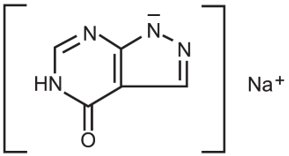
Following intravenous administration in six healthy male and female subjects, allopurinol was rapidly eliminated from the systemic circulation primarily via oxidative metabolism to oxypurinol, with no detectable plasma concentration of allopurinol after 5 hours post dosing. Approximately 12% of the allopurinol intravenous dose was excreted unchanged, 76% excreted as oxypurinol, and the remaining dose excreted as riboside conjugates in the urine. The rapid conversion of allopurinol to oxypurinol was not significantly different after repeated allopurinol dosing. Oxypurinol was present in systemic circulation in much higher concentrations and for a much longer period than allopurinol; thus, it is generally believed that the pharmacological action of allopurinol is mediated via oxypurinol. Oxypurinol was primarily eliminated unchanged in urine by glomerular filtration and tubular reabsorption, with a net renal clearance of about 30 mL/min.
To compare the pharmacokinetics of allopurinol and oxypurinol between intravenous (i.v.) and oral (p.o.) administration of allopurinol sodium for injection, a welI-controlled, four-way crossover study was conducted in 16 male healthy volunteers. Allopurinol sodium for injection was administered via an intravenous infusion over 30 minutes. Pharmacokinetic parameter estimates of allopurinol (mean ± S.D.) following single i.v. and p.o. administration of allopurinol sodium for injection are summarized as follows:
Administration of Allopurinol Sodium for Injection
Allopurinol Parameters | 100 mg i.v. | 300 mg i.v. | 100 mg p.o.* | 300 mg p.o. |
Cmax (mcg/mL) | 1.58 ± 0.22 | 5.12 ± 0.82 | 0.53 ± 0.1 | 1.35 ± 0.49 |
Tmax (hr) | 0.5 | 0.5 | 1 ± 0.39 | 1.67 ± 0.96 |
T ½ (hr) | 1 ± 0.46 | 1.21 ± 0.33 | 0.98 ± 0.43 | 1.32 ± 0.32 |
AUC0- >∞ (hr•mcg/mL) | 1.99 ± 0.63 | 7.1 ± 1.28 | 1.03 ± 0.24 | 3.69 ± 0.96 |
CL (mL/min/kg) | 12.2 ± 3.11 | 9.94 ± 2.36 | | |
Vss (L/kg)† | 0.84 ± 0.13 | 0.87 ± 0.13 | | |
Fabsolute (%)†† | | | 48.8 ± 19.7 | 52.7 ± 13.1 |
* n=7
† Volume of Distribution (Steady-State)
††Absolute Bioavailability
Oxypurinol was measurable in the plasma within 10 to 15 minutes following the administration of allopurinol sodium for injection. Pharmacokinetic parameter estimates of oxypurinol following i.v. and p.o. administration of allopurinol sodium for injection are shown below:
Administration of Allopurinol Sodium for Injection
Oxypurinol Parameters | 100 mg i.v. | 300 mg i.v. | 100 mg p.o. | 300 mg p.o. |
Cmax (mcg/Ml) | 2.2 ± 0.31 | 6.18 ± 0.78 | 2.36 ± 0.3 | 6.36 ± 0.83 |
Tmax (hr) | 3.89 ± 1.41 | 4.16 ± 1.2 | 3.1 ± 1.49 | 4.13 ± 1.35 |
T ½ (hr) | 24.1 ± 5.4 | 23.5 ± 4.5 | 24.9 ± 8.4 | 23.7 ± 3.4 |
AUC0 - >∞ (hr•mcg/mL) | 80 ± 24 | 231 ± 54 | 83 ± 22 | 245 ± 49 |
Frelative (%)* | | | 107 ± 25 | 108 ± 9 |
* Relative Bioavailability
In general, the ratio of the area under the plasma concentration vs time curve (AUC0 - >∞) between oxypurinol and allopurinol was in the magnitude of 30 to 40. The Cmax and AUC0 - >∞, for both allopurinol and oxypurinol following i.v. administration of allopurinol sodium for injection were dose proportional in the dose range of 100 to 300 mg. The half-life of allopurinol and oxypurinol was not influenced by the route of allopurinol sodium for injection administration. Oral and intravenous administration of allopurinol sodium for injection at equal doses produced nearly superimposable oxypurinol plasma concentration vs time profiles, and the relative bioavailability of oxypurinol (Frelative) was approximately 100%. Thus, the pharmacokinetics and plasma profiles of oxypurinol, the major pharmacological component derived from allopurinol, are similar after intravenous and oral administration of allopurinol sodium for injection.