Equivalent doses of intravenous (IV) levetiracetam and oral levetiracetam result in equivalent Cmax, Cmin, and total systemic exposure to levetiracetam when the IV levetiracetam is administered as a 15-minute infusion.
The pharmacokinetics of levetiracetam have been studied in healthy adult subjects, adults and pediatric patients with epilepsy, elderly subjects and subjects with renal and hepatic impairment.
Overview
Levetiracetam is rapidly and almost completely absorbed after oral administration. Levetiracetam injection and tablets are bioequivalent. The pharmacokinetics of levetiracetam are linear and time-invariant, with low intra- and inter-subject variability. Levetiracetam is not significantly protein-bound (<10% bound) and its volume of distribution is close to the volume of intracellular and extracellular water. Sixty-six percent (66%) of the dose is renally excreted unchanged. The major metabolic pathway of levetiracetam (24% of dose) is an enzymatic hydrolysis of the acetamide group. It is not liver cytochrome P450 dependent. The metabolites have no known pharmacological activity and are renally excreted. Plasma half-life of levetiracetam across studies is approximately 6-8 hours. It is increased in the elderly (primarily due to impaired renal clearance) and in subjects with renal impairment.
Distribution
The equivalence of levetiracetam injection and the oral formulation was demonstrated in a bioavailability study of 17 healthy volunteers. In this study, levetiracetam 1500 mg was diluted in 100 mL 0.9% sterile saline solution and was infused over 15 minutes. The selected infusion rate provided plasma concentrations of levetiracetam at the end of the infusion period similar to those achieved at Tmax after an equivalent oral dose. It is demonstrated that levetiracetam 1500 mg intravenous infusion is equivalent to levetiracetam 3 x 500 mg oral tablets. The time independent pharmacokinetic profile of levetiracetam was demonstrated following 1500 mg intravenous infusion for 4 days with BID dosing. The AUC(0-12) at steady-state was equivalent to AUCinf following an equivalent single dose.
Levetiracetam and its major metabolite are less than 10% bound to plasma proteins; clinically significant interactions with other drugs through competition for protein binding sites are therefore unlikely.
Metabolism
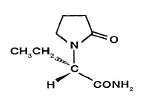
Levetiracetam is not extensively metabolized in humans. The major metabolic pathway is the enzymatic hydrolysis of the acetamide group, which produces the carboxylic acid metabolite, ucb L057 (24% of dose) and is not dependent on any liver cytochrome P450 isoenzymes. The major metabolite is inactive in animal seizure models. Two minor metabolites were identified as the product of hydroxylation of the 2-oxo-pyrrolidine ring (2% of dose) and opening of the 2-oxo-pyrrolidine ring in position 5 (1% of dose). There is no enantiomeric interconversion of levetiracetam or its major metabolite.
Elimination
Levetiracetam plasma half-life in adults is 7 ± 1 hour and is unaffected by either dose, route of administration or repeated administration. Levetiracetam is eliminated from the systemic circulation by renal excretion as unchanged drug which represents 66% of administered dose. The total body clearance is 0.96 mL/min/kg and the renal clearance is 0.6 mL/min/kg. The mechanism of excretion is glomerular filtration with subsequent partial tubular reabsorption. The metabolite ucb L057 is excreted by glomerular filtration and active tubular secretion with a renal clearance of 4 mL/min/kg. Levetiracetam elimination is correlated to creatinine clearance. Levetiracetam clearance is reduced in patients with renal impairment [see Dosage and Administration (2.6) and Use in Specific Populations (8.6)].
Specific Populations
Elderly
Pharmacokinetics of levetiracetam were evaluated in 16 elderly subjects (age 61-88 years) with creatinine clearance ranging from 30 to 74 mL/min. Following oral administration of twice-daily dosing for 10 days, total body clearance decreased by 38% and the half-life was 2.5 hours longer in the elderly compared to healthy adults. This is most likely due to the decrease in renal function in these subjects.
Pediatric Patients
• Intravenous Formulation
A population pharmacokinetic analysis for the intravenous formulation was conducted in 49 pediatric patients (1 month to < 16 years of age) weighing 3-79 kg. Patients received levetiracetam as a 15-minute IV infusion at doses between 14 mg/kg/day and 60 mg/kg/day twice daily. Plasma concentrations and model derived steady-state exposure AUC (0-12) were within the range of the exposure observed in pediatric patients receiving equivalent doses of the oral solution.
• Oral Formulations
Pharmacokinetics of levetiracetam were evaluated in 24 pediatric patients (age 6-12 years) after single oral dose (20 mg/kg) of the immediate release formulation of levetiracetam. The body weight adjusted apparent clearance of levetiracetam was approximately 40% higher than in adults.
A repeat dose pharmacokinetic study was conducted in pediatric patients (age 4 to 12 years) at doses of 20 mg/kg/day, 40 mg/kg/day, and 60 mg/kg/day of the immediate release formulation of levetiracetam. The evaluation of the pharmacokinetic profile of levetiracetam and its metabolite (ucb L057) in 14 pediatric patients demonstrated rapid absorption of levetiracetam at all doses, with a Tmax of about 1 hour and a t1/2 of 5 hours across all dosing levels. The pharmacokinetics of levetiracetam in pediatric patients was linear between 20 to 60 mg/kg/day. The potential interaction of levetiracetam with other AEDs was also evaluated in these patients. Levetiracetam had no significant effect on the plasma concentrations of carbamazepine, valproic acid, topiramate or lamotrigine. However, there was about a 22% increase of apparent clearance of levetiracetam when it was co-administered with an enzyme-inducing AED (e.g., carbamazepine).
Following single dose administration (20 mg/kg) of a 10% oral solution to pediatric patients with epilepsy (1 month to < 4 years), levetiracetam was rapidly absorbed and peak plasma concentrations were observed approximately 1 hour after dosing. Levetiracetam half-life in pediatric patients 1 month to < 4 years with epilepsy was shorter (5.3 h) than in adults (7.2 h), and apparent clearance (1.5 mL/min/kg) was faster than in adults (0.96 mL/min/kg).
Population pharmacokinetic analysis showed that body weight was significantly correlated to the clearance of levetiracetam in pediatric patients; clearance increased with an increase in body weight.
Pregnancy
Levetiracetam levels may decrease during pregnancy.
Gender
Levetiracetam Cmax and AUC were 20% higher in women (N=11) compared to men (N=12). However, clearances adjusted for body weight were comparable.
Race
Formal pharmacokinetic studies of the effects of race have not been conducted. Cross-study comparisons involving Caucasians (N=12) and Asians (N=12), however, show that pharmacokinetics of levetiracetam were comparable between the two races. Because levetiracetam is primarily renally excreted and there are no important racial differences in creatinine clearance, pharmacokinetic differences due to race are not expected.
Renal Impairment
The disposition of levetiracetam was studied in adult subjects with varying degrees of renal function. Total body clearance of levetiracetam is reduced in patients with impaired renal function by 40% in the mild group (CLcr = 50-80 mL/min), 50% in the moderate group (CLcr = 30-50 mL/min) and 60% in the severe renal impairment group (CLcr <30 mL/min). Clearance of levetiracetam is correlated with creatinine clearance.
In anuric (end stage renal disease) patients, the total body clearance decreased 70% compared to normal subjects (CLcr >80mL/min). Approximately 50% of the pool of levetiracetam in the body is removed during a standard 4 hour hemodialysis procedure [see Dosage and Administration (2.7)].
Hepatic Impairment
In subjects with mild (Child-Pugh A) to moderate (Child-Pugh B) hepatic impairment, the pharmacokinetics of levetiracetam were unchanged. In patients with severe hepatic impairment (Child-Pugh C), total body clearance was 50% that of normal subjects, but decreased renal clearance accounted for most of the decrease. No dose adjustment is needed for patients with hepatic impairment.
Drug Interactions
In vitro data on metabolic interactions indicate that levetiracetam is unlikely to produce, or be subject to, pharmacokinetic interactions. Levetiracetam and its major metabolite, at concentrations well above Cmax levels achieved within the therapeutic dose range, are neither inhibitors of, nor high affinity substrates for, human liver cytochrome P450 isoforms, epoxide hydrolase or UDP-glucuronidation enzymes. In addition, levetiracetam does not affect the in vitro glucuronidation of valproic acid.
Potential pharmacokinetic interactions of or with levetiracetam were assessed in clinical pharmacokinetic studies (phenytoin, valproate, warfarin, digoxin, oral contraceptive, probenecid) and through pharmacokinetic screening in the placebo-controlled clinical studies in epilepsy patients.
Phenytoin
Levetiracetam (3000 mg daily) had no effect on the pharmacokinetic disposition of phenytoin in patients with refractory epilepsy. Pharmacokinetics of levetiracetam were also not affected by phenytoin.
Valproate
Levetiracetam (1500 mg twice daily) did not alter the pharmacokinetics of valproate in healthy volunteers. Valproate 500 mg twice daily did not modify the rate or extent of levetiracetam absorption or its plasma clearance or urinary excretion. There also was no effect on exposure to and the excretion of the primary metabolite, ucb L057.
Other Antiepileptic Drugs
Potential drug interactions between levetiracetam and other AEDs (carbamazepine, gabapentin, lamotrigine, phenobarbital, phenytoin, primidone and valproate) were also assessed by evaluating the serum concentrations of levetiracetam and these AEDs during placebo-controlled clinical studies. These data indicate that levetiracetam does not influence the plasma concentration of other AEDs and that these AEDs do not influence the pharmacokinetics of levetiracetam.
Effect of AEDs in Pediatric Patients
There was about a 22% increase of apparent total body clearance of levetiracetam when it was co-administered with enzyme-inducing AEDs. Dose adjustment is not recommended. Levetiracetam had no effect on plasma concentrations of carbamazepine, valproate, topiramate, or lamotrigine.
Oral Contraceptives
Levetiracetam (500 mg twice daily) did not influence the pharmacokinetics of an oral contraceptive containing 0.03 mg ethinyl estradiol and 0.15 mg levonorgestrel, or of the luteinizing hormone and progesterone levels, indicating that impairment of contraceptive efficacy is unlikely. Co-administration of this oral contraceptive did not influence the pharmacokinetics of levetiracetam.
Digoxin
Levetiracetam (1000 mg twice daily) did not influence the pharmacokinetics and pharmacodynamics (ECG) of digoxin given as a 0.25 mg dose every day. Co-administration of digoxin did not influence the pharmacokinetics of levetiracetam.
Warfarin
Levetiracetam (1000 mg twice daily) did not influence the pharmacokinetics of R and S warfarin. Prothrombin time was not affected by levetiracetam. Co-administration of warfarin did not affect the pharmacokinetics of levetiracetam.
Probenecid
Probenecid, a renal tubular secretion blocking agent, administered at a dose of 500 mg four times a day, did not change the pharmacokinetics of levetiracetam 1000 mg twice daily. Css max of the metabolite, ucb L057, was approximately doubled in the presence of probenecid while the fraction of drug excreted unchanged in the urine remained the same. Renal clearance of ucb L057 in the presence of probenecid decreased 60%, probably related to competitive inhibition of tubular secretion of ucb L057. The effect of levetiracetam on probenecid was not studied.
![Ndc 0143-9673-01 Levetiracetam Injection 500 mg/5 mL (100 mg/ml) Must Be Diluted Prior To Administration For Iv Use Only Rx Only 5 mL Single Dose Vial Usual Dosage: See Package Insert. Discard Unused Portion. Retain In Carton Until Time Of Use. Store At 25ºc (77ºf); Excursions Permitted To 15º To 30ºc (59º To 86ºf) [see Usp Controlled Room Temperature]. (Levetiracetam Injection 8)](https://ndclist.com/assets/spl/images/8d767545-1eb9-45a5-bd16-e8a66e628fea/levetiracetam-injection-8.jpg "levetiracetam-injection-8.jpg")
![Ndc 0143-9673-10 Levetiracetam Injection 500 mg/5 mL (100 mg/ml) Rx Only Must Be Diluted Prior To Administration For Iv Use Only 10 X 5 mL Single Dose Vials Each 5 mL Vial Contains 500 mg Levetiracetam, 8.2 mg Sodium Acetate Trihydrate, 45 mg Sodium Chloride, Glacial Acetic Acid For Ph Adjustment To 6. Usual Dosage: See Package Insert. Discard Unused Portion. Retain In Carton Until Time Of Use. Store At 25ºc (77ºf); Excursions Permitted To 15ºc To 30ºc (59º To 86ºf) [see Usp Controlled Room Temperature]. (Levetiracetam Injection 9)](https://ndclist.com/assets/spl/images/8d767545-1eb9-45a5-bd16-e8a66e628fea/levetiracetam-injection-9.jpg "levetiracetam-injection-9.jpg")
![Ndc 0143-9673-25 Levetiracetam Injection 500 mg/5 mL (100 mg/ml) Rx Only Must Be Diluted Prior To Administration For Iv Use Only 25 X 5 mL Single Dose Vials Each 5 mL Vial Contains 500 mg Levetiracetam, 8.2 mg Sodium Acetate Trihydrate, 45 mg Sodium Chloride, Glacial Acetic Acid For Ph Adjustment To 6. Usual Dosage: See Package Insert. Discard Unused Portion. Retain In Carton Until Time Of Use. Store At 25ºc (77ºf); Excursions Permitted To 15ºc To 30ºc (59º To 86ºf) [see Usp Controlled Room Temperature]. (Levetiracetam Injection 10)](https://ndclist.com/assets/spl/images/8d767545-1eb9-45a5-bd16-e8a66e628fea/levetiracetam-injection-10.jpg "levetiracetam-injection-10.jpg")
