Combination with metformin and/or thiazolidinediones
In a 56-week, double-blind trial (NCT01930188), 1231 patients with type 2 diabetes mellitus were randomized to OZEMPIC 0.5 mg once weekly, OZEMPIC 1 mg once weekly, or sitagliptin 100 mg once daily, all in combination with metformin (94%) and/or thiazolidinediones (6%). Patients had a mean age of 55 years and 51% were men. The mean duration of type 2 diabetes was 6.6 years, and the mean BMI was 32 kg/m2. Overall, 68% were White, 5% were Black or African American, and 25% were Asian; 17% identified as Hispanic or Latino ethnicity.
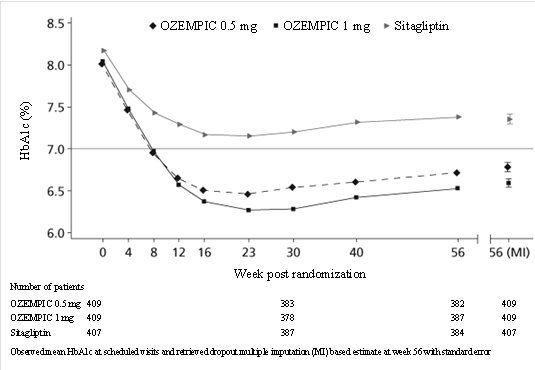
Treatment with OZEMPIC 0.5 mg and 1 mg once weekly for 56 weeks resulted in a statistically significant reduction in HbA1c compared to sitagliptin (see Table 4 and Figure 5).
Table 4. Results at Week 56 in a Trial of OZEMPIC Compared to Sitagliptin in Adult Patients with Type 2 Diabetes Mellitus in Combination with Metformin and/or Thiazolidinediones
| OZEMPIC 0.5 mg | OZEMPIC 1 mg | Sitagliptin |
Intent-to-Treat (ITT) Population (N)a | 409 | 409 | 407 |
HbA1c (%) | | | |
| 8.0 | 8.0 | 8.2 |
| -1.3 | -1.5 | -0.7 |
- Difference from sitagliptinb
- [95% CI]
| -0.6 [-0.7, -0.4]c | -0.8 [-0.9, -0.6]c | |
Patients (%) achieving HbA1c <7% | 66 | 73 | 40 |
FPG (mg/dL) | | | |
| 168 | 167 | 173 |
| -35 | -43 | -23 |
aThe intent-to-treat population includes all randomized and exposed patients. At week 56 the primary HbA1c endpoint was missing for 7%, 5% and 6% of patients and during the trial rescue medication was initiated by 5%, 2% and 19% of patients randomized to OZEMPIC 0.5 mg, OZEMPIC 1 mg and sitagliptin, respectively. Missing data were imputed using multiple imputation based on retrieved dropouts.
bIntent-to-treat analysis using ANCOVA adjusted for baseline value and country.
cp<0.0001 (2-sided) for superiority, adjusted for multiplicity.
The mean baseline body weight was 89.9 kg, 89.2 kg, 89.3 kg in the OZEMPIC 0.5 mg, OZEMPIC 1 mg, and sitagliptin arms, respectively. The mean changes from baseline to week 56 were -4.2 kg, -5.5 kg, and -1.7 kg for the OZEMPIC 0.5 mg, OZEMPIC 1 mg, and sitagliptin arms, respectively. The difference from sitagliptin (95% CI) for OZEMPIC 0.5 mg was -2.5 kg (-3.2, -1.8), and for OZEMPIC 1 mg was -3.8 kg (-4.5, -3.1).
- Figure 5. Mean HbA1c (%) over time - baseline to week 56
Combination with metformin or metformin with sulfonylurea
In a 56-week, open-label trial (NCT01885208), 813 patients with type 2 diabetes mellitus on metformin alone (49%), metformin with sulfonylurea (45%), or other (6%) were randomized to OZEMPIC 1 mg once weekly or exenatide 2 mg once weekly. Patients had a mean age of 57 years and 55% were men. The mean duration of type 2 diabetes was 9 years, and the mean BMI was 34 kg/m2. Overall, 84% were White, 7% were Black or African American, and 2% were Asian; 24% identified as Hispanic or Latino ethnicity.
Treatment with OZEMPIC 1 mg once weekly for 56 weeks resulted in a statistically significant reduction in HbA1c compared to exenatide 2 mg once weekly (see Table 5).
Table 5. Results at Week 56 in a Trial of OZEMPIC Compared to Exenatide 2 mg Once Weekly in Adult Patients with Type 2 Diabetes Mellitus in Combination with Metformin or Metformin with Sulfonylurea
| OZEMPIC 1 mg | Exenatide ER 2 mg |
Intent-to-Treat (ITT) Population (N)a | 404 | 405 |
HbA1c (%) | | |
| 8.4 | 8.3 |
| -1.4 | -0.9 |
- Difference from exenatideb
- [95% CI]
| -0.5 [-0.7, -0.3]c | |
Patients (%) achieving HbA1c <7% | 62 | 40 |
FPG (mg/dL) | | |
| 191 | 188 |
| -44 | -34 |
aThe intent-to-treat population includes all randomized and exposed patients. At week 56 the primary HbA1c endpoint was missing for 9% and 11% of patients and during the trial rescue medication was initiated by 5% and 10% of patients randomized to OZEMPIC 1 mg and exenatide ER 2 mg, respectively. Missing data were imputed using multiple imputation based on retrieved dropouts.
bIntent-to-treat analysis using ANCOVA adjusted for baseline value and country.
cp<0.0001 (2-sided) for superiority, adjusted for multiplicity.
The mean baseline body weight was 96.2 kg and 95.4 kg in the OZEMPIC 1 mg and exenatide ER arms, respectively. The mean changes from baseline to week 56 were -4.8 kg and -2.0 kg in the OZEMPIC 1 mg and exenatide ER arms, respectively. The difference from exenatide ER (95% CI) for OZEMPIC 1 mg was -2.9 kg (-3.6, -2.1).
Combination with metformin or metformin with sulfonylurea
In a 30-week, open-label trial (NCT02128932), 1089 patients with type 2 diabetes mellitus were randomized to OZEMPIC 0.5 mg once weekly, OZEMPIC 1 mg once weekly, or insulin glargine once daily on a background of metformin (48%) or metformin and sulfonylurea (51%). Patients had a mean age of 57 years and 53% were men. The mean duration of type 2 diabetes was 8.6 years, and the mean BMI was 33 kg/m2. Overall, 77% were White, 9% were Black or African American, and 11% were Asian; 20% identified as Hispanic or Latino ethnicity.
Patients assigned to insulin glargine had a baseline mean HbA1c of 8.1% and were started on a dose of 10 U once daily. Insulin glargine dose adjustments occurred throughout the trial period based on self-measured fasting plasma glucose before breakfast, targeting 71 to <100 mg/dL. In addition, investigators could titrate insulin glargine at their discretion between study visits. Only 26% of patients had been titrated to goal by the primary endpoint at week 30, at which time the mean daily insulin dose was 29 U per day.
Treatment with OZEMPIC 0.5 mg and 1 mg once weekly for 30 weeks resulted in a statistically significant reduction in HbA1c compared with the insulin glargine titration implemented in this study protocol (see Table 6).
Table 6. Results at Week 30 in a Trial of OZEMPIC Compared to Insulin Glargine in Adult Patients with Type 2 Diabetes Mellitus in Combination with Metformin or Metformin with Sulfonylurea
| OZEMPIC 0.5 mg | OZEMPIC 1 mg | Insulin Glargine |
Intent-to-Treat (ITT) Population (N)a | 362 | 360 | 360 |
HbA1c (%) | | | |
| 8.1 | 8.2 | 8.1 |
| -1.2 | -1.5 | -0.9 |
- Difference from insulin glargineb
- [95% CI]
| -0.3 [-0.5, -0.1]c | -0.6 [-0.8, -0.4]c | |
Patients (%) achieving HbA1c <7% | 55 | 66 | 40 |
FPG (mg/dL) | | | |
| 172 | 179 | 174 |
| -35 | -46 | -37 |
aThe intent-to-treat population includes all randomized and exposed patients. At week 30 the primary HbA1c endpoint was missing for 8%, 6% and 6% of patients and during the trial rescue medication was initiated by 4%, 3% and 1% of patients randomized to OZEMPIC 0.5 mg, OZEMPIC 1 mg and insulin glargine, respectively. Missing data were imputed using multiple imputation based on retrieved dropouts.
bIntent-to-treat analysis using ANCOVA adjusted for baseline value, country and stratification factors.
cp<0.0001 (2-sided) for superiority, adjusted for multiplicity.
The mean baseline body weight was 93.7 kg, 94.0 kg, 92.6 kg in the OZEMPIC 0.5 mg, OZEMPIC 1 mg, and insulin glargine arms, respectively. The mean changes from baseline to week 30 were -3.2 kg, -4.7 kg and 0.9 kg in the OZEMPIC 0.5 mg, OZEMPIC 1 mg, and insulin glargine arms, respectively. The difference from insulin glargine (95% CI) for OZEMPIC 0.5 mg was -4.1 kg (-4.9, -3.3) and for OZEMPIC 1 mg was -5.6 kg (-6.4, -4.8).
Combination with basal insulin
In a 30-week, double-blind trial (NCT02305381), 397 patients with type 2 diabetes mellitus inadequately controlled with basal insulin, with or without metformin, were randomized to OZEMPIC 0.5 mg once weekly, OZEMPIC 1 mg once weekly, or placebo. Patients with HbA1c ≤ 8.0% at screening reduced their insulin dose by 20% at start of the trial to reduce the risk of hypoglycemia. Patients had a mean age of 59 years and 56% were men. The mean duration of type 2 diabetes was 13 years, and the mean BMI was 32 kg/m2. Overall, 78% were White, 5% were Black or African American, and 17% were Asian; 12% identified as Hispanic or Latino ethnicity.
Treatment with OZEMPIC resulted in a statistically significant reduction in HbA1c after 30 weeks of treatment compared to placebo (see Table 7).
Table 7. Results at Week 30 in a Trial of OZEMPIC in Adult Patients with Type 2 Diabetes Mellitus in Combination with Basal Insulin with or without Metformin
| Placebo | OZEMPIC 0.5 mg | OZEMPIC 1 mg |
Intent-to-Treat (ITT) Population (N)a | 133 | 132 | 131 |
HbA1c (%) | | | |
| 8.4 | 8.4 | 8.3 |
| -0.2 | -1.3 | -1.7 |
- Difference from placebob
- [95% CI]
| | -1.1 [-1.4, -0.8]c | -1.6 [-1.8, -1.3]c |
Patients (%) achieving HbA1c <7% | 13 | 56 | 73 |
FPG (mg/dL) | | | |
| 154 | 161 | 153 |
| -8 | -28 | -39 |
aThe intent-to-treat population includes all randomized and exposed patients. At week 30 the primary HbA1c endpoint was missing for 7%, 5% and 5% of patients and during the trial rescue medication was initiated by 14%, 2% and 1% of patients randomized to placebo, OZEMPIC 0.5 mg and OZEMPIC 1 mg, respectively. Missing data were imputed using multiple imputation based on retrieved dropouts.
bIntent-to-treat analysis using ANCOVA adjusted for baseline value, country and stratification factors.
cp<0.0001 (2-sided) for superiority, adjusted for multiplicity.
The mean baseline body weight was 89.9 kg, 92.7 kg, and 92.5 kg in the placebo, OZEMPIC 0.5 mg, and OZEMPIC 1 mg arms, respectively. The mean changes from baseline to week 30 were -1.2 kg, -3.5 kg, and ‑6.0 kg in the placebo, OZEMPIC 0.5 mg, and OZEMPIC 1 mg arms, respectively. The difference from placebo (95% CI) for OZEMPIC 0.5 mg was -2.2 kg (-3.4, -1.1), and for OZEMPIC 1 mg was -4.7 kg (-5.8, -3.6).