For Studies 1, 2 and 3, the primary efficacy parameters were mean percent change in body weight and the percentages of patients achieving greater than or equal to 5% weight loss from baseline to week 68.
After 68 weeks, treatment with WEGOVY resulted in a statistically significant reduction in body weight compared with placebo. Greater proportions of patients treated with WEGOVY achieved 5%, 10% and 15% weight loss than those treated with placebo as shown in Table 4.
Table 4. Changes in Body Weight at Week 68 in Studies 1, 2 and 3
| Study 1 (Obesity or overweight with comorbidity) | Study 2 (Type 2 diabetes with obesity or overweight) | Study 3 (Obesity or overweight with comorbidity undergoing intensive lifestyle therapy) |
|---|
| Intention-to-Treata | PLACEBO
N = 655 | WEGOVY
N = 1306 | PLACEBO
N = 403 | WEGOVY
N = 404 | PLACEBO
N = 204 | WEGOVY
N = 407 |
|---|
Body Weight | | | | | | |
Baseline mean (kg) | 105.2 | 105.4 | 100.5 | 99.9 | 103.7 | 106.9 |
- % change from baseline (LSMean)
| -2.4 | -14.9 | -3.4 | -9.6 | -5.7 | -16.0 |
- % difference from placebo (LSMean) (95% CI)
| | -12.4
(‑13.3; ‑11.6)* | | -6.2
(-7.3; -5.2)* | | -10.3
(-11.8; -8.7)* |
- % of Patients losing greater than or equal to 5% body weight
| 31.1 | 83.5 | 30.2 | 67.4 | 47.8 | 84.8 |
- % difference from placebo (LSMean) (95% CI)
| | 52.4 (48.1; 56.7)* | | 37.2 (30.7; 43.8)* | | 37.0 (28.9; 45.2)* |
- % of Patients losing greater than or equal to 10% body weight
| 12.0 | 66.1 | 10.2 | 44.5 | 27.1 | 73.0 |
- % difference from placebo (LSMean) (95% CI)
| | 54.1 (50.4; 57.9)* | | 34.3 (28.4; 40.2)* | | 45.9 (38.0; 53.7)* |
- % of Patients losing greater than or equal to 15% body weight
| 4.8 | 47.9 | 4.3 | 25.1 | 13.2 | 53.4 |
- % difference from placebo (LSMean) (95% CI)
| | 43.1 (39.8; 46.3)* | | 20.7 (15.7; 25.8)* | | 40.2 (33.1; 47.3)* |
LSMean = least squares mean; CI = confidence interval
aThe intent-to-treat population includes all randomized patients. In Study 1, at week 68, the body weight was missing for 7.2% and 11.9% of patients randomized to WEGOVY and placebo, respectively. In Study 2, at week 68, the body weight was missing for 4.0% and 6.7% of patients randomized to WEGOVY and placebo, respectively. In Study 3, at week 68, the body weight was missing for 8.4% and 7.4% of patients randomized to WEGOVY and placebo, respectively. Missing data were imputed from retrieved subjects of the same randomized treatment arm (RD-MI).
* p<0.0001 (unadjusted 2-sided) for superiority.
For Study 4, the primary efficacy parameter was mean percent change in body weight from randomization (week 20) to week 68.
From randomization (week 20) to week 68, treatment with WEGOVY resulted in a statistically significant reduction in body weight compared with placebo (Table 5). Because patients who discontinued WEGOVY during titration and those who did not reach the 2.4 mg weekly dose were not eligible for the randomized treatment period, the results may not reflect the experience of patients in the general population who are first starting WEGOVY.
Table 5. Changes in Body Weight at Week 68 - Study 4 (Obesity or overweight with comorbidity after 20 week run-in)
| WEGOVY N = 803a |
Body Weight (only randomized patients) | |
Mean at week 0 (kg) | 107.2 |
| PLACEBO N = 268 | WEGOVY N = 535 |
Body Weight | | |
Mean at week 20 (SD) (kg) | 95.4 (22.7) | 96.5 (22.5) |
% change from week 20 at week 68 (LSMean) | 6.9 | -7.9 |
% difference from placebo (LSMean) (95% CI) | | -14.8 (-16.0; -13.5)* |
LSMean = least squares mean; CI = confidence interval
a902 patients were enrolled at week 0 with a mean baseline body weight of 106.8 kg. The intent-to-treat population includes all randomized patients. At week 68, the body weight was missing for 2.8% and 6.7% of patients randomized to WEGOVY and placebo, respectively. Missing data were imputed from retrieved subjects of the same randomized treatment arm (RD-MI).
*p<0.001 (unadjusted 2-sided) for superiority, controlled for multiplicity.
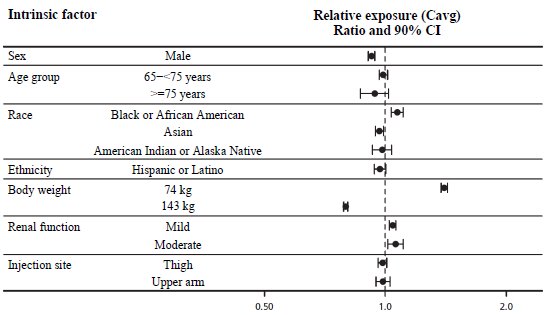
A reduction in body weight was observed with WEGOVY irrespective of age, sex, race, ethnicity, BMI at baseline, body weight (kg) at baseline, and level of renal function impairment.
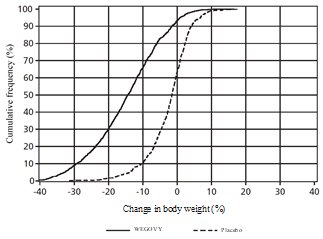
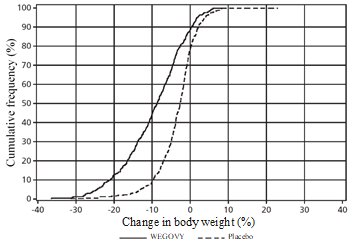
The cumulative frequency distributions of change in body weight are shown in Figure 4 and Figure 5 for Studies 1 and 2. One way to interpret this figure is to select a change in body weight of interest on the horizontal axis and note the corresponding proportions of patients (vertical axis) in each treatment group who achieved at least that degree of weight loss. For example, note that the vertical line arising from ‑10% in Study 1 intersects the WEGOVY and placebo curves at approximately 66%, and 12%, respectively, which correspond to the values shown in Table 4.
Figure 4. Change in body weight (%) from baseline to week 68 (Study 1)
Observed data from in-trial period including imputed data for missing observations (RD-MI).
Figure 5. Change in body weight (%) from baseline to week 68 (Study 2)
Observed data from in-trial period including imputed data for missing observations (RD-MI).
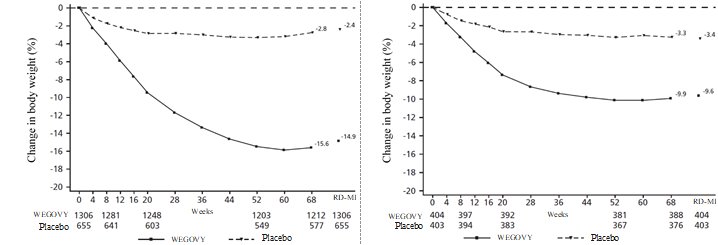
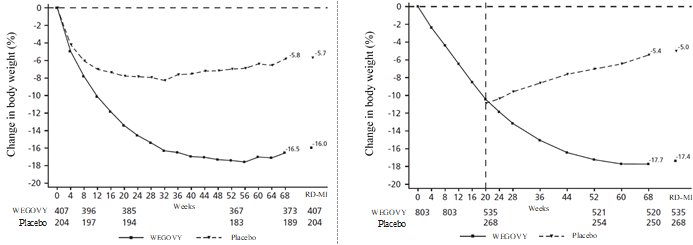
The time courses of weight loss with WEGOVY and placebo from baseline through week 68 are depicted in Figures 6 and Figure 7.
Figure 6. Change from baseline (%) in body weight (Study 1 on left and Study 2 on right)
Observed values for patients completing each scheduled visit, and estimates with multiple imputations from retrieved dropouts (RD-MI)
Figure 7. Change from baseline (%) in body weight (Study 3 on left and Study 4a on right)
Observed values for patients completing each scheduled visit, and estimates with multiple imputations from retrieved dropouts (RD-MI)
aChange from week 0 was not a primary endpoint in study 4. Dotted line indicates time of randomization. Randomized patients (shown) do not include 99 patients that discontinued during the 20 week run-in period.