Zegalogue Injection, Solution
Product Images NDC 0169-1913

View Photos of Packaging, Regulatory Labels, and Product Appearance

Product Visual Gallery

This gallery contains 27 technical images submitted to the FDA as part of the official labeling for Zegalogue (NDC 0169-1913). Unlike standard consumer photos, these assets often include clinical data figures, molecular chemical structures, and official manufacturer packaging layouts.

As provided by Novo Nordisk, these visuals offer a comprehensive scientific overview of the product's physical and chemical identity, aiding pharmacists and researchers in product verification and study.

FDA Label Image

Carton (AI)

Carton (AI)
ZEGALOGUE is an emergency injection for subcutaneous use and it's only available with a prescription. It's used to treat very low blood sugar and should be kept in the refrigerator between 2°C to 8°C (36°F to 46°F) and should not be frozen. In addition to the refrigerated storage, it can also be stored at room temperature between 20°C to 25°C (68°F to 77°F) in the provided red protective case for up to 12 months, so long as it is not returned to the refrigerator after storing at room temperature. It's important to read the instructions before use due to its dry natural rubber which may cause allergic reactions in those with latex allergies.*
FDA Label Image

Chemical Structure (Dasiglucagon 01)

FDA Label Image

Figure 1 (Dasiglucagon 02)

FDA Label Image

Figure 2 (Dasiglucagon 03)

FDA Label Image

Figure 3 (Dasiglucagon 04)

FDA Label Image

Figure 4 (Dasiglucagon 05)

Figure 4 (Dasiglucagon 05)
The text describes the results of a study or experiment related to the effect of a drug called "ZEGALOGUE" on plasma glucose recovery time compared to a placebo. The results are presented in a table with time intervals (in minutes) on the x-axis and the number of participants or samples (represented by "T") on the y-axis. The "T" values range from 4 to 30. The data suggests that ZEGALOGUE may be effective in reducing the time to plasma glucose recovery.*
FDA Label Image

Figure (Dasiglucagon 06)

Figure (Dasiglucagon 06)
If ZEGALOGUE is removed from the refrigerator for storage at room temperature, the new expiration date (12 months from the removal date) should be written on the label found on the red protective case. An example is given, showing how to write the new expiration date on the label. It is important to note that ZEGALOGUE will expire on the earlier of the two expiration dates.*
FDA Label Image

Pfs-description.jpg (Dasiglucagon 07)

Pfs-description.jpg (Dasiglucagon 07)
This description is not readable/available due to numerous misspellings and unclear terms.*
FDA Label Image

Figure (Dasiglucagon 08)

FDA Label Image

Figure (Dasiglucagon 09)

FDA Label Image

Figure (Dasiglucagon 10)

FDA Label Image

Figure (Dasiglucagon 11)

FDA Label Image

Figure (Dasiglucagon 12)

FDA Label Image

Figure (Dasiglucagon 13)

FDA Label Image

Figure (Dasiglucagon 14)

FDA Label Image

Figure (Dasiglucagon 15)

Figure (Dasiglucagon 15)
This text provides instructions for storing ZEGALOGUE at room temperature after removing it from the refrigerator and updating the expiration date on the label located on the red protective case. It gives an example of a 12-month expiration date and includes a chart indicating the months of the year and when ZEGALOGUE will expire. The note warns that ZEGALOGUE will expire on the earlier of the two expiration dates.*
FDA Label Image

Ai-description.jpg (Dasiglucagon 17)

Ai-description.jpg (Dasiglucagon 17)
The text seems to describe different components of an autoinjector, including a red protective case, gray lid, needle end, medicine window, and yellow needle guard. However, the purpose and context of these components is not clear from the given text.*
FDA Label Image

Figure (Dasiglucagon 18)

FDA Label Image

Figure (Dasiglucagon 19)

FDA Label Image

Figure (Dasiglucagon 20)

FDA Label Image

Figure (Dasiglucagon 21)

FDA Label Image

Figure (Dasiglucagon 22)

FDA Label Image

Figure (Dasiglucagon 23)

FDA Label Image

Figure (Dasiglucagon 24)

FDA Label Image

Carton (PFS)

Carton (PFS)
Emergency use for very low blood sugar is possible with the yA{cyNNeXcal)4 (dasiglucagon) injection. The injection has a dosage of 0.6 mg/0.6 mL in a prefilled Syringe. The ZEGALOGUE injection can be stored at room temperature of 20°C to 25°C or in a refrigerator between 2°C to 8°C. If it is stored at room temperature, it should not exceed 2 months. The injection should not be frozen, and the inside of the gray needle cover contains dry natural rubber that may cause allergic reactions to people with latex allergy. The instruction of usage should be read before injecting, as it is only used for subcutaneous application. A prescription is needed to use. The carton contains one single-dose prefilled syringe and one prescribing information.*
FDA Label Image

Carton (PFS)

Carton (PFS)
ZEGALOGUE (dasiglucagon) is a 0.6mg/0.6mL prefilled syringe designed for subcutaneous injection. It is to be used in emergency scenarios for very low blood sugar. The drug must be stored at a temperature between 36°F to 46°F or between 20°C to 25°C for up to 12 months. The gray needle cover contains dry natural rubber, which may cause allergic reactions in people with a latex allergy. Please read the instructions before use. Keep ZEGALOGUE out of reach of children.*
FDA Label Image

Carton-ai-2ct (Image 01)

Carton-ai-2ct (Image 01)
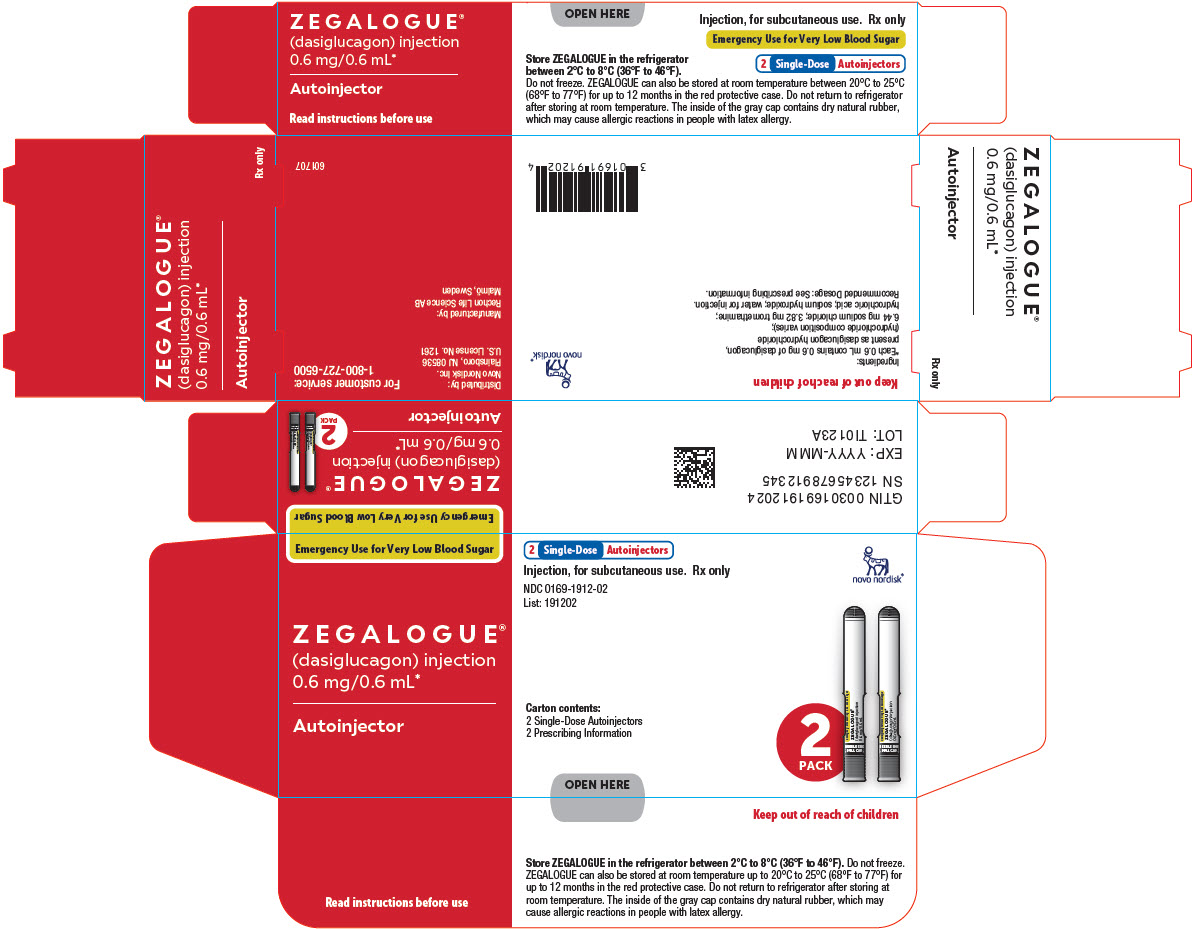
This is a description for Zegalogue injection, which is used in emergencies for very low blood sugar in individuals. The injection is only available through prescription and is for subcutaneous use. The autoinjector contents are 0.6mg/0.6mL and can be stored in the refrigerator between 2° to 8°C. It can also be stored at room temperature between 20° to 25°C for up to 12 months in the protective case. The inside of the gray cap container contains natural rubber, which may cause allergic reactions in people with allergies. The instructions should be read before use.*

* These product label images have been analyzed using experimental machine learning. Please verify findings with the primary label text.