Because clinical trials are conducted under widely varying conditions, adverse reaction rates observed in the clinical trials of a drug cannot be directly compared to rates in the clinical trials of another drug and may not reflect the rates observed in practice.
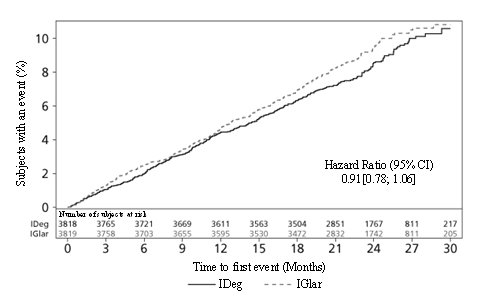
The safety of TRESIBA in subjects with type 1 diabetes or type 2 diabetes was evaluated in nine trials of 6-12 month duration in adults and in one trial of 12-month duration in pediatric patients 1 year of age and older with type 1 diabetes. The cardiovascular safety of TRESIBA was evaluated in one double-blinded, event-driven trial of 2-year median duration in patients with type 2 diabetes at high risk of cardiovascular events [see Clinical Studies (14)].
The data in Table 1 reflect the exposure of 1102 adults with type 1 diabetes to TRESIBA with a mean exposure duration to TRESIBA of 34 weeks in three open-label trials. The mean age was 43 years and 1% were older than 75 years. Fifty-seven percent were male, 81% were White, 2% were Black or African American and 4% were Hispanic. The mean body mass index (BMI) was 26 kg/m2. The mean duration of diabetes was 18 years and the mean HbA1c at baseline was 7.8%. A history of neuropathy, ophthalmopathy, nephropathy and cardiovascular disease at baseline was reported in 11%, 16%, 7% and 0.5% respectively. The mean eGFR at baseline was 87 mL/min/1.73 m2 and 7% of the patients had an eGFR less than 60 mL/min/1.73 m2.
The data in Table 2 reflect the exposure of 2713 adults with type 2 diabetes to TRESIBA with a mean exposure duration to TRESIBA of 36 weeks in six open-label trials. The mean age was 58 years and 3% were older than 75 years. Fifty-eight percent were male, 71% were White, 7% were Black or African American and 13% were Hispanic. The mean BMI was 30 kg/m2. The mean duration of diabetes was 11 years and the mean HbA1c at baseline was 8.3%. A history of neuropathy, ophthalmopathy, nephropathy and cardiovascular disease at baseline was reported for 14%, 10%, 6% and 0.6% of participants respectively. At baseline, the mean eGFR was 83 mL/min/1.73 m2 and 9% had an eGFR less than 60 mL/min/1.73 m2.
Common adverse reactions (excluding hypoglycemia)occurring in TRESIBA treated subjects during clinical trials in adult patients with type 1 diabetes mellitus and adults with type 2 diabetes mellitus are listed in Table 1 and Table 2, respectively. Common adverse reactions were defined as reactions occurring in ≥5% of the population studied. Hypoglycemia is not shown in these tables but discussed in a dedicated subsection below.
174 pediatric patients 1 year of age and older with type 1 diabetes were exposed to TRESIBA with a mean exposure to TRESIBA of 48 weeks. The mean age was 10 years: 25% were ages 1-5 years, 40% were ages 6-11 years, and 35% were ages 12-17 years. 55.2% were male, 78.2% were White, 2.9% were Black or African American and 4% were Hispanic. The mean body mass index (BMI) was 18.7 kg/m2. The mean duration of diabetes was 3.9 years and the mean HbA1c at baseline was 8.2%. Common adverse reactions in TRESIBA treated pediatric patients with type 1 diabetes mellitus were similar to the adverse reactions listed in Table 1.
Table 1: Adverse Reactions Occurring in ≥5% of TRESIBA-Treated Adult Patients with Type 1 Diabetes Mellitus
Adverse Reaction | TRESIBA (n=1102) |
Nasopharyngitis | 23.9 % |
Upper respiratory tract infection | 11.9 % |
Headache | 11.8 % |
Sinusitis | 5.1 % |
Gastroenteritis | 5.1 % |
Table 2: Adverse Reactions Occurring in ≥5% of TRESIBA-Treated Adult Patients with Type 2 Diabetes Mellitus
Adverse Reaction | TRESIBA (n=2713) |
Nasopharyngitis | 12.9 % |
Headache | 8.8 % |
Upper respiratory tract infection | 8.4 % |
Diarrhea | 6.3 % |
Hypoglycemia
Hypoglycemia is the most commonly observed adverse reaction in patients using insulin, including TRESIBA [see Warnings and Precautions (5.3)]. The rates of reported hypoglycemia depend on the definition of hypoglycemia used, diabetes type, insulin dose, intensity of glucose control, background therapies, and other intrinsic and extrinsic patient factors. For these reasons, comparing rates of hypoglycemia in clinical trials for TRESIBA with the incidence of hypoglycemia for other products may be misleading and also, may not be representative of hypoglycemia rates that will occur in clinical practice.
In the open-label adult clinical trials of patients with type 1 and type 2 diabetes, and in the open-label pediatric clinical trial of patients with type 1 diabetes, percentages of adult and pediatric patients with type 1 diabetes randomized to TRESIBA who experienced at least one episode of hypoglycemia in clinical trials [see Clinical Studies (14)] and adults with type 2 diabetes are shown in Tables 3 and 4, respectively.
Severe hypoglycemia in the open-label trials with adult patients was defined as an episode requiring assistance of another person to actively administer carbohydrate, glucagon, or other resuscitative actions. Severe hypoglycemia in the pediatric trial was defined as an altered mental status where the child could not assist in his own care, was semiconscious or unconscious, or in a coma ± convulsions and may require parenteral therapy (glucagon or intravenous glucose). A Novo Nordisk hypoglycemia episode was defined as a severe hypoglycemia episode or an episode where a laboratory or a self-measured glucose calibrated to plasma was less than 56 mg/dL or where a whole blood glucose was less than 50 mg/dL (i.e., with or without the presence of hypoglycemic symptoms).
Table 3: Percent (%) of Type 1 Diabetes Patients Experiencing at Least One Episode of Severe Hypoglycemia or Novo Nordisk Hypoglycemia§ on TRESIBA in Open-Label Adult and Pediatric Clinical Trials
| Study A
Adults
+ insulin aspart
52 weeks | Study B
Adults
+ insulin aspart
26 weeks | Study C
Adults
+ insulin aspart
26 weeks | Study J
Pediatrics
+ insulin aspart
52 weeks |
|---|
| TRESIBA
(N=472) | TRESIBA
(N=301) | TRESIBA at the same time each day
(N=165) | TRESIBA at alternating times
(N=164) | TRESIBA
(N=174) |
|---|
Severe hypoglycemia* | |
Percent of patients | 12.3% | 10.6% | 12.7% | 10.4% | 17.8% |
Novo Nordisk hypoglycemia§ | |
Percent of patients | 95.6% | 93.0% | 99.4% | 93.9% | 98.3% |
*Severe hypoglycemia in pediatric patients: an episode with altered mental status, where the child could not assist in his own care, was semiconscious or unconscious, or in a coma ± convulsions and may require parenteral therapy (glucagon or intravenous glucose).
§Novo Nordisk hypoglycemia: a severe hypoglycemia episode or an episode where a laboratory or a self-measured glucose calibrated to plasma was less than 56 mg/dL or where a whole blood glucose was less than 50 mg/dL (i.e., with or without the presence of hypoglycemic symptoms).
Table 4: Percent (%) of Patients with Type 2 Diabetes Experiencing at Least One Episode of Severe Hypoglycemia or Novo Nordisk Hypoglycemia§ on TRESIBA in Open-Label Adult Clinical Trials
| Study D
+ 1-2 OADs*
insulin naïve
52 weeks | Study E
+ 1-2 OADs*
insulin naïve
26 weeks | Study F
± 1-3 OADs*
insulin naïve
26 weeks | Study G
T2DM ± 0-3 OADs*
26 weeks | Study H
T2DM ± 0-2
OADs* +
insulin aspart
52 weeks | Study I
T2DM ± 1-2
OADs*
insulin naïve
26 weeks |
|---|
| TRESIBA
(N=766) | TRESIBA
(N=228) | TRESIBA
(N=284) | TRESIBA
(N=226) | TRESIBA (alternating
time)
(N=230) | TRESIBA
(N=753) | TRESIBA
(N=226) |
|---|
Severe Hypoglycemia |
Percent of patients | 0.3% | 0 | 0 | 0.9% | 0.4% | 4.5% | 0.4% |
Novo Nordisk Hypoglycemia§ |
Percent of patients | 46.5% | 28.5% | 50% | 43.8% | 50.9% | 80.9% | 42.5% |
*OAD: oral antidiabetic agent, §Novo Nordisk hypoglycemia: a severe hypoglycemia episode or an episode where a laboratory or a self-measured glucose calibrated to plasma was less than 56 mg/dL or where a whole blood glucose was less than 50 mg/dL (i.e., with or without the presence of hypoglycemic symptoms).
Allergic Reactions
Severe, life-threatening, generalized allergy, including anaphylaxis, generalized skin reactions, angioedema, bronchospasm, hypotension, and shock may occur with any insulin, including TRESIBA and may be life threatening [see Warnings and Precautions (5.5)]. Hypersensitivity (manifested with swelling of tongue and lips, diarrhea, nausea, tiredness, and itching) and urticaria were reported in 0.9% of patients treated with TRESIBA.
Lipodystrophy
Long-term use of insulin, including TRESIBA, can cause lipodystrophy at the site of repeated insulin injections. Lipodystrophy includes lipohypertrophy (thickening of adipose tissue) and lipoatrophy (thinning of adipose tissue) and may affect insulin absorption [see Dosage and Administration (2.1)]. In the clinical program, lipodystrophy, lipohypertrophy, or lipoatrophy was reported in 0.3% of patients treated with TRESIBA.
Injection Site Reactions
Patients taking TRESIBA may experience injection site reactions, including injection site hematoma, pain, hemorrhage, erythema, nodules, swelling, discoloration, pruritus, warmth, and injection site mass. In the clinical program, injection site reactions occurred in 3.8% of patients treated with TRESIBA.
Weight Gain
Weight gain can occur with insulin therapy, including TRESIBA, and has been attributed to the anabolic effects of insulin. In the clinical program after 52 weeks of treatment, patients with type 1 diabetes treated with TRESIBA gained an average of 1.8 kg and patients with type 2 diabetes treated with TRESIBA gained an average of 3.0 kg.
Peripheral Edema
Insulin, including TRESIBA, may cause sodium retention and edema. In the clinical program, peripheral edema occurred in 0.9% of patients with type 1 diabetes mellitus and 3.0% of patients with type 2 diabetes mellitus treated with TRESIBA.