Victoza Injection
Product Images NDC 0169-4060

23 FDA label images from Novo Nordisk · Packaging, Regulatory Labels, and Product Appearance

Product Visual Gallery

This gallery contains 23 technical images submitted to the FDA as part of the official labeling for Victoza (NDC 0169-4060). Unlike standard consumer photos, these assets often include clinical data figures, molecular chemical structures, and official manufacturer packaging layouts.

As provided by Novo Nordisk, these visuals offer a comprehensive scientific overview of the product's physical and chemical identity, aiding pharmacists and researchers in product verification and study.

FDA Label Image

Figure 1: Structural Formula Of Liraglutide (49f302f5 F315 48b8 83a4 6ca56f01fded 01)
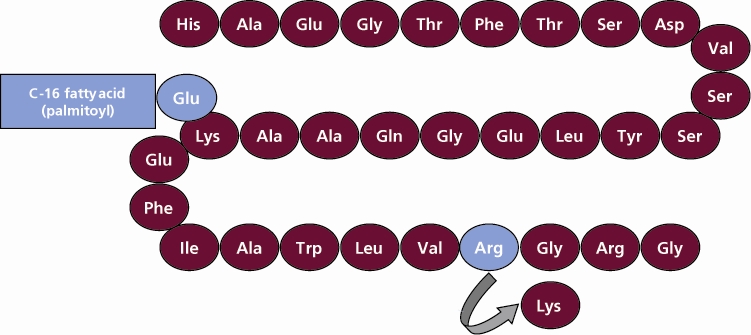
Figure 1: Structural Formula Of Liraglutide (49f302f5 F315 48b8 83a4 6ca56f01fded 01)
An illustration showing the molecular sequence of liraglutide, the active ingredient in Victoza 6 mg/mL injection. The diagram displays an amino acid sequence with individual amino acids labeled in ovals and highlights a C-16 fatty acid (palmitoyl) linked to the peptide structure. Two amino acids, Arg and Lys, are emphasized with arrows indicating a connection.*
FDA Label Image

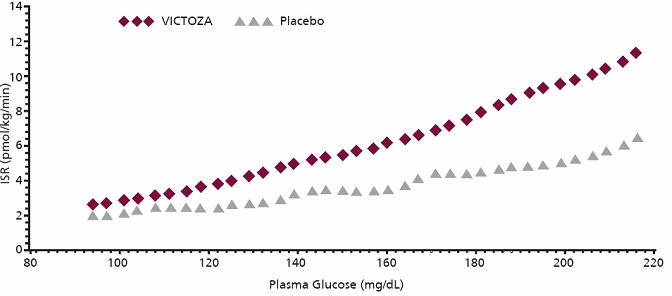
Figure 2 Mean Insulin Secretion Rate (isr) Versus Glucose Concentration (49f302f5 F315 48b8 83a4 6ca56f01fded 02)

Figure 2 Mean Insulin Secretion Rate (isr) Versus Glucose Concentration (49f302f5 F315 48b8 83a4 6ca56f01fded 02)
A graph comparing insulin secretion rate (ISR) in pmol/kg/min versus plasma glucose levels in mg/dL. The graph shows two data series: Victoza (liraglutide) represented by purple diamonds, and Placebo represented by gray triangles. ISR increases with higher plasma glucose for both, with Victoza showing higher ISR values than Placebo across the range.*
FDA Label Image

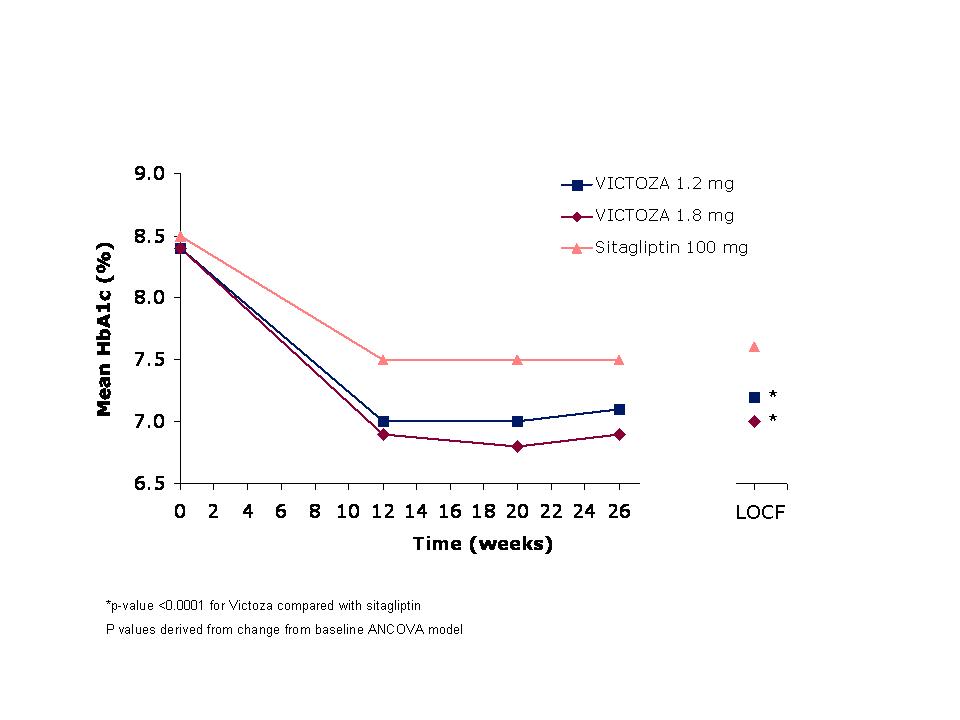
Figure 4 Mean Hba1c For Patients Who Completed The 26-week Trial And For The Last Observation Carried Forward (locf, Intent-to-treat) Data At Week 26 (49f302f5 F315 48b8 83a4 6ca56f01fded 04)

Figure 4 Mean Hba1c For Patients Who Completed The 26-week Trial And For The Last Observation Carried Forward (locf, Intent-to-treat) Data At Week 26 (49f302f5 F315 48b8 83a4 6ca56f01fded 04)
A line graph comparing mean HbA1c (%) levels over 26 weeks for Victoza 1.2 mg, Victoza 1.8 mg, and Sitagliptin 100 mg treatments. The x-axis represents time in weeks, while the y-axis shows mean HbA1c percentage. Both Victoza doses show a decline in HbA1c levels, followed by stabilization, whereas Sitagliptin's decline is smaller and plateaus earlier.*
FDA Label Image

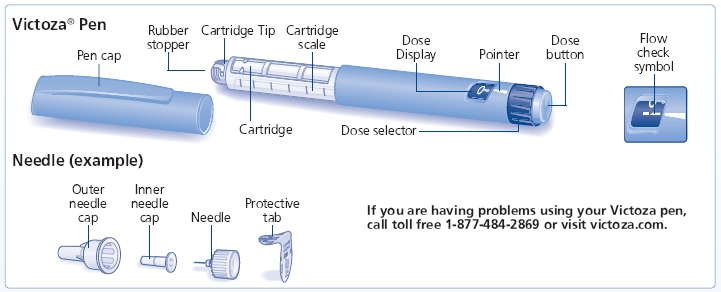
Victoza Pen And Needle (Image 01)

Victoza Pen And Needle (Image 01)
An illustration diagram showing components of the Victoza Pen injection device by Novo Nordisk. The pen is labeled with parts including the pen cap, rubber stopper, cartridge tip and scale, dose selector, dose display, pointer, dose button, and a flow check symbol. The needle components include the outer and inner needle caps, needle, and a protective tab. Instructions for user support are also noted.*
FDA Label Image

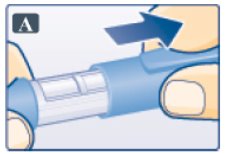
Figure: Pull Off Pen Cap (Image 02)

Figure: Pull Off Pen Cap (Image 02)
An instructional illustration showing a close-up of a person holding the Victoza injection pen, with an arrow indicating how to pull back a component on the pen, likely to prepare it for use or remove a cap.*
FDA Label Image

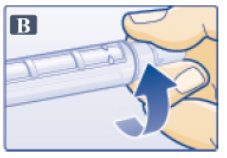
Figure: Attaching Needle (Image 03)

Figure: Attaching Needle (Image 03)
An instructional diagram labeled with a 'B' showing a hand holding a subcutaneous injection pen device, with an arrow indicating the step of pulling or rotating a part of the injection pen, likely to prepare the device for use.*
FDA Label Image

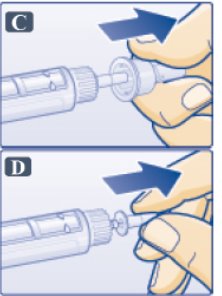
Figure: Remove Outer Needle Cap (Image 04)

Figure: Remove Outer Needle Cap (Image 04)
An instructional illustration showing a hand manipulating parts of an injection pen device. The top panel (labeled C) depicts the hand pushing or pulling a component on the pen, while the bottom panel (labeled D) shows the hand removing or adjusting the pen needle, indicating steps in preparing the pen for subcutaneous injection.*
FDA Label Image

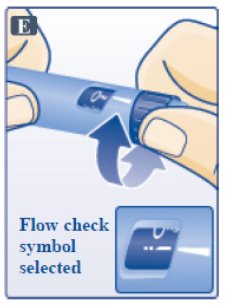
Figure: Remove Inner Needle Cap (Image 05)

Figure: Remove Inner Needle Cap (Image 05)
An instructional illustration showing how to perform a flow check on a Victoza (liraglutide) injection pen. The image depicts a hand twisting the pen cap and features a close-up inset highlighting the flow check symbol on the pen display.*
FDA Label Image

Figure: Turn Dose Selector To Flow Check Symbol (Image 06)

Figure: Turn Dose Selector To Flow Check Symbol (Image 06)
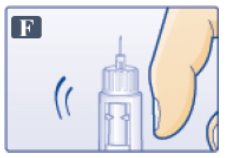
An illustration showing a close-up of a hand pressing down on the top of an injection pen, with motion lines indicating the action of pushing the injection button. This image likely depicts how to administer a subcutaneous injection using the pen device.*
FDA Label Image

Figure: Tap Cartridge Gently With Finger (Image 07)

Figure: Tap Cartridge Gently With Finger (Image 07)
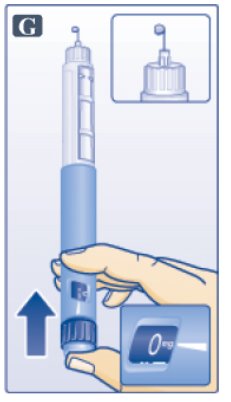
Instructional illustration showing a hand holding a Victoza (liraglutide) injection pen with the dose selector being pulled upward. A close-up inset shows the dose selector mechanism in detail, with an indicator displaying a dose of 0 mg. The diagram is designed to guide the user on how to adjust the dose on the injection pen.*
FDA Label Image

Figure: Keep Needle Pointing Up And Press Dose Button (Image 08)

Figure: Keep Needle Pointing Up And Press Dose Button (Image 08)
Illustration showing a close-up of a hand holding a Victoza subcutaneous injection pen, with an arrow indicating a step to pull or slide a component of the pen, likely part of the injection preparation or administration process.*
FDA Label Image

Figure: Pull Off Pen Cap (Image 09)

Figure: Pull Off Pen Cap (Image 09)
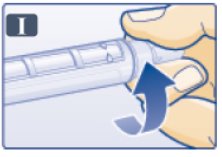
An instructional illustration showing a hand holding a pen injector device for subcutaneous injection. The thumb is pulling back the grey needle cap on the pen to prepare it for injection, indicated by a blue curved arrow pointing upward and away from the device.*
FDA Label Image

Figure: Attaching Needle (Image 10)

Figure: Attaching Needle (Image 10)
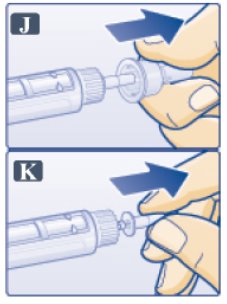
Instructional illustration showing two steps of preparing a Victoza injection pen. The first panel (J) depicts the removal of a protective cap from the pen needle by pulling it straight off. The second panel (K) shows the removal of the outer needle cap before injection. Both steps are shown with directional arrows indicating the correct removal motion.*
FDA Label Image

Figure: Remove Outer Needle Cap (Image 11)

Figure: Remove Outer Needle Cap (Image 11)
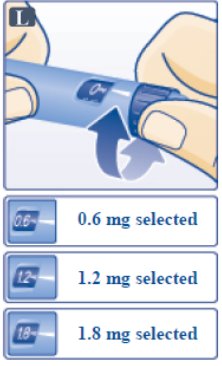
An instructional illustration showing a close-up of a person adjusting the dosage selector on a Victoza injection pen. The pen displays dosage options of 0.6 mg, 1.2 mg, and 1.8 mg, with 0.6 mg highlighted as selected.*
FDA Label Image

Figure: Remove Inner Needle Cap (Image 12)

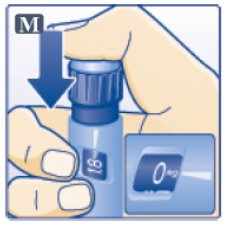
Figure: Remove Inner Needle Cap (Image 12)
An instructional illustration showing a hand holding a Victoza 6 mg/mL injection vial with an arrow indicating downward pressure on the vial cap. A close-up inset displays the number '0' as part of the injection device's dial or setting mechanism.*
FDA Label Image

Figure: Turn Dose Selector To Dose (Image 13)

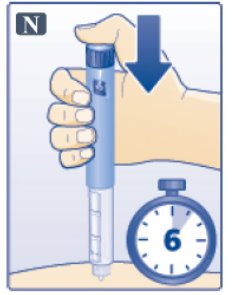
Figure: Turn Dose Selector To Dose (Image 13)
An instructional illustration showing a hand holding a Victoza injection pen for subcutaneous use. An arrow points downward indicating injection technique, alongside a stopwatch icon marked with the number 6, possibly indicating injection duration in seconds.*
FDA Label Image

Figure: 0.6 mg, 1.2 mg And 1.8 mg Dose (Image 14)

Figure: 0.6 mg, 1.2 mg And 1.8 mg Dose (Image 14)
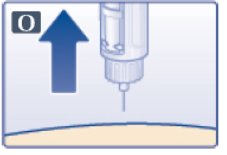
An instructional illustration showing a close-up of a subcutaneous injection needle positioned above the skin, indicated by an upward arrow. The image likely demonstrates the proper orientation or delivery method for a subcutaneous injection, relevant to injectable drugs like Victoza (liraglutide).*
FDA Label Image

Figure: Delivering The Dose (Image 15)

Figure: Delivering The Dose (Image 15)
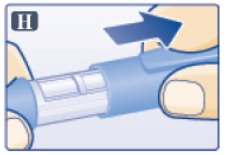
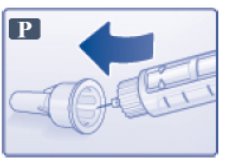
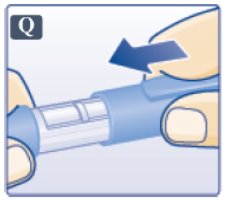
Instructional illustration showing the removal of a cap from a prefilled injection pen. A leftward arrow indicates the direction to pull the cap off the injection device prior to use.*
FDA Label Image

Keep Dose Button Pressed Down For 6 Seconds. (Image 16)

Keep Dose Button Pressed Down For 6 Seconds. (Image 16)
Illustration showing a close-up of hands holding a Victoza injection pen, with an arrow indicating an action step on the device, likely demonstrating how to prepare or use the subcutaneous injection pen for liraglutide.*
FDA Label Image

Figure: Withdraw The Needle (Image 17)

Figure: Withdraw The Needle (Image 17)
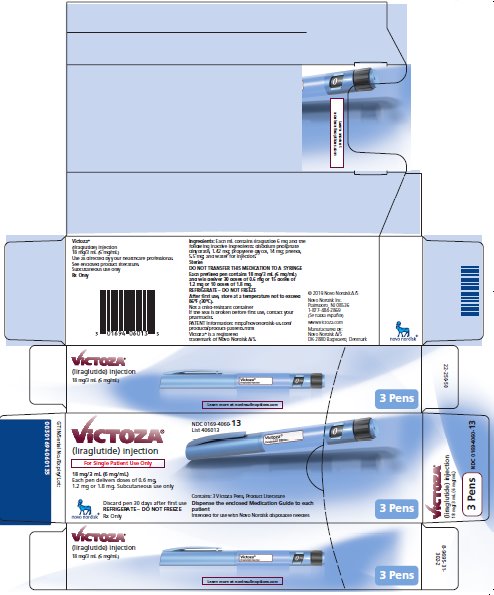
Victoza 6 mg/mL liraglutide injection packaging label for subcutaneous use by Novo Nordisk. The label displays the product name Victoza with liraglutide injection, strength 6 mg/mL (18 mg/3 mL), indicating it is for single patient use only. The package contains 3 pens. Instructions include discarding 20 days after first use and refrigerated storage. The label features Novo Nordisk logos and standard labeling information.*
FDA Label Image

Figure: Safely Remove The Needle (Image 18)

Figure: Safely Remove The Needle (Image 18)
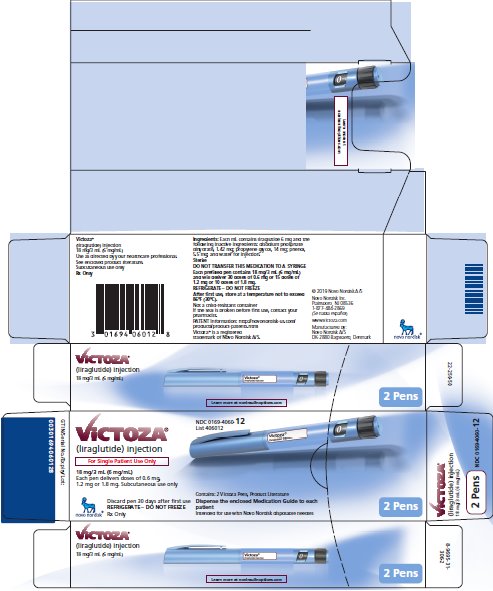
Victoza (liraglutide) injection 6 mg/mL subcutaneous solution packaging label from Novo Nordisk. The label shows a blue pen injector device with detailed product information including strength, dosage form, usage instructions, and storage warnings. The packaging is designed for 2 pens per carton and includes a barcode and NDC 0169-4060.*
FDA Label Image

Figure 5 (Image 20)

Figure 5 (Image 20)
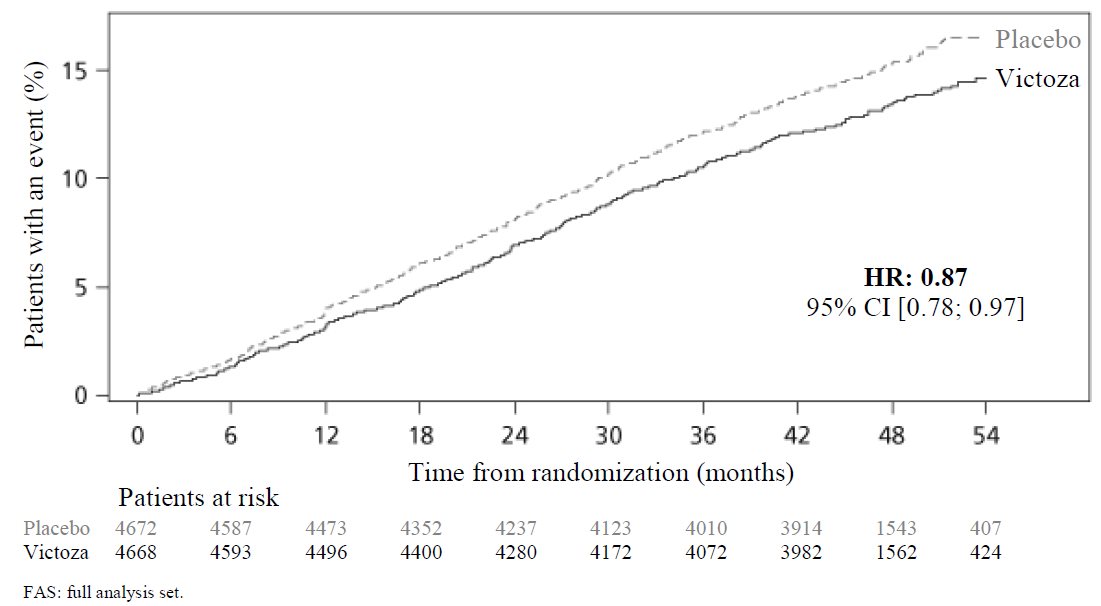
A Kaplan-Meier curve showing the percentage of patients with an event over approximately 54 months from randomization, comparing Victoza (liraglutide) to placebo. The graph displays lower event rates for Victoza versus placebo, with the hazard ratio (HR) 0.87 and 95% confidence interval (0.78, 0.97) indicated. Patient risk numbers at various time points are listed below the x-axis.*
FDA Label Image

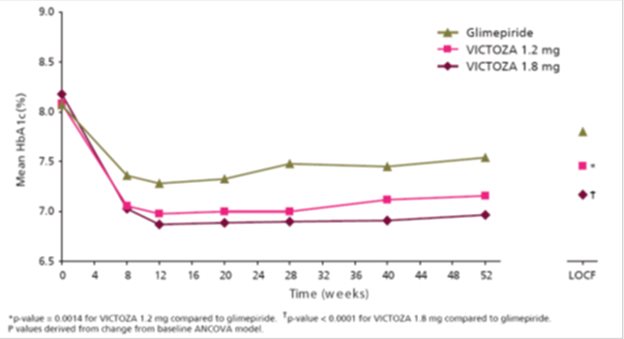
Figure 3 (Image 21)

Figure 3 (Image 21)
A line graph comparing mean HbA1c percentage over 52 weeks among patients treated with Glimepiride, Victoza 1.2 mg, and Victoza 1.8 mg. The x-axis represents time in weeks, and the y-axis shows mean HbA1c (%). The chart illustrates trends and differences in glycemic control between the three treatments over time.*

* About these descriptions: Image descriptions on this page are generated by automated AI analysis of the product label images from the manufacturer's FDA label submission (SPL). They are provided for reference only and may contain errors or omissions. Always rely on the printed label itself and the official FDA labeling, and consult a pharmacist or healthcare professional with any questions about this product.