Trelegy Ellipta Powder
Product Images NDC 0173-0887

27 FDA label images from Glaxosmithkline Llc · Packaging, Regulatory Labels, and Product Appearance

Product Visual Gallery

This gallery contains 27 technical images submitted to the FDA as part of the official labeling for Trelegy Ellipta (NDC 0173-0887). Unlike standard consumer photos, these assets often include clinical data figures, molecular chemical structures, and official manufacturer packaging layouts.

As provided by Glaxosmithkline Llc, these visuals offer a comprehensive scientific overview of the product's physical and chemical identity, aiding pharmacists and researchers in product verification and study.

FDA Label Image

Ff Chemical Structure (Trelegy Ellipta Spl Graphic 01)

Ff Chemical Structure (Trelegy Ellipta Spl Graphic 01)
Chemical structure of fluticasone furoate, the active ingredient in Trelegy Ellipta, showing its molecular arrangement including fluorine and oxygen atoms.*
FDA Label Image

Umeclidinium Chemical Structure (Trelegy Ellipta Spl Graphic 02)

Umeclidinium Chemical Structure (Trelegy Ellipta Spl Graphic 02)
Chemical structure diagram showing the molecular structure of umeclidinium bromide, one of the active ingredients in Trelegy Ellipta.*
FDA Label Image

Vilanterol Chemical Structure (Trelegy Ellipta Spl Graphic 03)

Vilanterol Chemical Structure (Trelegy Ellipta Spl Graphic 03)
Chemical structure diagram showing the molecular structure of the active ingredient fluticasone furoate in Trelegy Ellipta inhalation powder.*
FDA Label Image

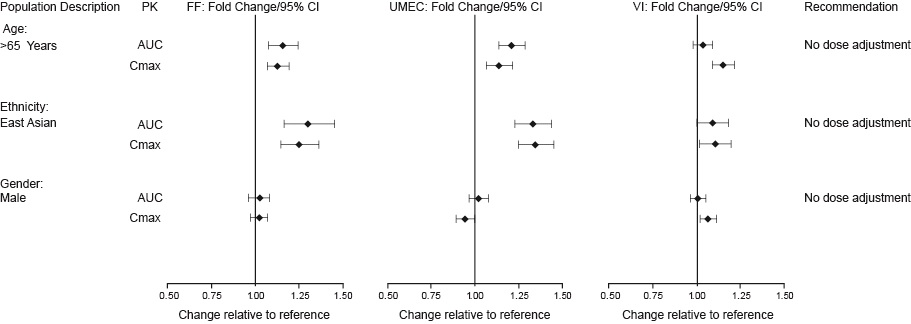
Figure 1. Impact Of Intrinsic Factors On The Pharmacokinetics (pk) Of Fluticasone Furoate (ff) And Vilanterol (vi) Following Administration As Fluticasone Furoate/vilanterol Combination (Trelegy Ellipta Spl Graphic 04)

Figure 1. Impact Of Intrinsic Factors On The Pharmacokinetics (pk) Of Fluticasone Furoate (ff) And Vilanterol (vi) Following Administration As Fluticasone Furoate/vilanterol Combination (Trelegy Ellipta Spl Graphic 04)
A pharmacokinetic chart illustrating fold changes with 95% confidence intervals for fluticasone furoate (FF), umeclidinium bromide (UMEC), and vilanterol trifenatate (VI) in different population groups: age >65 years, East Asian ethnicity, and male gender. The chart compares AUC and Cmax values relative to a reference with recommendations stating no dose adjustment is needed.*
FDA Label Image

Figure 2. Impact Of Coadministered Drugsa On The Pharmacokinetics (pk) Of Fluticasone Furoate (ff) And Vilanterol (vi) (Trelegy Ellipta Spl Graphic 05)

Figure 2. Impact Of Coadministered Drugsa On The Pharmacokinetics (pk) Of Fluticasone Furoate (ff) And Vilanterol (vi) (Trelegy Ellipta Spl Graphic 05)
A pharmacokinetic chart showing fold change and 95% confidence intervals for fluticasone furoate (FF), umeclidinium bromide (UMEC), and vilanterol trifenatate (VI) across population subgroups by age (>65 years), ethnicity (East Asian), and gender (male). The x-axis measures change relative to reference for AUC and Cmax, and recommendations indicate no dose adjustment.*
FDA Label Image

Figure 3. Impact Of Intrinsic And Extrinsic Factors On The Systemic Exposure Of Umeclidinium (Trelegy Ellipta Spl Graphic 06)

Figure 3. Impact Of Intrinsic And Extrinsic Factors On The Systemic Exposure Of Umeclidinium (Trelegy Ellipta Spl Graphic 06)
A pharmacokinetic (PK) comparison chart showing fold changes with 90% confidence intervals for fluticasone furoate (FF) and vilanterol (VI) in populations with severe renal impairment, varying degrees of hepatic impairment, and with interacting drugs ketoconazole and verapamil. The chart includes AUC and Cmax parameters, changes relative to a reference, and corresponding dosing recommendations such as 'No dose adjustment' or 'Caution.'*
FDA Label Image

Trelegy Fig 4 (Trelegy Ellipta Spl Graphic 07)

Trelegy Fig 4 (Trelegy Ellipta Spl Graphic 07)
A pharmacokinetic chart showing fold change in umeclidinium (UMEC) exposure with 90% confidence intervals across different populations and conditions, including severe renal impairment, moderate hepatic impairment, CYP2D6 poor metabolizers, and P-gp transport inhibitor Verapamil. The chart plots change relative to reference for AUC and Cmax, with dose adjustment recommendations noted as 'No dose adjustment' for all categories.*
FDA Label Image

Trelegy Fig 5 (Trelegy Ellipta Spl Graphic 08)

Trelegy Fig 5 (Trelegy Ellipta Spl Graphic 08)
A line graph depicting the least squares mean change from baseline in mL over a 24-hour period. The x-axis shows time in hours (0 to 24), and the y-axis shows LS mean change from baseline ranging from -50 to 250 mL. Two treatments are compared: umeclidinium 62.5 mcg plus fluticasone furoate/vilanterol 100/25 mcg (represented by triangles) and placebo plus fluticasone furoate/vilanterol 100/25 mcg (represented by circles). Both curves show changes over time, with the umeclidinium combination showing higher values throughout the period.*
FDA Label Image

Figure 6. Least Squares (ls) Mean Change From Baseline In Trough Fev1 (ml) (Trelegy Ellipta Spl Graphic 09)

Figure 6. Least Squares (ls) Mean Change From Baseline In Trough Fev1 (ml) (Trelegy Ellipta Spl Graphic 09)
Line graph showing LS mean change from baseline in mL over time (0 to 24 hours) for two treatments: umeclidinium 62.5 mcg plus fluticasone furoate/vilanterol 100/25 mcg, and placebo plus fluticasone furoate/vilanterol 100/25 mcg. The umeclidinium combination shows a greater increase peaking around 3 hours, while placebo remains lower throughout the time course.*
FDA Label Image

Trelegy-ellipta-spl-graphic-10.jpg (Trelegy Ellipta Spl Graphic 10)

Trelegy-ellipta-spl-graphic-10.jpg (Trelegy Ellipta Spl Graphic 10)
A line graph showing least squares mean change from baseline in mL over time (weeks) for three treatments: Trelegy Ellipta, Fluticasone furoate/vilanterol 100/25 mcg, and Umeclidinium/vilanterol 62.5/25 mcg. The x-axis represents time in weeks (4 to 52), and the y-axis represents change from baseline. Trelegy Ellipta shows the highest LS mean values consistently over time.*
FDA Label Image

Figure A (Trelegy Ellipta Spl Graphic 11)

Figure A (Trelegy Ellipta Spl Graphic 11)
A line graph depicting the least squares mean change from baseline in mL over 24 weeks. The x-axis shows time in weeks (Baseline, 4, 12, 24), and the y-axis shows change from baseline in mL with 95% confidence intervals. Two treatments are compared: Trelegy Ellipta 100/62.5/25 mcg (n=406) represented by squares, and Fluticasone furoate/vilanterol 100/25 mcg (n=407) represented by circles. The graph shows Trelegy Ellipta consistently has a larger mean change with statistically significant difference at week 24 (P<0.001).*
FDA Label Image

Figure B (Trelegy Ellipta Spl Graphic 12)

Figure B (Trelegy Ellipta Spl Graphic 12)
Line graph showing the least squares mean change from baseline in milliliters over 24 weeks comparing Trelegy Ellipta 200/62.5/25 mcg and fluticasone furoate/vilanterol 200/25 mcg. The x-axis represents time in weeks (Baseline, 4, 12, 24), and the y-axis shows LS mean change with 95% confidence intervals. Trelegy Ellipta demonstrates a higher increase throughout the study period.*
FDA Label Image

Figure C (Trelegy Ellipta Spl Graphic 13)

Figure C (Trelegy Ellipta Spl Graphic 13)
An illustration diagram showing the packaging components for Trelegy Ellipta inhaler. It depicts a carton box, a tray with a tray lid, the inhaler device, a desiccant packet, and a folded patient information leaflet typically included with the product.*
FDA Label Image

Figure D (Trelegy Ellipta Spl Graphic 14)

Figure D (Trelegy Ellipta Spl Graphic 14)
An instructional illustration showing a hand peeling back the foil lid of a blister pack containing individual medication doses. This likely demonstrates the opening of the Trelegy Ellipta powder inhaler blister packaging for dose access.*
FDA Label Image

Figure E (Trelegy Ellipta Spl Graphic 15)

Figure E (Trelegy Ellipta Spl Graphic 15)
An instructional illustration showing a hand disposing of a small packet into a trash can. The image likely demonstrates proper disposal of medication packaging or used components for the Trelegy Ellipta inhalation powder product.*
FDA Label Image

Figure F (Trelegy Ellipta Spl Graphic 16)

Figure F (Trelegy Ellipta Spl Graphic 16)
An instructional diagram of the Trelegy Ellipta inhaler showing the cover and the dose counter displaying '30'. The diagram highlights the main parts involved in inhaler usage.*
FDA Label Image

Figure G (Trelegy Ellipta Spl Graphic 17)

Figure G (Trelegy Ellipta Spl Graphic 17)
An instructional diagram showing the parts of a Trelegy Ellipta inhaler device. The illustration highlights the mouthpiece, air vent, cover, and a counter displaying the number 29. An arrow indicates the cover opening with a "Click" sound noted, and a finger pressing the counter button is shown for operating the device.*
FDA Label Image

Figure H (Trelegy Ellipta Spl Graphic 18)

Figure H (Trelegy Ellipta Spl Graphic 18)
Illustration showing a person holding the Trelegy Ellipta inhaler and exhaling away from the device. Arrows indicate the direction of breath before inhalation, demonstrating correct use of the inhaler for respiratory drug administration.*
FDA Label Image

Figure I (Trelegy Ellipta Spl Graphic 19)

Figure I (Trelegy Ellipta Spl Graphic 19)
An instructional illustration showing a person holding and preparing to use a handheld inhalation device, likely a dry powder inhaler. The person is placing the inhaler to their mouth while gripping the device with one hand and pressing down with the other hand to activate the dose.*
FDA Label Image

Figure J (Trelegy Ellipta Spl Graphic 20)

Figure J (Trelegy Ellipta Spl Graphic 20)
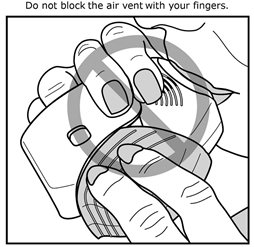
An instructional illustration showing a hand holding a respiratory inhaler with a warning not to block the air vent with fingers. The image focuses on proper inhaler handling technique.*
FDA Label Image

Figure K (Trelegy Ellipta Spl Graphic 21)

Figure K (Trelegy Ellipta Spl Graphic 21)
An instructional illustration showing the lower half of a face with instructions to hold breath for 3 to 4 seconds. It likely relates to inhalation technique for a respiratory drug such as Trelegy Ellipta.*
FDA Label Image

Figure L (Trelegy Ellipta Spl Graphic 22)

Figure L (Trelegy Ellipta Spl Graphic 22)
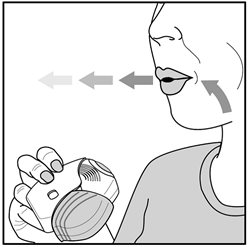
An instructional illustration showing a person preparing to inhale medication from an inhaler device. The image depicts airflow direction with arrows indicating exhalation away from the mouth, emphasizing proper inhalation technique.*
FDA Label Image

Trelegy Ellipta 30 Dose Carton (Trelegy Ellipta Spl Graphic 23)

Trelegy Ellipta 30 Dose Carton (Trelegy Ellipta Spl Graphic 23)
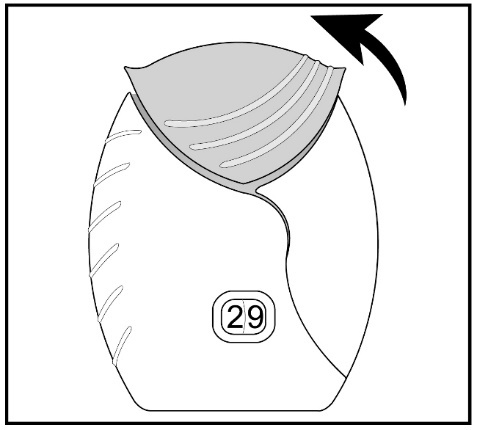
Illustration of the Trelegy Ellipta inhaler showing the device with a curved top mouthpiece cover partially opened, an arrow indicating the opening direction, and a dose counter displaying the number 29.*
FDA Label Image

Trelegy Ellipta Spl Graphic 24

Trelegy Ellipta Spl Graphic 24
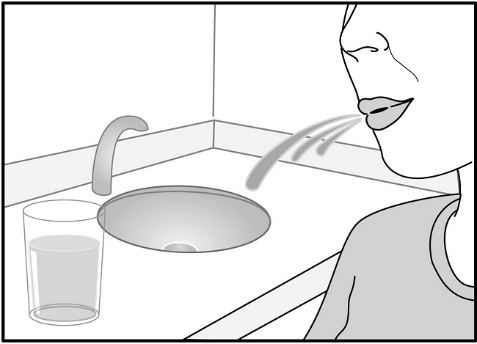
An instructional line drawing showing a person rinsing their mouth over a sink with water, emphasizing proper oral hygiene after inhalation therapy. A glass of water is placed near the sink's edge.*
FDA Label Image

Trelegy Ellipta Spl Graphic 25

Trelegy Ellipta Spl Graphic 25
An illustration of the Trelegy Ellipta inhaler device in powder form for respiratory inhalation. The diagram highlights a red indicator on the device with the number 9 displayed, likely representing the dose counter or remaining doses.*
FDA Label Image

Trelegy Ellipta Spl Graphic 26

Trelegy Ellipta Spl Graphic 26
Trelegy Ellipta inhalation powder containing fluticasone furoate 100 mcg, umeclidinium 62.5 mcg, and vilanterol 25 mcg per dose. The label shows a white elliptical inhaler with a tan mouthpiece cap, designed for oral inhalation only, holding 30 doses (60 blisters total). Labeler is GlaxoSmithKline LLC.*
FDA Label Image

Trelegy Ellipta Spl Graphic 27

Trelegy Ellipta Spl Graphic 27
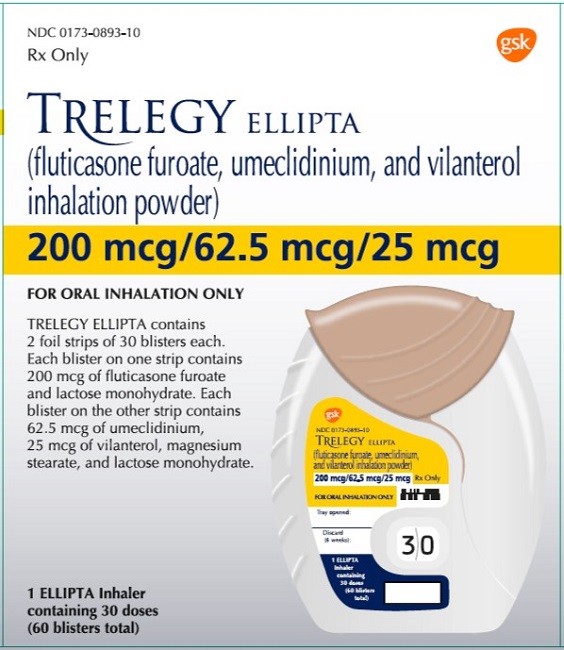
Trelegy Ellipta inhalation powder 200 mcg/62.5 mcg/25 mcg packaging label shows the product name with active ingredients fluticasone furoate, umeclidinium, and vilanterol. The label indicates it is for oral inhalation only and details the contents of 2 foil strips with 30 blisters each. The labeler is GlaxoSmithKline LLC. The inhaler device image is also shown displaying dosage information and a 30-day dose counter.*

* About these descriptions: Image descriptions on this page are generated by automated AI analysis of the product label images from the manufacturer's FDA label submission (SPL). They are provided for reference only and may contain errors or omissions. Always rely on the printed label itself and the official FDA labeling, and consult a pharmacist or healthcare professional with any questions about this product.