The efficacy of EXDENSUR for the add‑on maintenance treatment of severe asthma characterized by an eosinophilic phenotype was evaluated in 2 replicate, randomized (2:1 to EXDENSUR or placebo), double‑blind, parallel‑group, placebo‑controlled, multicenter clinical trials (SWIFT‑1 [NCT04719832] and SWIFT‑2 [NCT04718103]) of 52 weeks duration. The trials enrolled adult and pediatric patients aged 12 years and older with asthma characterized by an eosinophilic phenotype, defined as a blood eosinophil count ≥150 cells/mcL at screening or ≥300 cells/mcL documented in the year prior to study entry. Patients were required to have 2 or more asthma exacerbations requiring treatment with systemic corticosteroids (SCS) in the prior year while on background asthma therapy consisting of a medium‑ to high‑dose ICS plus at least one additional asthma controller with or without maintenance oral corticosteroids (OCS). Patients were also required to have reduced lung function at baseline (pre‑bronchodilator forced expiratory volume in 1 second [FEV1] <80% predicted normal in adults; FEV1 <90% or FEV1 to forced vital capacity ratio <0.8 in pediatric patients aged 12 years and older). Patients were enrolled without requiring a minimum baseline Asthma Control Questionnaire‑5 (ACQ‑5) score. In these trials, EXDENSUR 100 mg was administered SC once every 6 months for a total of 2 doses in addition to background asthma therapy. The efficacy population consisted of 762 patients who received at least 1 dose of EXDENSUR 100 mg or placebo in SWIFT‑1 (N = 382) and SWIFT‑2 (N = 380).
The demographics and baseline characteristics of the efficacy population in SWIFT‑1 and SWIFT‑2 are provided in Table 2.
Table 2. Demographics and Baseline Characteristics of Adult and Pediatric Patients Aged 12 Years and Older with Severe Asthma in SWIFT-1 and SWIFT-2| FEV1 = forced expiratory volume in 1 second; ICS = inhaled corticosteroid; IgE = immunoglobulin E; LABA = long‑acting beta agonist; LAMA = long‑acting muscarinic antagonist; mcL = microliter; N = number of patients in the efficacy population; n = number of patients in the respective group; OCS = oral corticosteroid; SD = standard deviation; U = units. |
| a Medium ICS dose = 440 mcg fluticasone propionate (FP) daily or equivalent; High ICS dose >440 mcg FP daily or equivalent. |
| SWIFT‑1 N = 382 | SWIFT‑2 N = 380 |
Age (years), n (%) | | |
12‑17 | 8 (2) | 22 (6) |
18‑64 | 276 (72) | 262 (69) |
≥65 | 98 (26) | 96 (25) |
Mean (SD) | 54 (14.2) | 53 (16.2) |
Female, n (%) | 223 (58) | 241 (63) |
Race, n (%) | | |
White | 316 (83) | 272 (72) |
Asian | 58 (15) | 75 (20) |
Black or African American | 8 (2) | 28 (7) |
Other | 0 | 5 (1) |
Hispanic or Latino, n (%) | 23 (6) | 65 (17) |
Never smoked, n (%) | 288 (75) | 294 (77) |
Duration of asthma (years), mean (SD) | 22 (16.2) | 25 (18.5) |
Pre‑bronchodilator % predicted FEV1, mean (SD) | 62 (15.2) | 62 (15.9) |
% reversibility, mean (SD) | 17 (15.3) | 18 (17.4) |
Eosinophil count (cells/mcL), median (min; max) | 310 (20; 2,360) | 340 (10; 4,440) |
Exacerbations in previous year, mean (SD) | 2.2 (0.7) | 2.7 (1.9) |
High‑dose ICS use, n (%)a | 203 (53) | 226 (59) |
ICS + LABA + LAMA use, n (%) | 95 (25) | 127 (33) |
Maintenance OCS use, n (%) | 21 (5) | 19 (5) |
Total IgE (U/mcL), median (min; max) | 185 (2; 12,142) | 180 (2; 16,199) |
Exacerbations
The primary efficacy endpoint for SWIFT‑1 and SWIFT‑2 was the annualized rate of clinically significant exacerbations over the 52‑week treatment period. A clinically significant exacerbation was defined as worsening of asthma requiring use of SCS such as intravenous (IV) or oral steroids for at least 3 days or a single intramuscular (IM) corticosteroid dose and/or hospitalization and/or Emergency Department visit. For patients on maintenance SCS, at least double the existing maintenance dose for at least 3 days was required. All patients experiencing an exacerbation were treated with SCS.
In SWIFT‑1 and SWIFT‑2, the annualized rate of asthma exacerbations was significantly lower in patients receiving EXDENSUR compared to placebo (Table 3). During the 52‑week treatment period, fewer patients experienced exacerbations in the EXDENSUR group (32% and 32%) compared to the placebo group (46% and 50%) in SWIFT‑1 and SWIFT‑2, respectively.
Table 3. Annualized Rate of Clinically Significant Asthma Exacerbations Over 52 Weeks in SWIFT-1 and SWIFT-2| N = number of patients in the efficacy population. |
| Note: Results obtained from a negative binomial model with an offset term for years in study and fixed effects for treatment group, asthma exacerbation history, baseline ICS dose, geographical region, and baseline pre‑bronchodilator % predicted FEV1. |
| SWIFT‑1 | SWIFT‑2 |
EXDENSUR N = 250 | Placebo N = 132 | EXDENSUR N = 252 | Placebo N = 128 |
Annualized rate of clinically significant asthma exacerbations | 0.46 | 1.11 | 0.56 | 1.08 |
Rate ratio (95% CI) | 0.42 (0.30, 0.59) | 0.52 (0.36, 0.73) |
P‑value | <0.001 | <0.001 |
The percentage of patients with exacerbations requiring hospitalization and/or Emergency Department visit was numerically lower for patients treated with EXDENSUR (1% and 4%) compared with placebo (8% and 10%) in SWIFT‑1 and SWIFT‑2, respectively.
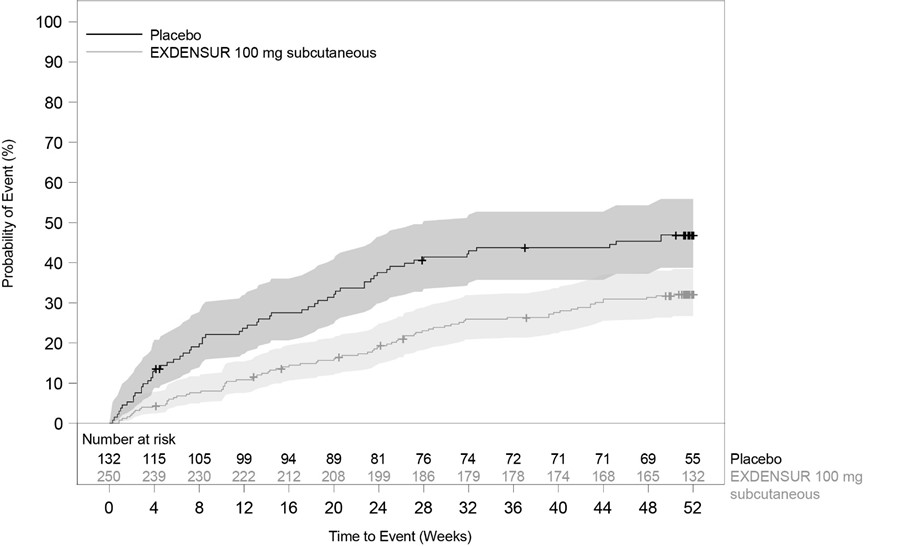
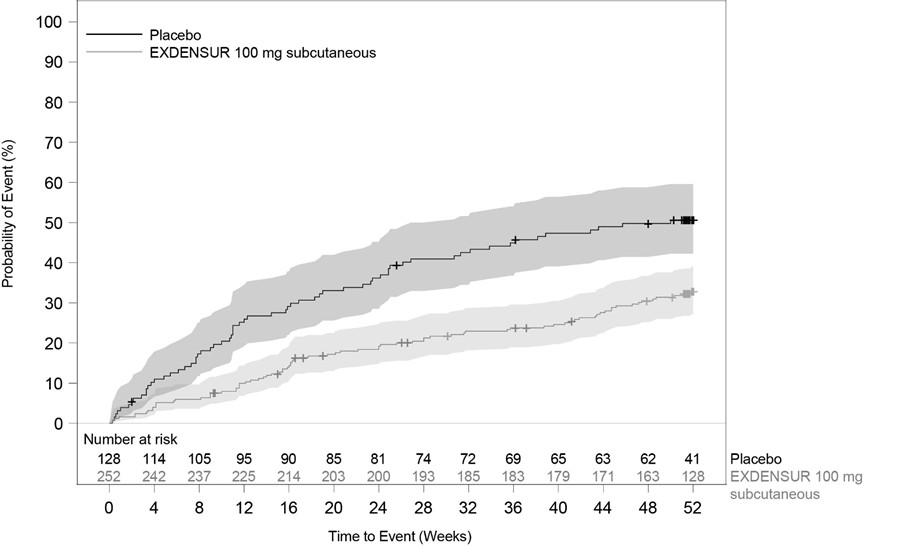
In SWIFT‑1 and SWIFT‑2, the time to first clinically significant exacerbation was longer for EXDENSUR compared to placebo (Figures 3 and 4).
Figure 3. Kaplan Meier Curve for Time to First Clinically Significant Exacerbation (SWIFT‑1)
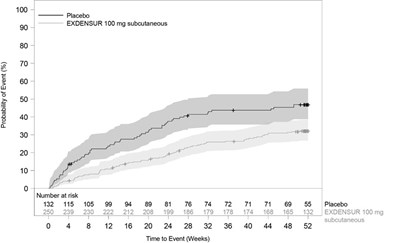
Figure 3 (Exdensur Spl Graphic 10)
Shaded areas represent 95% confidence intervals.
Figure 4 Kaplan Meier Curve for Time to First Clinically Significant Exacerbation (SWIFT‑2)
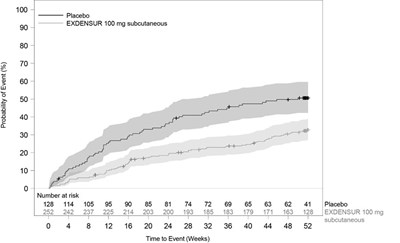
Figure 4 (Exdensur Spl Graphic 11)
Shaded areas represent 95% confidence intervals.
Lung Function
In SWIFT‑1 and SWIFT‑2, the mean change from baseline in pre‑bronchodilator FEV1 for EXDENSUR was 160 mL and 240 mL, respectively, compared to 160 mL and 184 mL for placebo. The treatment difference in SWIFT‑1 and SWIFT‑2 relative to placebo was -1 mL (95% CI: -89, 88) and 56 mL (95% CI: -43, 154), respectively.
Patient-Reported Outcome
In SWIFT‑1 and SWIFT‑2, the proportion of ACQ‑5 responders (clinically meaningful improvement defined as a decrease in score of 0.5 or more) at Week 52 was 54% for EXDENSUR in both studies compared to 55% and 53%, respectively, for placebo.