The starting dose for immunotherapy is related directly to a patient’s sensitivity as determined by carefully executed percutaneous (prick/puncture) and intracutaneous (intradermal) skin testing with non-alum adsorbed allergenic extract. A general rule is to begin at 1/10 of the intradermal dose that produces sum of erythema of 50 mm (approximately a 2+ positive skin test reaction). Patient’s response to skin testing is graded on the basis of the size of the erythema and wheal. Refer to the diagnostic allergenic extract package enclosure for specific information.
TRANSFER OF PATIENTS FROM OTHER AQUEOUS
EXTRACTS TO CENTER-AL EXTRACTS
Patients may be transferred from other aqueous allergens to Center-Al Alum Precipitated Extracts during treatment. To avoid untoward reactions, it may be necessary to initiate treatment as though the patient were previously untreated. In transferring from standardized extracts, the more rapid rate of decline in activity of aqueous extract relative to alum precipitated extract must be considered in cautiously transferring patients to alum precipitated extract.
Caution should be observed since the Center-Al preparation may be more potent than the aqueous product.
TRANSFER OF PATIENTS FROM OTHER ALUM-COMPLEXED
EXTRACTS TO CENTER-AL EXTRACTS
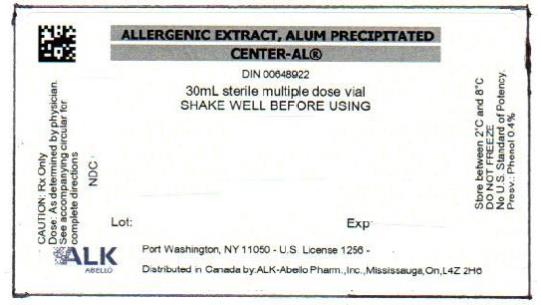
Patients may be transferred from other alum-complexed allergenic extracts to Center-Al Alum Precipitated extracts. In order to avoid untoward reactions, it is recommended that previous therapy be disregarded and therapy with Center-Al be initiated as though the patient were previously untreated. The first dose of Center-Al should be related to the patient’s sensitivity, determined by history and confirmed by skin testing. CAUTION: Center-Al Alum Precipitated extracts should not be mixed with other alum precipitated or aqueous extracts.
PRE-SEASONAL AND PERENNIAL METHOD OF TREATMENT
The use of Center-Al Allergenic extract, Alum Precipitated, in the treatment of patients by the pre-seasonal method should be started 10 to 12 weeks prior to the usual onset of symptoms. Therapy should be initiated early enough to permit a graduated series of doses at weekly intervals. It is recommended that the larger doses be spaced 2 to 3 weeks apart and that the top dose be reached prior to the season.
Increased tolerance acquired through hyposensitization can vary from a few to several months. To assure prolongation of this acquired tolerance, perennial or year-round treatment is recommended. Some physicians continue therapy into or through the season by repeating a reduced MAINTENANCE dose at 4 to 6 week intervals.
SUGGESTED DOSAGE SCHEDULE
A treatment schedule is related directly to the patient’s degree of sensitivity, determined initially by clinical history and skin testing, and continuously by response to therapeutic doses. Thus, an individual treatment schedule for each patient must be established during the course of therapy. Maximum protection can be obtained with a dosage kept constantly below the patient’s limit of tolerance. Every precaution should be taken to avoid a systemic or generalized reaction which in addition to being dangerous, may depress rather than increase the patient’s tolerance.
FOR ALL PREPARATIONS (EXCEPT SHORT RAGWEED AND
MIXED SHORT AND TALL RAGWEED)
Labeled Antigen E content of extracts containing Short Ragweed at a weight/volume concentration more dilute than 1:10 may have been obtained by calculation from the Antigen E assay value of a more concentrated extract that was analyzed, officially released by the Office of Biologics, and subsequently diluted.
Below is listed a suggested dosage schedule for Pre-Seasonal Treatment. A column has been left blank for AgE dosage of short ragweed containing extracts.
Note: For extracts of short ragweed or equal part mixture of Short and Tall Ragweed refer to AgE dosage schedule. The AgE content for those products is indicated on the vial label. The physician may use the formula below to determine the AgE dosage for each injection.
AgE dosage can be monitored by using the formula:
Labeled AgE X dose in PNU = dose in AgE Labeled PNU/mL
Note: Suggested dosage schedules which follow have not been subjected to adequate and well controlled trials to establish their safety and efficacy.
| Dose No. | Vial Strength | Volume Injected | PNU Per Dose | AgE Dose |
| 1 | 100 PNU/mL | 0.1 mL | 10 | |
| 2 | 100 PNU/mL | 0.2 mL | 20 | |
| 3 | 100 PNU/mL | 0.5 mL | 50 | |
| 4 | 1,000 PNU/mL | 0.1 mL | 100 | |
| 5 | 1,000 PNU/mL | 0.25 mL | 250 | |
| 6 | 1,000 PNU/mL | 0.5 mL | 500 | |
| 7 | 10,000 PNU/mL | 0.1 mL | 1,000 | |
| 8 | 10,000 PNU/mL | 0.2 mL | 2,000 | |
| 9 | 10,000 PNU/mL | 0.3 mL | 3,000 | |
| 10 | 10,000 PNU/mL | 0.4 mL | 4,000 | |
| 11 | 10,000 PNU/mL | 0.5 mL | 5,000 | |
| MAINTENANCE DOSE: |
| 10,000 PNU/mL 0.5 mL
5,000 |
NO SINGLE DOSE SHOULD EXCEED 5,000 PNU. For continuing therapy with extracts containing Short Ragweed, see following section on Dosage Adjustments.
SHORT RAGWEED EQUAL PARTS MIXES OF SHORT AND TALL
RAGWEED (DOSAGE BASED ON ANTIGEN CONTENT)
Suggested dosage schedule for Short Ragweed and Equal Part Mixture of Short and Tall Ragweed:
| Dose No | AgE
Units/mL | Volume
Injected | AgE Per Dose |
| 1 | 0.4 | 0.1 | 0.04 |
| 2 | 0.4 | 0.2 | 0.08 |
| 3 | 0.4 | 0.5 | 0.2 |
| 4 | 4 | 0.1 | 0.4 |
| 5 | 4 | 0.25 | 1.0 |
| 6 | 4 | 0.5 | 2.0 |
| 7 | 40 | 0.1 | 4.0 |
| 8 | 40 | 0.2 | 8.0 |
| 9 | 40 | 0.3 | 12 |
| 10 | 40 | 0.4 | 16 |
| 11 | 40 | 0.5 | 20 |
| MAINTENANCE DOSE: |
| 40 | 0.5 | 20 |
| 80 | 0.25 | 20 |
NO SINGLE DOSE SHOULD EXCEED 20 UNITS
DOSAGE ADJUSTMENTS
(FOR PRODUCTS CONTAINING SHORT RAGWEED)
AgE is important in adjusting dosage of Short Ragweed extracts to accurately transfer a patient from older extracts to fresher material. In such cases, the dosage of AgE should be considered in addition to the protein nitrogen units. Antigen E concentration continuously declines in Short Ragweed Pollen extracts at a rate that varies with the formulation of the product. Aqueous extracts retain Antigen E potency less effectively than 50% glycinerated or Alum Precipitated extracts. Antigen E is most stable in freeze-dried extracts. These differences are reflected in the expiration date declared on the vial label. The continuous decline should be considered. Also, where Ragweed is a component of an allergen mixture, clinical response to the other components must be considered in adjustment of dosage based on AgE content alone.
CAUTION: A small percent of individuals allergic to Short Ragweed are more sensitive to minor antigens such as Ra3 and Ra5 than AgE. There is no correlation between the amount of these antigens and either AgE or PNU content.