The asthma development program for FASENRA included one 52-week dose ranging exacerbation trial (NCT01238861) three confirmatory trials, (Trial 1 [NCT01928771], Trial 2 [NCT01914757], Trial 3 [NCT02075255]) and one 12-week lung function trial (NCT02322775).
Dose-Ranging Trial
The Phase 2 randomized, double-blind, placebo-controlled, 52-week dose-ranging trial, enrolled 609 asthmatic patients 18 years of age and older. Patients were treated with benralizumab 2 mg, 20 mg, or 100 mg or placebo administered subcutaneously every 4 weeks for 3 doses followed by every 8 weeks. The primary endpoint was the annual exacerbation rate and forced expiratory volume in 1 second (FEV1) and ACQ-6 were key secondary endpoints. Patients were required to have a history of 2 or more asthma exacerbations (but no more than 6 exacerbations) requiring systemic corticosteroid treatment in the past 12 months, ACQ-6 score of 1.5 at least twice during screening, and reduced morning lung function at screening [pre-bronchodilator FEV1 below 90%] despite treatment with medium- or high-dose ICS plus LABA. Patients were stratified by eosinophilic status. The annual exacerbation rate reduction for patients receiving benralizumab 2 mg, 20 mg, and 100 mg were -12% (80% CI: -52, 18), 34% (80% CI: 6, 54), 29% (80% CI: 10, 44), respectively, compared to placebo (rate 0.56).
Results from this trial and exposure-response modelling of exacerbation rate reduction supported the evaluation of benralizumab 30 mg in the subsequent trials [see Clinical Pharmacology (12.2 and 12.3)]. FASENRA is not approved at 2 mg, 20 mg, or 100 mg doses, and should only be administered at the recommended dose of 30 mg [see Dosage and Administration (2.1)].
Confirmatory Trials
Trial 1 and Trial 2, were randomized, double-blind, parallel-group, placebo-controlled, exacerbation trials in patients 12 years of age and older and 48 and 56 weeks in duration, respectively. The trials randomized a total of 2510 patients. Patients were required to have a history of 2 or more asthma exacerbations requiring oral or systemic corticosteroid treatment in the past 12 months, ACQ-6 score of 1.5 or more at screening, and reduced lung function at baseline [pre-bronchodilator FEV1 below 80% in adults, and below 90% in adolescents] despite regular treatment with high dose inhaled corticosteroid (ICS) (Trial 1) or with medium or high dose ICS (Trial 2) plus a long-acting beta agonist (LABA) with or without oral corticosteroids (OCS) and additional asthma controller medications. Patients were stratified by geography, age, and blood eosinophils count (≥300 cells/μL or <300 cells/μL). FASENRA administered once every 4 weeks for the first 3 doses, and then every 4 or 8 weeks thereafter as add-on to background treatment was evaluated compared to placebo.
All subjects continued their background asthma therapy throughout the duration of the trials.
Trial 3 was a randomized, double-blind, parallel-group, OCS reduction trial in 220 asthma patients. Patients were required treatment with daily OCS (7.5 to 40 mg per day) in addition to regular use of high-dose ICS and LABA with or without additional controller(s). The trial included an 8-week run-in period during which the OCS was titrated to the minimum effective dose without losing asthma control. For the purposes of the OCS dose titration, asthma control was assessed by the investigator based on a patient’s FEV1, peak expiratory flow, nighttime awakenings, short-acting bronchodilator rescue medication use or any other symptoms that would require an increase in OCS dose. Baseline median OCS dose was similar across all treatment groups. Patients were required to have blood eosinophil counts greater than or equal to 150 cells/μL and a history of at least one exacerbation in the past 12 months. The baseline median OCS dose was 10 mg (range: 8 to 40 mg) for all 3 treatment groups (placebo, FASENRA every 4 weeks, and FASENRA every 4 weeks for the first 3 doses, and then once every 8 weeks).
While 2 dosing regimens were studied in Trials 1, 2, and 3, the recommended dosing regimen is 30 mg FASENRA administered every 4 weeks for the first 3 doses, then every 8 weeks thereafter [see Dosage and Administration (2.1)].
Table 2. Demographics and Baseline Characteristics of Asthma Trials | Total Population |
|---|
| Trial 1 (N=1204) | Trial 2 (N=1306) | Trial 3 (N=220) |
Mean age (yr) | 49 | 49 | 51 |
Female (%) | 66 | 62 | 61 |
White (%) | 73 | 84 | 93 |
Duration of asthma, median (yr) | 15 | 16 | 12 |
Never smoked (%) | 80 | 78 | 79 |
Mean baseline FEV1 pre-bronchodilator (L) | 1.67 | 1.76 | 1.85 |
Mean baseline % predicted FEV1 | 57 | 58 | 60 |
Mean post-SABA FEV1/FVC (%) | 66 | 65 | 62 |
Mean baseline eosinophil count (cells/μL) | 472 | 472 | 575 |
Mean number of exacerbations in previous year | 3 | 3 | 3 |
Exacerbations
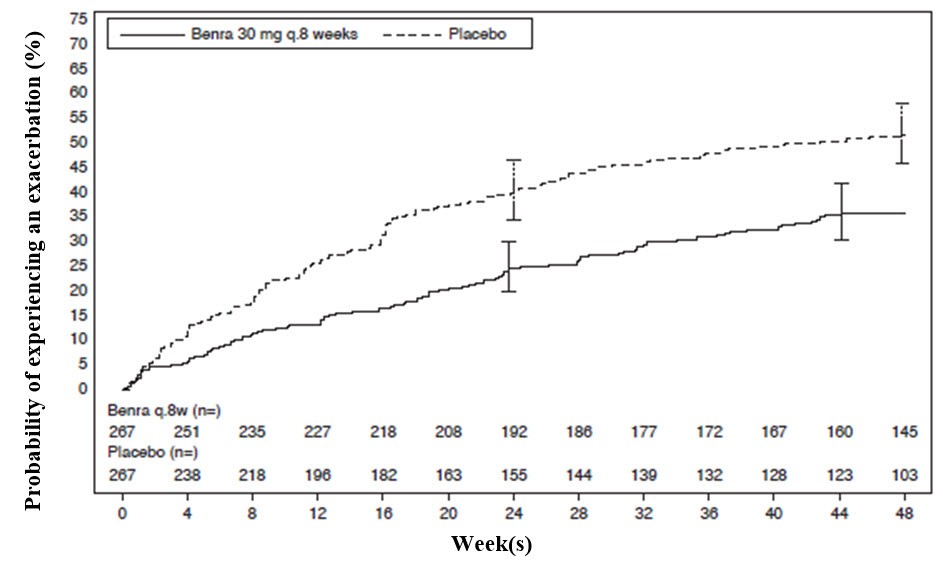
The primary endpoint for Trials 1 and 2 was the rate of asthma exacerbations in patients with baseline blood eosinophil counts of greater than or equal to 300 cells/μL who were taking high-dose ICS and LABA. Asthma exacerbation was defined as a worsening of asthma requiring use of oral/systemic corticosteroids for at least 3 days, and/or emergency department visits requiring use of oral/systemic corticosteroids and/or hospitalization. For patients on maintenance oral corticosteroids, an asthma exacerbation requiring oral corticosteroids was defined as a temporary increase in stable oral/systemic corticosteroids for at least 3 days or a single depo-injectable dose of corticosteroids. In Trial 1, 35% of patients receiving FASENRA experienced an asthma exacerbation compared to 51% on placebo. In Trial 2, 40% of patients receiving FASENRA experienced an asthma exacerbation compared to 51% on placebo (Table 3).
Table 3. Rate of Exacerbations, Trial 1 and 2 (ITT Population)Baseline blood eosinophil counts of greater than or equal to 300 cells/μL and taking high-dose ICS
| Trial | Treatment | Exacerbations per year |
|---|
| | Rate | Difference | Rate Ratio (95% CI) |
All exacerbations |
Trial 1 | FASENRA FASENRA 30 mg administered every 4 weeks for the first 3 doses, and every 8 weeks thereafter (n=267) | 0.74 | -0.78 | 0.49 (0.37, 0.64) |
Placebo (n=267) | 1.52 | -- | -- |
Trial 2 | FASENRA (n=239) | 0.73 | -0.29 | 0.72 (0.54, 0.95) |
Placebo (n=248) | 1.01 | -- | -- |
Exacerbations requiring hospitalization/emergency room visit |
Trial 1 | FASENRA (n=267) | 0.09 | -0.16 | 0.37 (0.20, 0.67) |
Placebo (n=267) | 0.25 | -- | -- |
Trial 2 | FASENRA (n=239) | 0.12 | 0.02 | 1.23 (0.64, 2.35) |
Placebo (n=248) | 0.10 | -- | -- |
Exacerbations requiring hospitalization |
Trial 1 | FASENRA (n=267) | 0.07 | -0.07 | 0.48 (0.22, 1.03) |
Placebo (n=267) | 0.14 | -- | -- |
Trial 2 | FASENRA (n=239) | 0.07 | 0.02 | 1.48 (0.65, 3.37) |
Placebo (n=248) | 0.05 | -- | -- |
The time to first exacerbation was longer for the patients receiving FASENRA compared with placebo in Trial 1 (Figure 2). Similar findings were seen in Trial 2.
Figure 2. Kaplan-Meier Cumulative Incidence Curves for Time to First Exacerbation, Trial 1
Subgroup analyses from Trials 1 and 2 identified patients with a higher prior exacerbation history and baseline blood eosinophil count as potential predictors of improved treatment response. Reductions in exacerbation rates were observed irrespective of baseline peripheral eosinophil counts; however, patients with a baseline blood eosinophil count ≥300 cells/μL showed a numerically greater response than those with counts <300 cells/μL. In both trials patients with a history of 3 or more exacerbations within the 12 months prior to FASENRA randomization showed a numerically greater exacerbation response than those with fewer prior exacerbations.
Oral Corticosteroid Reduction
Trial 3 evaluated the effect of FASENRA on reducing the use of maintenance oral corticosteroids. The primary endpoint was percent reduction from baseline of the final OCS dose during Weeks 24 to 28, while maintaining asthma control (see definition of asthma control in trial description). Compared to placebo, patients receiving FASENRA achieved greater reductions in daily maintenance oral corticosteroid dose, while maintaining asthma control. The median percent reduction in daily OCS dose from baseline was 75% in patients receiving FASENRA (95% CI: 60, 88) compared to 25% in patients receiving placebo (95% CI: 0, 33). Reductions of 50% or higher in the OCS dose were observed in 48 (66%) patients receiving FASENRA compared to those receiving placebo 28 (37%). The proportion of patients with a mean final dose less than or equal to 5 mg at Weeks 24 to 28 was 59% for FASENRA and 33% for placebo (odds ratio 2.74, 95% CI: 1.41, 5.31). Only patients with an optimized baseline OCS dose of 12.5 mg or less were eligible to achieve a 100% reduction in OCS dose during the study. Of those patients, 52% (22 of 42) receiving FASENRA and 19% (8 of 42) on placebo achieved a 100% reduction in OCS dose. Exacerbations resulting in hospitalization and/or ER visit were also assessed as a secondary endpoint. In this 28-week trial, patients receiving FASENRA had 1 event while those on placebo had 14 events (annualized rate 0.02 and 0.32, respectively; rate ratio of 0.07, 95% CI: 0.01, 0.63).
Lung Function
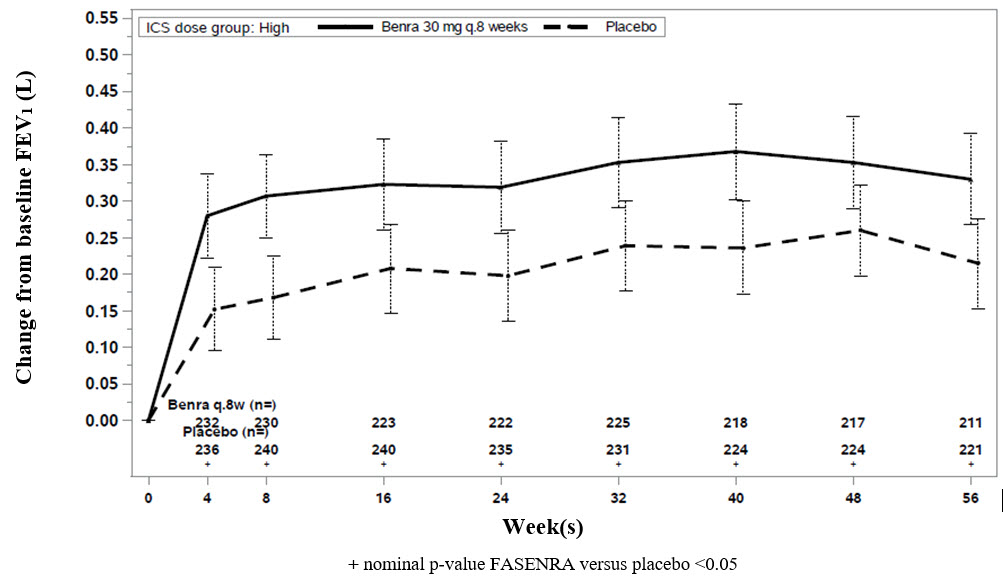
Change from baseline in mean FEV1 was assessed in Trials 1, 2, and 3 as a secondary endpoint. Compared with placebo, FASENRA provided consistent improvements over time in the mean change from baseline in FEV1 (Figure 3 and Table 4).
Figure 3. Mean Change from Baseline in Pre-Bronchodilator FEV1 (L), Trial 2

Figure_3_change_from_baseline_fev1 (Figure 3 Change From Baseline Fev1)
Table 4. Change from Baseline in Mean Pre-Bronchodilator FEV1 (L) at End of TrialWeek 48 in Trial 1, Week 56 in Trial 2, Week 28 in Trial 3.
Trial | Difference from Placebo in Mean Change from Pre-Bronchodilator Baseline FEV1 (L)
(95% CI) |
1 | 0.159 (0.068, 0.249) |
2 | 0.116 (0.028, 0.204) |
3 | 0.112 (-0.033, 0.258) |
Sub group analyses also showed greater improvements in FEV1 in patients with higher baseline blood eosinophil counts and more frequent prior exacerbation history.
The clinical development program for FASENRA also included a 12-week, randomized, double-blind, placebo-controlled lung function trial conducted in 211 patients with mild to moderate asthma. Patients were treated with placebo or benralizumab 30 mg SC every 4 weeks for 3 doses. Lung function, as measured by the change from baseline in FEV1 at Week 12 was improved in the benralizumab treatment group compared to placebo.
Patient Reported Outcomes
The Asthma Control Questionnaire-6 (ACQ-6) and Standardized Asthma Quality of Life Questionnaire for 12 Years and Older (AQLQ(S)+12) were assessed in Trials 1, 2 and 3. The responder rate for both measures was defined as improvement in score of 0.5 or more as threshold at the end of Trials 1, 2, and 3 (48, 56, and 28 weeks, respectively). In Trial 1, the ACQ-6 responder rate for FASENRA was 60% vs 50% placebo (odds ratio 1.55; 95% CI: 1.09, 2.19). In Trial 2, the ACQ-6 responder rate for the FASENRA was 63% vs 59% placebo (odds ratio 1.16; 95% CI: 0.80, 1.68). In Trial 1, the responder rate for AQLQ(S)+12 for FASENRA was 57% vs 49% placebo (odds ratio 1.42; 95% CI: 0.99, 2.02), and in Trial 2, 60% FASENRA vs 59% placebo (odds ratio of 1.03; 95% CI: 0.70,1.51). Similar results were seen in Trial 3.