ANDEXXA has not been shown to be effective for, and is not indicated for, the treatment of bleeding related to any FXa inhibitors other than apixaban or rivaroxaban.
Discard the syringe and needle.
Discard the vials, including any unused portion.
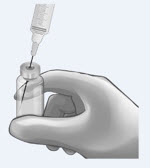
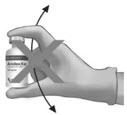
- Follow the same procedure outlined above for IV bolus preparation. Reconstitute the total number of vials needed based on the dose requirements. More than one 40 to 60-mL syringe, or an equivalent 100-mL syringe, may be used for transfer of reconstituted solution to the IV bag.
- Infusion will require a 0.2 or 0.22 micron in-line polyethersulfone or equivalent low protein-binding filter.
Deaths
In the ongoing ANNEXA-4 study, of the 352 subjects completing 30-day safety follow-up, there were 54 deaths (15%) occurring prior to the Day 30 visit. The number of cardiovascular deaths, including three with unknown causes and two that were unadjudicated, was 42 of 352 (12%), and the number of non-cardiovascular deaths was 12 (3%). Twenty (37%) subjects died within ten days after the ANDEXXA infusion. All subjects died prior to Day 45. Of the 54 subjects who died, the bleeding type was intracranial bleeding in 37 (69%), gastrointestinal bleeding in 12 (22%), and other bleeding types in 5 (9%) subjects.
Thromboembolic and Ischemic Events
In the ANNEXA-4 study, 63/352 (18%) subjects experienced one or more of the following overall thromboembolic events: cerebrovascular accident (CVA) (16/63; 25%), deep venous thrombosis (16/63; 25%), acute myocardial infarction (10/63; 16%), pulmonary embolism (5/63; 8%), and transient ischemic attack (1/63; 2%). The median time to event was seven days. A total of 33% of subjects with thromboembolic events (21/63) experienced the thromboembolic event during the first three days. Of the 352 subjects who received ANDEXXA, 223 received at least one anticoagulation dose within 30 days after treatment. Of these 223, 18 subjects (8%) had a thrombotic event and/or ischemic event after resumption [see Warnings and Precautions (5.1)].
No thromboembolic events were observed in 223 healthy volunteers who received FXa inhibitors and were treated with ANDEXXA.
Infusion-Related Reactions
Infusion-related reactions occurred in 18% (39/223) of ANDEXXA-treated healthy volunteers vs. 6% (6/94) of placebo-treated subjects. These reactions were characterized by a range of symptoms, including flushing, feeling hot, cough, dysgeusia, and dyspnea. Symptoms were mild to moderate in severity, and 90% (35/39) did not require treatment. One subject with a history of hives prematurely discontinued ANDEXXA after developing mild hives. Two of 352 (0.6%) subjects in the ANNEXA-4 study experienced an infusion-related reaction.
Risk Summary
There are no adequate and well-controlled studies of ANDEXXA in pregnant women to inform patients of associated risks. Animal reproductive and developmental studies have not been conducted with ANDEXXA.
In the U.S. general population, the estimated background risk of major birth defects and miscarriage in clinically recognized pregnancies is 2% to 4% and 15% to 20%, respectively.
Labor or Delivery
The safety and effectiveness of ANDEXXA during labor and delivery have not been evaluated.
Risk Summary
There is no information regarding the presence of ANDEXXA in human milk, the effects on the breastfed child, or the effects on milk production.
The developmental and health benefits of breastfeeding should be considered along with the mother's clinical need for ANDEXXA and any potential adverse effects on the breastfed child from ANDEXXA or from the underlying maternal condition.
12.2.1 Therapeutic Monitoring
Current commercial clinical anti-FXa-activity assays are unsuitable for measuring FXa activity following administration of ANDEXXA. Due to the reversible binding of ANDEXXA to the FXa inhibitor, the high sample dilution currently used in commercial clinical assays promotes dissociation of the inhibitor from ANDEXXA, resulting in detection of erroneously elevated anti-FXa activity levels, thereby causing a substantial underestimation of the reversal activity of ANDEXXA.
Drug-Drug Interaction
The pharmacokinetics of ANDEXXA were not affected by apixaban (5 mg orally BID for six days) or rivaroxaban (20 mg orally once daily for six days).
Study 1 ANNEXA-A (NCT02207725) – apixaban reversal
In Study 1, healthy subjects (median age: 57 years; range: 50 to 73 years) received apixaban 5 mg twice daily for three and a half days to achieve steady-state. At three hours after the last apixaban dose (~ Cmax), ANDEXXA or placebo was administered. Eight subjects received placebo, and 24 received ANDEXXA, administered as a 400 mg IV bolus followed by a 4 mg per minute continuous infusion for 120 minutes (total 480 mg).
Study 2 ANNEXA-R (NCT02220725) – rivaroxaban reversal
In Study 2, healthy subjects (median age: 57 years; range: 50 to 68 years) received rivaroxaban 20 mg once per day for four days to achieve steady-state. At four hours after the last rivaroxaban dose (~ Cmax), ANDEXXA or placebo was administered. Thirteen subjects received placebo, and 26 received ANDEXXA, administered as an 800 mg IV bolus followed by an 8 mg per minute continuous infusion for 120 minutes (total 960 mg).
Reduction in Anti-FXa Activity
In Study 1 and Study 2, the percent change from baseline in anti-FXa activity at its nadir was statistically significant (p < 0.0001) in favor of the ANDEXXA groups compared to placebo in both Studies 1 and 2. The results of Study 1 and Study 2 are provided below (see Table 4).
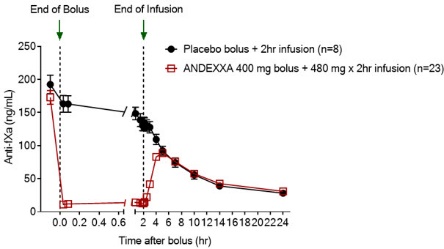
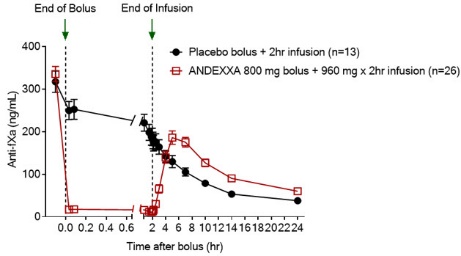
The time courses of anti-FXa activity before and after ANDEXXA administration are shown in Figure 1.
Table 4 - A: Change in Anti-FXa Activity/Study 1 (apixaban)| Anti-FXa Activity | ANDEXXA
n=23 | Placebo
n=8 |
|---|
Mean baseline ng/mL (± SD) | 173.0
(50.5) | 191.7
(34.4) |
Mean ng/mL (± SD) change from baseline at the nadir Nadir is the smallest value for anti-FXa activity at the 110-minute (ten minutes prior to the end of the infusion) time point, 2-minute time point before completion of the infusion, or the 5-minute time point after the completion of the infusion for each subject. | -160.6
(49.3) | -63.2
(18.1) |
Mean % (± SD) change from baseline at the nadir | -92.3
(2.8) | -32.7
(5.6) |
95% confidence interval (CI) The CI is for the Hodges-Lehman estimate of shift. | -59.5 (-64.1; -55.2) | not applicable |
p-value | < 0.0001 p-value obtained from a 2-sided exact Wilcoxon rank-sum test. | not applicable |
Table 4 - B: Change in Anti-FXa Activity/Study 2 (rivaroxaban)| Anti-FXa Activity | ANDEXXA
n=26 | Placebo
n=13 |
|---|
SD = Standard deviation.
Note: Baseline is the last assessment obtained prior to the first dose of ANDEXXA or placebo. |
Mean baseline ng/mL (± SD) | 335.3
(91.0) | 317.2
(91.0) |
Mean ng/mL (± SD) change from baseline at the nadir | -324.5
(89.2) | -14.4
(58.8) |
Mean % (± SD) change from baseline at the nadir | -96.7
(1.8) | -44.6
(11.8) |
95% confidence interval (CI) | -51.9 (-58.0; -47.0) | not applicable |
p-value | < 0.0001 | not applicable |
Anti-FXa activity was measured prior to and after ANDEXXA or placebo administration.
Dashed lines indicate the end of the bolus or infusion. A break in the x-axis is added to better visualize the immediate, short-term dynamics of anti-FXa activity following ANDEXXA treatment. The points on the graph represent the mean anti-FXa activity level; error bars illustrate standard error. There was a statistically significant difference (p < 0.05) in the percent change of anti-FXa activity normalized to pre-bolus between ANDEXXA and placebo until two hours after administration of infusion.
A. Apixaban – with ANDEXXA 400 mg IV bolus plus 4 mg/min infusion for 120 minutes.
B. Rivaroxaban – with ANDEXXA 800 mg IV bolus plus 8 mg/min infusion for 120 minutes.
Study 3 ANNEXA-4 (NCT02329327)
In an ongoing multinational, prospective, single-arm, open-label study, ANDEXXA was administered to 352 subjects taking FXa inhibitors who presented with acute major bleeding. The co-primary endpoints are: (a) percent change in anti-FXa activity from baseline to the nadir between five minutes after the end of the bolus up until the end of the infusion; and (b) rate of effective hemostasis within 12 hours after infusion, as rated by an independent endpoint adjudication committee.
Interim results of the study include data for 352 subjects dosed with ANDEXXA, of which 234 were efficacy-evaluable defined as subjects (1) on treatment with apixaban or rivaroxaban; (2) who had a baseline anti-FXa activity above 75 ng/mL; and (3) were adjudicated as meeting eligibility criteria for acute major bleeding [also see Adverse Reactions (6)].
For anti-FXa activity, the median decrease from baseline to nadir in anti-FXa activity for apixaban was -93% with a 95% CI of (-94%; -92%) and for rivaroxaban was -93% with a 95% CI of (-94%; -90%).
An improvement in hemostasis has not been established. ANDEXXA has not been shown to be effective for bleeding related to any FXa inhibitors other than apixaban or rivaroxaban.
How Supplied
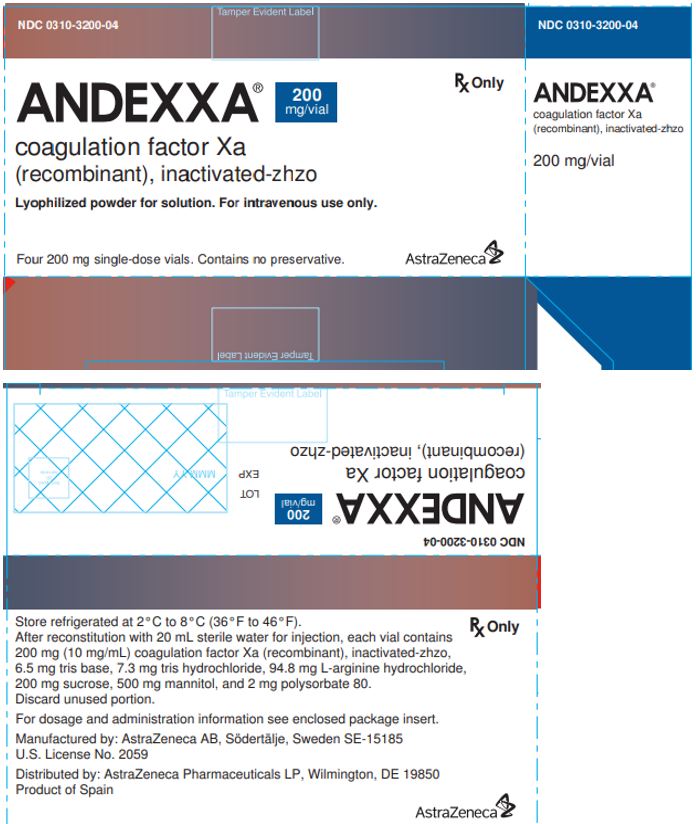
ANDEXXA (coagulation factor Xa (recombinant), inactivated-zhzo) is a white to off-white lyophilized cake or powder supplied as 4 single-use vials in a carton. ANDEXXA is not made with natural rubber latex.
ANDEXXA vials are provided as follows (see Table 5):
Table 5: Presentation of ANDEXXA| NDC | Carton Configuration | Vial Cap Color | Packaging Color |
|---|
NDC 0310-3200-04 | 4 single use vials in a carton, each vial containing 200 mg of ANDEXXA | Vials have a red flip-off cap. | - 1.Carton and vial label have a red to blue transition colored stripe across the front.
- 2.Carton and label have "200 mg/vial" in a blue graphic on the front panel.
|
Manufactured by:
AstraZeneca AB
Södertälje, Sweden SE-15185
Distributed by:
AstraZeneca Pharmaceuticals LP
Wilmington, DE 19850
U.S. License No. 2059
Product of Spain
ANDEXXA is a registered trademark of the AstraZeneca group of companies.
©AstraZeneca 2022