Acetic Acid Irrigant
Product Images NDC 0338-0656

View Photos of Packaging, Regulatory Labels, and Product Appearance

Product Visual Gallery

This gallery contains 2 technical images submitted to the FDA as part of the official labeling for Acetic Acid (NDC 0338-0656). Unlike standard consumer photos, these assets often include clinical data figures, molecular chemical structures, and official manufacturer packaging layouts.

As provided by Baxter Healthcare Corporation, these visuals offer a comprehensive scientific overview of the product's physical and chemical identity, aiding pharmacists and researchers in product verification and study.

FDA Label Image

Acetic Acid Representative Carton Label Ndc 0338-0656-04 (Acetic Acid Representative Carton Label Ndc 0338 0656 04)
Acetic Acid Representative Carton Label  Ndc 0338-0656-04 (Acetic Acid Representative Carton Label Ndc 0338 0656 04)
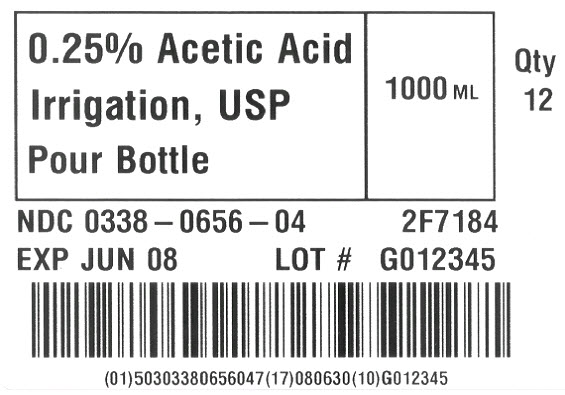
This is a 0.25% acetic acid irrigation solution in a pour bottle. The package contains 1000 mL and has an NDC code of 0338-0656-04. It has an expiration date of June 2008 and lot number 2F7184. The solution is intended for medical use as per the USP standards. The quantity mentioned in the package is twelve.*
FDA Label Image

Image 01

Image 01
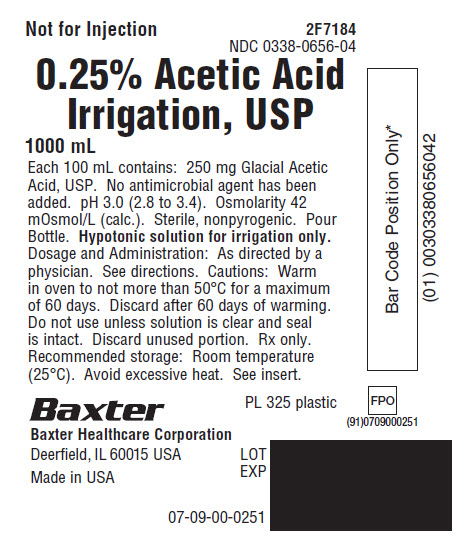
This is a 1000mL bottle of 0.25% Acetic Acid Irrigation, USP, for use as a hypotonic solution for irrigation only. Each 100mL contains 250mg Glacial Acetic Acid, USP with no added antimicrobial agent. It has a pH range of 2.8 to 3.4 and an osmolarity of 42 mOsmol/L. It is sterile, nonpyrogenic and a pour bottle, with dosage and administration advised as directed by a physician. It is recommended for warming in an oven for no more than 50°C for a maximum of 60 days, and is to be discarded after 60 days of warming. It is not to be used if the solution is not clear and the seal is not intact. The recommended storage is room temperature (25°C) while avoiding excessive heat. It is manufactured by Baxter Healthcare in the USA, with the lot number provided.*

* These product label images have been analyzed using experimental machine learning. Please verify findings with the primary label text.