Plasma-lyte 148 (ph 7.4) Injection, Solution
Product Images NDC 0338-9593

View Photos of Packaging, Regulatory Labels, and Product Appearance

Product Visual Gallery

This gallery contains 7 technical images submitted to the FDA as part of the official labeling for Plasma-lyte 148 (ph 7.4) (NDC 0338-9593). Unlike standard consumer photos, these assets often include clinical data figures, molecular chemical structures, and official manufacturer packaging layouts.

As provided by Baxter Healthcare Corporation, these visuals offer a comprehensive scientific overview of the product's physical and chemical identity, aiding pharmacists and researchers in product verification and study.

FDA Label Image

Dhcp Letter 1.jpg (Image 01)
Dhcp Letter 1.jpg (Image 01)
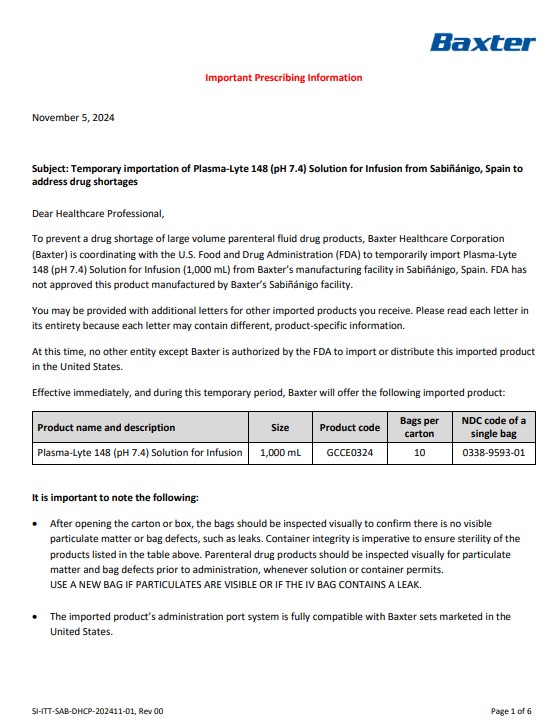
This text document from Baxter Healthcare Corporation provides important prescribing information regarding the temporary importation of Plasma-Lyte 148 (pH 7.4) solution for infusion. It details the product name, size (1,000 mL), product code (GCCE0324), bags per carton (10), and NDC code for a single bag (0338-9593-01). The letter emphasizes sterility inspection and compatibility with U.S. Baxter administration port systems due to supply shortages.*
FDA Label Image

Dhcp Letter 2 (Image 02)

Dhcp Letter 2 (Image 02)
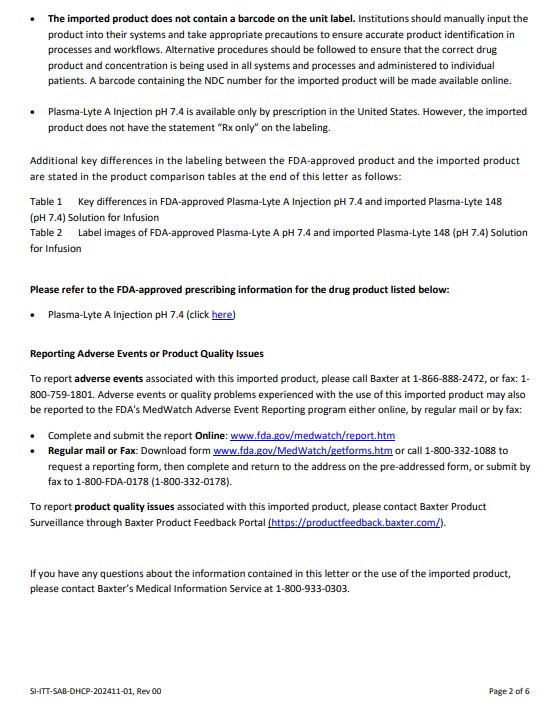
Text from a product letter describing labeling differences and usage instructions for Plasma-Lyte 148 (pH 7.4) Injection. It includes information on barcode absence, prescription status, and directs to FDA-approved prescribing information, adverse event reporting procedures, and product quality issue contacts for Baxter Healthcare Corporation.*
FDA Label Image

Dhcp Letter 3.jpg (Image 03)

Dhcp Letter 3.jpg (Image 03)
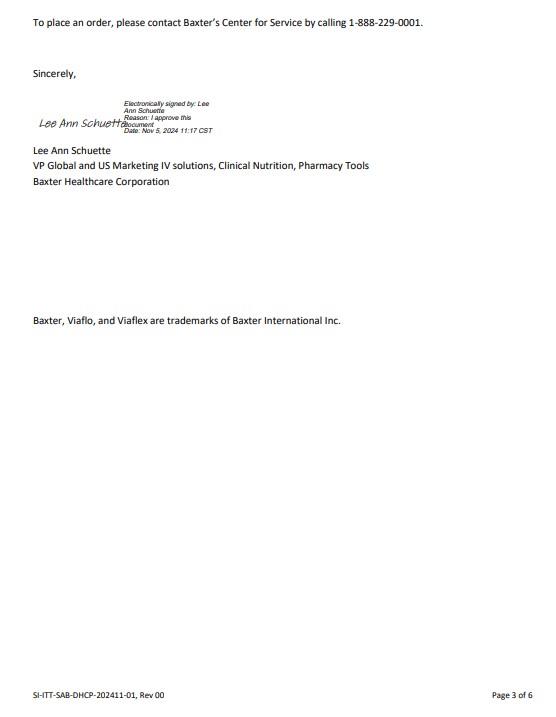
A letter from Lee Ann Schuette, Vice President of Global and US Marketing IV solutions at Baxter Healthcare Corporation, providing contact information for ordering. The letter includes a signature, approval timestamp, and trademark notice for Baxter, Viaflo, and Viaflex.*
FDA Label Image

Dhcp Letter 4.jpg (Image 04)

Dhcp Letter 4.jpg (Image 04)
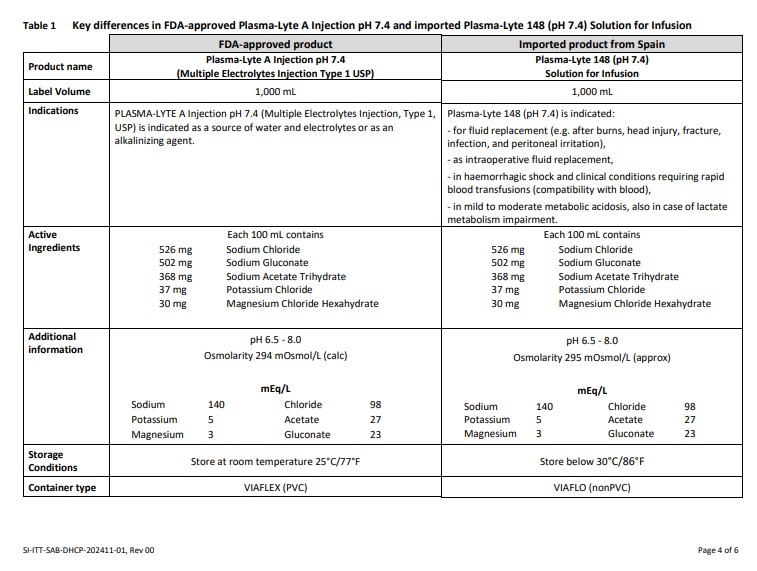
A data table comparing FDA-approved Plasma-Lyte A Injection pH 7.4 with imported Plasma-Lyte 148 (pH 7.4) solution from Spain. It details product names, label volume (1,000 mL), indications, active ingredient amounts per 100 mL, pH range (6.5-8.0), osmolality, electrolyte concentrations (mEq/L), storage conditions, and container types (VIAFLEX PVC vs. VIAFLO nonPVC).*
FDA Label Image

Dhcp Letter 5.jpg (Image 05)

Dhcp Letter 5.jpg (Image 05)
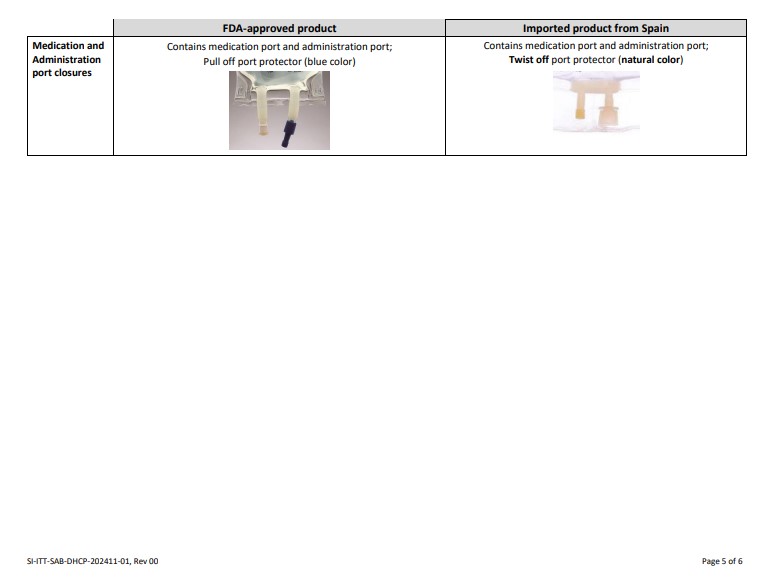
Illustration comparing medication and administration port closures of Plasma-Lyte 148 (pH 7.4) intravenous solution. The FDA-approved product features a pull-off port protector in blue, while the imported product from Spain uses a twist-off port protector in natural color.*
FDA Label Image

Dhcp Letter 6.jpg (Image 06)

Dhcp Letter 6.jpg (Image 06)
This image shows label panels for Plasma-Lyte 148 (pH 7.4) intravenous injection solution from two sources. The FDA-approved label by Baxter Healthcare Corporation features black text on a white background with product name, volume of 1000 mL, ingredients, and manufacturer's information. The imported product from Spain label includes similar data with additional electrolyte concentrations and usage instructions, branded under Baxter and Viaflo with volume 1000 mL.*
FDA Label Image

Plasmalyte 1000ml Representative Container Label.jpg (Image 07)

Plasmalyte 1000ml Representative Container Label.jpg (Image 07)
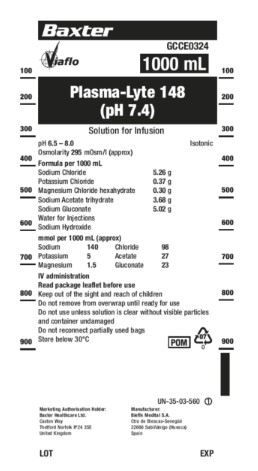
Plasma-Lyte 148 (pH 7.4) injection solution in a 1000 mL volume by Baxter Healthcare Corporation. The label shows formulation details per 1000 mL, including sodium chloride 5.26 g, potassium chloride 0.37 g, magnesium chloride hexahydrate 0.30 g, sodium acetate trihydrate 3.68 g, sodium gluconate 5.02 g, and water for injections. The solution is isotonic with pH 6.5 to 8.0 and osmolarity approximately 295 mOsm/L. Directions for administration, storage under 30°C, and precautions are also included.*

* About these descriptions: Image descriptions on this page are generated by automated AI analysis of the product label images from the manufacturer's FDA label submission (SPL). They are provided for reference only and may contain errors or omissions. Always rely on the printed label itself and the official FDA labeling, and consult a pharmacist or healthcare professional with any questions about this product.