Product Images Sodium Chloride
View Photos of Packaging, Labels & Appearance
- DHCP Letter 1 - image 01
- DHCP Letter 2 - image 02
- DHCP Letter 3 - image 03
- DHCP Letter 4 - image 04
- DHCP Letter 5 - image 05
- DHCP Letter 6 - image 06
- DHCP Letter 7 - image 07
- DHCP Letter 8 - image 08
- DHCP Letter 9 - image 09
- DHCP Letter 10 - image 10
- DHCP Letter 11 - image 11
- DHCP Letter 12 - image 12
- DHCP Letter 13 - image 13
- DHCP Letter 14 - image 14
- DHCP Letter 15 - image 15
- DHCP Letter 16 - image 16
- DHCP Letter 17 - image 17
- Sodium Chloride JB1301 Representative Container Label - image 18
- Sodium Chloride JB1302 Representative Container Label - image 19
- Sodium Chloride JB1322 Representative Container Label - image 20
- Sodium Chloride JB1323 Representative Container Label - image 21
- Sodium Chloride JB1324 Representative Container Label - image 22
Product Label Images
The following 22 images provide visual information about the product associated with Sodium Chloride NDC 0338-9612 by Baxter Healthcare Corporation, such as packaging, labeling, and the appearance of the drug itself. This resource could be helpful for medical professionals, pharmacists, and patients seeking to verify medication information and ensure they have the correct product.
DHCP Letter 1 - image 01

This text is a letter addressed to healthcare professionals from Baxter Healthcare Corporation. It discusses Baxter's coordination with the US FDA to increase the availability of critical drug products through the temporary importation of products from Baxter's manufacturing facility in Canada. The letter states that at this time, no other entity except Baxter is authorized by the FDA to import or distribute these products in the United States. A list of the products being temporarily imported is included. The letter also indicates that each letter may contain different, product-specific information.*
DHCP Letter 2 - image 02

DHCP Letter 3 - image 03

This document provides important information about Canadian products imported into the United States. The products have bilingual labels in English and French, and their administration port system is compatible with IV set spike heads on Baxter IV sets in the US, but the barcode may not register accurately on US scanning systems. The labeling of US and Canadian products differs, and comparisons for 0.9% Sodium Chloride Injections, 5% Dextrose Injections, and Lidocaine Hydrochloride and Dextrose Injection are included in the product tables at the end of the letter. The FDA-approved package inserts should be referred to for the full prescribing information for each drug product.*
DHCP Letter 4 - image 04

This letter provides contact information for inquiries related to the use of imported products from Baxter. For questions, contact the Baxter Medical Information Service or the Center for Service for orders. Quality issues and adverse events can be reported to Baxter Product Surveillance or the FDA's MedWatch Adverse Event Reporting program. A weblink is provided to access the online reporting form.*
DHCP Letter 5 - image 05

This text provides instructions on how to report medical related issues to the FDA via regular mail or fax. It includes a website and phone number to access a reporting form to complete and submit. The text also includes a closing from the General Manager of US Hospital Products at Baxter Healthcare Corporation, mentioning the trademarks Baxter and Viaflex.*
DHCP Letter 6 - image 06
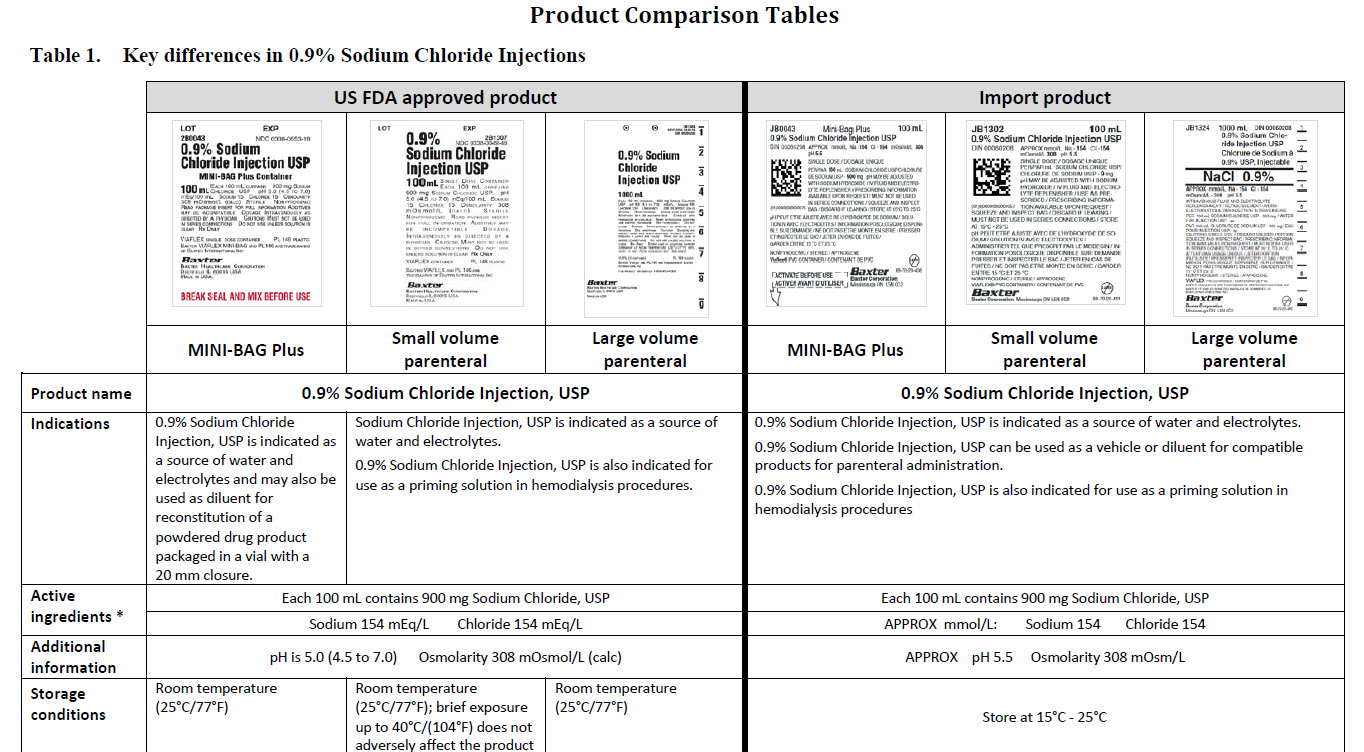
This is a product comparison table of two types of 0.9% Sodium Chloride Injection, one approved by the US FDA and the other an imported product. The table lists their differences in terms of packaging, volume, and indications for use. Each 100 mL of both injections contain 900 mg of Sodium Chloride, USP with a sodium concentration of 154 mEq/L and chloride concentration of 154 mEq/L. The injections can be used as a source of water and electrolytes, as well as a vehicle or diluent for compatible products for parenteral administration. It also indicated for use as a priming solution in hemodialysis procedures. The storage condition recommended is at room temperature (15°C - 25°C).*
DHCP Letter 7 - image 07

DHCP Letter 8 - image 08

This is a comparison table of two different types of 5% Dextrose Injections, one approved by the US FDA and the other an imported product. The table highlights key differences between them, including their composition, volume, and container type. The injections are indicated as a source of water and calories and may be used as a diluent for reconstituting other drug products. The active ingredient in each 100 mL is 5 g of Dextrose Hydrous USP. The injections should be stored at room temperature, and brief exposure up to 40°C/104°F does not affect the product. The container type for one injection is MINI-BAG Plus, while the other is in a VIAFLEX Container made of PVC.*
DHCP Letter 9 - image 09

DHCP Letter 10 - image 10
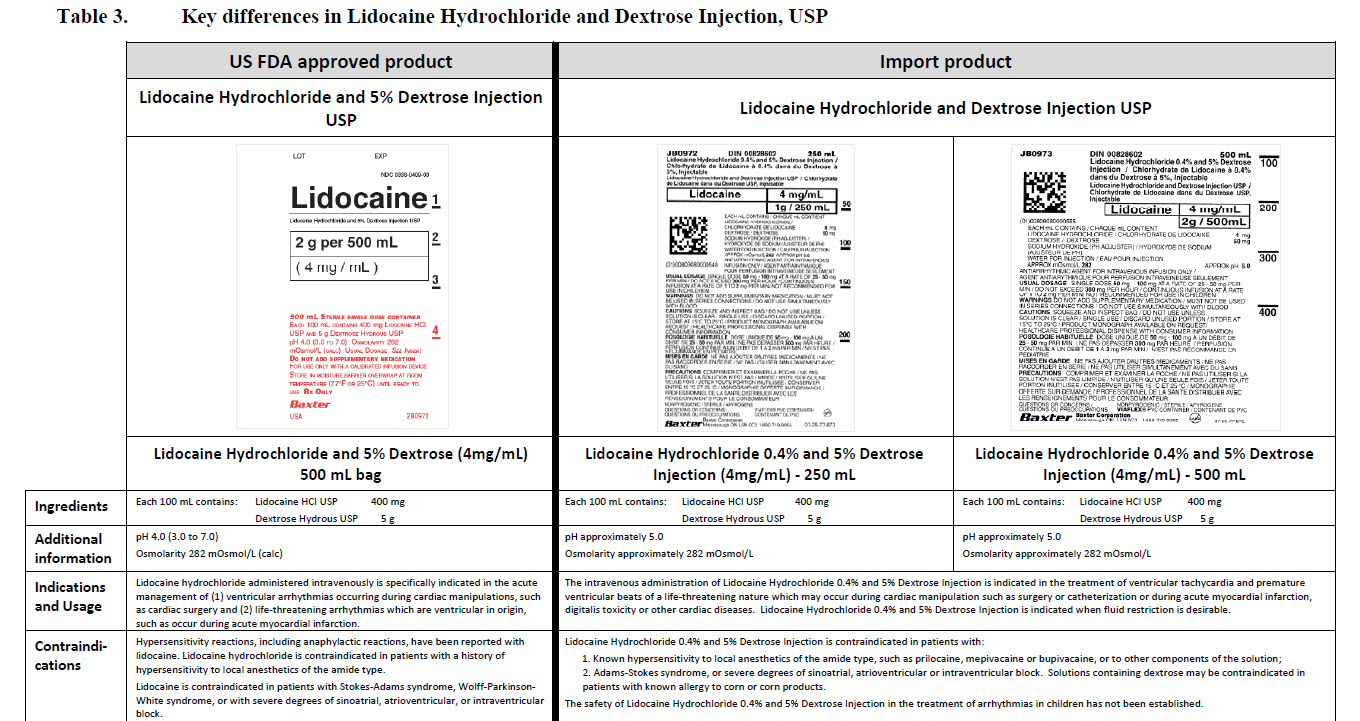
Table 3 shows the key differences between Lidocaine Hydrochloride and Dextrose Injection, USP, and an import product approved by the US FDA. The table includes information about ingredients, indications, usage, contraindications, and additional information for each product. It is not clear what the specific formatting of the table is.*
DHCP Letter 11 - image 11

This text provides important warnings and safety information for the proper administration of Lidocaine Hydrochloride 0.4% and 5% Dextrose Injection intravenously. It advises constant ECG monitoring and prompt cessation of the infusion if signs of excessive depression of cardiac conductivity or arrhythmias occur. Hypersensitivity and anaphylactic reactions have been reported and emergency resuscitative equipment is mandatory. The text also highlights the risks for patients with renal or hepatic insufficiency, and warns against the administration of the drug to patients with certain heart conditions without proper acceleration of the heart rate.*
DHCP Letter 12 - image 12
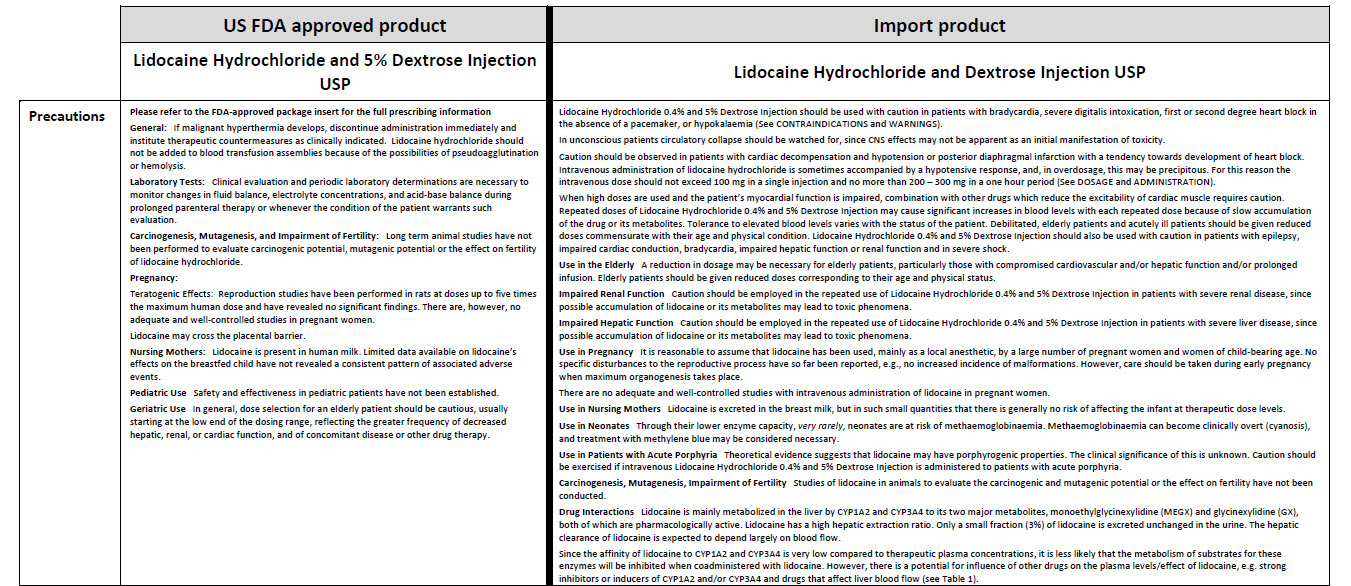
This text describes a Lidocaine Hydrochloride and Dextrose Injection USP product that has been approved by the US FDA and imported. The text provides important information regarding the general use, safety and precautions of the product. It cautions against using the product in certain conditions such as malignant hyperthermia, impaired cardiac or hepatic function, bradycardia, hypotension, renal disease and porphyria. It provides dosage and administration recommendations and warning against overdosage and accumulation. The text also discusses the use of the product during pregnancy, lactation, neonates and geriatric patients. It mentions the potential of Lidocaine to interact with other drugs and the importance of close monitoring of the patient.*
DHCP Letter 13 - image 13

This is a description of adverse events related to the administration of idocaine, a type of medication. The adverse events can affect the nervous, cardiovascular, gastrointestinal, hematalogic, and immune systems. Common adverse reactions include symptoms like dizziness, numbness, tingling, or drowsiness. Rare adverse reactions can have more severe consequences, such as respiratory depression, unconsciousness, or cardiac arrest. The frequency of adverse reactions is dose-related, and hypersensitivity can also play a role in their occurrence. Some patients may experience allergic reactions, although they are rare. Cross-sensitivity with other drugs can also occur.*
DHCP Letter 14 - image 14
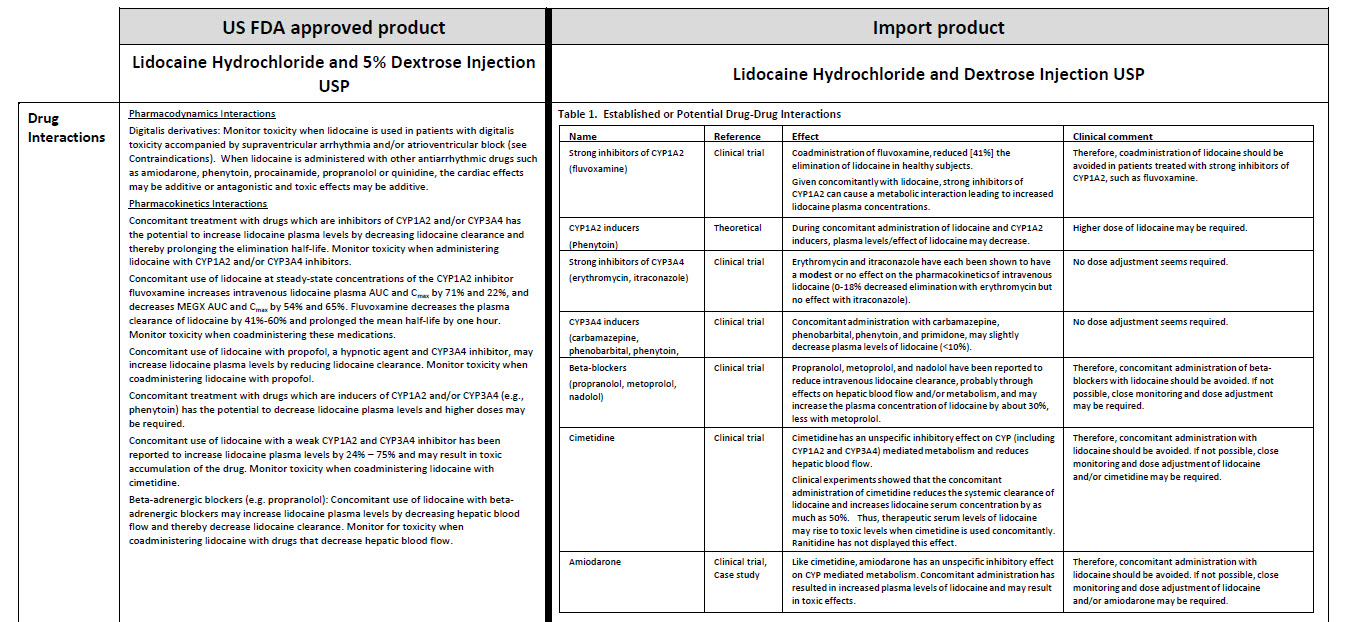
This is a description of a US FDA approved import product which is a Lidocaine Hydrochloride and 5% Dextrose Injection, USP. The text contains information about drug interactions related to the use of Lidocaine Hydrochloride, with various drugs such as digital derivatives, anti-arrhythmic drugs, beta-adrenergic blockers, CYP1A2 and/or CYP3AS inhibitors/inducers, propofol, and histamine H2-receptor antagonists. The text provides guidance for clinicians in monitoring toxicity, adjusting dosage, or avoiding co-administration when necessary.*
DHCP Letter 15 - image 15

This is a description about the dosage and infusion of Lidocaine Hydrochloride Injection used to treat ventricular arrhythmias. The text describes the dosage and administration of the injection for both adult and pediatric patients. The text includes information on potential toxicity and overdosage, the need for constant ECG monitoring, and precautions when administering this injection. The recommended dosage regimen is determined based on patient characteristics and response. Different administration methods for Lidocaine Hydrochloride Injection are also described in the text, including single intravenous injection and continuous intravenous infusion. The text advises using an infusion pump or a precision volume control set when administering the injection by continuous intravenous infusion. It recommends that the administration set be replaced at least once every 24 hours.*
DHCP Letter 16 - image 16
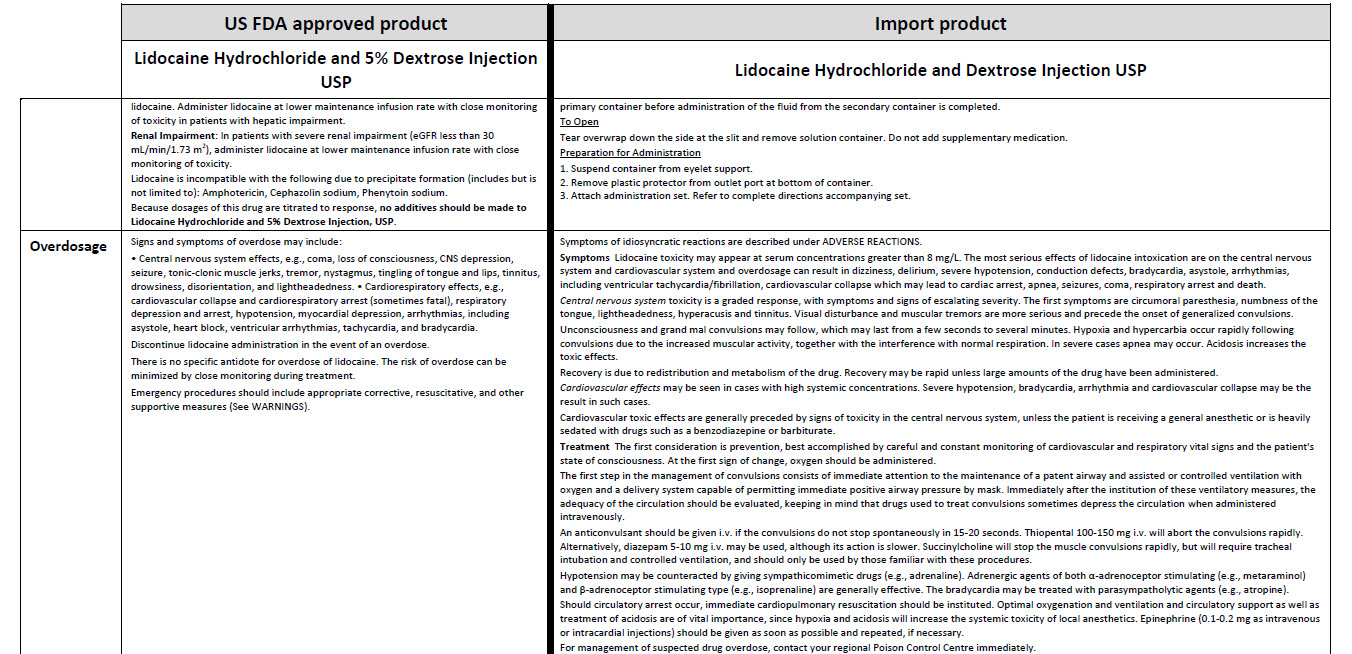
This is a description of Lidocaine Hydrochloride and 5% Dextrose Injection, a US FDA approved import product used for its anesthetic properties. The text provides information on dosage, contraindications, and adverse reactions. It warns against using Lidocaine in patients with severe renal or hepatic impairment or using certain medications with it due to incompatibility. The text also provides guidance for the administration of Lidocaine and outlines emergency procedures for managing adverse reactions, including overdose.*
DHCP Letter 17 - image 17

The text appears to be about storage and handling of pharmaceutical products. It advises avoiding exposure to heat and recommends storing at room temperature (15-25°C). It also mentions that exposure up to 40°C does not adversely affect the product. There is a mention of pull off port protectors for the product's administration ports.*
Sodium Chloride JB1301 Representative Container Label - image 18

This is a 50mL single dose/dosage unique intravenous fluid and electrolyte replenisher. It contains 0.9% Sodium Chloride Injection USP and can adjust pH with sodium hydroxide, with a pH of 5.5. The prescribing information is available upon request. The bag must be inspected before use and discarded if leaking. It cannot be used in series. The container is made of VIAFLEX® PVC and is non-pyrogenic and sterile. It is manufactured by Baxter Corporation in Mississauga, ON.*
Sodium Chloride JB1302 Representative Container Label - image 19
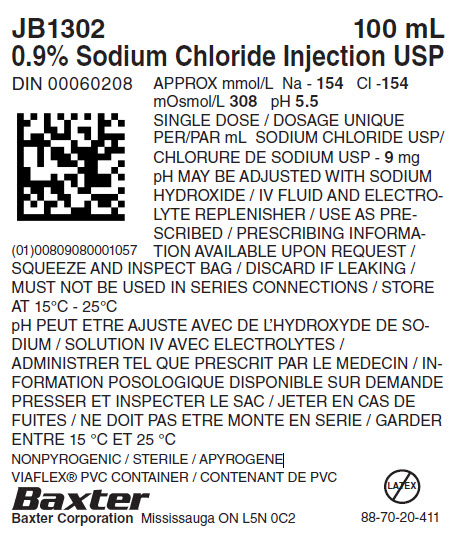
This is a 100 mL single dose bag of 0.9% Sodium Chloride Injection USP, with a pH of 5.5 and sodium of 154 mmol/L and chloride of 154 mmol/L. The bag can be adjusted with sodium hydroxide and used as prescribed. The information on dosing is available on request. The bag should be squeezed and inspected before use, and discarded if leaking. It should not be used in series connections and must be stored between 15°C - 25°C. The container is nonpyrogenic and sterile, made of PVC, and produced by Baxter Corporation in Mississauga, ON.*
Sodium Chloride JB1322 Representative Container Label - image 20

This is a description of a 250 mL solution of intravenous fluid and electrolyte replacement. The solution is 0.9% Sodium Chloride Injection USP, with approximately 308 milliosmoles per liter, a pH of around 5.5, and an approximate molar concentration of sodium and chloride of 154 each. The solution should be stored at a temperature between 15°C to 25°C, and the bag should be squeezed and inspected before use. The text indicates that the solution is non-pyrogenic and sterile, and that it is for single use only. It is not clear what is the purpose of the item but it might be used for medical purposes.*
Sodium Chloride JB1323 Representative Container Label - image 21
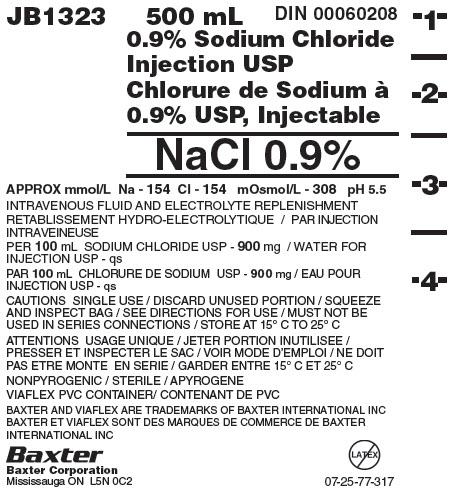
This is a 500mL bag of sodium chloride (NaCl) 0.9% injection USP, which is used for intravenous fluid and electrolyte replenishment. It contains 900mg of sodium chloride USP and water for injection USP per 100mL. The approximate values for electrolytes in the solution are Na-154, Cl-154, and mOsmol-308, with a pH of 5.5. This product is for single use and any unused portion should be discarded. It is stored between 15°C to 25°C and caution is advised when squeezing and inspecting the bag. The bag is non-pyrogenic and sterile, made from a Viaflex PVC container, and is a trademark of Baxter International Inc. The other text seems to be descriptions and cautions in French.*
Sodium Chloride JB1324 Representative Container Label - image 22

This is a description of a 1000 mL bag of 0.9% Sodium Chloride Injection USP, used for intravenous fluid and electrolyte replenishment. It contains 900 mg of sodium chloride USP and water for injection, and has an osmolality of -308 and a pH of 5.5. The approximate values of mmol/L for sodium and chloride are 154. The packaging cautions that it is for single use only, and any unused portion should be discarded. The bag needs to be inspected before use, and prescribing information is available upon request. It must not be used in series connections, and it should be stored between 15°C to 25°C. The container is non-pyrogenic, sterile and the brand is Viaflex PV from Baxter Corporation in Mississauga.*
* The product label images have been analyzed using a combination of traditional computing and machine learning techniques. It should be noted that the descriptions provided may not be entirely accurate as they are experimental in nature. Use the information in this page at your own discretion and risk.
