Glucose And Sodium Chloride Injection, Solution
Product Images NDC 0338-9799

View Photos of Packaging, Regulatory Labels, and Product Appearance

Product Visual Gallery

This gallery contains 17 technical images submitted to the FDA as part of the official labeling for Glucose And Sodium Chloride (NDC 0338-9799). Unlike standard consumer photos, these assets often include clinical data figures, molecular chemical structures, and official manufacturer packaging layouts.

As provided by Baxter Healthcare Corporation, these visuals offer a comprehensive scientific overview of the product's physical and chemical identity, aiding pharmacists and researchers in product verification and study.

FDA Label Image

Dhcp Letter 1.jpg (Image 01)
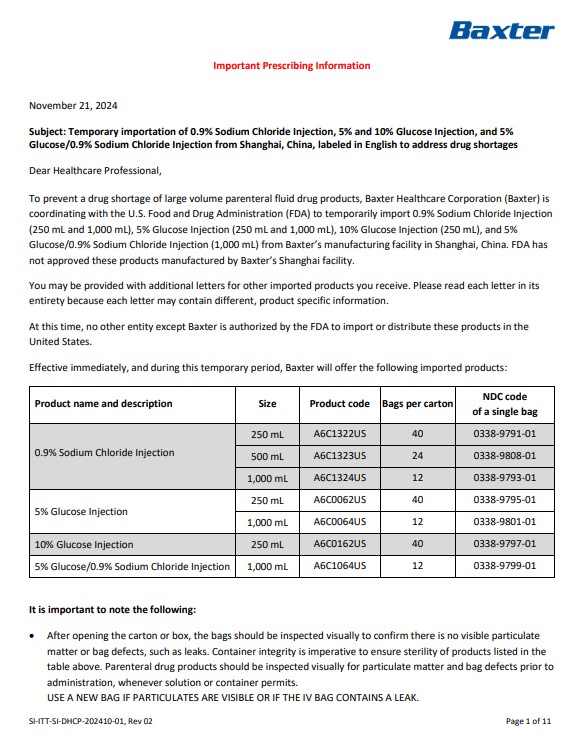
Dhcp Letter 1.jpg (Image 01)
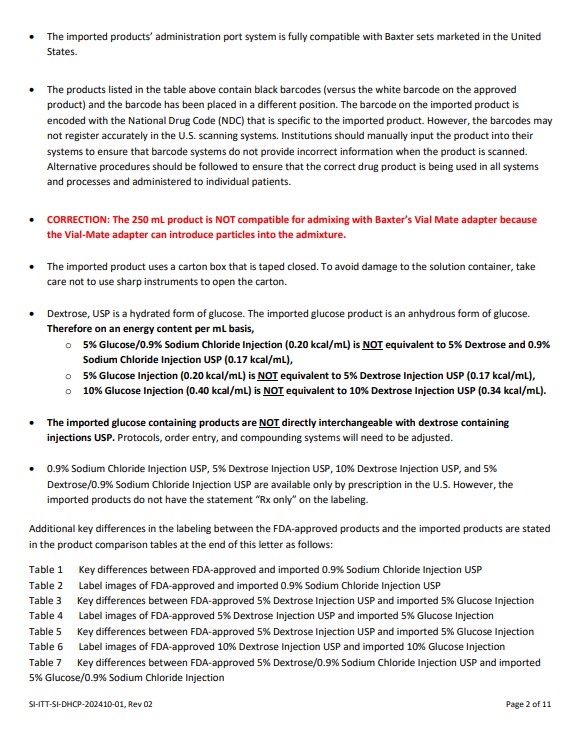
Baxter Healthcare Corporation is coordinating with the U.S. Food and Drug Administration to temporarily import various injectable products from Shanghai, China, to address drug shortages of large volume parenteral liquid drug products. The imported products include 0.9% Sodium Chloride Injection, 5% Glucose Injection, 10% Glucose Injection, and 5% Glucose/0.9% Sodium Chloride Injection. Each product has specific size variants available. It is crucial to visually inspect the bags for particulate matter or defects before administration to ensure product sterility. If any particulates are visible or if the bag has a leak, it is recommended to use a new bag for administration.*
FDA Label Image

Dhcp Letter 2.jpg (Image 02)

Dhcp Letter 2.jpg (Image 02)
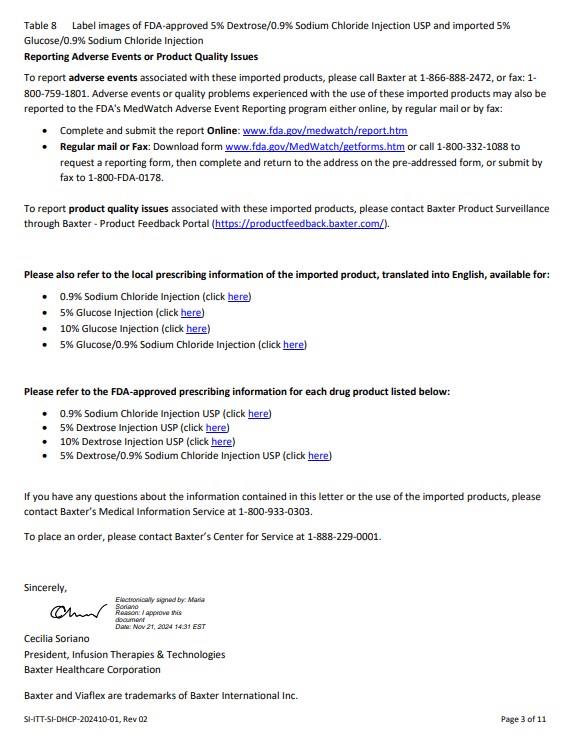
This is a description of differences between FDA-approved products and imported products related to barcodes, compatibility for admixing, packaging, energy content, interchangeability, labeling, and protocols. It highlights the need for manual input of product information, caution in handling the imported product's packaging, and adjustments in protocols and systems for using the imported products. The descriptions also include differences in energy content between glucose and dextrose products, the incompatibility of certain products with specific adapters, and the need for prescription for certain products in the US. The text also references comparison tables for a detailed view of the differences.*
FDA Label Image

Dhcp Letter 3.jpg (Image 03)

Dhcp Letter 3.jpg (Image 03)
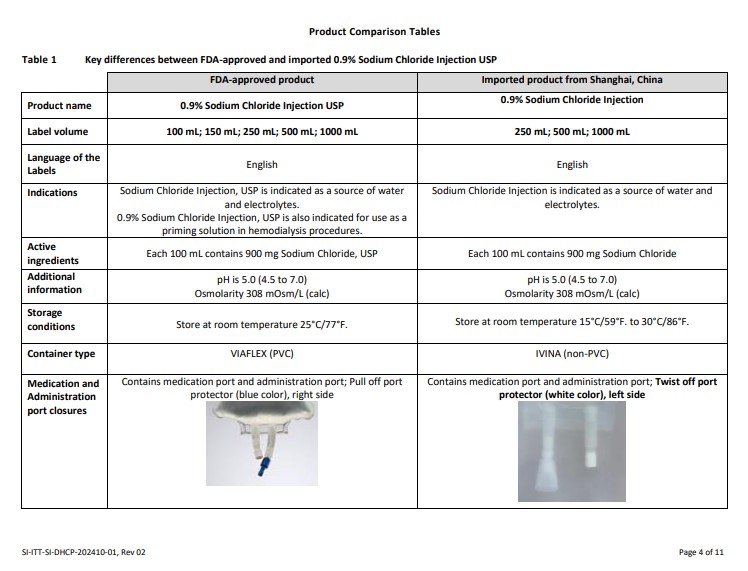
This text provides important information regarding the labeling and reporting of adverse events or product quality issues related to FDA-approved and imported products like Dextrose/Sodium Chloride Injections. It includes instructions on how to report adverse events to Baxter or the FDA, as well as how to report product quality issues. Additionally, it offers resources for accessing prescribing information in English for various types of injections. Contact information for Baxter's Medical Information Service and Center for Service is also provided for further inquiries or to place an order.*
FDA Label Image

Dhcp Letter 4.jpg (Image 04)

Dhcp Letter 4.jpg (Image 04)
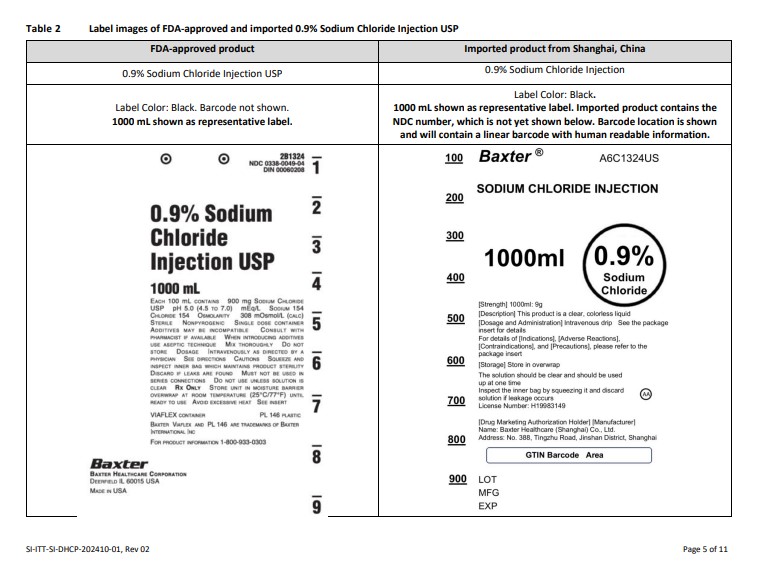
This is a comparison table of two different products: FDA-approved 0.9% Sodium Chloride Injection USP and an imported product from Shanghai, China. The table outlines key differences such as product names, label volumes, language of indications, active ingredients, additional information, storage conditions, container types, and medication administration details. The FDA-approved product is indicated as a source of water and electrolytes, with additional indications for use in hemodialysis procedures, while the imported product serves the same purpose. The table provides detailed information for a comparative analysis of these two products.*
FDA Label Image

Dhcp Letter 5.jpg (Image 05)

Dhcp Letter 5.jpg (Image 05)
This text mentions a table with label images comparing FDA-approved and imported 0.9% Sodium Chloride Injection USP products. It describes the differences in labeling and markings such as NDC numbers, barcode presence, and country of origin. The information provided is specific to the labels of these medical products, including brand names and volume specifications.*
FDA Label Image

Dhcp Letter 6.jpg (Image 06)

Dhcp Letter 6.jpg (Image 06)
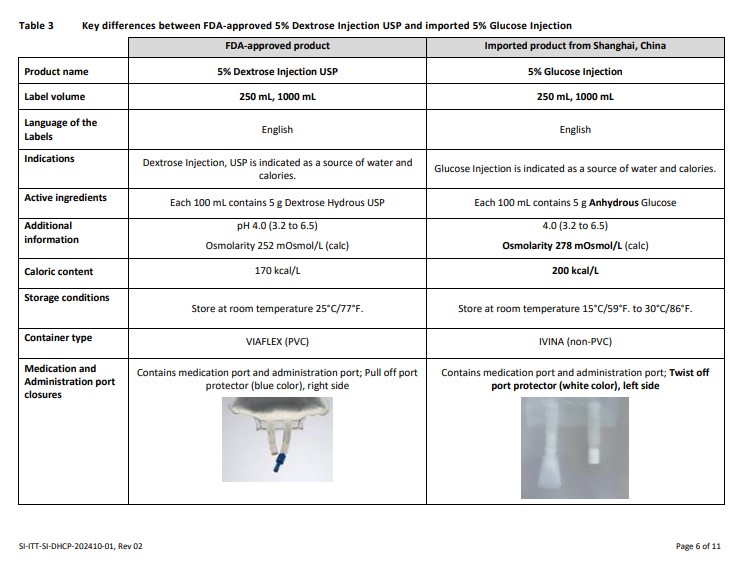
This is a comparison between FDA-approved 5% Dextrose Injection USP and imported 5% Glucose Injection. The differences include the product names, label volumes (250mL and 1000mL), language of indications (English for both), active ingredients (Dextrose Hydrous USP and Anhydrous Glucose), osmolarity (252 mOsml/L and 278 mosmol/L), caloric content (10 kcal and 200 kcal), storage conditions, container types, and medication administration port closures. The Dextrose Injection is indicated as a source of water and calories, while Glucose Injection is indicated as a source of water and calories as well. The FDA-approved product has a lower caloric content and different storage conditions compared to the imported product.*
FDA Label Image

Dhcp Letter 7.jpg (Image 07)

Dhcp Letter 7.jpg (Image 07)
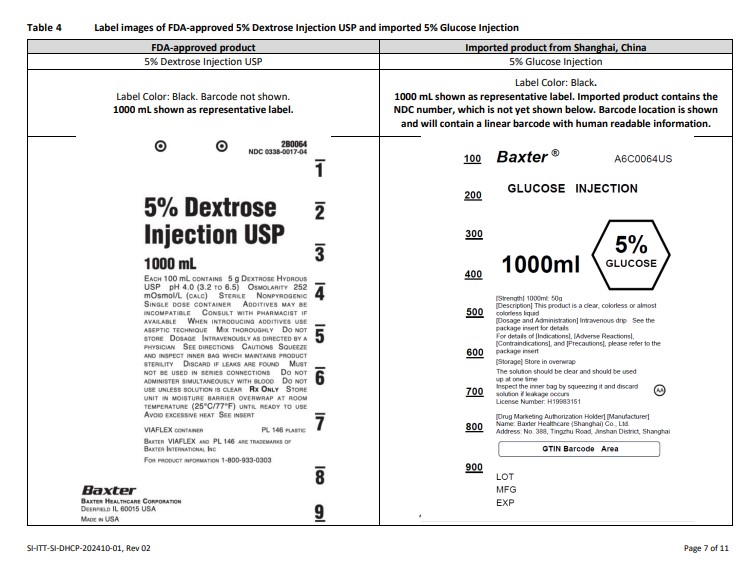
The given text describes the comparison between FDA-approved 5% Dextrose Injection USP and an imported 5% Glucose Injection from Shanghai, China. It includes details about the label color, representative label size of 1000 mL, and mentions that the imported product contains the NDC number. The text also references Baxter as the brand for the FDA approved product. Additionally, it mentions that the imported product contains a linear barcode with human-readable information. The text provides insights into the labels and general information about the two products.*
FDA Label Image

Dhcp Letter 8.jpg (Image 08)

Dhcp Letter 8.jpg (Image 08)
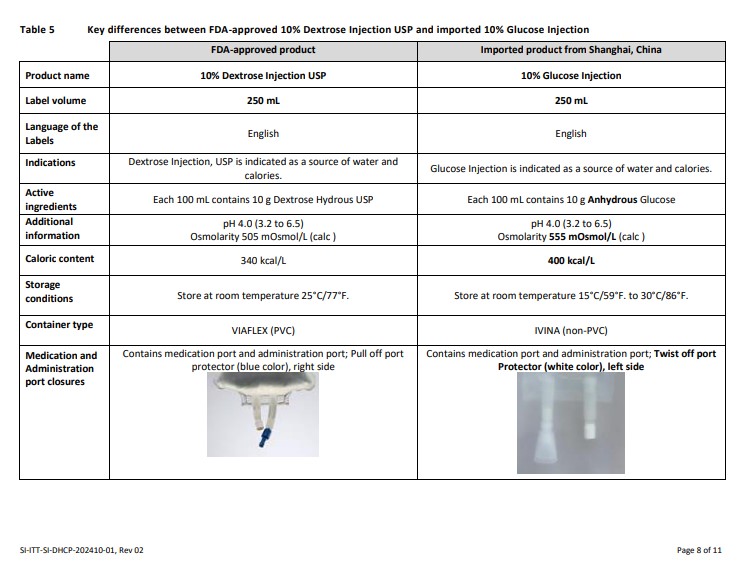
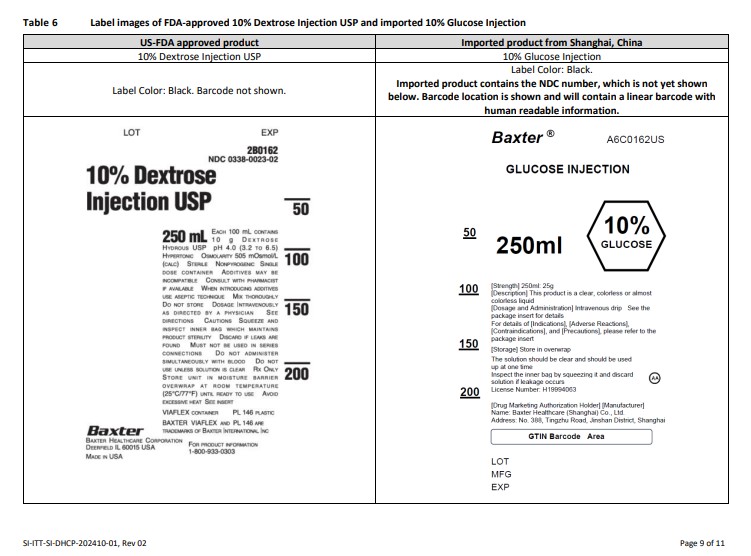
This is a comparison of key differences between FDA-approved 10% Dextrose Injection USP and imported 10% Glucose Injection. The FDA-approved product is labeled as 10% Dextrose Injection USP, with a volume of 250mL, whereas the imported product from Shanghai, China is labeled as 10% Glucose Injection also with a volume of 250mL. The language on the labels is in English for both products. Each 100 mL of the FDA-approved product contains 10 Dextrose Hydrus USP, while each 100 mL of the imported product contains 108 Anhydrous Glucose. The osmolarity of the FDA-approved product is 505 mOsmol/L, while the osmolarity of the imported product is 555 mOsmol/L. The caloric content of the FDA-approved product is 0kcal, and the imported product has 00 kcal. The storage instructions differ slightly, with the FDA-approved product to be stored at room temperature 25°C/77°F, and the imported product at room temperature 15-30°C/59-86°F. The container types for the products are i.e., a FLEX (PVC) for FDA-approved and VINA (non-PVC) for the imported product. The administration ports and protectors also differ in color and closure type between the two products.*
FDA Label Image

Dhcp Letter 9.jpg (Image 09)

FDA Label Image

Dhcp Letter 10.jpg (Image 10)

Dhcp Letter 10.jpg (Image 10)
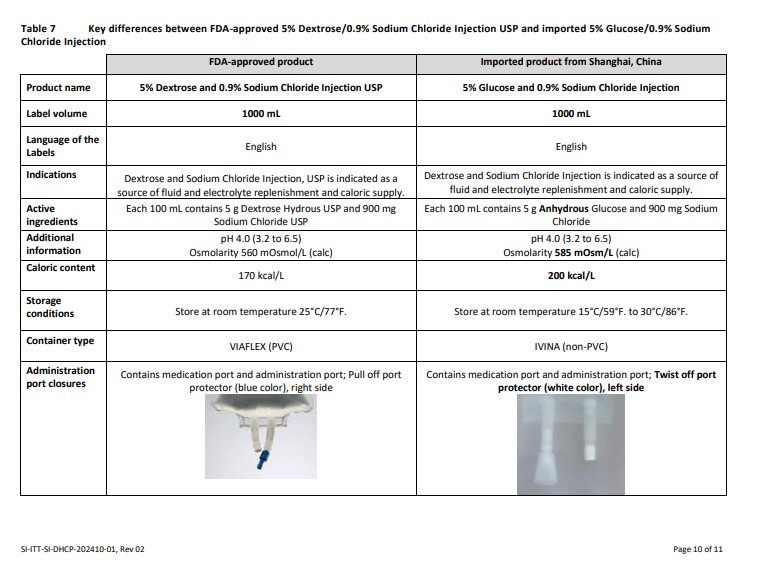
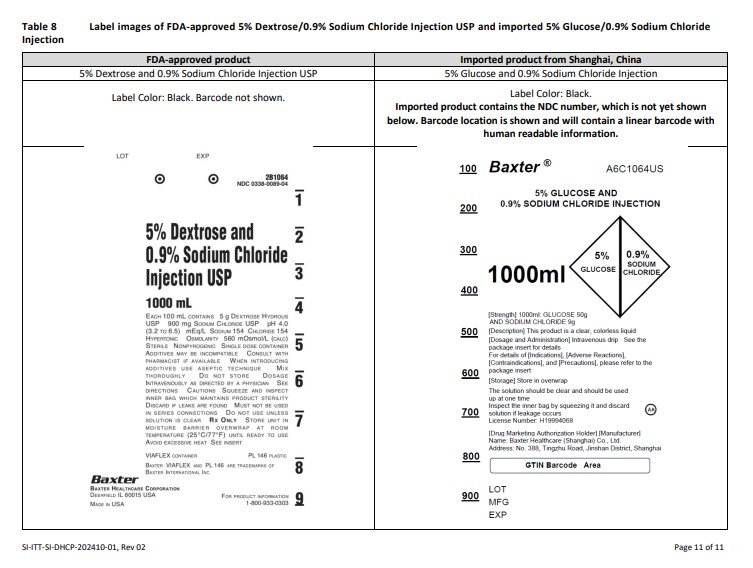
This is a comparison between the FDA-approved 5% Dextrose/0.9% Sodium Chloride Injection USP and the imported 5% Glucose/0.9% Sodium Chloride Injection. The FDA-approved product has a label volume of 1000mL, while the imported product has a label volume of 100mL. Both products are in English and are indicated for fluid and electrolyte replenishment and caloric supply. The active ingredients in the FDA-approved product are 5g Dextrose Hydrous USP and 900 mg Sodium Chloride USP, while the imported product contains 5g Anhydrous Glucose and 500 mg Sodium Chloride. The osmolarity differs between the two products. The storage conditions also vary, with the FDA-approved product needing to be stored at room temperature of 25°C/77°F, while the imported product should be stored at a temperature range of 15°C/59°F to 30°C/86°F. The container types and administration port closures are also different between the two products.*
FDA Label Image

Dhcp Letter 11.jpg (Image 11)

FDA Label Image

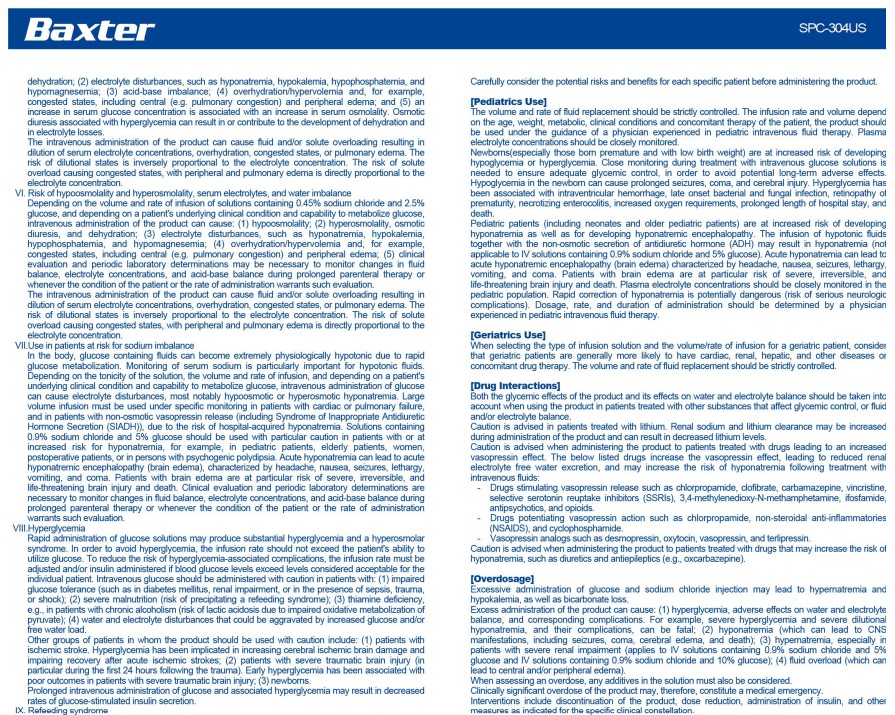
Spc304us Image 1.jpg (Image 12)

Spc304us Image 1.jpg (Image 12)
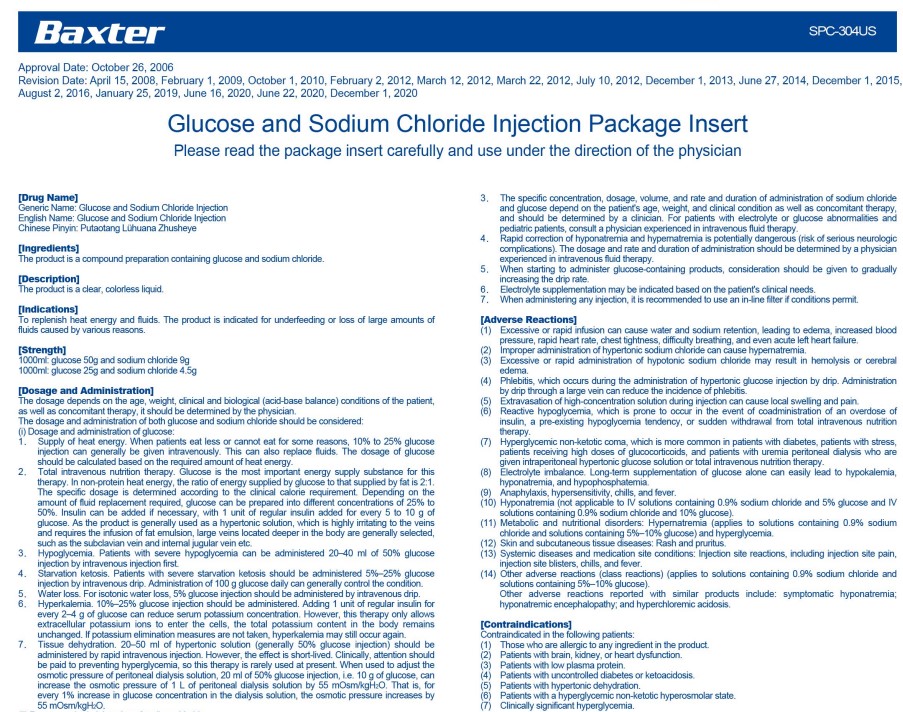
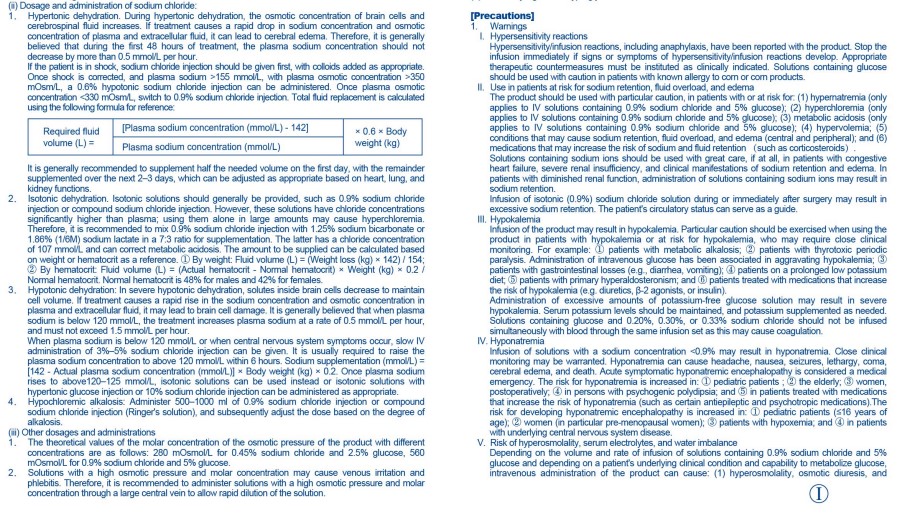
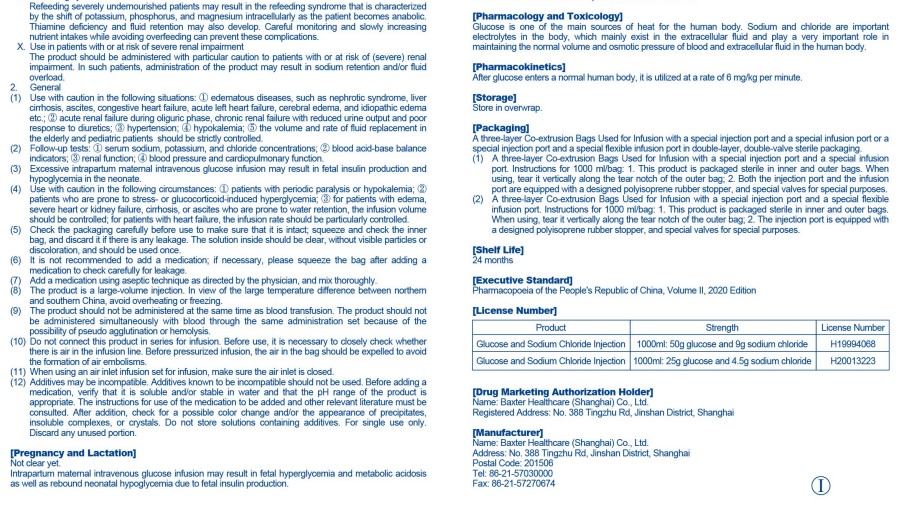
The text provides detailed information about Glucose and Sodium Chloride Injection, including the approval dates and revisions for the package insert, drug name, ingredients, indications, strength, dosage, administration guidelines, adverse reactions, contraindications, and more. It is essential to read the package insert carefully and use the product under the direction of a physician. Instructions are given on dosage adjustments based on age, clinical conditions, and energy requirements, along with considerations for different concentrations of glucose. The text highlights potential adverse reactions and contraindications to consider before use.*
FDA Label Image

Spc304us Image 2.jpg (Image 13)

FDA Label Image

Spc304us Image 3.jpg (Image 14)

FDA Label Image

Spc304us Image 4.jpg (Image 15)

FDA Label Image

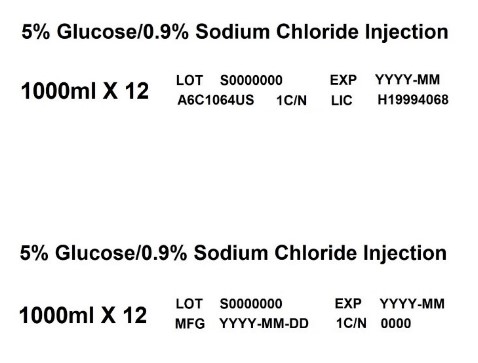
A6c1064us Representative Carton Label 1 (Image 16)

FDA Label Image

A6c1064us Representative Carton Label 2.jpg (Image 17)

A6c1064us Representative Carton Label 2.jpg (Image 17)
This text provides details about a solution called "5% Glucose/0.9% Sodium Chloride Injection" with a quantity of 1000mL X 12. It also includes information about the LOT number (50000000) and expiration date (YYYY-MM) of the product.*

* These product label images have been analyzed using experimental machine learning. Please verify findings with the primary label text.