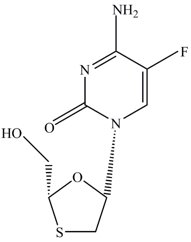
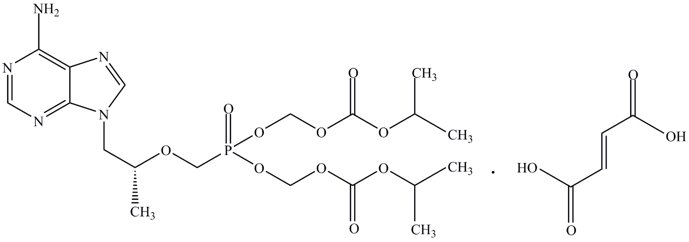
In pediatric clinical trials (Studies 352 and 321) conducted in 184 HIV-1 infected subjects 2 to less than 18 years of age, the adverse reactions observed in pediatric subjects who received treatment with TDF were consistent with those observed in clinical trials of TDF in adults.
In Study 352 (2 to less than 12 years of age), 89 pediatric subjects received TDF for a median exposure of 104 weeks. Of these, 4 subjects discontinued from the trial due to adverse reactions consistent with proximal renal tubulopathy. Three of these 4 subjects presented with hypophosphatemia and had decreases in total body or spine BMD Z-score [see Warnings and Precautions (5.5)]. Total body BMD gain at Week 48 was less in the TDF group compared to the stavudine (d4T) or zidovudine (AZT) treatment groups. The mean rate of BMD gain in lumbar spine was similar between treatment groups. One TDF-treated subject and none of the d4T- or AZT-treated subjects experienced significant (greater than 4%) lumbar spine BMD loss at Week 48. Changes from baseline in BMD Z-scores were -0.012 for lumbar spine and -0.338 for total body in the 64 subjects who were treated with TDF for 96 weeks.
In Study 321 (12 to less than 18 years of age), the mean rate of BMD gain at Week 48 was less in the TDF compared to the placebo treatment group. Six TDF-treated subjects and one placebo-treated subject had significant (greater than 4%) lumbar spine BMD loss at Week 48. Changes from baseline BMD Z-scores were -0.341 for lumbar spine and -0.458 for total body in the 28 subjects who were treated with TDF for 96 weeks.
In both trials, skeletal growth (height) appeared to be unaffected.
Based on prospective reports to the APR of exposures to TDF-containing regimens during pregnancy resulting in live births (including over 4,000 exposed in the first trimester and over 1,700 exposed in the second/third trimester), the prevalence of major birth defects in live births was 2.4% (95% CI: 2.0% to 2.9%) and 2.4% (95% CI: 1.7% to 3.2%) following first and second/third trimester exposure, respectively, to TDF-containing regimens.
Methodologic limitations of the APR include the use of MACDP as the external comparator group. The MACDP population is not disease-specific, evaluates women and infants from a limited geographic area, and does not include outcomes for births that occurred at < 20 weeks gestation.
Additionally, published observational studies on emtricitabine and tenofovir exposure in pregnancy have not shown an increased risk for major malformations.
TDF was administered orally to pregnant rats (at 0, 50, 150, or 450 mg/kg/day) and rabbits (at 0, 30, 100, or 300 mg/kg/day) through organogenesis (on gestation days 7 through 17, and 6 through 18, respectively). No significant toxicological effects were observed in embryo-fetal toxicity studies performed with TDF in rats at doses up to 14 times the human dose based on body surface area comparisons and in rabbits at doses up to 19 times the human dose based on body surface area comparisons. In a pre/postnatal development study in rats, TDF was administered orally through lactation at doses up to 600 mg/kg/day; no adverse effects were observed in the offspring at tenofovir exposures of approximately 2.7 times higher than human exposures at the recommended daily dose of emtricitabine and tenofovir disoproxil fumarate tablets.
The pharmacokinetic properties of TDF are summarized in Table 8. Following oral administration of TDF, maximum tenofovir serum concentrations are achieved in 1.0 ± 0.4 hour. Less than 0.7% of tenofovir binds to human plasma proteins in vitro, and the binding is independent of concentration over the range of 0.01-25 µg/mL. Approximately 70-80% of the intravenous dose of tenofovir is recovered as unchanged drug in the urine. Tenofovir is eliminated by a combination of glomerular filtration and active tubular secretion. Following a single oral dose of TDF, the terminal elimination half-life of tenofovir is approximately 17 hours.
Table 8. Single Dose Pharmacokinetic Parameters for FTC and Tenofovir in AdultsNC = Not calculated
| FTC | Tenofovir |
Fasted Oral Bioavailability Median (range) (%) | 92 (83.1-106.4) | 25 (NC-45.0) |
Plasma Terminal Elimination Half-Life (hr) | 10 (7.4-18.0) | 17 (12.0-25.7) |
Cmax Mean (± SD) (μg/mL) | 1.8 ± 0.72 Data presented as steady state values | 0.30 ± 0.09 |
AUC (μg·hr/mL) | 10.0 ± 3.12 | 2.29 ± 0.69 |
CL/F (mL/min) | 302 ± 94 | 1043 ± 115 |
CLrenal (mL/min) | 213 ± 89 | 243 ± 33 |
There were insufficient numbers from racial and ethnic groups other than Caucasian to adequately determine potential pharmacokinetic differences among these populations following the administration of TDF.
TDF is an acyclic nucleoside phosphonate diester analog of adenosine monophosphate. TDF requires initial diester hydrolysis for conversion to tenofovir and subsequent phosphorylations by cellular enzymes to form tenofovir diphosphate (TFV-DP), which inhibits the activity of HIV-1 RT by competing with the natural substrate deoxyadenosine 5′-triphosphate and, after incorporation into DNA, by DNA chain termination. TFV-DP is a weak inhibitor of mammalian DNA polymerases α, β, and mitochondrial DNA polymerase γ.
The antiviral activity of tenofovir against laboratory and clinical isolates of HIV-1 was assessed in lymphoblastoid cell lines, primary monocyte/macrophage cells, and peripheral blood lymphocytes. The EC50 values for tenofovir were in the range of 0.04-8.5 µM. In drug combination studies of tenofovir with nucleoside RT inhibitors (abacavir, didanosine, lamivudine, stavudine, zidovudine), non-nucleoside RT inhibitors (delavirdine, efavirenz, nevirapine), and protease inhibitors (amprenavir, indinavir, nelfinavir, ritonavir, saquinavir), no antagonism was observed. Tenofovir displayed antiviral activity in cell culture against HIV-1 clades A, B, C, D, E, F, G, and O (EC50 values ranged from 0.5-2.2 µM) and showed strain-specific activity against HIV-2 (EC50 values ranged from 1.6 µM to 5.5 µM).
HIV-1 isolates with reduced susceptibility to tenofovir have been selected in cell culture. These viruses expressed a K65R substitution in RT and showed a 2- to 4-fold reduction in susceptibility to tenofovir.
In treatment-naïve subjects, isolates from 8/47 (17%) analyzed subjects developed the K65R substitution in the TDF arm through 144 weeks; 7 occurred in the first 48 weeks of treatment and 1 at Week 96. In treatment-experienced subjects, 14/304 (5%) isolates from subjects failing TDF through Week 96 showed greater than 1.4-fold (median 2.7) reduced susceptibility to tenofovir. Genotypic analysis of the resistant isolates showed a K65R amino acid substitution in the HIV-1 RT.
The K65R and K70E substitutions selected by tenofovir are also selected in some HIV-1 infected patients treated with abacavir or didanosine. HIV-1 isolates with the K65R and K70E substitutions also showed reduced susceptibility to FTC and lamivudine. Therefore, cross-resistance among these NRTIs may occur in patients whose virus harbors the K65R or K70E substitutions. HIV-1 isolates from subjects (N = 20) whose HIV-1 expressed a mean of 3 zidovudine-associated RT amino acid substitutions (M41L, D67N, K70R, L210W, T215Y/F, or K219Q/E/N) showed a 3.1-fold decrease in the susceptibility to tenofovir. Subjects whose virus expressed an L74V substitution without zidovudine resistance-associated substitutions (N = 8) had reduced response to TDF. Limited data are available for patients whose virus expressed a Y115F substitution (N = 3), Q151M substitution (N = 2), or T69 insertion (N = 4), all of whom had a reduced response.
Long-term oral carcinogenicity studies of TDF in mice and rats were carried out at exposures up to approximately 16 times (mice) and 5 times (rats) those observed in humans at the therapeutic dose for HIV-1 infection. At the high dose in female mice, liver adenomas were increased at exposures 16 times that in humans. In rats, the study was negative for carcinogenic findings at exposures up to 5 times that observed in humans at the therapeutic dose.
TDF was mutagenic in the in vitro mouse lymphoma assay and negative in an in vitro bacterial mutagenicity test (Ames test). In an in vivo mouse micronucleus assay, TDF was negative when administered to male mice.
There were no effects on fertility, mating performance, or early embryonic development when TDF was administered to male rats at a dose equivalent to 10 times the human dose based on body surface area comparisons for 28 days prior to mating and to female rats for 15 days prior to mating through day 7 of gestation. There was, however, an alteration of the estrous cycle in female rats.